The largest land animals alive, with the biggest brains of any land mammal. Elephants live in families led by their oldest female, talk in rumbles too low for us to hear, and reshape whole landscapes as they feed.
Elephants are the three living species of the family Elephantidae: the African savanna (bush) elephant, the African forest elephant and the Asian elephant. The savanna elephant is the largest land animal on Earth. Females and young live in family groups led by the oldest female, the matriarch; adult males mostly live alone or in loose groups. All three species are threatened, mainly by ivory poaching, habitat loss and conflict with farmers.
Figures graded and sourced in the fact sheet below.What makes the elephant unlike any other animal?
Short answer: A trunk with no bones, a brain that keeps maps for decades, and the ability to hear through its feet.
How big do elephants get?
Short answer: A savanna bull stands up to about 4 m at the shoulder and weighs around 6 tonnes; the largest on record was about 10 tonnes.
How many kinds of elephant are there?
Short answer: Three. African forest and savanna elephants were confirmed as separate species by DNA, and the IUCN listed them separately in 2021.
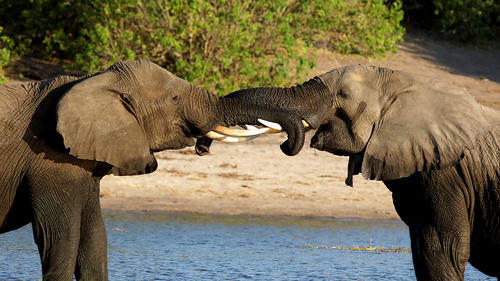
What can an elephant do with its trunk?
Short answer: Almost everything: breathe, smell, drink, grab, greet, fight and snorkel. It has no bones, only muscle.
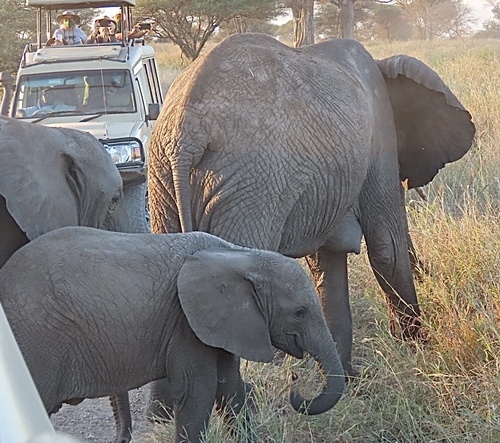
Who leads an elephant family?
Short answer: The oldest female, the matriarch. Her memory of water, danger and other families decides where the group goes.
How do elephants communicate?
Short answer: With low rumbles, trumpets, touch and smell, and through ground vibrations they sense with their feet.
Do elephants really never forget?
Short answer: Not literally, but their long-term memory is exceptional: matriarchs recall water sources and the voices of other families for decades.
What is the elephant’s closest relative?
Short answer: Living: manatees and dugongs, then hyraxes. Extinct: the woolly mammoth, which was closer to the Asian elephant than African elephants are.
Why are elephants endangered?
Short answer: Ivory poaching drove the steepest losses; today habitat loss and conflict with farmers are just as serious, especially for Asian elephants.
Six elephant claims, checked
What science still doesn’t know
Frequently asked questions
How many species of elephant are there?+
Three: the African savanna elephant, the African forest elephant and the Asian elephant.
How long do elephants live?+
Wild elephants can live 60 to 70 years. Elephants in zoos usually live shorter lives.
How much does an elephant weigh?+
A savanna bull weighs around 6 tonnes; the largest on record was about 10 tonnes. Asian elephants are lighter.
Why do elephants have tusks?+
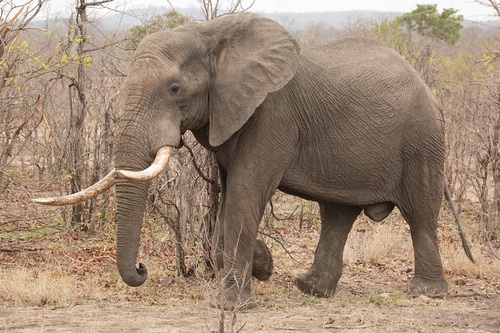
Tusks are enlarged incisor teeth used for digging, stripping bark, lifting and fighting.
What is the difference between African and Asian elephants?+
African elephants are larger with big ears and two trunk tips; Asian elephants have smaller ears, one trunk tip and a twin-domed head.
Are elephants related to mammoths?+
Yes. Mammoths were elephants; the woolly mammoth was closest to the Asian elephant.
Explore elephants further
Sources and how we check
This page is written by Strange Animals and checked against primary research. Every figure carries a grade and a numbered source.
- 01Payne, K. B. et al. Infrasonic calls of the Asian elephant. Behavioral Ecology and Sociobiology 181986
- 02McComb, K. et al. Unusually extensive networks of vocal recognition in African elephants. Animal Behaviour 592000
- 03McComb, K. et al. Matriarchs as repositories of social knowledge in African elephants. Science 292: 491-4942001
- 04Plotnik, J. M. et al. Self-recognition in an Asian elephant. PNAS 103: 170532006
- 05Thouless, C. R. et al. African Elephant Status Report 2016. IUCN SSC Occasional Paper 602016
- 06Chase, M. J. et al. Continent-wide survey reveals massive decline in African savannah elephants. PeerJ 4: e23542016
- 07Maisels, F. et al. Devastating decline of forest elephants in Central Africa. PLoS ONE 8: e594692013
- 08Campbell-Staton, S. C. et al. Ivory poaching and the rapid evolution of tusklessness in African elephants. Science 374: 483-4872021
- 09Pardo, M. A. et al. African elephants address one another with individually specific name-like calls. Nature Ecology & Evolution 82024
- 10Schulz, A. K. et al. Suction feeding by elephants. Journal of the Royal Society Interface 182021
- 11Rohland, N. et al. Proboscidean mitogenomics: chronology and mode of elephant evolution. PLoS Biology 5: e2072007
- 12Clubb, R. et al. Compromised survivorship in zoo elephants. Science 322: 16492008
- 13Morris, S. et al. Myth, marula, and elephant: an assessment of voluntary ethanol intoxication. Physiological and Biochemical Zoology 792006
- 14King, L. E. et al. Beehive fences as a multidimensional conflict-mitigation tool. Conservation Biology 312017
Three films worth your time
In pictures: the african bush elephant
Hear it
Where it has been recorded


Where are elephants seen most?
Protected areas with the most research-grade sightings on iNaturalist, out of 38,797 worldwide. Bars show sightings by month.
How it came to be protected
- 1975Asian elephant trade bannedCITES placed the Asian elephant on Appendix I, banning commercial international trade in the species and its ivory.Source: CITES Species+
- 1977African elephants join CITESCITES listed the African elephant, then treated as one species, on Appendix II, putting its international trade under permit control.Source: CITES Species+
- 1986Asian elephant listed EndangeredThe IUCN Red List classed the Asian elephant as Endangered, a category it has held ever since.Source: Wikipedia
- 1989Ivory trade bannedCITES parties voted to move African savanna and forest elephants to Appendix I; the ivory trade ban took effect in January 1990.Source: Wikipedia
- 1992Project Elephant beginsIndia's environment ministry launched Project Elephant to protect Asian elephants and set up elephant reserves.Source: Wikipedia
- 1997Southern herds downlistedCITES moved the African savanna elephants of Botswana, Namibia and Zimbabwe to Appendix II; South Africa's followed in 2000.Source: Wikipedia
- 2017China closes ivory marketChina made it illegal to buy and sell elephant ivory, shutting its remaining ivory shops and carving factories by 31 December.Source: Mongabay
- 2021African species listed separatelyThe IUCN listed the African forest elephant as Critically Endangered and the African savanna elephant as Endangered.Source: IUCN
Test yourself
About how long does an elephant pregnancy last, the longest of any living mammal?
About how much does an elephant's brain weigh?
What kind of teeth are an elephant's tusks?