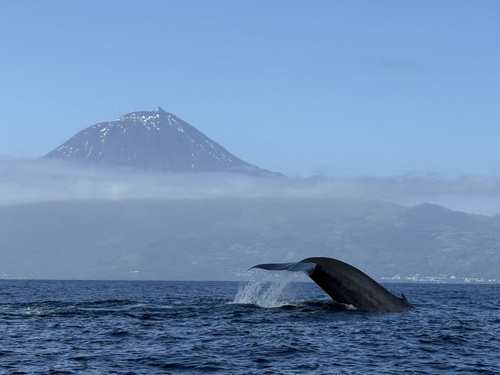
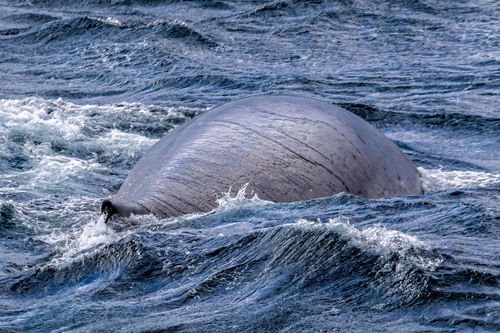
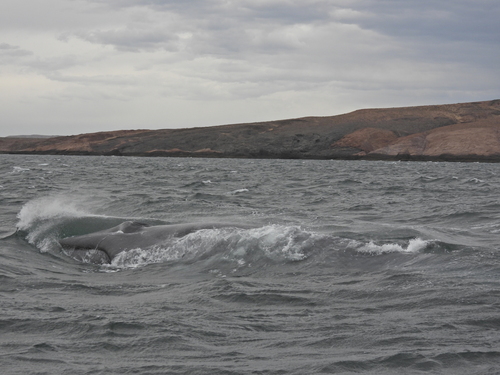
The heaviest animal known to have lived, heavier than any dinosaur found so far. It grows to about 30 m on a diet of krill the size of a little finger, calls in notes too low for us to hear, and was hunted to within a few thousand animals before protection in 1966.

FamilyBalaenopteridae (rorquals)
Lives inAll oceans except the Arctic
IUCN statusEndangered
DietKrill, almost only
BLUE WHALES AT A GLANCE

The blue whale (Balaenoptera musculus) is a baleen whale of the rorqual family, found in every ocean except the high Arctic. Adults commonly reach 24 to 27 m and the largest approach 30 m and well over 150 tonnes; females are larger than males. It feeds almost entirely on krill, which it takes by lunging into swarms and straining the water through baleen plates. Most populations feed in cold waters in summer and move to warmer waters in winter. Twentieth-century whaling killed hundreds of thousands. Today there are an estimated 5,000 to 15,000 mature animals, and the species is Endangered.

Figures graded and sourced in the fact sheet below.
KEY DISCOVERIES
1860sNow huntableSteam catcher boats and the exploding harpoon let whalers take fast rorquals for the first time.
1966ProtectedThe International Whaling Commission bans blue whale hunting worldwide.
1971Loudness measuredCalls off Chile are measured at about 188 decibels underwater (Cummings & Thompson).
2009Songs getting deeperBlue whale song has dropped in pitch worldwide since the 1960s (McDonald et al.).
2019First heartbeatA suction-cup tag records a wild blue whale’s heart: as slow as 2 beats a minute (Goldbogen et al.).
2021Bigger appetiteTagged whales eat about three times more than older estimates (Savoca et al.).
ONLY IN THE BLUE WHALE

What makes the blue whale unlike any other animal?

Short answer: Size. Nothing alive or in the fossil record is known to have been heavier, and almost everything else about it follows from that.

01The heaviest animal knownThe largest weigh more than 150 tonnes, roughly twice the best estimates for the biggest dinosaurs.Sears & Perrin 2018
02A heart you can time by handOn a deep dive its heart slows to as few as 2 beats a minute, then races to over 30 at the surface.Goldbogen et al. 2019
03A voice that crosses oceansLow calls of about 188 decibels underwater can be detected hundreds of kilometres away.Cummings & Thompson 1971
04The biggest mouthfulOne lunge takes in tens of tonnes of water and krill, a load close to the whale’s own weight.Goldbogen et al. 2011
05Fastest-growing babyA calf is about 7 m at birth and gains roughly 90 kg a day on milk.Sears & Perrin 2018
06A song sliding lowerPopulations worldwide now sing at a lower pitch than in the 1960s. Nobody is sure why.McDonald et al. 2009
FACT SHEET

How big is a blue whale?

Short answer: The largest reliably measured was 29.9 m. Adults commonly weigh 70 to 130 tonnes, and the largest are estimated above 150.

MeasuredEstimatedQuoted, unverified
LengthMeasuredup to ~30 mLargest measured29.9 mTypical adult24 to 27 mWhaling-era reports of 33 m were not measured to modern standards. Females are longer
WeightEstimatedup to ~150 t+Largest150 to 190 tTypical adult70 to 130 tNo blue whale has been weighed whole; figures come from pieces weighed on whaling ships
Heart rateMeasured2 to 37 beats/minAt surface25 to 37Deep diveas low as 2First recording from a wild whale, Monterey Bay. Goldbogen et al. 2019
Food per dayMeasured~16 tonnes2021 tag study10 to 20 tOlder estimates~4 to 6 tNorth Pacific blue whales in feeding season. Savoca et al. 2021
Call loudnessMeasured~188 dBBlue whale188 dBSperm whale clickup to ~236 dBUnderwater decibels (re 1 µPa at 1 m), not comparable with decibels in air
Call pitchMeasured~10 to 40 HzBlue whale song10 to 40 HzHuman hearing from~20 HzMuch of the song is below what humans can hear
Feeding divesMeasured~100 to 300 mDeep feedingto ~300 mDive time~10 to 15 minThey follow krill, which sink by day and rise at night
LifespanEstimated~80 to 90 yearsEstimated80 to 90 yrsOldest estimate~110 yrsAged by counting wax layers in the earplug
Mature animalsEstimated5,000 to 15,000Today5,000 to 15,000Antarctic, 1900~239,000IUCN 2018; pre-whaling Antarctic estimate from Branch et al. 2004
HOW BIG

Is the blue whale bigger than the dinosaurs?

Short answer: Heavier, yes. A few sauropods were probably longer, but none is estimated at much more than half a large blue whale’s weight.

Size Comparison tool →
Length, metresArgentinosaurus~30 to 35Blue whale~30Sperm whale~18City bus12African elephant~6 to 7Sauropod lengths are reconstructed from partial skeletons.
Weight, tonnesBlue whale~150Argentinosaurus~65 to 80Sperm whale~45City bus~12African elephant~6Why so heavy? Water carries the weight that legs could not.
HeartAbout 180 kg, the size of a small bumper car, pumping through an aorta about 23 cm wide.
TongueRoughly 3 tonnes, about the weight of a small elephant.
Tail flukesAbout 7 m from tip to tip.
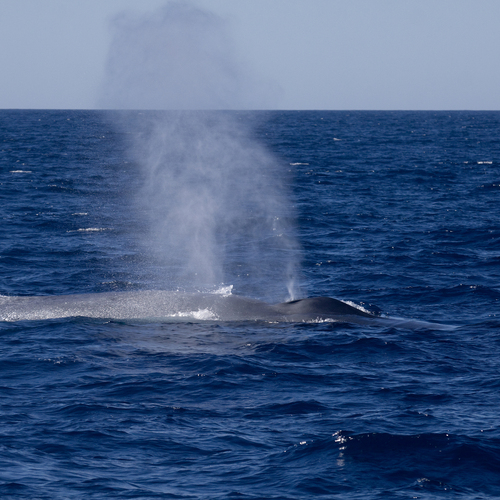
BlowA single column of spray 9 to 12 m high.
Throat pleats60 to 90 grooves from chin to navel that stretch like an accordion when it feeds.
BaleenRoughly 270 to 400 black plates on each side of the upper jaw, about 1 m long.
NewbornAbout 7 m and 2 to 3 tonnes, after a pregnancy of 10 to 12 months.
ThroatThe gullet is only wide enough for something about the size of a grapefruit.
Sears & Perrin 2018. Heart weight from a specimen preserved at the Royal Ontario Museum.
FEEDING

How does the largest animal live on krill?

Short answer: By lunge feeding. It accelerates into a swarm, opens its mouth to about 80 degrees, takes in a load of water near its own weight, then strains the krill out through its baleen.

Food Chain Builder →
01ChooseIt checks a swarm and skips small or thin patches. Opening the mouth is expensive.
02AccelerateIt speeds up, often rolling onto its side or back.
03EngulfThe jaw drops and the throat pleats balloon out, stopping the whale almost dead.
04FilterThe tongue and throat muscles push water out through the baleen. Krill stay in.
05SwallowThe krill go down a throat no wider than a grapefruit. Then it lunges again.
About 16 tonnes a dayIn the feeding season, tagged North Pacific blue whales ate 10 to 20 tonnes of krill daily.
Feast, then fastMost feeding happens in a few summer months. Whales live off blubber for much of the rest of the year.
Fertilising the seaTheir iron-rich dung feeds the plankton that krill eat. Fewer whales may have meant less krill, not more.
Goldbogen et al. 2011; Savoca et al. 2021.
SONG

How loud is a blue whale?

Short answer: About 188 decibels underwater, in notes mostly too low for people to hear. It is among the loudest sustained sounds any animal makes.

Hearing Range tool →
Low and longNotes of 10 to 40 Hz that last 10 to 30 seconds, repeated for hours.
Long rangeLow sound loses little energy in water. Calls are picked up hundreds of kilometres away, and probably travelled farther in quieter, pre-shipping seas.
Who singsOnly males are known to sing, so song is thought to play a part in finding or competing for mates.
Regional dialectsEach population has its own song type, which is how researchers tell them apart from recordings.
The falling pitchSince the 1960s, blue whale song has dropped steadily in pitch in every ocean studied, by around 30% off California. One idea is that recovering populations no longer need to sing as loudly, and quieter songs can be lower. Others point to ocean noise or changing sea chemistry. It is unresolved.
Cummings & Thompson 1971; Oleson et al. 2007; McDonald et al. 2009. Underwater decibels use a different reference from decibels in air, so 188 dB is not like a 188 dB sound on land.
LIFE AND TRAVEL

Where do blue whales live?

Short answer: In every ocean except the high Arctic. Most feed in cold, krill-rich water in summer and move towards the tropics in winter, though some stay put.

Animal Map →
Five kinds of blue whaleNorthern blue whale B. m. musculusNorth Atlantic and North PacificAntarctic blue whale B. m. intermediaSouthern Ocean; the largest, and the hardest hit by whalingPygmy blue whale B. m. brevicaudaIndian Ocean and South Pacific; up to about 24 mNorthern Indian Ocean blue whale B. m. indicaArabian Sea to Sri Lanka; some stay year-roundChilean blue whale not yet namedFeeds off southern Chile; genetically distinct
Mostly aloneUsually seen singly or in pairs. Groups form only where krill is dense.
One calf at a timeA single calf every two to three years, nursed for six to seven months.
SpeedCruises at a few km/h while feeding; can sprint above 30 km/h when chased.
PredatorsOnly orcas. Packs have been recorded killing an adult and two calves off Western Australia.
Sears & Perrin 2018; Totterdell et al. 2022.
EVOLUTION

What did whales evolve from?

Short answer: From four-legged, hoofed land mammals about 50 million years ago. Their closest living relatives are hippos. Giant size came late, within the last few million years.

Read: whales and dolphins →
HipposClosest living relatives of whalesToothed whalesDolphins, orcas, sperm whalesRight and bowhead whalesSlow skim-feedersHumpback whaleA rorqual with long flippersFin whaleSecond-largest animal; can hybridise with bluesBlue whaleBalaenoptera musculusWhalesBaleen whalesRorquals
Relationships simplified, not to time scale; the exact order among rorquals is still debated. After Árnason et al. 2018; size history from Slater et al. 2017. Outlines: PhyloPic, CC0 or public domain.
WHALING AND THREATS

Are blue whales endangered?

Short answer: Yes. Whaling removed the great majority of them in about sixty years. Numbers are rising slowly in places, but remain a small fraction of what they were.

Endangered register →
Antarctic blue whalesBefore whaling~239,0001973 low~3601996 estimate~1,700Around 380,000 blue whales were killed worldwide in the twentieth century, most of them in the Southern Ocean. Illegal Soviet catches continued for years after the 1966 ban. Since then the Antarctic population has grown by an estimated 7% a year.Branch et al. 2004; Rocha et al. 2014.
Ship strikesHIGHBusy shipping lanes cross feeding grounds off California and Sri Lanka.
Ocean noiseMEDIUMShipping and seismic surveys overlap the low frequencies blue whales call in.
Krill and climateMEDIUMWarming seas and krill fishing may shift or shrink their only food.
EntanglementWATCHLess common than in humpbacks, but recorded.
Moving shipping lanesLanes have been shifted and ships asked to slow down in whale seasons off California.
Listening networksUnderwater microphones track populations by their songs.
MYTH OR FACT

Six blue whale claims, checked

2Myths2Half true2Facts
01FACT“The blue whale is the largest animal that has ever lived.”WHERE IT CAME FROMTextbooks and museum halls.
WHAT THE EVIDENCE SAYSNo fossil animal has a reliable weight estimate above a large blue whale. A 2023 claim that the extinct whale Perucetus was heavier was cut to about 60 to 114 tonnes by a 2024 reanalysis.
WHAT IS TRUE INSTEADStill the heaviest animal known. A few dinosaurs were probably longer.Sources: 10
02HALF TRUE“Its heart is the size of a car.”WHERE IT CAME FROMDecades of fact lists.
WHAT THE EVIDENCE SAYSA preserved heart weighed about 180 kg and measured roughly 1.5 m across: closer to a bumper car or a golf cart than a family car.
WHAT IS TRUE INSTEADHuge, but not car-sized.Sources: 01
03MYTH“A person could swim through its arteries.”WHERE IT CAME FROMThe same fact lists.
WHAT THE EVIDENCE SAYSThe aorta is about 23 cm across. A human head might fit; a swimmer would not.
WHAT IS TRUE INSTEADWide enough for a head, not a body.Sources: 01
04MYTH“A blue whale could swallow a person.”WHERE IT CAME FROMJonah, Pinocchio and news stories.
WHAT THE EVIDENCE SAYSIts throat stretches only to about the width of a grapefruit. Anything larger than small fish cannot be swallowed.
WHAT IS TRUE INSTEADIt could take you into its mouth, not down its throat.Sources: 01
05HALF TRUE“Its tongue weighs as much as an elephant.”WHERE IT CAME FROMA popular comparison.
WHAT THE EVIDENCE SAYSThe tongue is estimated at around 3 tonnes: about a small Asian elephant, well short of a large African bull.
WHAT IS TRUE INSTEADA small elephant, yes.Sources: 01
06FACT“Blue whales and fin whales interbreed.”WHERE IT CAME FROMWhalers reported odd-looking animals.
WHAT THE EVIDENCE SAYSGenetic tests confirm hybrids, and a 2024 genome study found fin whale DNA in every North Atlantic blue whale sampled, about 3.5% on average.
WHAT IS TRUE INSTEADTrue, and more common than thought.Sources: 15
OPEN QUESTIONS

What science still doesn’t know

?Where do they give birth?No blue whale birth has ever been documented, and calving grounds are barely known.
?Why is the song getting lower?The worldwide drop in pitch has several explanations and no agreed one.
?How many are there?The global range of 5,000 to 15,000 mature animals is wide because most oceans are thinly surveyed.
?How do they find krill?How a whale locates swarms across thousands of kilometres of ocean is not understood.
?What limits their size?Lunge feeding may cap how big a whale can get, but the limit is modelled, not measured.
?How well can they hear ships?Their hearing has never been tested directly; it is inferred from anatomy and calls.
FAQ

Frequently asked questions

How big is a blue whale?+

Adults are commonly 24 to 27 m long; the largest reliably measured was 29.9 m. The heaviest are estimated at over 150 tonnes.

What do blue whales eat?+

Almost only krill, small shrimp-like animals. In the feeding season a blue whale can eat around 16 tonnes a day.

Is the blue whale the biggest animal ever?+

It is the heaviest animal known to have lived. Some dinosaurs were probably longer, but much lighter.

How loud is a blue whale?+

Its calls reach about 188 decibels underwater, at frequencies mostly too low for humans to hear.

How long do blue whales live?+

An estimated 80 to 90 years.

How many blue whales are left?+

An estimated 5,000 to 15,000 mature animals. The species is listed as Endangered.

COMPARE AND EXPLORE

Explore blue whales further

HOW WE KNOW

Sources and how we check

This page is written by Strange Animals and checked against primary research. Every figure carries a grade and a numbered source.

Cite this pageStrange Animals. (2026, November 15). Blue whale (Balaenoptera musculus): size, feeding, song and recovery. https://strangeanimals.info/marine-life/whales-dolphins/blue-whale
  1. 01Sears, R. and Perrin, W. F. Blue whale: Balaenoptera musculus. Encyclopedia of Marine Mammals, 3rd ed., Academic Press2018
  2. 02Goldbogen, J. A. et al. Extreme bradycardia and tachycardia in the world’s largest animal. PNAS 116: 25329-253322019
  3. 03Savoca, M. S. et al. Baleen whale prey consumption based on high-resolution foraging measurements. Nature 599: 85-902021
  4. 04Goldbogen, J. A. et al. Mechanics, hydrodynamics and energetics of blue whale lunge feeding. Journal of Experimental Biology 214: 131-1462011
  5. 05Cummings, W. C. and Thompson, P. O. Underwater sounds from the blue whale, Balaenoptera musculus. Journal of the Acoustical Society of America 50: 1193-11981971
  6. 06McDonald, M. A., Hildebrand, J. A. and Mesnick, S. Worldwide decline in tonal frequencies of blue whale songs. Endangered Species Research 9: 13-212009
  7. 07Oleson, E. M. et al. Behavioral context of call production by eastern North Pacific blue whales. Marine Ecology Progress Series 330: 269-2842007
  8. 08Branch, T. A., Matsuoka, K. and Miyashita, T. Evidence for increases in Antarctic blue whales based on Bayesian modelling. Marine Mammal Science 20: 726-7542004
  9. 09Rocha, R. C., Clapham, P. J. and Ivashchenko, Y. V. Emptying the oceans: a summary of industrial whaling catches in the 20th century. Marine Fisheries Review 76: 37-482014
  10. 10Motani, R. and Pyenson, N. D. Downsizing a heavyweight: factors and methods that revise weight estimates of the giant fossil whale Perucetus colossus. PeerJ 12: e169782024
  11. 11Cooke, J. G. (IUCN) Balaenoptera musculus. IUCN Red List. Endangered2018
  12. 12Slater, G. J., Goldbogen, J. A. and Pyenson, N. D. Independent evolution of baleen whale gigantism linked to Plio-Pleistocene ocean dynamics. Proceedings of the Royal Society B 284: 201705462017
  13. 13Árnason, Ú. et al. Whole-genome sequencing of the blue whale and other rorquals finds signatures for introgressive gene flow. Science Advances 4: eaap98732018
  14. 14Totterdell, J. A. et al. The first three records of killer whales killing and eating blue whales. Marine Mammal Science 382022
  15. 15Jossey, S. et al. Population structure and history of North Atlantic blue whales. Conservation Genetics 252024
WATCH

Three films worth your time

AnimationTED-Ed · Asha de VosWhy are blue whales so enormous?How the size of krill shaped the biggest animal, and what stops it getting bigger.Pairs with: Feeding →
Drone footageOregon State UniversityRare images of blue whale feeding behaviorA blue whale sizes up krill patches off New Zealand, lunges at one and passes up another.Pairs with: Feeding →
Drone footageOregon State UniversityBlue Whales Surface FeedingResearchers talk through a surface lunge frame by frame.Pairs with: How big →
PHOTOS

In pictures

Blue whale
Photo: Dan Vickers, CC BY 4.0, via iNaturalist
Blue whale
Photo: Vsevolod Rudyi, CC BY 4.0, via iNaturalist
Blue whale
Photo: Dan Harville, CC BY-SA 4.0, via iNaturalist
Blue whale
Photo: Tomás Tamagno, CC BY 4.0, via iNaturalist
LISTEN

Hear it

Blue whale call, northeast Pacific, sped up so it can be heard
Recording by NOAA, Public domain, via Wikimedia Commons.
SIGHTINGS

Where it has been recorded

Map of recorded Balaenoptera musculus occurrences, western hemisphereMap of recorded Balaenoptera musculus occurrences, eastern hemisphere
Each dot marks a georeferenced sighting or specimen record of Balaenoptera musculus, from 30,067 records shared through GBIF.org.
WHERE TO SEE ONE

Where are blue whales seen most?

Protected areas with the most research-grade sightings on iNaturalist, out of 2,256 worldwide. Bars show sightings by month.

CONSERVATION TIMELINE

How it came to be protected

  1. 1955North Atlantic protectionBlue whales received complete protection in the North Atlantic under the International Convention for the Regulation of Whaling.Source: Wikipedia
  2. 1966Worldwide hunting banThe International Whaling Commission banned all hunting of blue whales and gave the species worldwide protection.Source: Wikipedia
  3. 1970Listed endangered in USThe United States listed the blue whale as endangered, with the listing taking effect on 2 December 1970.Source: NOAA Fisheries
  4. 2018Assessed as EndangeredThe IUCN Red List assessment classed the blue whale as Endangered, estimating 5,000 to 15,000 mature individuals.Source: Wikipedia
  5. 2020US recovery plan revisedNOAA Fisheries issued a revised recovery plan for the blue whale, effective 9 November 2020.Source: NOAA Fisheries
QUIZ

Test yourself

How slow can a blue whale's heart beat on a deep dive?

Roughly how much weight does a blue whale calf gain each day on milk?

In what year was blue whale hunting banned worldwide?

SPECIES PROFILES

More species profiles

All 28 species profiles →

All blue whale articles

4 articles