A colony of tens of thousands of sisters that behaves like one animal. Honeybees tell each other where flowers are by dancing, choose a new home by something close to a vote, keep their nursery within a degree or two of 35 °C, and make a food that can keep for years.
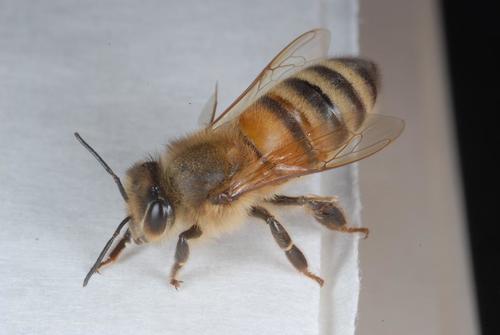
The western honeybee (Apis mellifera) is a social bee native to Africa, Europe and western Asia, and now kept on every continent except Antarctica. A colony has one egg-laying queen, tens of thousands of sterile female workers and, in summer, a few hundred to a few thousand male drones. Workers change jobs as they age, from nurse to builder to guard to forager. They store nectar as honey to survive winter as a group, which few other insects do. Managed hives are increasing worldwide, but colonies suffer heavy yearly losses from the Varroa mite, viruses, pesticides and poor forage.
Figures graded and sourced in the fact sheet below.What makes the honeybee unlike any other animal?
Short answer: It has the only known symbolic "language" outside humans, and its colonies make group decisions no single bee could make.
How many bees live in a hive?
Short answer: Roughly 20,000 to 60,000 at the summer peak: one queen, a few hundred to a few thousand drones, and the rest workers.
Who does what in a beehive?
Short answer: Three kinds of bee. The queen lays, the drones mate, and the workers do everything else, changing jobs as they age.
How does the waggle dance work?
Short answer: The angle of the waggle run from straight up equals the angle of the flowers from the sun. The longer the run, the farther the flowers.
How do bees make honey?
Short answer: They collect nectar, add enzymes, and fan it until it is about 18% water. Then they seal it under wax.
Why do honeybees swarm?
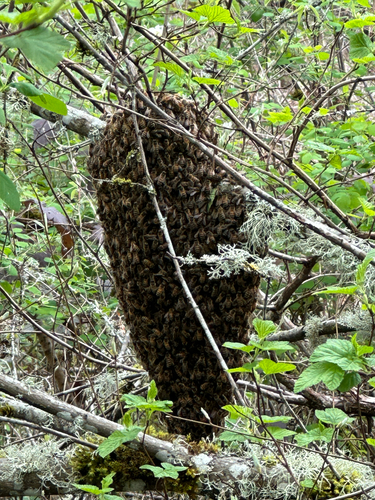
Short answer: It is how a colony reproduces. The old queen leaves with a large share of the workers, and a daughter queen inherits the nest.
Are bees a kind of wasp?
Short answer: In evolutionary terms, yes. Bees descend from hunting wasps that switched from feeding their young on prey to feeding them pollen, over 100 million years ago.
Are honeybees dying out?
Short answer: No. Managed honeybee hives have increased worldwide. But colonies now die at high rates each year, and beekeepers keep numbers up by constantly splitting and replacing them.
Six honeybee claims, checked
What science still doesn’t know
Frequently asked questions
How long do honeybees live?+
Summer workers live about 5 to 6 weeks, winter workers 4 to 6 months, and queens about 2 to 5 years.
How many bees are in a hive?+
About 20,000 to 60,000 at the summer peak, falling to roughly 10,000 to 15,000 in winter.
How do bees make honey?+
They collect nectar, add enzymes, fan it until it is about 18% water, and seal it in wax cells.
What is the waggle dance?+
A figure-of-eight dance in which the angle and length of the waggle run tell other bees the direction and distance of flowers.
Do honeybees die after stinging?+
Worker honeybees usually do when they sting mammals, because the barbed sting tears out. Queens can sting repeatedly.
Are honeybees endangered?+
No. Managed hives are increasing worldwide, though colonies suffer heavy yearly losses. Many wild bee species are at greater risk.
Explore honeybees further
Sources and how we check
This page is written by Strange Animals and checked against primary research. Every figure carries a grade and a numbered source.
- 01von Frisch, K. The Dance Language and Orientation of Bees. Harvard University Press1967
- 02Riley, J. R. et al. The flight paths of honeybees recruited by the waggle dance. Nature 435: 205-2072005
- 03Seeley, T. D. Honeybee Democracy. Princeton University Press2010
- 04Seeley, T. D. et al. Stop signals provide cross inhibition in collective decision-making by honeybee swarms. Science 335: 108-1112012
- 05Honeybee Genome Sequencing Consortium Insights into social insects from the genome of the honeybee Apis mellifera. Nature 443: 931-9492006
- 06Klein, A.-M. et al. Importance of pollinators in changing landscapes for world crops. Proceedings of the Royal Society B 274: 303-3132007
- 07Altshuler, D. L. et al. Short-amplitude high-frequency wing strokes determine the aerodynamics of honeybee flight. PNAS 102: 18213-182182005
- 08Howard, S. R. et al. Numerical ordering of zero in honey bees. Science 360: 1124-11262018
- 09Beekman, M. and Ratnieks, F. L. W. Long-range foraging by the honey-bee, Apis mellifera L.. Functional Ecology 14: 490-4962000
- 10Rosenkranz, P., Aumeier, P. and Ziegelmann, B. Biology and control of Varroa destructor. Journal of Invertebrate Pathology 103: S96-S1192010
- 11Goulson, D. et al. Bee declines driven by combined stress from parasites, pesticides, and lack of flowers. Science 347: 12559572015
- 12Hales, T. C. The honeycomb conjecture. Discrete & Computational Geometry 25: 1-222001
- 13Cardinal, S. and Danforth, B. N. Bees diversified in the age of eudicots. Proceedings of the Royal Society B 280: 201226862013
- 14Menzel, R. and Giurfa, M. Cognitive architecture of a mini-brain: the honeybee. Trends in Cognitive Sciences 5: 62-712001
- 15Winston, M. L. The Biology of the Honey Bee. Harvard University Press1987
- 16Dyer, A. G., Neumeyer, C. and Chittka, L. Honeybee (Apis mellifera) vision can discriminate between and recognise images of human faces. Journal of Experimental Biology 208: 4709-47142005
Three films worth your time
In pictures


Hear it
Where it has been recorded


Test yourself
About how many times a second does a honeybee beat its wings?
To about what water content do honeybees dry nectar when making honey?
In the honeybee waggle dance, what does a longer waggle run tell other bees?