By Strange Animals · Updated 15 Nov 2026 · 15 sources
The tallest animal on land, with a two-metre neck built from the same seven bones as yours. To get blood up to its head it runs at about twice our blood pressure. It hums at night, fights by swinging its head like a hammer, and has quietly lost about a third of its numbers in three decades.
Giraffes (Giraffa) are the tallest living land animals. Males reach about 5.5 m and well over a tonne. They live in savanna and open woodland across sub-Saharan Africa and browse leaves, mostly from acacia trees, with a long, dark, gripping tongue. Their only living relative is the okapi of the Congo rainforest. Herds are loose and change from day to day. Females give birth standing up after about 15 months. Long treated as one species, giraffes are now widely split into four. About 140,000 remain, and several populations are in serious trouble.
Figures graded and sourced in the fact sheet below.
KEY DISCOVERIES
1809Lamarck’s exampleLamarck uses the giraffe’s neck to argue that stretching is inherited. He was wrong, but the example stuck.
1996Necks for sexSimmons and Scheepers propose that long necks evolved as weapons for fighting males.
2015Night hummingZoo giraffes are recorded humming at about 92 Hz after dark (Baotic et al.).
2016Four species?DNA from 190 giraffes points to four species, not one (Fennessy et al.).
2016VulnerableThe IUCN moves the giraffe to Vulnerable after a decline of 36 to 40% in 30 years.
2022A head-butting cousinDiscokeryx, a 17-million-year-old relative from China, had a helmet skull and a neck built for ramming (Wang et al.).
ONLY IN THE GIRAFFE
What makes the giraffe unlike any other animal?
Short answer: Height. It is the tallest land animal by more than a metre, and its heart, blood vessels, skin and behaviour are all reshaped around that.
01The tallest land animalLarge males stand about 5.5 m. A newborn is already taller than most adult people.Dagg 2014
02Twice our blood pressurePressure at the heart is roughly double a human’s, the highest of any mammal measured.Mitchell & Skinner 2009
03Seven neck bonesThe same number as a human or a mouse. Each one is simply stretched, to 25 cm or more.Danowitz et al. 2015
04It hums at nightLong thought nearly silent, giraffes make a low, steady hum in the dark.Baotic et al. 2015
05Inherited spotsCalves inherit features of their mother’s coat pattern, and the pattern is linked to their survival.Lee et al. 2018
06Head as a hammerMales fight by swinging their necks and landing blows with a heavy, bone-plated skull.Simmons & Scheepers 1996
FACT SHEET
How tall is a giraffe?
Short answer: Males reach about 5.5 m and females about 4.5 m. Around 2 m of that is neck.
MeasuredEstimatedQuoted, unverified
HeightMeasuredup to ~5.5 mMalesup to 5.5 mFemalesup to ~4.5 mMeasured to the top of the ossicones. Dagg 2014
WeightMeasured~800 to 1,900 kgLarge maleup to ~1,900Typical female~830 kgA typical adult male is about 1,200 kg
NeckMeasured~2 m, 7 bonesGiraffe7 bonesHuman7 bonesAlmost all mammals have seven neck vertebrae, whatever the neck length
Blood pressureMeasured~2× a human’sGiraffe, at heart~280/180Human~120/80In mmHg. By the time blood reaches the head, pressure is close to ours. Mitchell & Skinner 2009
HeartMeasured0.5% of body massLeft wallup to ~8 cmShare of body~0.5%Not unusually large for the animal’s size. The power comes from very thick walls
TongueMeasured~45 to 50 cmGiraffe45 to 50 cmHuman~10 cmDark purple-black towards the tip, possibly as protection from sun
Top speedEstimated~50 to 60 km/hGallop~50 to 60Lion sprint~74 km/hShort bursts only. It ambles with both legs on one side moving together
PregnancyMeasured~15 monthsGestation~15 moNewborn height~1.8 mOne calf of about 100 kg, born with the mother standing
Sleeps 30 minutes a dayQuoted, unverifiedNoZoo giraffes monitored overnight slept about 4.6 hours a day, mostly lying down, with only minutes of deep sleep. Sleep in the wild has not been measured (Tobler & Schwierin 1996).Popular claim
Short answer: Probably for more than one reason. Reaching leaves other animals cannot is the best-supported; fighting between males likely added to it. The textbook story is less settled than it looks.
Reaching high leavesWELL SUPPORTEDThe claimA longer neck reaches food that kudu, impala and other browsers cannot.Evidence forWhere smaller browsers were fenced out, leaves at low heights recovered. Giraffes get more leaf per bite higher up.AgainstGiraffes, females especially, often feed at shoulder height or below.Cameron & du Toit 2007
Necks for sexPARTLY SUPPORTEDThe claimMales with longer, heavier necks win fights and father more calves.Evidence forMales keep adding bone to the skull and neck through life, and bigger-necked males dominate.AgainstFemales’ necks are just as long for their body size, which fighting alone does not explain.Simmons & Scheepers 1996; Mitchell et al. 2009
Lookout and coolingSUGGESTEDThe claimHeight helps spot lions early, and a long, thin body sheds heat.Evidence forGiraffes are often the first animals to notice predators. Their shape gives a large surface for their weight.AgainstLittle direct testing. These may be useful side effects, not causes.Mitchell & Skinner 2004
Fossils fill the gapSamotherium, about 7 million years old, had a neck halfway between an okapi’s and a giraffe’s.
A ramming relativeDiscokeryx had a thick disc of bone on its head and reinforced neck joints. Head weapons run in the family.
A nerve’s detourThe nerve to the voice box runs down the neck, loops around an artery near the heart and comes back up: over 4 m to cover a few centimetres.
Not from stretchingLamarck thought generations of reaching lengthened the neck. Acquired stretch is not inherited; selection on inherited variation is.
Danowitz et al. 2015; Wang et al. 2022.
BLOOD PRESSURE
How does blood reach a giraffe’s head?
Short answer: With a thick-walled heart that pumps at about twice our pressure, and a set of valves and elastic vessels that stop the head flooding when it bends down to drink.
01PumpThe left side of the heart has walls up to about 8 cm thick.
02ClimbBlood is pushed about 2 m straight up the neck arteries.
03ArriveBy the time it reaches the brain, pressure has dropped to roughly what ours is.
04Head downValves in the neck veins and a net of fine vessels under the brain buffer the surge when it drinks.
05LegsTight skin and thick-walled arteries in the lower legs stop fluid pooling, like built-in compression stockings.
An awkward drinkIt must splay or bend its front legs to reach water, its most vulnerable moment.
No head rushLifting the head 5 m in a second or two does not make it faint. How well this is controlled is still studied.
A slow-ish heartAbout 40 to 90 beats a minute at rest, faster than expected for an animal this size.
Of interest to medicineGiraffes live with pressure that would damage human organs, without the damage. Their genes for this are being studied.
Mitchell & Skinner 2009; Hargens et al. 1987; Agaba et al. 2016.
FEEDING
What do giraffes eat?
Short answer: Leaves, shoots and flowers, mostly from acacia trees. An adult eats roughly 30 kg or more a day and spends most of its waking hours doing it.
A gripping tongueThe tongue wraps around a twig and strips the leaves in one pull, working around long thorns.
Thorn-proof mouthTough lips, a leathery palate and thick, sticky saliva deal with thorns that are swallowed.
A ruminantLike a cow, it has a four-chambered stomach and chews the cud, often while walking.
Little need to drinkMost water comes from leaves. It can go days without drinking when browse is fresh.
Males high, females lowBulls tend to feed with the neck stretched up; cows more often at body height. It reduces competition between them.
Chewing bonesGiraffes mouth old bones for calcium and phosphorus, which leaves are short of.
Pollinators and prunersFeeding shapes the flat-bottomed look of savanna trees, and giraffes carry pollen on their faces.
HitchhikersOxpecker birds ride on giraffes, picking off ticks and sometimes pecking at wounds.
Dagg 2014.
SOCIETY AND CALVES
How do giraffes live and raise their young?
Short answer: In loose groups that change by the day, with lasting bonds between females underneath. A calf is born after about 15 months, drops nearly 2 m to the ground and is walking within an hour.
Any seasonCourtshipA bull tastes a cow’s urine to tell whether she is ready to mate, then follows her for days.
~15 monthsPregnancyOne calf. Twins are rare.
BirthA long dropThe mother stands, so the calf falls nearly 2 m. It stands within about an hour.
Weeks 2 to 12CrècheCalves gather in a nursery group watched by one or two cows while the rest feed.
Years 4 to 7Growing upFemales breed from about 4 or 5. Males rarely win matings before 7 or older.
Fission and fusionGroups split and merge constantly, so giraffes were long thought to have no social structure.
Female friendshipsTracking shows cows keep preferred companions for years, often relatives.
NeckingMales spar by leaning and swinging necks. Serious fights can knock a bull out or, rarely, kill him.
Lions and kicksLions are the main predator, mostly of calves. Around half of calves die in their first year. An adult’s kick can kill a lion.
VoicesSnorts, grunts and bleats by day, and a low hum at night whose purpose is unknown.
Spots as identityNo two coats match. Researchers identify individuals by pattern, using photographs.
LifespanAbout 25 years in the wild, somewhat longer in zoos.
RestGiraffes doze standing and lie down for short spells of deeper sleep, neck curled back onto the body.
Bercovitch & Berry 2013; Baotic et al. 2015; Lee et al. 2018.
FOUR SPECIES
How many kinds of giraffe are there?
Short answer: Four, according to DNA studies and, since 2025, the IUCN’s specialist group. The four have been separate for one to two million years and do not normally interbreed in the wild.
Northern giraffeG. camelopardalisChad to Uganda, plus NigerThe rarest. Includes the West African giraffe of Niger and the Nubian and Kordofan giraffes.Estimated~6,000
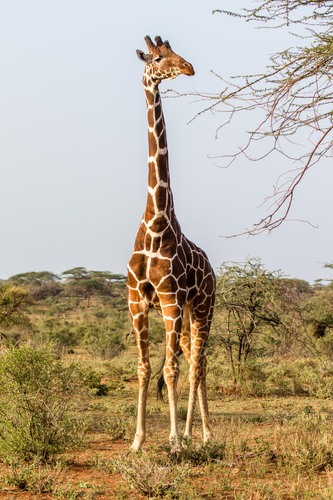
Reticulated giraffeG. reticulataNorthern Kenya, Ethiopia, SomaliaSharp-edged, polygon-shaped patches separated by thin white lines.Estimated~16,000
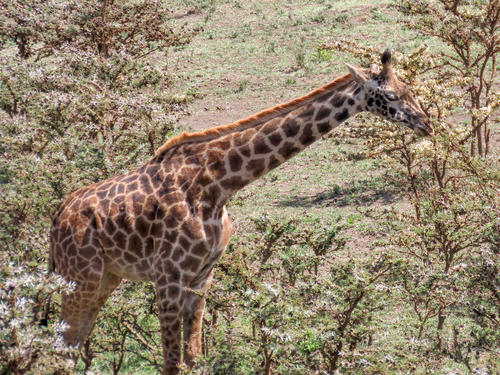
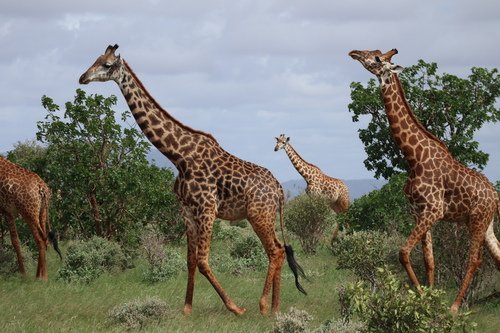
Masai giraffeG. tippelskirchiSouthern Kenya, Tanzania, ZambiaJagged, vine-leaf patches. The tallest on average.Estimated~45,000
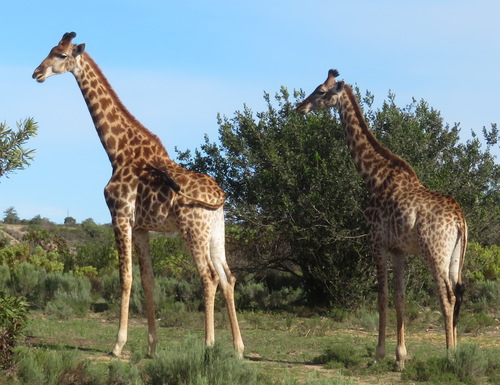
Southern giraffeG. giraffaNamibia, Botswana, South AfricaRounder blotches. The most numerous of the four species.Estimated~48,000
Estimated numbers, thousandsNorthern giraffe~6,000Reticulated giraffe~16,000Masai giraffe~45,000Southern giraffe~48,000Giraffe Conservation Foundation estimates, about 2020. Later counts are higher for some groups; treat all as approximate.
One species or four?The IUCN Red List assessed giraffes as a single species in 2016, with nine subspecies. A 2016 genetic study proposed four species, later work supported it, and in 2025 the IUCN’s giraffe specialists adopted the four-species view. Separate Red List assessments for each are still to come, so this page gives the 2016 status.Fennessy et al. 2016; Coimbra et al. 2021.
EVOLUTION
What is the giraffe’s closest relative?
Short answer: The okapi, a short-necked, striped forest animal from the Congo. The two are the last survivors of a family that once had dozens of species across Africa, Europe and Asia.
Relationships simplified, not to time scale; the order of the ruminant families is debated. After Hassanin et al. 2012. Okapi and pronghorn outlines: PhyloPic.
Split from the okapiAbout 11 to 12 million years ago. The okapi kept the ancestral short neck.
SivatheriumAn extinct giraffid built like a giant moose, with a short neck and broad, flattened horns, weighing over a tonne.
OssiconesGiraffe "horns" are bone covered in skin and hair. Calves are born with them lying flat; they fuse to the skull later.
Short answer: As a whole the giraffe is Vulnerable. Numbers fell by more than a third between 1985 and 2015, a decline so little noticed it was called a silent extinction. Some groups are now recovering; others are still falling.
Giraffes in the wild1985~155,0002015~97,5002020~117,000IUCN Red List 2016; Giraffe Conservation Foundation 2020. The 2020 rise partly reflects better counting.
Habitat lossHIGHSavanna woodland cleared for farms, charcoal and settlements, and cut up by roads and fences.
PoachingHIGHKilled for meat, hides and tail hair, often in wire snares set for other animals.
Conflict and droughtMEDIUMCivil unrest has emptied parks in central Africa. Long droughts kill calves and push herds into farmland.
Niger’s comebackWest African giraffes rose from 49 animals in 1996 to around 600, living among farmers outside any park.
Moving giraffesHerds have been trucked and ferried to start new populations in Uganda, Niger and elsewhere.
Trade controlsSince 2019 international trade in giraffe parts has been regulated under CITES Appendix II.
Muller et al. (IUCN) 2016; Giraffe Conservation Foundation.
MYTH OR FACT
Six giraffe claims, checked
3Myths2Half true1Facts
01MYTH“Giraffes have extra neck bones.”WHERE IT CAME FROMThe neck is so long it seems they must.
WHAT THE EVIDENCE SAYSThey have seven neck vertebrae, like nearly every mammal. Each is greatly lengthened. The first back vertebra also behaves partly like a neck bone.
WHAT IS TRUE INSTEADSeven bones, stretched.Sources: 05
02MYTH“Giraffes are mute.”WHERE IT CAME FROMThey are rarely heard by day.
WHAT THE EVIDENCE SAYSGiraffes snort, grunt, hiss and bleat, and recordings show a sustained hum at night at about 92 Hz, within human hearing.
03HALF TRUE“The long neck evolved to reach tall trees.”WHERE IT CAME FROMDarwin’s explanation, repeated in every textbook.
WHAT THE EVIDENCE SAYSFeeding height is well supported, but giraffes often feed low, and fighting between males and other factors probably contributed.
WHAT IS TRUE INSTEADOne good reason among several.Sources: 03
04HALF TRUE“Giraffes cannot swim.”WHERE IT CAME FROMNobody has filmed one swimming.
WHAT THE EVIDENCE SAYSA computer model suggests a giraffe would float and could swim, but badly: front-heavy, with its neck held low and awkward. They avoid deep water.
WHAT IS TRUE INSTEADProbably able, certainly unwilling.Sources: 01
05MYTH“A giraffe’s heart is enormous.”WHERE IT CAME FROMOld figures of 25 lb and 60 cm.
WHAT THE EVIDENCE SAYSAt about 0.5% of body weight it is ordinary in size for a mammal. Its strength comes from unusually thick muscle walls.
WHAT IS TRUE INSTEADThick-walled, not oversized.Sources: 02
06FACT“No two giraffes have the same pattern.”WHERE IT CAME FROMField researchers noticed early.
WHAT THE EVIDENCE SAYSCoat patterns are individually unique and stay fixed for life, which is how scientists track thousands of animals from photographs.
This page is written by Strange Animals and checked against primary research. Every figure carries a grade and a numbered source.
Cite this pageStrange Animals. (2026, November 15). Giraffe (Giraffa): height, neck, blood pressure and conservation. https://strangeanimals.info/mammals/ungulates/giraffe
01Dagg, A. I.Giraffe: Biology, Behaviour and Conservation.Cambridge University Press2014
02Mitchell, G. and Skinner, J. D.An allometric analysis of the giraffe cardiovascular system.Comparative Biochemistry and Physiology A 154: 523-5292009
14Bercovitch, F. B. and Berry, P. S. M.Herd composition, kinship and fission-fusion social dynamics among wild giraffe.African Journal of Ecology 51: 206-2162013
ClipBBC EarthBrutal Giraffe ShowdownAn old bull will not tolerate a rival, and a full fight breaks out. From the BBC series Africa.Pairs with: Society and calves →
ExplainerPBS EonsWhy The Giraffe Got Its NeckHow the giraffe’s neck evolved, and why biologists have argued over it since Lamarck and Darwin.Pairs with: Why the long neck →
ClipShamwari TVGiraffes using their necks to fightHow necking works: males swing their necks and use their heavy skulls as clubs.Pairs with: Society and calves →
PHOTOS
In pictures
Masai giraffe. Photo: Emanuele Santarelli, CC BY-SA 4.0, via iNaturalistSouthern giraffe. Photo: Nicola van Berkel, CC BY-SA 4.0, via iNaturalistReticulated giraffe. Photo: Dan Harville, CC BY-SA 4.0, via iNaturalistMasai giraffe. Photo: Thom Doeleman, CC BY 4.0, via iNaturalist
LISTEN
Hear it
A giraffe humming at nightRecording by Anton Baotic, Florian Sicks and Angela S. Stoeger, CC BY-SA 4.0, via Wikimedia Commons.
SIGHTINGS
Where it has been recorded
Each dot marks a georeferenced sighting or specimen record of Giraffa camelopardalis, from 5,632 records shared through GBIF.org.
Protected areas with the most research-grade sightings on iNaturalist, out of 24,982 worldwide. Bars show sightings by month.
CONSERVATION TIMELINE
How it came to be protected
2010Rothschild's giraffe EndangeredThe IUCN listed Rothschild's giraffe, a subspecies of Giraffa camelopardalis in Kenya and Uganda, as Endangered.Source: IUCN
2016Listed as VulnerableThe IUCN moved the giraffe, assessed as one species (Giraffa camelopardalis), from Least Concern to Vulnerable.Source: IUCN
2017Migratory species protectionThe Convention on Migratory Species selected giraffes (Giraffa camelopardalis) for protection.Source: Wikipedia
2018Kordofan giraffe Critically EndangeredThe IUCN Red List classified the Kordofan giraffe, a northern giraffe subspecies, as Critically Endangered.Source: Wikipedia
2018Rothschild's giraffe improvesThe IUCN moved Rothschild's giraffe from Endangered to Near Threatened.Source: IUCN
2019Masai giraffe EndangeredThe IUCN listed the Masai giraffe (Giraffa tippelskirchi) as Endangered.Source: National Geographic
2019Trade regulatedGiraffes were listed in CITES Appendix II, which regulates international trade in their parts.Source: Wikipedia
2024US protection proposedThe US Fish and Wildlife Service proposed listing West African, Kordofan and Nubian giraffes as endangered and reticulated and Masai as threatened.Source: US Fish and Wildlife Service
QUIZ
Test yourself
How many bones are in a giraffe's neck?
Which animal is the giraffe's only living relative?
How soon after its 2 metre drop at birth does a giraffe calf stand up?
 Strange Animals