The only sea turtle that grazes like a cow, and one of the great navigators. A female crosses hundreds or thousands of kilometres of open ocean to lay her eggs on the stretch of coast where she hatched decades earlier. In 2025, after forty years of protection, it came off the endangered list.
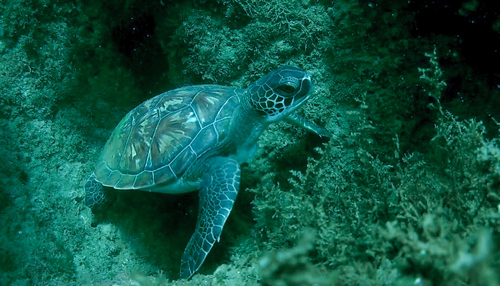
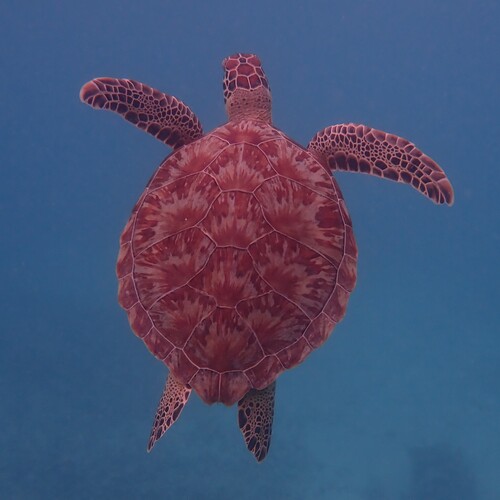
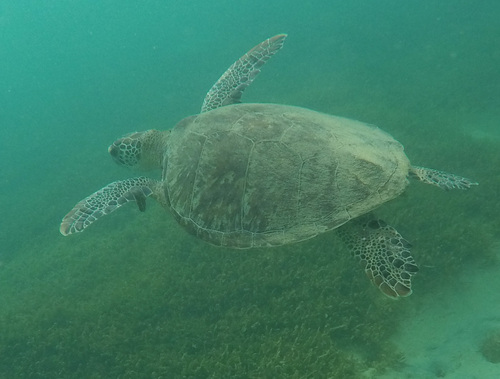
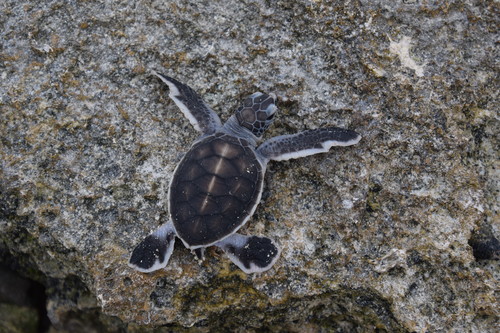
The green sea turtle (Chelonia mydas) is the largest hard-shelled sea turtle, with a shell about a metre long. It lives in warm coastal waters around the world and nests on beaches in more than 80 countries. Young turtles eat jellyfish and other small animals in the open ocean; adults settle in shallow water and graze on seagrass and algae. It is named for the green colour of its body fat, not its shell. Females take 25 to 35 years to mature and then migrate, every few years, back to the region where they hatched. The sex of each hatchling is set by the temperature of the sand.
Figures graded and sourced in the fact sheet below.What makes the green sea turtle unlike any other turtle?
Short answer: It is the only sea turtle that lives mainly on plants as an adult, and its grazing shapes the seagrass meadows it feeds on.
How big is a green sea turtle?
Short answer: The shell is usually 0.8 to 1.2 m long and adults weigh 110 to 190 kg, which makes it the largest hard-shelled sea turtle.
What is the life cycle of a green sea turtle?
Short answer: It starts on a beach, spends years out of sight in the open ocean, settles on a coastal feeding ground for decades, and returns to its home region to breed.
What do green sea turtles eat?
Short answer: Adults eat seagrass and algae. Young turtles in the open ocean eat animals, mostly jellyfish and other drifting creatures, and switch to plants when they move inshore.
How long can a green sea turtle hold its breath?
Short answer: Usually a few minutes while feeding, but resting turtles in cool water have stayed down for about five hours. An active or frightened turtle needs air far sooner.
Where do green sea turtles live?
Short answer: In warm coastal waters of the Atlantic, Pacific and Indian Oceans and the Mediterranean. They nest in more than 80 countries, but a handful of beaches hold most of the females.
What are sea turtles related to?
Short answer: Among living animals, turtles are closest to crocodiles and birds, not to lizards. Sea turtles took to the ocean over 100 million years ago, and seven species survive.
Are green sea turtles endangered?
Short answer: Globally, no longer. In October 2025 the IUCN moved the species from Endangered to Least Concern after its numbers rose by about 28% since the 1970s. Several regional populations are still threatened.
Six sea turtle claims, checked
What science still doesn’t know
Frequently asked questions
How big do green sea turtles get?+
The shell is usually 0.8 to 1.2 m long and adults weigh 110 to 190 kg.
What do green sea turtles eat?+
Adults eat seagrass and algae. Young turtles in the open ocean eat jellyfish and other small animals.
How long do green sea turtles live?+
An estimated 60 to 70 years or more. They take 25 to 35 years to reach breeding age.
Why are they called green sea turtles?+
Because their body fat is green, coloured by a plant diet. The shell is brown or olive.
How long can a green sea turtle hold its breath?+
A few minutes when active, 30 to 60 minutes when resting, and up to about five hours when resting in cool water.
Are green sea turtles endangered?+
The species was moved from Endangered to Least Concern in 2025. Some regional populations remain Vulnerable or Endangered.
Explore sea turtles further
Sources and how we check
This page is written by Strange Animals and checked against primary research. Every figure carries a grade and a numbered source.
- 01Hirth, H. F. Synopsis of the biological data on the green turtle Chelonia mydas (Linnaeus 1758). US Fish and Wildlife Service Biological Report 97(1)1997
- 02Bjorndal, K. A. Nutrition and grazing behavior of the green turtle Chelonia mydas. Marine Biology 56: 147-1541980
- 03Lohmann, K. J. et al. Regional magnetic fields as navigational markers for sea turtles. Science 294: 364-3662001
- 04Brothers, J. R. and Lohmann, K. J. Evidence for geomagnetic imprinting and magnetic navigation in the natal homing of sea turtles. Current Biology 25: 392-3962015
- 05Jensen, M. P. et al. Environmental warming and feminization of one of the largest sea turtle populations in the world. Current Biology 28: 154-1592018
- 06Mansfield, K. L. et al. First satellite tracks of neonate sea turtles redefine the "lost years" oceanic niche. Proceedings of the Royal Society B 281: 201330392014
- 07Luschi, P. et al. The navigational feats of green sea turtles migrating from Ascension Island investigated by satellite telemetry. Proceedings of the Royal Society B 265: 2279-22841998
- 08Papi, F. et al. Open-sea migration of magnetically disturbed sea turtles. Journal of Experimental Biology 203: 3435-34432000
- 09Broderick, A. C. et al. Fidelity and over-wintering of sea turtles. Proceedings of the Royal Society B 274: 1533-15392007
- 10Hays, G. C. et al. The diving behaviour of green turtles at Ascension Island. Animal Behaviour 59: 577-5862000
- 11Whittow, G. C. and Balazs, G. H. Basking behavior of the Hawaiian green turtle (Chelonia mydas). Pacific Science 36: 129-1391982
- 12Chaloupka, M. et al. Encouraging outlook for recovery of a once severely exploited marine megaherbivore. Global Ecology and Biogeography 17: 297-3042008
- 13IUCN Marine Turtle Specialist Group Chelonia mydas. IUCN Red List. Least Concern2025
- 14Pfaller, J. B. et al. Odors from marine plastic debris elicit foraging behavior in sea turtles. Current Biology 30: R213-R2142020
- 15Crawford, N. G. et al. A phylogenomic analysis of turtles. Molecular Phylogenetics and Evolution 83: 250-2572015
Three films worth your time
In pictures
Where it has been recorded


Where are green sea turtles seen most?
Protected areas with the most research-grade sightings on iNaturalist, out of 45,659 worldwide. Bars show sightings by month.
How it came to be protected
- 1975Listed by CITESThe green sea turtle was listed on Appendix II of CITES, the convention on international wildlife trade.Source: Wikipedia
- 1977Moved to Appendix ICITES moved the sea turtle family to Appendix I, except the Australian population of the green turtle, which followed in 1981.Source: Wikipedia
- 1978Protected under US lawThe green turtle was first listed under the US Endangered Species Act.Source: NOAA Fisheries
- 1982Listed as EndangeredThe IUCN classified the green sea turtle as Endangered.Source: Wikipedia
- 1992Escape hatches requiredNOAA Fisheries finalized regulations requiring turtle excluder devices in US shrimp trawl fisheries.Source: NOAA Fisheries
- 2004Endangered status reassessedThe IUCN reassessed the green sea turtle and kept it as Endangered.Source: Wikipedia
- 2016US listing revisedUS agencies revised the listing into 11 distinct population segments, 3 endangered and 8 threatened.Source: NOAA Fisheries
- 2025Moved to Least ConcernThe IUCN moved the green sea turtle from Endangered to Least Concern.Source: IUCN
Test yourself
What is the green sea turtle named for?
How long can a green sea turtle's longest resting dive last?
What sets the sex of a green sea turtle hatchling?