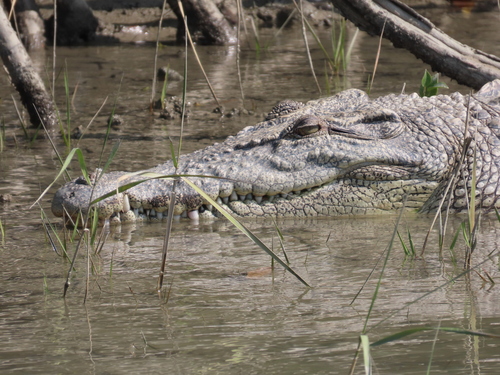
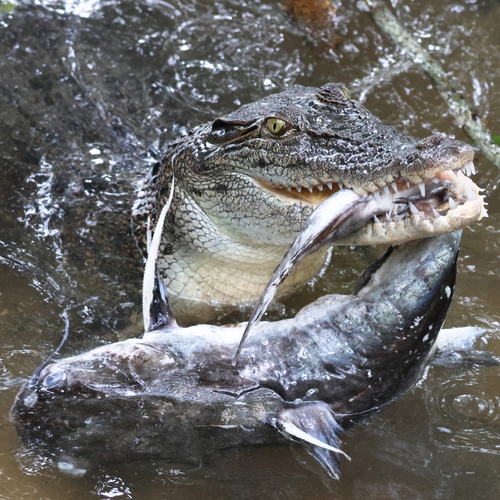
The largest living reptile and the owner of the strongest bite ever measured in a living animal. It rides ocean currents between islands, can stay underwater for over an hour, and came back from near-extinction in northern Australia within a single human lifetime.
The saltwater crocodile (Crocodylus porosus) is the largest living reptile. Adult males commonly reach 4 to 5 m and 400 to 500 kg, and the largest exceed 6 m and a tonne. Females are much smaller, usually under 3.5 m. It lives in rivers, swamps, estuaries and coasts from eastern India through Southeast Asia to northern Australia and the western Pacific, and travels by sea between them. It is an ambush predator that takes anything from crabs and fish to buffalo. Hunted close to extinction for its skin by 1970, it has recovered strongly in Australia and is listed as Least Concern, though it remains rare or gone in parts of Asia.
Figures graded and sourced in the fact sheet below.What makes the saltwater crocodile unlike any other animal?
Short answer: It is the largest reptile alive, the hardest biter ever measured, and the only crocodile that routinely crosses open sea.
How big do saltwater crocodiles get?
Short answer: Adult males are usually 4 to 5 m. The largest reliably measured was 6.17 m and weighed 1,075 kg.
How strong is a saltwater crocodile’s bite?
Short answer: 16,414 newtons, about 1.7 tonnes of force, measured on a living animal. It is the strongest bite recorded for any animal alive today.
How does a saltwater crocodile hunt?
Short answer: By waiting. It lies still at the water’s edge with only eyes and nostrils showing, then launches forward with its tail and drags prey under.
Can saltwater crocodiles really cross the ocean?
Short answer: Yes. They are poor long-distance swimmers but good passengers: tagged animals wait for a current running their way and ride it, sometimes for weeks.
How do saltwater crocodiles breed?
Short answer: The female builds a mound nest in the wet season, guards it for about three months, then carries the hatchlings to the water in her mouth. Nest temperature decides their sex.
Where do saltwater crocodiles live?
Short answer: From the east coast of India through Southeast Asia and New Guinea to northern Australia and the Solomon Islands. Despite the name, most live in tidal rivers and freshwater swamps.
Are crocodiles living dinosaurs?
Short answer: No, but they are the dinosaurs’ closest living relatives after birds. Crocodiles and birds are the two surviving branches of one group, the archosaurs.
Are saltwater crocodiles endangered?
Short answer: No. The species is Least Concern, and northern Australia’s recovery is one of conservation’s clearest successes. The cost is living alongside a predator that sometimes kills people.
Six crocodile claims, checked
What science still doesn’t know
Frequently asked questions
How big do saltwater crocodiles get?+
Adult males are usually 4 to 5 m long. The largest reliably measured was 6.17 m and weighed 1,075 kg.
How strong is a saltwater crocodile’s bite?+
The highest measured was 16,414 newtons, the strongest bite recorded for any living animal.
Where do saltwater crocodiles live?+
From eastern India through Southeast Asia and New Guinea to northern Australia and the Solomon Islands.
Do saltwater crocodiles live in the ocean?+
They mostly live in tidal rivers and swamps, but they travel by sea and can spend weeks in salt water.
Are saltwater crocodiles dangerous to people?+
Yes. They are among the few animals that treat people as prey. In Australia, fatal attacks average about one or two a year.
Are saltwater crocodiles endangered?+
No. The species is listed as Least Concern, though it has disappeared from parts of mainland Southeast Asia.
Explore saltwater crocodiles further
Sources and how we check
This page is written by Strange Animals and checked against primary research. Every figure carries a grade and a numbered source.
- 01Webb, G. J. W. and Manolis, S. C. Crocodiles of Australia. Reed Books1989
- 02Erickson, G. M. et al. Insights into the ecology and evolutionary success of crocodilians revealed through bite-force and tooth-pressure experimentation. PLoS ONE 7: e317812012
- 03Britton, A. R. C., Whitaker, R. and Whitaker, N. Here be a dragon: exceptional size in a saltwater crocodile (Crocodylus porosus) from the Philippines. Herpetological Review 43: 541-5462012
- 04Campbell, H. A. et al. Estuarine crocodiles ride surface currents to facilitate long-distance travel. Journal of Animal Ecology 79: 955-9642010
- 05Taplin, L. E. and Grigg, G. C. Salt glands in the tongue of the estuarine crocodile Crocodylus porosus. Science 212: 1045-10471981
- 06Leitch, D. B. and Catania, K. C. Structure, innervation and response properties of integumentary sensory organs in crocodilians. Journal of Experimental Biology 215: 4217-42302012
- 07Kelly, M. L. et al. Unihemispheric sleep in crocodilians? Journal of Experimental Biology 218: 3175-31782015
- 08Grigg, G. and Kirshner, D. Biology and Evolution of Crocodylians. CSIRO Publishing2015
- 09Fukuda, Y. et al. Recovery of saltwater crocodiles following unregulated hunting in tidal rivers of the Northern Territory, Australia. Journal of Wildlife Management 75: 1253-12662011
- 10Read, M. A. et al. Satellite tracking reveals long distance coastal travel and homing by translocated estuarine crocodiles. PLoS ONE 2: e9492007
- 11Caldicott, D. G. E. et al. Crocodile attack in Australia: an analysis of its incidence and review of the pathology and management of crocodilian attacks in general. Wilderness & Environmental Medicine 16: 143-1592005
- 12Webb, G. J. W. et al. Saltwater crocodile Crocodylus porosus. Crocodiles: Status Survey and Conservation Action Plan, IUCN Crocodile Specialist Group2010
- 13Webb, G. J. W. et al. The effects of incubation temperature on sex determination and embryonic development rate in Crocodylus johnstoni and C. porosus. Wildlife Management: Crocodiles and Alligators, Surrey Beatty1987
- 14Oaks, J. R. A time-calibrated species tree of Crocodylia reveals a recent radiation of the true crocodiles. Evolution 65: 3285-32972011
- 15Crocodile Specialist Group (IUCN) Crocodylus porosus. IUCN Red List. Least Concern2021
Three films worth your time
In pictures


Where it has been recorded


Where are saltwater crocodiles seen most?
Protected areas with the most research-grade sightings on iNaturalist, out of 10,221 worldwide. Bars show sightings by month.
How it came to be protected
- 1971Northern Territory protectionThe Northern Territory gave the saltwater crocodile legal protection, after Western Australia in 1970 and before Queensland in 1974.Source: Wikipedia
- 1979Moved to CITES Appendix ICITES Parties transferred the saltwater crocodile from Appendix II to Appendix I, except for the Papua New Guinea population.Source: Federal Register
- 1979Listed endangered in USThe US Fish and Wildlife Service listed all saltwater crocodile populations outside Papua New Guinea as endangered.Source: Federal Register
- 1985Australia to Appendix IICITES Parties voted to transfer the Australian population from Appendix I to Appendix II.Source: Federal Register
- 1996US downlists Australian populationThe US Fish and Wildlife Service reclassified the Australian population from endangered to threatened, effective 24 July 1996.Source: Federal Register
- 1996Listed as Least ConcernThe IUCN Red List has listed the saltwater crocodile as Least Concern since 1996.Source: Wikipedia
Test yourself
What bite force was measured for a large male saltwater crocodile in 2012?
Where are the glands that let a saltwater crocodile pump out excess salt?
How long was Lolong, the largest saltwater crocodile ever measured in captivity?