A half-gram insect that flies up to about 4,000 km to a few mountain forests in Mexico it has never seen. No single butterfly makes the round trip: it takes several generations, and the one that flies south lives eight times longer than its parents.

FamilyNymphalidae
RangeAmericas, plus Pacific, Iberia
Migratory statusIUCN Vulnerable (2023)
Larval foodMilkweed only
MONARCHS AT A GLANCE

The monarch (Danaus plexippus) is an orange and black butterfly of the milkweed butterfly subfamily Danainae. Its caterpillars eat only milkweed and store its toxins, which makes adults poisonous to birds. In North America, eastern monarchs migrate each autumn to oyamel fir forests in central Mexico, and western monarchs to the California coast. The migration spans several generations: a long-lived "super generation" flies south and overwinters, and its offspring recolonise the north over the following summer. The migratory subspecies is listed as Vulnerable.

Figures graded and sourced in the fact sheet below.
KEY DISCOVERIES
1975The forests foundAfter decades of tagging by Fred Urquhart, Ken Brugger and Catalina Aguado locate the winter roosts in Mexico.
1991Viceroy is toxic tooThe viceroy, thought a harmless copy, is also distasteful (Ritland & Brower).
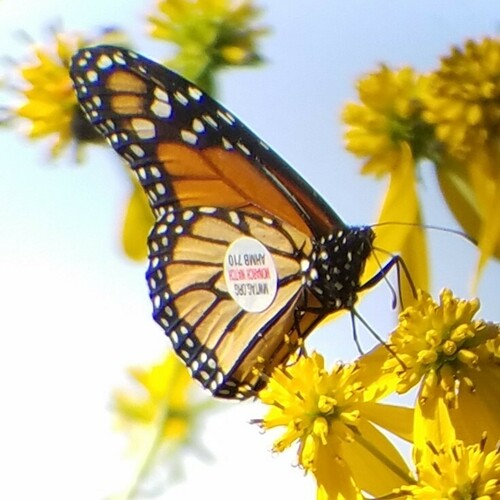
1992Monarch WatchA public tagging programme begins; volunteers now tag about 100,000 a year.
2009A clock in the antennaeAntennae hold the clocks that correct the sun compass (Merlin et al.).
2014Magnetic compassMonarchs can steer by the Earth’s magnetic field on cloudy days (Guerra et al.).
2024Proposed threatenedThe US Fish and Wildlife Service proposes listing the monarch as threatened.
ONLY IN THE MONARCH

What makes the monarch unlike any other butterfly?

Short answer: It makes a two-way migration like a bird, back to the same few winter forests every year, and it does it across generations.

01Two-way migrationEastern monarchs fly to Mexico and back each year. Most other migrating insects travel one way.Urquhart & Urquhart 1978
02A super generationMigrating adults live 8 to 9 months; summer adults live 2 to 6 weeks.Herman & Tatar 2001
03Sun compass with a clockIt flies by the sun’s position and corrects for time of day with clocks in its antennae.Merlin et al. 2009
04Borrowed poisonCaterpillars store heart toxins from milkweed, which make birds vomit.Brower 1969
05Packed forestsAbout 21 million butterflies roost per hectare of Mexican fir forest, on average.Thogmartin et al. 2017
06Inherited routeFirst-time migrants find forests their great-grandparents left.Reppert & de Roode 2018
FACT SHEET

How far does a monarch fly?

Short answer: Up to about 4,000 km, from southern Canada to central Mexico, on a body weighing about half a gram.

MeasuredEstimatedQuoted, unverified
WingspanMeasured~9 to 10 cmMonarch~9 to 10 cmViceroy~7 to 8 cmMigrants tend to have larger, longer wings
WeightMeasured~0.5 gAdult~0.5 gPaperclip~0.5 gAbout the weight of a paperclip
Migration distanceEstimatedup to ~4,000 km+Longest~4,000+ kmTypical~3,000 kmSouthern Canada to central Mexico; tag recoveries
Migrant lifespanMeasured~8 to 9 monthsSuper gen.~8 to 9 moSummer gen.~2 to 6 wkReproduction is paused by hormones in migrants
Generations a yearMeasured~4Eastern~3 to 4 + 1Western~3 to 5Three or four breeding generations plus one migrant generation
Daily distanceEstimated~25 to 100 kmGood daysup to ~100+Average~40 kmGliding on thermals saves energy
Roost altitudeMeasured~3,000 mMexico roosts~2,900 to 3,300 mOyamel fir forests in Michoacán and México State
Eastern winter areaMeasured~1.8 ha2024-251.79 ha1996-97 peak18.19 haForest area occupied in Mexico; WWF-Mexico counts
Monarchs taste good to birdsQuoted, unverifiedn/aMost birds that eat one vomit and learn to avoid them. A few, like black-backed orioles, can eat them in Mexico.Common claim
MIGRATION

How does the monarch migration work?

Short answer: In relay. The butterflies that fly south in autumn are the great-grandchildren of those that left Mexico in spring.

Read: the monarch migration mystery →
SSuper generationAug to MarBorn in late summer in the north. Flies to Mexico, overwinters, then mates and heads north in March.8 to 9 months
1Generation 1Mar to MayHatches in Texas and the southern US from eggs laid by returning migrants.2 to 6 weeks
2Generation 2May to JunMoves north into the Midwest and Northeast.2 to 6 weeks
3Generation 3Jun to AugReaches southern Canada and the northern US.2 to 6 weeks
SGeneration 4 = next super generationFrom AugShort days and cool nights switch off breeding and switch on migration.8 to 9 months
Eastern populationRockies to the Atlantic; winters in about a dozen fir forests in Mexico.
Western populationWest of the Rockies; winters in groves along the California coast.
Non-migratory groupsFlorida, the Caribbean, Hawaii, Australia and Spain; monarchs spread with milkweed.
LIFE CYCLE

How long does it take a monarch to grow up?

Short answer: About a month from egg to adult in summer warmth.

Read: metamorphosis →
~3 to 5 daysEggOne egg per milkweed leaf; a female lays about 300 to 500.
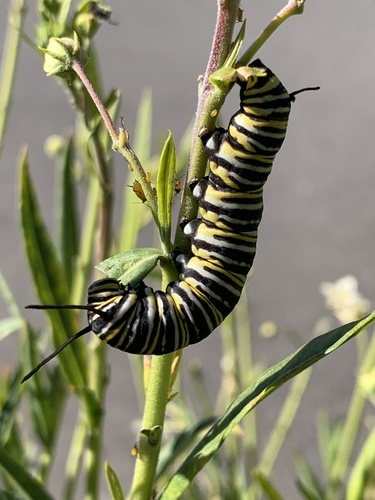
~10 to 14 daysCaterpillarFive instars; grows about 2,000 times in mass.
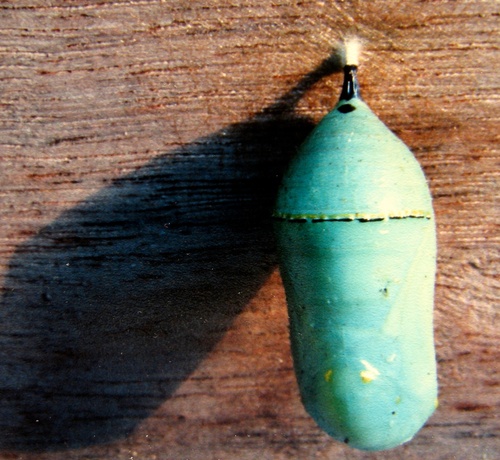
~8 to 15 daysChrysalisJade green with gold dots; the body is rebuilt inside.
2 to 6 weeks, or 8 to 9 monthsAdultSummer adults breed quickly; migrants wait.
MILKWEED AND POISON

Why are monarchs poisonous?

Short answer: Caterpillars eat milkweed and store its cardenolides, heart toxins that make most birds sick. The orange warns them off.

The milkweed bargainToxinCardenolides block a pump in heart cellsMonarch trickChanges in the same pump protein make it resistantSame fix, other insectsSeveral milkweed bugs and beetles evolved identical changesCostToo much toxin slows caterpillar growthAgrawal 2017; Karageorgi et al. 2019.
The viceroyLooks alike, with an extra black line on the hindwing. Both taste bad: a shared warning.
MedicineInfected females lay eggs on more toxic milkweed, which helps their young fight a parasite.
Tropical milkweedA non-native species planted in gardens can keep monarchs breeding in winter and spread disease.
Plant nativesLocal milkweeds support the cycle best.
EVOLUTION

Are butterflies a kind of moth?

Short answer: In evolutionary terms, yes. Butterflies are one branch that evolved within the moths, about 100 million years ago.

Read: moths, the overlooked majority →
CaddisfliesClosest relatives of butterflies and mothsMothsMost of LepidopteraSilk moths and relativesBombycoideaSwallowtails, whites, bluesOther butterfly familiesPainted lady, longwingsOther brush-footed butterfliesMonarchDanaus plexippus, a milkweed butterflyLepidopteraButterfliesNymphalidae
Relationships simplified, not to time scale. After Kawahara et al. 2019. Outlines: PhyloPic, CC0.
THREATS AND CONSERVATION

Are monarch butterflies endangered?

Short answer: The migratory monarch is listed as Vulnerable by the IUCN, and the US has proposed listing it as threatened. The eastern winter colonies have shrunk by about 90% since the 1990s.

Endangered register →
Forest occupied in Mexico each winter, hectares1996-9718.192003-0411.122013-140.672018-196.052023-240.92024-251.79WWF-Mexico and CONANP surveys. One hectare holds roughly 21 million monarchs.
Milkweed lossHIGHHerbicide-tolerant crops removed milkweed from Midwest farmland.
Winter forest damageHIGHLogging and storms thin the canopy that shelters roosts.
Climate and weatherHIGHDroughts, heat and late frosts hit breeding and migration.
Biosphere reserveMexico’s Monarch Butterfly Biosphere Reserve, a UNESCO World Heritage Site since 2008.
Milkweed plantingGardens, roadsides and farms restore native milkweed and nectar flowers.
Tagging and countsMonarch Watch and the Western Monarch Count track the population each year.
Pesticide limitsReducing spraying on field edges helps caterpillars and nectar plants.
Western monarchsCounted in the millions in the 1980s, fewer than 2,000 at California sites in 2020, a rebound to about 247,000 in 2021, about 9,000 in 2024 and about 12,000 in 2025 (Xerces Society).
MYTH OR FACT

Six monarch claims, checked

3Myths2Half true1Facts
01MYTH“One monarch flies all the way to Mexico and back.”WHERE IT CAME FROMThe migration is often described as one trip.
WHAT THE EVIDENCE SAYSNo butterfly makes the round trip; it takes about four generations.
WHAT IS TRUE INSTEADA relay across generations.Sources: 03
02HALF TRUE“The viceroy is a harmless copy of the monarch.”WHERE IT CAME FROMA textbook example of Batesian mimicry.
WHAT THE EVIDENCE SAYSViceroys are also distasteful to birds, so both share one warning pattern.
WHAT IS TRUE INSTEADA shared warning, not a bluff.Sources: 05
03MYTH“Monarchs only live in North America.”WHERE IT CAME FROMThe famous migration.
WHAT THE EVIDENCE SAYSMonarchs spread with milkweed to Hawaii, Australia, New Zealand, the Canaries and southern Spain.
WHAT IS TRUE INSTEADFound on several continents.Sources: see list below
04HALF TRUE“Planting any milkweed helps monarchs.”WHERE IT CAME FROMGarden campaigns.
WHAT THE EVIDENCE SAYSNative milkweed helps. Tropical milkweed in warm areas can disrupt migration and spread a parasite.
WHAT IS TRUE INSTEADPlant native species.Sources: 08
05FACT“Monarchs taste with their feet.”WHERE IT CAME FROMStudies of egg-laying females.
WHAT THE EVIDENCE SAYSFemales drum on leaves with their front legs to taste whether a plant is milkweed.
WHAT IS TRUE INSTEADTrue.Sources: see list below
06MYTH“Monarchs are going extinct.”WHERE IT CAME FROMSteep population drops.
WHAT THE EVIDENCE SAYSMonarchs as a species are widespread; it is the migration that is at risk.
WHAT IS TRUE INSTEADThe phenomenon is threatened, not the species.Sources: 09
OPEN QUESTIONS

What science still doesn’t know

?How do they find the exact forests?The compasses explain direction, not how they pinpoint a few mountain sites.
?Why fewer reach Mexico?Summer numbers are often fine; losses during the autumn journey are poorly understood.
?Is the route encoded in genes?Migration genes are being mapped, but the full program is unknown.
?What drove the western crash?Habitat, pesticides and weather all fit; their weight is debated.
?Can the migration adapt?Warmer winters may change where and whether monarchs migrate.
?How many are there?Estimates of the eastern population vary from tens of millions to hundreds of millions.
FAQ

Frequently asked questions

How far do monarch butterflies migrate?+

Eastern monarchs fly up to about 4,000 km from southern Canada and the northern US to central Mexico.

How long do monarch butterflies live?+

Summer adults live about 2 to 6 weeks. The migrating generation lives about 8 to 9 months.

Why are monarchs poisonous?+

Their caterpillars eat milkweed and store its cardenolide toxins.

Where do monarchs go in winter?+

Eastern monarchs go to fir forests in central Mexico; western monarchs to the California coast.

Are monarch butterflies endangered?+

The migratory monarch is listed as Vulnerable by the IUCN, and the US proposed a threatened listing in 2024.

How can I help monarchs?+

Plant native milkweed and nectar flowers, avoid pesticides and join tagging or counting programmes.

COMPARE AND EXPLORE

Explore monarchs further

HOW WE KNOW

Sources and how we check

This page is written by Strange Animals and checked against primary research. Every figure carries a grade and a numbered source.

Cite this pageStrange Animals. (2026, November 14). Monarch butterfly (Danaus plexippus): migration, navigation, milkweed and conservation. https://strangeanimals.info/insects/butterflies/monarch-butterfly
  1. 01Urquhart, F. A. and Urquhart, N. R. Autumnal migration routes of the eastern population of the monarch butterfly. Canadian Journal of Zoology 561978
  2. 02Herman, W. S. and Tatar, M. Juvenile hormone regulation of longevity in the migratory monarch butterfly. Proceedings of the Royal Society B 2682001
  3. 03Reppert, S. M. and de Roode, J. C. Demystifying monarch butterfly migration. Current Biology 28: R1009-R10222018
  4. 04Merlin, C., Gegear, R. J. and Reppert, S. M. Antennal circadian clocks coordinate sun compass orientation in migratory monarch butterflies. Science 325: 1700-17042009
  5. 05Ritland, D. B. and Brower, L. P. The viceroy butterfly is not a Batesian mimic. Nature 350: 497-4981991
  6. 06Guerra, P. A., Gegear, R. J. and Reppert, S. M. A magnetic compass aids monarch butterfly migration. Nature Communications 5: 41642014
  7. 07Brower, L. P. Ecological chemistry. Scientific American 2201969
  8. 08Agrawal, A. A. Monarchs and Milkweed. Princeton University Press2017
  9. 09IUCN Migratory monarch butterfly reassessed as Vulnerable. IUCN Red List update2023
  10. 10Thogmartin, W. E. et al. Density estimates of monarch butterflies overwintering in central Mexico. PeerJ 5: e32212017
  11. 11Karageorgi, M. et al. Genome editing retraces the evolution of toxin resistance in the monarch butterfly. Nature 574: 409-4122019
  12. 12Pleasants, J. M. and Oberhauser, K. S. Milkweed loss in agricultural fields because of herbicide use. Insect Conservation and Diversity 62013
  13. 13Xerces Society Western Monarch Count results. xerces.org2024
  14. 14US Fish and Wildlife Service Proposed threatened listing for the monarch butterfly. Federal Register2024
WATCH

Three films worth your time

ClipBBC Earth · Earth’s Great SeasonsA Breathtaking Swarm of 100 Million ButterfliesMillions of monarchs wake from their Mexican winter roosts in spring.Pairs with: Migration →
Short filmPhil TorresThe Great Monarch MigrationTens of millions of butterflies in one small Mexican forest.Pairs with: Threats →
ReportWorld Wildlife FundMonarch Butterflies: Their Epic Migration and Hope for a Species in DeclineThe 3,000-mile journey to the biosphere reserve and what is being done to protect it.Pairs with: Threats →
PHOTOS

In pictures

Monarch butterfly
Photo: Leila Dasher, CC BY 4.0, via iNaturalist
Monarch butterfly
Photo: Christine Young, CC BY 4.0, via iNaturalist
Monarch butterfly
Photo: Scott Loarie, CC0, via iNaturalist
Monarch butterfly
Photo: Jon Sullivan, CC BY 4.0, via iNaturalist
SIGHTINGS

Where it has been recorded

Map of recorded Danaus plexippus occurrences, western hemisphereMap of recorded Danaus plexippus occurrences, eastern hemisphere
Each dot marks a georeferenced sighting or specimen record of Danaus plexippus, from 835,019 records shared through GBIF.org.
CONSERVATION TIMELINE

How it came to be protected

  1. 1980Winter forests protectedPresident José López Portillo of Mexico decreed the first protection for the monarch overwintering areas.Source: Wikipedia
  2. 2008World Heritage listingThe UNESCO World Heritage Committee listed Mexico's Monarch Butterfly Biosphere Reserve as a natural site.Source: Wikipedia
  3. 2016Assessed Endangered in CanadaCOSEWIC designated the monarch Endangered in Canada, after rating it Special Concern since 1997.Source: Government of Canada
  4. 2020US listing found warrantedThe US Fish and Wildlife Service found that listing the monarch was warranted but precluded by higher priorities.Source: Wikipedia
  5. 2022Listed as EndangeredThe IUCN placed the migratory monarch butterfly on its Red List as Endangered.Source: IUCN
  6. 2023Reassessed as VulnerableThe IUCN changed the migratory monarch's Red List status from Endangered to Vulnerable after a petition.Source: Wikipedia
  7. 2023Listed under Canadian lawThe Government of Canada listed the monarch as an endangered species under federal law.Source: Wikipedia
  8. 2024Proposed as threatenedThe US Fish and Wildlife Service proposed listing the monarch as threatened under the Endangered Species Act.Source: Wikipedia
QUIZ

Test yourself

About how much does an adult monarch butterfly weigh?

Where does a monarch butterfly keep the clocks that correct its sun compass?

What do female monarch butterflies use to taste whether a plant is milkweed?
SPECIES PROFILES

More species profiles

All 28 species profiles →

All monarch articles

2 articles