African Forest Elephant: Small and Most at Risk
Loxodonta cyclotisThe smallest living elephant became one of the most threatened large mammals the day it was named its own species. It plants the forest by spreading seeds.
 Strange Animals EditorialApril 9, 2025·16 min read·Editorial standards ↗
The African forest elephant is the smaller, rarer and more elusive of the two African elephant species. Loxodonta cyclotis lives in the deep equatorial rainforests of central and west Africa, where it helps shape the botanical makeup of the Congo Basin.
Although it looks superficially like a smaller version of its famous savanna cousin, the forest elephant is genetically distinct, ecologically separate and now in far worse trouble: the IUCN classifies it as Critically Endangered, with a population estimated to have fallen by around 86 per cent over the 31 years before 2021.
This guide covers every major aspect of forest elephant biology and conservation: taxonomy and the species split, size and anatomy, straight tusks and rounded ears, rainforest ecology, diet and geophagy at forest clearings, the 22-month gestation and slow reproduction, infrasonic communication, keystone seed dispersal, the ivory crisis and the scientists who have dedicated their careers to counting an animal that cannot be seen from the air.
Etymology and Classification
The genus name Loxodonta was proposed by Frédéric Cuvier in 1825, with the Latinised spelling first used by an anonymous author in 1827. It comes from Greek words for 'slanting' and 'tooth', a reference to the lozenge-shaped enamel of African elephant molars. The species name cyclotis comes from the Greek kyklos ('circle') and otis ('ear'), meaning 'round-eared', an immediate field mark that distinguishes the forest elephant from its savanna cousin.
For most of the twentieth century, zoologists lumped all African elephants into a single species, Loxodonta africana , and treated cyclotis as a subspecies, Loxodonta africana cyclotis . Early naturalists had long noted that elephants in the Congo rainforest looked and behaved differently from those in the savanna, but the scientific consensus was that the differences were environmental, not genetic.
That changed with genetics. Morphological work by Peter Grubb and colleagues in 2000 and genetic work by Alfred Roca and colleagues in 2001 argued for two species. A 2010 paper in PLOS Biology by Nadin Rohland and colleagues analysed nuclear DNA and found that forest and savanna elephants diverged between 2.6 and 5.6 million years ago.
These findings support recognising two distinct species: Loxodonta africana (bush) and Loxodonta cyclotis (forest).
In 2021 the IUCN Red List assessment was updated to recognise two separate species and assigned each its own conservation status, Endangered for the bush elephant, Critically Endangered for the forest elephant. The reclassification made the forest elephant one of the most threatened large mammals on Earth in a single stroke.
Ancient DNA studies have since added further texture. Forest elephants share some genes with the extinct straight-tusked elephant ( Palaeoloxodon antiquus ) of Pleistocene Europe, hinting at historic gene flow and a more complex proboscidean family tree than classical taxonomy allowed.
Size and Physical Description
Forest elephants are the smallest living elephant species on average. Their compact body plan is a direct adaptation to dense forest, where navigating between tree trunks and moving under low canopy favours a smaller frame.
Adult females:
- Shoulder height: up to about 2.4 metres (estimates vary)
- Weight: estimates vary, up to roughly 2-4 tonnes
- Noticeably more gracile than bush elephant females
Adult males:
- Shoulder height: about 2.2 metres on average, with the very largest individuals no taller than about 2.75 m
- Weight: about 2 tonnes on average, with the largest no heavier than about 3.5 tonnes
Calves at birth:
- Weight: around 105 kg
For comparison, fully grown bush elephant bulls average 3.0-3.4 metres at the shoulder and 5.2-6.9 tonnes, making them far larger than their forest relatives.
Field identification features:
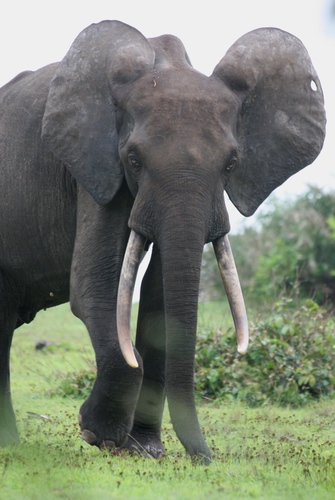
- Ears. Small, rounded, close to the head. Bush elephant ears are enormous triangles shaped to radiate heat, forest elephant ears are modest semicircles because rainforest is warm but shaded, not hot and exposed.
- Tusks. Straight and pointing almost directly downward, rather than curving up and out. Tusks appear in both sexes, are pink and are thinner and harder than bush elephant tusks. Tusks of bulls grow throughout life, while those of cows stop growing at sexual maturity.
- Trunk. Slightly shorter and more muscular than the bush elephant's, with fine sensory hairs that help detect fruit in dim forest understorey.
- Toenails. Five on each front foot, four on each hind foot. Bush elephants have four and three respectively.
- Body shape. More rounded back with a high, rounded forehead, bush elephants have a sloping back and more angular head.
- Skin. Grey, looking yellow to reddish after wallowing.
These differences are consistent enough that experienced field biologists can distinguish the two species instantly in photographs, but the smaller size and straight tusks are the diagnostic combination.
Habitat and Range
Forest elephants are animals of the closed-canopy equatorial rainforest. Their historical range extended across the Guinean forests of west Africa and the entire Congo Basin. Today the species is much reduced.
Current strongholds:
| Country | Status |
|---|---|
| Gabon | Largest population, about half of the total |
| Republic of Congo | Present |
| Cameroon | Present |
| Central African Republic | Present |
| Democratic Republic of Congo | Present |
| West Africa (combined pockets) | Small, fragmented populations |
Within these countries forest elephants use a mosaic of habitats:
- Primary lowland rainforest. The core habitat. Closed canopy, dense understorey, slow-growing hardwoods.
- Swamp forest. Seasonally flooded forest on river edges, especially important in the Likouala and Sangha basins.
- Riverine forest. Narrow forest corridors along rivers, critical for movement between larger habitat blocks.
- Forest clearings (bais). Natural mineral-rich openings in the forest. These may be only a few hectares across but are disproportionately important: bais such as Dzanga Bai (Central African Republic), Mbeli Bai (Republic of Congo), and Langoue Bai (Gabon) attract dozens to hundreds of elephants to drink mineral water and socialise.
- Secondary forest and agricultural edges. Increasingly used as primary forest is logged, often bringing elephants into conflict with farmers.
Forest elephants in West Africa, including Ghana and Ivory Coast, survive in small, isolated populations.
Tusks, Ivory, and Why They Are Still Hunted
At first glance, the forest elephant's smaller tusks should make it a less attractive target for ivory poachers than its larger savanna cousin. The reality is the opposite. Over several decades, forest elephant numbers are estimated to have fallen from approximately 700,000 to fewer than 100,000, with poaching for ivory and bushmeat a major driver.
Three features make forest elephant ivory particularly desirable to the black market:
- Hardness. Forest elephant ivory is thinner and harder than savanna elephant ivory. This makes it better for carving and it fetches a higher price on the black market, especially in Japan, where hard ivory has long dominated the trade.
- Colour. Forest elephant tusks are characteristically pink.
- Scarcity. With the population declining, the ivory itself has become rarer and prices higher, following a pattern seen in markets for extinct goods.
Genetic analysis of 2,871 tusks seized in Hong Kong between 2006 and 2013 traced them to the Dja-Odzala-Minkébé protected area complex and the adjacent Dzanga Sangha Reserve. A spike in poaching was behind the species' 2021 listing as Critically Endangered.
International commercial ivory trade has been banned under CITES since 1989, and China announced in 2015 that it would phase out its legal domestic ivory trade.
Reproduction and Life Cycle
Forest elephant reproduction is extraordinarily slow, slower than any other elephant species and among the slowest of any large mammal. This is the single most important fact for understanding why the population cannot rebound quickly.
Reproductive parameters:
| Metric | Value |
|---|---|
| Age at first reproduction (F) | About 23 years on average |
| Puberty (M) | One to two years after females |
| Gestation length | 22 months |
| Calving interval | 5-6 years |
| Weaning age | 4-5 years |
| Lifespan (wild) | 60-70 years |
By contrast, bush elephants typically start breeding at around 12 years and have a calf every 3-4 years.
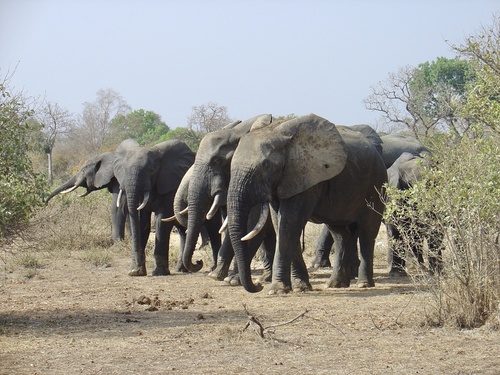
Calves are born into family groups that in Gabon's Lope National Park numbered three to eight individuals, with groups of up to 20 seen in Dzanga-Sangha. Female offspring typically stay with the natal group for life, males disperse around puberty and live largely solitary lives, associating with bulls in loose, shifting bachelor groups.
At forest clearings groups meet frequently, consistent with a fission-fusion society.
Diet, Fruit, and Forest Gardening
Forest elephants eat a great deal of fruit: in Lope National Park they fed on at least 72 different fruits, along with bark and leaves. They also eat aquatic plants and seek out minerals at clearings, but the fruit relationship is what defines their ecological role.
Typical plant groups consumed:
- Fruiting trees: Irvingia gabonensis , Parinari excelsa , Tridesmostemon omphalocarpoides
- Lianas and climbers
- Aquatic macrophytes in swamp clearings
- Raffia and other palms
In one lowland forest in the northern Republic of Congo, forest elephants were estimated to disperse large seeds of at least 73 tree species, moving about a third of them more than 5 km. In the Cuvette Centrale, 14 of 18 megafaunal tree species depend on elephants to disperse their seeds. Seeds passed through the elephant gut germinate faster.
A 2019 study in Nature Geoscience , led by Fabio Berzaghi, used modelling to examine how forest elephants affect carbon storage in central African rainforests. The proposed mechanism is that the slow-growing, high-wood-density hardwood trees the elephants disperse are also the species that store the most carbon.
Losing the disperser means losing the disperser's tree species, which means a forest with fewer, smaller, faster-growing trees, and therefore less carbon. Research suggests forest elephants can significantly increase the forest's carbon uptake.
Geophagy and the Forest Clearings
Forest clearings, called bais in central African languages, are one of the most remarkable features of the Congo Basin. These are natural openings in the otherwise continuous forest canopy, a few hectares in size, fed by mineral-rich groundwater or sitting on natural salt licks.
Dzanga Bai, in the Dzanga-Sangha Special Reserve of the Central African Republic, is the most famous. Researchers including Andrea Turkalo have studied individually identified elephants at the bai over many years.
Elephants gather here to dig in the mineral-rich mud, drink the enriched water and socialise.
Mineral supplementation at bais provides sodium, calcium, magnesium and other nutrients that are scarce in leaves and fruit but essential for milk production, bone growth and muscle function.
Bais are also where forest elephant social networks become visible to researchers, because most of the forest itself is too dense for observation. Dung-DNA sampling, camera traps and direct observation at bais have produced most of what we know about individual identification, kinship and social structure in the species.
Communication and Cognition
Communication in rainforest is a hard engineering problem. Dense foliage absorbs and scatters sound, visibility is limited and family groups can become separated by kilometres. Forest elephants solve this with low-frequency calls that travel through vegetation the way light does not.
Acoustic communication:
- Infrasonic rumbles. Calls below 20 Hz, beneath human hearing, can travel several kilometres through forest with relatively low attenuation. These carry information about identity, family, reproductive state and alarm.
- Trumpets, roars and snorts. Short-range vocalisations used in aggressive, defensive, or excited contexts.
- Seismic signals. Foot-stomping produces ground-borne vibrations that can be detected by other elephants through their feet and trunks.
The Cornell Lab of Ornithology's Elephant Listening Project, founded by Katy Payne and led by Peter Wrege, has deployed long-term acoustic monitoring arrays at Dzanga Bai and in Nouabale-Ndoki National Park. Acoustic monitoring has shown, among other things, that forest elephants lower their vocalisations in response to gunfire linked to poaching.
Cognitively, forest elephants are thought to share the intelligence documented in other elephants. Dense forest makes controlled experiments difficult, so much of this evidence is inferential.
Counting an Invisible Elephant
Counting bush elephants is hard but tractable: aerial surveys across open savanna can cover enormous areas quickly. Forest elephants are another matter. Under a closed canopy they are effectively invisible from the air. Even trained observers standing on the ground can pass within a few metres of an elephant without seeing it.
Methods used to monitor forest elephants:
- Dung counts. Transects are walked through the forest, dung piles are counted, age is estimated and densities are calculated using known decay rates and defecation rates.
- Dung-DNA surveys. Samples are genotyped to identify individuals and estimate population size through capture-recapture modelling.
- Forest clearing observation. At bais, researchers identify individuals by ear shape, tusk configuration, tail hair and scarring. Cumulative observation over years produces a catalogue.
- Camera trap networks. Thousands of cameras across study sites record presence, absence and relative abundance.
- Acoustic monitoring. Fixed microphone arrays record calls across landscapes and estimate density from call rates.
- Satellite tracking. GPS collars on a small number of individuals map long-distance movement patterns.
Population estimates come with wide uncertainty, but suggest that fewer than 100,000 forest elephants survive, down from approximately 700,000 over several decades. Researchers including Fiona Maisels, Samantha Strindberg, Stephen Blake, Andrea Turkalo and John Poulsen have carried the quantitative work that makes these numbers defensible.
Conservation Status and Threats
The IUCN Red List classifies Loxodonta cyclotis as Critically Endangered as of the 2021 reassessment. The species is listed on CITES Appendix I, which bans international commercial trade in the animal or its parts. It is also protected under national laws in every range state, though enforcement varies dramatically.
Primary threats:
- Ivory poaching. The proximate cause of the 86 per cent decline. Organised trafficking networks link poachers in the Congo Basin to buyers in east Asia, with transit points in east African ports.
- Habitat loss and fragmentation. Commercial logging (selective and industrial), road building for logging and oil extraction, industrial oil palm and rubber plantations, and subsistence agriculture all reduce and fragment forest habitat. Road construction is particularly damaging because new roads provide poachers access to previously remote forest.
- Human-elephant conflict. As forest is cleared and elephants are compressed into smaller areas, crop raiding on cassava, plantain, cocoa and other subsistence crops increases. Retaliatory killings by farmers are a growing source of mortality.
- Slow reproduction. The 5-6 year calving interval and 22-month gestation mean that even small sustained mortality above natural rates leads to population decline.
- Climate change. Rainfall patterns shifting across the Congo Basin could alter fruiting phenology in ways with unclear but potentially serious consequences for a frugivore-dependent species.
Conservation responses:
- Protected area networks such as Nouabale-Ndoki National Park, Dzanga-Sangha Special Reserve, Lope National Park, Loango National Park and the Minkebe-Odzala-Dja transboundary complex.
- Anti-poaching units with aerial, foot and canine patrol components, often trained and supported by NGOs such as WCS, WWF and African Parks.
- High-profile parks in Gabon and Republic of Congo benefit from well-developed community-based conservation and benefit-sharing programmes.
- Ivory-market demand reduction, most notably China's announced phase-out of its domestic ivory trade.
- Human-elephant conflict mitigation: chili fences, beehive fences, early-warning systems and compensation schemes.
- Long-term research programmes at Dzanga Bai, Mbeli Bai and Langoue Bai.
Forest Elephants and Humans
Forest elephants have shared central Africa with humans for as long as humans have lived there. BaAka and Baka communities in the Congo Basin hold deep traditional knowledge of forest elephant behaviour, seasonal movements and feeding grounds. In many cases this knowledge predates and complements modern scientific research. Conservation programmes in Dzanga-Sangha and elsewhere now routinely employ BaAka trackers whose forest skills exceed those of any outsider.
At the same time, the relationship is under strain. Crop-raiding by elephants can destroy a subsistence farmer's annual harvest in a single night. Retaliatory killings, both by aggrieved farmers and by poachers using the cover of conflict, are an increasing source of mortality in some regions.
Effective forest elephant conservation requires that rural communities see tangible benefits from keeping elephants alive: through ecotourism revenue, research employment, crop protection and compensation schemes.
Ecotourism around forest elephants is limited by the very inaccessibility that protects them. Dzanga Bai, Mbeli Bai and Langoue Bai offer rare, world-class viewing opportunities but receive only modest visitor numbers compared with savanna safari destinations. This is both a strength (low disturbance) and a weakness (less financial leverage for conservation).
Globally, the forest elephant is the great unknown of elephant conservation, less famous than its savanna cousin, less studied than the Asian elephant, yet arguably the most ecologically important of the three. The fate of the Congo Basin rainforest, and through it a significant fraction of the planet's tropical carbon sink, is tied directly to whether enough forest elephants survive to keep planting new trees.
Frequently asked questions
Forest elephants (Loxodonta cyclotis) and bush elephants (Loxodonta africana) were long treated as subspecies, but morphological and genetic analyses showed they are distinct species, and the IUCN assessed them separately in 2021. Forest elephants are considerably smaller: males average about 2.2 m at the shoulder and about 2 tonnes, while fully grown bush elephant bulls average 3.0-3.4 m and 5.2-6.9 tonnes.
Their tusks are straight and point downward rather than curving forward, their ears are small and rounded rather than large, and they have five toenails on the front feet and four on the back (bush elephants have four and three). Forest elephants live in humid forest in central and west Africa, while bush elephants range across savanna and woodland.
African forest elephants inhabit the Congo Basin and the humid forests of central and west Africa. The largest population is in Gabon, thought to hold about half of the remaining animals, with others in Cameroon, the Central African Republic, the Republic of Congo, the Democratic Republic of Congo, Ivory Coast and Ghana.
They prefer closed-canopy primary forest but also use swamp forest, riverine forest and the open mineral-rich clearings called bais, such as Dzanga Bai and Mbeli Bai, where dozens to hundreds of individuals gather to drink mineral-enriched water and socialise. West African populations survive in small, fragmented pockets.
The IUCN listed forest elephants as Critically Endangered in 2021 because the population had declined by more than 80% over three generations, an estimated 86% over 31 years. Two intertwined threats drive this collapse. First, poaching for ivory and bushmeat. Forest elephant ivory is thinner and harder than bush elephant ivory and fetches a higher price on the black market.
Second, habitat loss and fragmentation from logging, plantations, mining and road construction, which carve the forest into isolated patches and open previously inaccessible areas to poachers. Because forest elephants begin breeding at around 23 years on average and give birth only every 5-6 years after a 22-month gestation, their populations recover slowly.
Numbers show fewer than 100,000 African forest elephants survive today, starting from roughly 700,000 just several decades ago. Counting forest elephants from the air is not feasible under dense canopies, so researchers use dung counts, dung-DNA analysis, camera traps and observations at forest clearings to estimate density and then extrapolate.
Globally, Gabon is estimated to hold around half of the remaining forest elephant population.
Forest elephants are among the most effective seed dispersers in the tropics. In one lowland forest in the northern Republic of Congo they were estimated to disperse large seeds of at least 73 tree species, moving about a third of them more than 5 km. In the Cuvette Centrale, 14 of 18 megafaunal tree species depend on them for seed dispersal.
Research also suggests that forest elephants can significantly increase the carbon uptake of tropical forest, so losing them would mean degrading an important carbon sink as well as losing a species.
Forest elephants eat a great deal of fruit, along with leaves, bark, twigs and aquatic plants. In Lope National Park, Gabon, they were recorded feeding on at least 72 different fruits.
They also visit mineral-rich clearings and waterholes to supplement their diet with minerals that are scarce in rainforest vegetation.
Rainforests make long-distance communication challenging due to dense foliage that absorbs and scatters sound and limited visibility. Forest elephants depend on low-frequency rumbles, including some infrasonic and below what humans can hear, which propagate farther through the forest.
The Elephant Listening Project at Cornell University has deployed long-term acoustic monitoring in central Africa and found forest elephants reduce their vocalisations in response to gunshots tied to poaching. Elephants also employ scent, touch and ground vibrations in their communication toolkit.
Forest elephants are generally shy and avoid humans, but dense forest means encounters can happen at very close range with little warning, so researchers and rangers follow strict protocols.
Crop-raiding around forest edges has become a human-elephant conflict issue, with elephants drawn to cassava, plantain and cocoa and sometimes killed in retaliation. Conservation groups work with communities on chili fences, beehive fences and early-warning systems to reduce losses and prevent retaliatory killings.
References
- Relevant peer-reviewed and governmental sources consulted for this entry include the 2021 IUCN Red List assessment for Loxodonta cyclotis, the Rohland et al. (2010) PLOS Biology paper on the deep divergence of forest and savanna elephants, Maisels et al. (2013) in PLOS ONE on forest elephant decline, Berzaghi et al.
- (2019) in Nature Geoscience on forest elephants and carbon storage, and long-term datasets from the Cornell Elephant Listening Project and the Wildlife Conservation Society's central Africa programmes. Population figures reflect consolidated estimates from the 2021 IUCN assessment and subsequent national monitoring reports.