 Strange Animals
ClipBBC Earth · Planet EarthGreat White Shark Attack and BreachCape fur seals run the gauntlet past breaching sharks at dawn.Pairs with: Hunting →
By Strange Animals · Updated 13 Nov 2026 · 12 sources
The ocean’s most famous predator is slow-growing, long-lived and partly warm-blooded. It crosses oceans, can live for decades past 70, and is now itself hunted by orcas in parts of South Africa.
FamilyLamnidae
Lives inTemperate seas
IUCN statusVulnerable
DietFish, seals, carrion
GREAT WHITE AT A GLANCE
The great white shark (Carcharodon carcharias) is the largest predatory fish alive, reaching about 6 metres. It lives in cool and temperate coastal seas worldwide, keeps parts of its body warmer than the water, and feeds on fish, seals and whale carcasses. It can live more than 70 years, matures late and breeds slowly, which is why the IUCN lists it as Vulnerable.
Figures graded and sourced in the fact sheet below.KEY DISCOVERIES
2005Ocean crossingA female called Nicole swam from South Africa to Australia and back in about nine months (Bonfil et al., Science).
2008Bite modelledA 3D skull model estimates one of the strongest bites of any living animal (Wroe et al.).
2014Older than thoughtRadiocarbon from Cold War bomb tests dates a male at about 73 years (Hamady et al.).
2015Late bloomersFemales are estimated to mature at about 33 years old (Natanson & Skomal).
2017+Hunted by orcasA pair of orcas begins killing white sharks off South Africa for their livers.
ONLY IN THE GREAT WHITE SHARK
What makes the great white shark unlike any other animal?
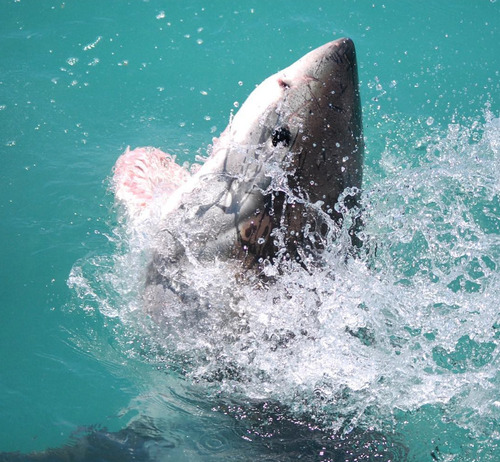
01Looks above the surfaceIt is one of few sharks seen spyhopping: lifting its head out of the water to look around.Observed behaviour
02A genome built for repairIts genome is about 1.5 times the size of ours, with extra genes linked to wound healing and keeping DNA stable.Marra et al. 2019
03Teeth on a conveyor beltRows of serrated teeth move forward to replace lost ones throughout its life.Compagno 2001
04Senses electricityGel-filled pores on the snout detect the tiny electric fields of a prey animal’s muscles.Kalmijn 1971
05A mid-ocean meeting placeCalifornian white sharks swim to a remote patch of the Pacific each year, nicknamed the White Shark Café.Weng et al. 2007
06Afraid of orcasWhen orcas pass through, even briefly, white sharks abandon the area for months. Few top predators flee like this.Jorgensen et al. 2019
FACT SHEET
How big and how old do great white sharks get?
Short answer: Adults reach 4 to 6 metres, and the oldest one aged so far was about 73.
MeasuredEstimatedQuoted, unverified
Length, adultsMeasured4 to 6 m02468 mFemales larger than males. Reliable records top out near 6 m
Oldest agedMeasured~73 yearsGreat white73 yrsEarlier estimate~23 yrsBomb-carbon dating of vertebrae. Hamady et al., PLoS ONE 2014
Female maturityEstimated~33 years010203040 yrsNatanson & Skomal 2015. Males mature at around 26
Longest tracked tripMeasured~20,000 kmNicole, 2003-0420,000 kmEarth’s width12,742Round trip South Africa-Australia in about 9 months. Bonfil et al., Science 2005
Deepest diveMeasured~1,200 m05001,0001,500 mSatellite tags; most time is spent near the surface
Bite forceEstimated~18,000 NLarge white (model)~18 kNHuman molars~1.3 kNComputer model of a 6.4 m shark; never measured on a live animal. Wroe et al. 2008
TeethEstimated~300Rows of replacements wait behind the working teeth.Rows of serrated, triangular teeth, constantly replaced
A drop of blood in a poolQuoted, unverifiedn/aSharks smell blood well, but the "one drop in an Olympic pool" line has no study behind it.Popular claim
Must swim or dieQuoted, unverifiedn/aWhite sharks do need to keep moving to breathe, but many other sharks can rest and pump water over their gills.Often applied to all sharks
SENSES
How does a great white find prey?
Short answer: In stages: smell and hearing from far away, then the lateral line and eyes up close, and electric sense in the final strike.
SmellKilometresOlfactory bulbs make up about 14 to 18% of brain mass, the largest share of any shark examined.
HearingHundreds of metresTuned to low-frequency sounds of struggling animals.
Lateral lineTens of metresPressure-sensing canals feel movement in the water.
SightUp closeGood in dim light; eyes roll back for protection at the bite.
Electric senseCentimetresJelly-filled pores (ampullae of Lorenzini) detect muscle signals.
TasteOn contactTest bites help decide whether to eat.
WARM BODY
Is a great white shark warm-blooded?
Short answer: Partly. Heat-exchanging blood vessels keep its swimming muscles, eyes and brain warmer than the surrounding water.
Body warmth vs water (schematic)Water10°CSkin11°CGut20°CRed swimming muscle24°CIllustrative values for cool water; reported differences reach about 10 to 14 °C.
Rete mirabileA "wonderful net" of vessels passes heat from outgoing to incoming blood.
Faster, longerWarm muscle contracts faster, powering bursts and long migrations.
Cold water reachLets it hunt seals in chilly seas most sharks avoid.
Shared with relativesMakos and salmon sharks have the same trick.
EVOLUTION
Is the great white related to megalodon?
Short answer: Only distantly. Both are mackerel sharks, but megalodon belonged to a separate extinct family. The white shark’s closest living relatives are the makos.
Where the great white sits among sharksRelationships only, not to time scale · † extinct
Megalodon’s placement follows most recent studies, which put it in the extinct family Otodontidae rather than with the white shark. Its ancestry is still debated.HUNTING
How does a great white hunt?
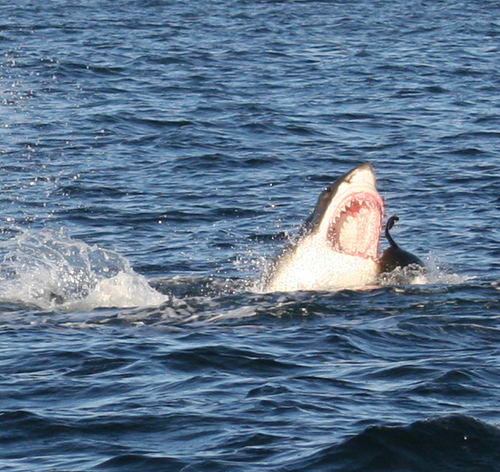
Short answer: Mostly by ambush from below. Off South Africa it launches up at seals so fast it can leave the water completely.
01Patrol deepCruises below, where its dark back blends with the depths.
02Spot a silhouetteA seal shows against the bright surface above.
03Vertical rushAccelerates straight up from below.
04BreachThe strike can carry it clear of the surface.
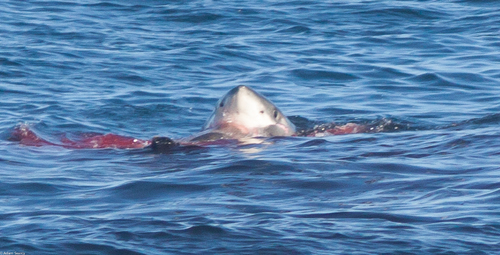
05Wait it outLets badly injured prey weaken before feeding.
Young eat fishJuveniles feed on fish and rays; their teeth are narrower.
Adults add mammalsSeals, sea lions and dolphins become important as sharks grow.
Whale feastsDead whales draw many sharks at once to feed side by side.
MIGRATION
How far do great whites travel?
Short answer: Across whole oceans. Tagged sharks cross the Indian and Pacific, and many gather each year at a mid-ocean spot nicknamed the White Shark Café.
Nicole’s round tripAbout 20,000 km from South Africa to Western Australia and back in roughly nine months.
The White Shark CaféA patch of open Pacific between Mexico and Hawaii where Californian sharks spend months, diving deep by day and staying shallower at night.
Deep divesOffshore, sharks dive to hundreds of metres, likely following squid and fish.
LIFE CYCLE
How do great white sharks reproduce?
Short answer: Slowly. Pups grow inside the mother, feeding on unfertilised eggs, and are born at well over a metre long after a pregnancy thought to last over a year.
1MatingRarely seen; males bite females to hold on.
2PregnancyThought to last 12 to 18 months (Estimated).
3Birth2 to 10 pups, each about 1.2 to 1.5 m long.
4NurseryPups grow up in warm coastal nurseries.
5MaturityFemales at around 33, males around 26.
6Old ageCan live past 70 years.
ORCAS
What eats a great white shark?
Short answer: Orcas. Since 2017, a pair nicknamed Port and Starboard has killed white sharks off South Africa, eating only the energy-rich liver.
›
Liver onlyThe liver is huge and oily, the most nutritious part.
Sharks leaveWhite sharks abandoned hotspots like False Bay after attacks.
A ripple effectOther species, such as bronze whalers, moved into the gap.
Fear of the scentSharks seem to avoid areas for months after a kill.
SHARKS AND PEOPLE
Are great white sharks dangerous to humans?
Short answer: Rarely, but they cause more recorded unprovoked bites than any other shark. Most bites on people are thought to be exploratory or mistaken identity.
Rare eventsWorldwide, fatal shark bites number in the single digits most years, across all species.
Reduce the riskAvoid murky water, dawn and dusk, seal colonies and swimming alone.
We kill far morePeople kill tens of millions of sharks each year through fishing.
THREATS AND CONSERVATION
Endangered register →Why are great white sharks vulnerable?
Short answer: They breed late and slowly, so bycatch, fishing for fins and jaws, and beach nets remove sharks faster than they are replaced.
BycatchHIGHCaught by accident on longlines and in gillnets.
Beach nets and drumlinesMEDIUMShark-control programmes in Australia and South Africa.
Fins, jaws and teethMEDIUMIllegal trade continues despite protection.
Prey and habitat changeWATCHShifts in seal and fish stocks move sharks.
Legal protectionProtected in South Africa, Australia, the US and the EU, among others.
CITES Appendix IIInternational trade in white shark parts needs permits.
Tagging and trackingPublic tracking maps show where sharks travel and help plan protected areas.
Shark spottersCape Town’s spotter programme warns beaches without killing sharks.
MYTH OR FACT
Three things people get wrong
MYTH“Great whites hunt humans.”People are not prey. Most bites are single exploratory strikes, and the shark often leaves.
MYTH“Great whites are descended from megalodon.”They are separate lineages. Megalodon belonged to an extinct family; the white shark’s ancestors were broad-toothed makos.
FACT“Great whites keep parts of their body warm.”Heat-exchanging blood vessels keep muscle, eyes and brain warmer than the water.
FAQ
Frequently asked questions
How big can a great white shark get?+
Reliable measurements top out near 6 metres. Claims of 7 to 8 m sharks have not been verified.
Can great whites live in captivity?+
Not for long. Every attempt has ended with the shark released or dead within months.
How fast can a great white swim?+
Tags on hunting sharks have recorded bursts of about 24 km/h (6.7 m/s) during seal attacks; cruising is much slower.
Why are they called white sharks?+
For their white underside. The back is grey, which hides them from above.
How many great white sharks are left?+
No reliable global count exists. Regional studies estimate from hundreds to about 1,500 adults per population, such as about 750 adults off eastern Australia and New Zealand.
Do great whites sleep?+
They don’t sleep like we do, but they have been filmed in a resting, trance-like state while swimming slowly into a current.
COMPARE AND EXPLORE
How does it compare with other giants?
Short answer: Smaller than the filter-feeding whale and basking sharks, but the largest shark that hunts big prey.
HOW WE KNOW
Sources and how we check
This page is written by Strange Animals and checked against primary research. Every figure carries a grade and a numbered source.
Cite this pageStrange Animals. (2026, November 13). Great white shark (Carcharodon carcharias): size, senses, migration and orcas. https://strangeanimals.info/marine-life/sharks/great-white-shark
- 01Bonfil, R. et al. Transoceanic migration, spatial dynamics, and population linkages of white sharks. Science 3102005
- 02Hamady, L. L. et al. Vertebral bomb radiocarbon suggests extreme longevity in white sharks. PLoS ONE 92014
- 03Natanson, L. J. and Skomal, G. B. Age and growth of the white shark in the western North Atlantic. Marine and Freshwater Research 662015
- 04Wroe, S. et al. Three-dimensional computer analysis of white shark jaw mechanics. Journal of Zoology 2762008
- 05Rigby, C. L. et al. (IUCN) Carcharodon carcharias. IUCN Red List. Vulnerable2019
- 06Jorgensen, S. J. et al. Killer whales redistribute white shark foraging pressure on seals. Scientific Reports 92019
- 07Towner, A. V. et al. Fear at the top: killer whale predation drives white shark absence at South Africa’s largest aggregation site. African Journal of Marine Science 442022
- 08Goldman, K. J. Regulation of body temperature in the white shark. J. Comp. Physiol. B 1671997
- 09Weng, K. C. et al. Migration and habitat of white sharks in the eastern Pacific. Marine Biology 1522007
- 10International Shark Attack File Species implicated in attacks. Florida Museumongoing
- 11CITES Appendix II listing of Carcharodon carcharias. CITES2004
- 12Ehret, D. J. et al. Origin of the white shark Carcharodon (Lamniformes: Lamnidae) based on recalibration of the Upper Neogene Pisco Formation of Peru. Palaeontology 552012
WATCH
Three films worth your time
ClipBBC · Planet Earth IIIThe incredible moment seals chase away a great white sharkA group of seals turns the tables and mobs a hunting shark.Pairs with: Hunting →
ClipBBC EarthGreat White Shark Attacks Robotic SealA spy camera disguised as a seal films the strike from the prey’s view.Pairs with: Senses →
PHOTOS
In pictures
SIGHTINGS
Where it has been recorded


WHERE TO SEE ONE
Where are great white sharks seen most?
Monterey Bay National Marine SanctuaryUnited States176 verified sightingsMost sightings: Jun to AugNeptune Islands Conservation ParkAustralia94 verified sightingsMost sightings: Dec to FebIsla Guadalupe Biosphere ReserveMexico82 verified sightingsMost sightings: Aug to OctSoutheast Farallon Island State Marine ReserveUnited States38 verified sightingsMost sightings: Sep to Nov
Protected areas with the most research-grade sightings on iNaturalist, out of 1,282 worldwide. Bars show sightings by month.
CONSERVATION TIMELINE
How it came to be protected
- 1991Protected in South AfricaSouth Africa gave the white shark legal protection in its waters.Source: Wikipedia
- 1994Protected in CaliforniaCalifornia began protecting white sharks in state waters, up to 3 miles offshore.Source: Wikipedia
- 1997US harvest prohibitedThe US federal government prohibited the harvesting of white sharks.Source: Wikipedia
- 1999Protected in AustraliaThe Australian Government gave the white shark legal protection, then declared it vulnerable in 2000.Source: Wikipedia
- 2001CITES Appendix IIIAustralia listed the white shark on CITES Appendix III, effective 29 October 2001.Source: CITES
- 2002Listed under CMSThe Convention on Migratory Species listed the white shark on its Appendices I and II.Source: Convention on Migratory Species
- 2005Moved to Appendix IIThe CITES Appendix II listing agreed in Bangkok in October 2004 entered into force on 12 January 2005.Source: CITES
- 2018Assessed as VulnerableThe IUCN assessed the white shark as Vulnerable worldwide.Source: Wikipedia
QUIZ
Test yourself
How old was the oldest great white shark that scientists have aged so far?
What do the gel-filled pores on a great white shark's snout detect?
Which part of a great white shark do the orcas hunting off South Africa eat?
SPECIES PROFILES
All 28 species profiles →More species profiles
BIRDS · HUMMINGBIRDSHummingbirdHovering, torpor, 366 speciesMAMMALS · MARSUPIALSKangarooHopping, pouch, mobsMAMMALS · SLOTHSSlothSlowness, fur, seven speciesMARINE LIFE · SEA TURTLESGreen sea turtleNavigation, grazing, recoveryMAMMALS · UNGULATESGiraffeNeck, blood pressure, speciesBIRDS · RAPTORSBald eagleNests, piracy, recoveryPETS · DOGSDomestic dogOrigins, nose, mind, breedsREPTILES · CROCODILIANSSaltwater crocodileBite, sea travel, recoveryPETS · CATSDomestic catDomestication, senses, purringEXTINCT · DINOSAURSTyrannosaurus rexBite, growth, extinctionREPTILES · MONITORSKomodo dragonVenom, iron teeth, islandsMARINE LIFE · WHALESBlue whaleSize, krill, song