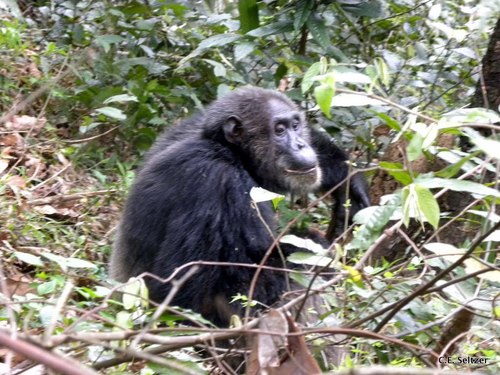
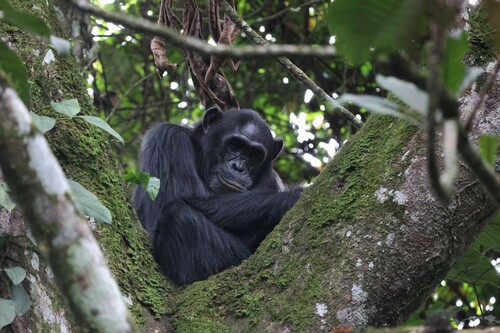
With the bonobo, our closest living relative. Chimpanzees make and use tools, pass on local traditions, hunt in teams and fight wars over territory. Every population studied has its own culture, and every one is shrinking.

FamilyHominidae (great apes)
Lives in21 African countries
IUCN statusEndangered
DietFruit, leaves, insects, meat
CHIMPANZEES AT A GLANCE

The chimpanzee (Pan troglodytes) is a great ape of the forests and savannas of equatorial Africa. With the bonobo it forms the genus Pan, our closest living relatives; the lineages split from ours about 7 to 8 million years ago. Chimps live in communities of about 20 to 150 that split and merge through the day. Males stay in their birth community and defend its territory; females usually move away at adolescence. Chimps make tools, show local cultures and hunt monkeys. All four subspecies are Endangered, and the western one is Critically Endangered.

Figures graded and sourced in the fact sheet below.
KEY DISCOVERIES
1960ToolsJane Goodall watches David Greybeard fish for termites with a stripped twig at Gombe.
1974-78The Gombe warOne community splits and the larger group kills the males of the smaller.
1999Cultures39 behaviours vary between sites like traditions (Whiten et al.).
2005GenomeChimp and human DNA differ by about 1.2% in single letters (Chimpanzee Sequencing Consortium).
2007SpearsFongoli chimps in Senegal sharpen sticks to hunt bushbabies (Pruetz & Bertolani).
2007Stone ageChimps in Côte d’Ivoire have cracked nuts with stones for at least 4,300 years.
ONLY IN THE CHIMPANZEE

What makes the chimpanzee unlike any other animal?

Short answer: No other animal combines toolkits, local cultures, team hunts and organised killing between groups.

01ToolkitsSome populations use a sequence of different tools for one task, like a stout stick to open a termite mound and a thin probe to fish.Sanz et al. 2009
02CulturesNearly 40 behaviours, from nut-cracking to leaf-clipping, differ between populations and are learned socially.Whiten et al. 1999
03WarGroups of males patrol borders and kill members of neighbouring communities to take territory.Mitani et al. 2010
04Self-medicationSick chimps swallow rough leaves whole or chew bitter pith that fights parasites.Huffman 1997
05Spear huntingAt Fongoli in Senegal, mostly females and young sharpen sticks to stab bushbabies in tree holes.Pruetz & Bertolani 2007
06ArchaeologyStone hammers used by chimps have left a dig site record going back over 4,000 years.Mercader et al. 2007
FACT SHEET

How strong is a chimpanzee?

Short answer: About 1.5 times as strong as a human for its size, not the often-quoted five to eight times.

MeasuredEstimatedQuoted, unverified
Height standingMeasured~1 to 1.7 mMales~1.2 to 1.7 mFemales~1 to 1.3 mUsually walk on knuckles; upright only briefly
Weight, wildMeasured~25 to 70 kgMales~40 to 70 kgFemales~25 to 50 kgCaptive chimps can be heavier
DNA shared with usMeasured~98.8%Single letters~98.8%Incl. gaps~96%Depends on how difference is counted. Chimpanzee Sequencing Consortium 2005
Pull strengthMeasured~1.5× a humanChimp~1.5×Human1×Pulling and jumping tests; muscle itself measured 1.35×. "5× stronger" is wrong. O’Neill et al. 2017
Lifespan, wildEstimated~33 to 50 yearsWild femalesup to ~50+Captiveup to ~60+Wild life expectancy at birth is much lower
BrainMeasured~380 gChimp~380 gHuman~1,350 gAbout a third of ours
Birth intervalMeasured~5 to 6 yearsChimp~5 to 6 yrsGorilla~4 yrsYoung nurse for about 4 to 5 years
Wild populationEstimated~170,000 to 300,000Today≤ 300,000~1900~1 million?IUCN 2016; historical figure a rough estimate
Chimps are monkeysQuoted, unverifiedn/aChimps are apes: no tail, larger brains, and closer to humans than to any monkey.Common mix-up
TOOLS AND CULTURE

What tools do chimpanzees use?

Short answer: Dozens: sticks for termites, stones for nuts, leaves as sponges and even spears. Which tools a group uses depends on its local tradition, not only on what is available.

Gombe, GoualougoTermite fishingTwig or grass stem, stripped and frayed at the tip
Taï, BossouNut crackingStone or wood hammer on a root or stone anvil
Many sitesLeaf spongeChewed leaves to soak up water from tree holes
Bossou, GombeAnt dippingLong wand to collect biting army ants
FongoliSpearSharpened branch to stab bushbabies
Mahale, BossouLeaf clippingRipping leaves noisily, a courtship signal
Why it counts as cultureChimps at Taï crack nuts with stones; chimps at Gombe have the same nuts and stones and never do. Young learn by watching their mothers for years, and techniques spread between groups when females move.
SOCIETY

How do chimpanzees live together?

Short answer: In "fission-fusion" communities: everyone belongs to one group, but they travel and feed in smaller, shifting parties. Males rank in a hierarchy led by an alpha.

A typical communityAlpha maleHolds rank with allies, not only strengthOther adult malesBorn here, stay for life, patrol bordersAdult femalesMostly immigrants from other communitiesYoungNurse 4 to 5 years, stay close for ~10
GroomingThe main way to build and repair friendships; can take hours a day.
CoalitionsAlpha males rise and fall through alliances, like David in BBC’s Dynasties.
ReconciliationAfter fights, rivals often kiss and embrace.
Pant-hootsLoud calls identify individuals and keep scattered parties in touch.
HUNTING AND WAR

Do chimpanzees eat meat and kill each other?

Short answer: Yes. Chimps hunt monkeys, especially red colobus, and adult males sometimes kill chimps from neighbouring communities.

Team huntsAt Taï, hunters take roles: driver, blocker, chaser and ambusher.
Meat is a small shareMeat is under about 5% of the diet; fruit dominates.
Lethal raidsAt Ngogo, Uganda, males killed 18 neighbours over a decade and took their land (Mitani et al. 2010).
A study of 18 communities found 152 killings in 15 of them, mostly by males, and are linked to competition, not human disturbance (Wilson et al. 2014).
MIND

How smart is a chimpanzee?

Short answer: Very, in specific ways: young chimps can beat adult humans at a quick number-memory task, and chimps plan, deceive and understand what others can see.

Ayumu’s memoryA young chimp recalled numbers flashed for a fraction of a second better than adult humans (Inoue & Matsuzawa 2007).
Seeing othersChimps know what a rival can and can’t see, and steal food out of view.
GesturesWild chimps use about 66 gestures with set meanings (Hobaiter & Byrne 2014).
Mirror testChimps recognise themselves in a mirror (Gallup 1970).
CHIMP VS BONOBO

What is the difference between a chimpanzee and a bonobo?

Short answer: Both are equally close to us. Bonobos, found only south of the Congo River, are more slender, female-led and less violent.

Read: bonobo →
ChimpanzeeRangeNorth of the Congo River, 21 countriesLeadersMales, with an alphaConflictLethal raids between groupsHuntingRegular, monkeysStatusEndangered
BonoboRangeSouth of the Congo River, DR Congo onlyLeadersFemales, in alliancesConflictNo lethal raids recordedHuntingLess oftenStatusEndangered
Bonobo outline: PhyloPic, CC0. The two species split about 1 to 2 million years ago.
EVOLUTION

Did humans evolve from chimpanzees?

Short answer: No. Humans and chimps share a common ancestor that lived about 7 to 8 million years ago. Both lineages have kept evolving since.

Read: how similar are chimpanzees to humans? →
MonkeysOld and New World monkeysGibbonsLesser apesOrangutansSplit ~14 million years agoGorillasSplit ~8 to 10 million years agoHumansSplit ~7 to 8 million years agoChimpanzee and bonoboGenus PanGreat apesHominini
Relationships only, not to time scale. Split dates after Langergraber et al. 2012. Gibbon outline: PhyloPic, CC0.
THREATS AND CONSERVATION

Why are chimpanzees endangered?

Short answer: Forest loss, hunting for bushmeat and disease. Western chimps fell by about 80% between 1990 and 2014.

Endangered register →
Four subspecies
Western P. t. verus~53,000CRITICALLY ENDANGERED
Nigeria-Cameroon P. t. ellioti~6,000 to 9,000ENDANGERED
Central P. t. troglodytes~140,000ENDANGERED
Eastern P. t. schweinfurthii~180,000 to 250,000ENDANGERED
Population figures: IUCN SSC action plans; rough estimates. Western decline: Kühl et al. 2017.
Bushmeat and pet tradeHIGHHunting kills adults; infants are taken and sold.
Forest lossHIGHLogging, mining, farming and oil palm.
DiseaseHIGHEbola and human respiratory viruses have killed thousands.
Protected areas and patrolsRangers in parks like Taï and Gombe reduce poaching.
SanctuariesPASA sanctuaries care for orphans from the pet and bushmeat trade.
Research banThe US stopped invasive chimp research in 2015 and listed captive chimps as endangered.
MYTH OR FACT

Six chimpanzee claims, checked

3Myths1Half true2Facts
01MYTH“Humans evolved from chimpanzees.”WHERE IT CAME FROMA popular shorthand for evolution.
WHAT THE EVIDENCE SAYSHumans and chimps share an ancestor that lived about 7 to 8 million years ago; neither came from the other.
WHAT IS TRUE INSTEADCousins, not ancestors.Sources: 11
02MYTH“Chimps are 5 to 8 times stronger than people.”WHERE IT CAME FROMA 1920s test and later retellings.
WHAT THE EVIDENCE SAYSMuscle tests show chimps are about 1.35 to 1.5 times as strong for their size.
WHAT IS TRUE INSTEADStronger, but not by much.Sources: 05
03HALF TRUE“We share 99% of our DNA with chimps.”WHERE IT CAME FROMGenome comparisons.
WHAT THE EVIDENCE SAYSAbout 98.8% in single-letter differences, but closer to 96% when insertions and deletions are counted.
WHAT IS TRUE INSTEADIt depends how you count.Sources: 04
04MYTH“Chimpanzees are monkeys.”WHERE IT CAME FROMThey are often grouped together.
WHAT THE EVIDENCE SAYSChimps are great apes. They have no tail and are more closely related to us than to any monkey.
WHAT IS TRUE INSTEADApes, not monkeys.Sources: see list below
05FACT“Chimps go to war.”WHERE IT CAME FROMLong-term field studies.
WHAT THE EVIDENCE SAYSMales from one community kill members of another and take territory; documented at Gombe, Ngogo and elsewhere.
WHAT IS TRUE INSTEADLethal intergroup conflict is real.Sources: 06
06FACT“Chimps have culture.”WHERE IT CAME FROMComparisons across field sites.
WHAT THE EVIDENCE SAYSMany behaviours differ between populations and are learned from others, not explained by genes or habitat.
WHAT IS TRUE INSTEADYes, by most scientists’ definition.Sources: 01
OPEN QUESTIONS

What science still doesn’t know

?Why are chimps violent and bonobos not?Food, female alliances and ecology all play a part; the balance is debated.
?How do cultures start?Who invents a new technique and why it spreads is rarely observed.
?Do gestures form a language?Gestures have meanings, but there is no clear grammar.
?How many are left?Counts are rough; central and eastern totals vary widely.
?Can they cope with roads and mines?Long-term effects of development are poorly known.
?What did our shared ancestor look like?Fossils from 6 to 7 million years ago are few and disputed.
FAQ

Frequently asked questions

How much DNA do humans share with chimpanzees?+

About 98.8% when comparing single letters; about 96% when counting insertions and deletions too.

Did humans evolve from chimps?+

No. Humans and chimpanzees share a common ancestor from about 7 to 8 million years ago.

How strong is a chimpanzee?+

About 1.35 to 1.5 times stronger than a human of the same size, not 5 to 8 times.

Where do chimpanzees live?+

In forests and wooded savannas across 21 countries of equatorial Africa.

Do chimpanzees eat meat?+

Yes, mainly monkeys, but meat is only a small part of a mostly fruit diet.

Are chimpanzees endangered?+

Yes. The species is Endangered and the western subspecies is Critically Endangered.

COMPARE AND EXPLORE

Explore chimpanzees further

HOW WE KNOW

Sources and how we check

This page is written by Strange Animals and checked against primary research. Every figure carries a grade and a numbered source.

Cite this pageStrange Animals. (2026, November 14). Chimpanzee (Pan troglodytes): tools, culture, society and conservation. https://strangeanimals.info/mammals/primates/chimpanzee
  1. 01Whiten, A. et al. Cultures in chimpanzees. Nature 399: 682-6851999
  2. 02Goodall, J. The Chimpanzees of Gombe: Patterns of Behavior. Harvard University Press1986
  3. 03Humle, T. et al. (IUCN) Pan troglodytes. IUCN Red List. Endangered2016
  4. 04Chimpanzee Sequencing and Analysis Consortium Initial sequence of the chimpanzee genome and comparison with the human genome. Nature 437: 69-872005
  5. 05O’Neill, M. C. et al. Chimpanzee super strength and human skeletal muscle evolution. PNAS 114: 7343-73482017
  6. 06Mitani, J. C., Watts, D. P. and Amsler, S. J. Lethal intergroup aggression leads to territorial expansion in wild chimpanzees. Current Biology 20: R5072010
  7. 07Wilson, M. L. et al. Lethal aggression in Pan is better explained by adaptive strategies than human impacts. Nature 513: 414-4172014
  8. 08Pruetz, J. D. and Bertolani, P. Savanna chimpanzees hunt with tools. Current Biology 17: 412-4172007
  9. 09Mercader, J. et al. 4,300-year-old chimpanzee sites and the origins of percussive stone technology. PNAS 104: 3043-30482007
  10. 10Inoue, S. and Matsuzawa, T. Working memory of numerals in chimpanzees. Current Biology 17: R10042007
  11. 11Langergraber, K. E. et al. Generation times in wild chimpanzees and gorillas suggest earlier divergence times in great ape and human evolution. PNAS 109: 157162012
  12. 12Kühl, H. S. et al. The Critically Endangered western chimpanzee declines by 80%. American Journal of Primatology 792017
  13. 13Hobaiter, C. and Byrne, R. W. The meanings of chimpanzee gestures. Current Biology 24: 1596-16002014
  14. 14Sanz, C., Call, J. and Morgan, D. Design complexity in termite-fishing tools of chimpanzees. Biology Letters 52009
WATCH

Three films worth your time

ClipBBC Earth · DynastiesMeet David: The Alpha Chimp Defending His CrownAn alpha male holds power through allies as younger rivals rise.Pairs with: Society →
ClipBBC Earth · Trials of LifeChimps Set Up an Ambush for MonkeysDavid Attenborough follows a team hunt for colobus monkeys.Pairs with: Hunting and war →
PHOTOS

In pictures

Chimpanzee
Photo: Wairambar Rainforest, CC BY 4.0, via iNaturalist
Chimpanzee
Photo: Carrie Seltzer, CC BY 4.0, via iNaturalist
Chimpanzee
Photo: Tommy Andriollo, CC BY 4.0, via iNaturalist
Chimpanzee
Photo: Scott Loarie, CC0, via iNaturalist
LISTEN

Hear it

Pant-hoot call of an adult male chimpanzee
Recording by Pawel Fedurek et al., CC BY 4.0, via Wikimedia Commons.
SIGHTINGS

Where it has been recorded

Map of recorded Pan troglodytes occurrences, western hemisphereMap of recorded Pan troglodytes occurrences, eastern hemisphere
Each dot marks a georeferenced sighting or specimen record of Pan troglodytes, from 4,471 records shared through GBIF.org.
WHERE TO SEE ONE

Where are chimpanzees seen most?

Protected areas with the most research-grade sightings on iNaturalist, out of 1,422 worldwide. Bars show sightings by month.

CONSERVATION TIMELINE

How it came to be protected

  1. 1976Listed as threatenedThe US Fish and Wildlife Service listed the chimpanzee as threatened under the Endangered Species Act.Source: US Fish and Wildlife Service
  2. 1990Wild chimpanzees uplistedThe US Fish and Wildlife Service reclassified wild chimpanzees as endangered, leaving captive ones listed as threatened.Source: US Fish and Wildlife Service
  3. 2000Great Ape Conservation ActThe US Congress passed the Great Ape Conservation Act.Source: US Fish and Wildlife Service
  4. 2015All chimpanzees listed endangeredA US Fish and Wildlife Service rule listed all chimpanzees, wild and captive, as endangered from 14 September 2015.Source: US Fish and Wildlife Service
  5. 2016Western subspecies Critically EndangeredThe IUCN moved the western chimpanzee from Endangered to Critically Endangered.Source: IUCN
QUIZ

Test yourself

About how much does a chimpanzee's brain weigh?

What do the chimpanzees of Fongoli in Senegal hunt with sharpened sticks?

For at least how long have chimpanzees in Côte d'Ivoire cracked nuts with stones?
SPECIES PROFILES

More species profiles

All 28 species profiles →

All chimpanzee articles

4 articles