 Strange Animals
ClipNat Geo AnimalsThe Mantis Shrimp Packs a Powerful PunchSlow-motion footage of the peacock mantis shrimp breaking shells.Pairs with: The strike →
CrustaceansGroup profile · about 500 species
Mantis shrimp
Order Stomatopoda · flagship: peacock mantis shrimp, Odontodactylus scyllarusNeither shrimp nor mantis. Stomatopods are an ancient branch of crustaceans with two record-breaking systems: a spring-loaded club that strikes faster than any other limb, and eyes unlike anything else on Earth.
ClassMalacostraca
Lives inTropical seas
IUCN statusMostly not assessed
DietCrabs, snails, fish
MANTIS SHRIMP AT A GLANCE
Mantis shrimp are marine crustaceans of the order Stomatopoda, with about 500 known species, mostly in warm, shallow seas. "Smasher" species break shells with a spring-loaded club that reaches 23 metres per second, the fastest limb strike measured in any animal. Their compound eyes carry up to 16 types of photoreceptor, including 12 for colour, and can detect polarised light.
Figures graded and sourced in the fact sheet below.KEY DISCOVERIESPeer-reviewed
2004Strike clockedHigh-speed video times the peacock mantis shrimp’s club at 23 m/s (Patek et al., Nature).
2005Two hits, not oneThe club’s impact and a collapsing cavitation bubble deliver separate force peaks (Patek & Caldwell).
2008Circular polarisationFirst animal shown to see circularly polarised light (Chiou et al., Current Biology).
2012The club decodedLayered mineral and chitin structure explains how the club survives thousands of blows (Weaver et al., Science).
2014The colour paradoxDespite 12 colour channels, they are poor at telling similar colours apart (Thoen et al., Science).
ONLY IN THE MANTIS SHRIMP
What makes the mantis shrimp unlike any other animal?
01Up to 16 photoreceptor typesTwelve are for colour, where humans have 3. Yet tests show they are worse than us at telling similar colours apart; they may recognise colours directly instead.Thoen et al. 2014
02Sees circular polarised lightThe first animal shown to detect circularly polarised light, which it may use to signal.Chiou et al. 2008
03Depth vision in one eyeEach eye is split into three regions, so a single eye can judge distance.Marshall et al. 2007
04A strike that hits twiceThe club moves so fast it creates vapour bubbles, and their collapse hits the prey with a second blow.Patek & Caldwell 2005
05A club that resists crackingFibres in the club are stacked in a twisting spiral that stops cracks spreading, now copied in materials science.Weaver et al. 2012
06Long-term pairsSome species, like Lysiosquillina maculata, are reported to live in the same burrow as a pair for many years.Reported, not measured
FACT SHEET
How fast and powerful is a mantis shrimp?
Short answer: A smasher’s club reaches 23 m/s and hits with up to about 1,500 newtons, the fastest limb strike measured in any animal.
MeasuredEstimatedQuoted, unverified
Club speedMeasured23 m/sMantis club23 m/sPro boxer punch~9 m/sPeacock mantis shrimp, high-speed video. Patek et al., Nature 2004
Peak accelerationMeasured~10,400 gRoughly a thousand times what a fighter pilot can survive, reached in water, which is far denser than air.Patek et al., Nature 2004
Peak impact forceMeasuredup to ~1,500 NMantis shrimp1,500 NIts own weight< 1 NThousands of times its body weight. Patek & Caldwell, J. Exp. Biol. 2005
Strike durationMeasured~2.7 msBar = one human blink (~100 ms); the strike fills one cell.About 35 to 40 times faster than a blink
Photoreceptor typesMeasuredup to 16Mantis shrimp16Humans312 for colour, including UV, plus 4 for polarisation. Marshall & Oberwinkler; Thoen et al. 2014
Body lengthMeasured~3 to 38 cm010203040 cmMost species under 20 cm; the zebra mantis shrimp is among the largest
Known speciesEstimated~500Each dot ≈ 10 species. More are described every year.World Register of Marine Species
Fastest movement in natureQuoted, unverifiedn/aFastest limb strike, yes. But trap-jaw ant mandibles close faster, so "fastest movement" overstates it.Update to Ed Yong’s National Geographic post, 2008
As hot as the Sun’s surfaceQuoted, unverified~4,700 °CMeasured for pistol shrimp bubbles, not mantis shrimp. Applied to mantis shrimp by extrapolation.Lohse et al., Nature 2001 (pistol shrimp)
SMASHERS AND SPEARERS
Are all mantis shrimp punchers?
Short answer: No. Smashers club hard-shelled prey; spearers stab soft, fast prey with barbed tips. Both use the same spring-loaded arm.
SMASHERSClub-shaped dactyl
EatsSnails, crabs, clams and oystersHomeLive in rock or coral holesExamplePeacock mantis shrimp
- Hard, mineralised club
- Strikes are short and explosive
- Fights are ritualised: rivals strike each other’s armoured tail plate
SPEARERSBarbed, spiny dactyl
EatsFish and shrimpHomeDig burrows in sand or mud and ambushExampleZebra mantis shrimp
- Long, spined tip
- Slower strike, longer reach
- Many sit in a burrow with only the eyes showing
THE STRIKE
How does a mantis shrimp punch so fast?
Short answer: With a latch and a spring. Muscles slowly load a saddle-shaped spring, then a latch releases it all at once.
01LockA latch holds the arm while muscles contract slowly.
02LoadA saddle-shaped spring in the arm bends and stores energy, like a drawn bow.
03ReleaseThe latch lets go. The spring snaps back faster than muscle could move.
04ImpactThe club hits at 23 m/s with up to about 1,500 N.
05Second hitLow pressure behind the club boils water into a bubble. Its collapse delivers a second shockwave.
Force over one strike (schematic)
Prey gets hit twice in under a millisecond. The bubble peak can be close to the impact peak (Patek & Caldwell 2005).THE CLUB
Why doesn’t the club break?
Short answer: Because it is built in layers: a hard mineral face over a spiral of chitin fibres that steers cracks around and stops them.
Cross-section of a smasher’s clubSchematic, not to scale. Weaver et al., Science 2012.
Impact regionCrystalline hydroxyapatite, the mineral in our bones, packed hard at the surface
Periodic regionChitin fibres laid in a twisting spiral (Bouligand structure) that stops cracks from spreading
Striated regionFibres wrapped around the club like tape on a boxer’s fist, keeping it from bulging
Thousands of strikesA club survives countless blows between moults, then is replaced when the animal sheds its shell.
Cracks turn, not runThe spiral fibre layout forces cracks to twist and branch, soaking up energy instead of splitting the club.
Armour at the other endThe tail plate (telson) is built to absorb strikes, which is where rivals aim during ritual fights.
EYES
What can mantis shrimp see?
Short answer: Ultraviolet, polarised and circularly polarised light, with 12 colour channels. Yet they are worse than us at telling similar colours apart.
Colour receptor types compared
Human
Dog
Butterfly (typical)UV
Mantis shrimpUVPolarised
Swatches show the number of colour receptor types, not exact sensitivities.Trinocular in each eyeEach eye is split by a central band, so it judges depth on its own. The two eyes swivel independently.
Circular polarisationSome species reflect circularly polarised light from their bodies, possibly as a covert signal to other mantis shrimp.
The colour paradoxIn tests they struggled to tell apart colours less than about 25 nm apart, where humans manage 1 to 4 nm. They may recognise colours directly instead of comparing them (Thoen et al. 2014).
Cancer-camera spin-offCameras modelled on their polarisation vision are being developed to spot early cancer in tissue.
EVOLUTION
Are mantis shrimp actually shrimp?
Short answer: No. They split from the line leading to crabs, lobsters and true shrimp about 400 million years ago.
The crustacean family treeMantis shrimp lineExtinct †Mya = million years ago
Branch dates are approximate, from fossils and molecular studies. True shrimp sit with crabs and lobsters, on the opposite side of the tree from mantis shrimp.MalacostracaCrabs, lobsters, shrimp, krill, woodlice and mantis shrimp
HoplocaridaAn ancient subclass; mantis shrimp are its only living members
StomatopodaThe order: about 500 living species
SuperfamiliesSeven superfamilies, including Gonodactyloidea (most smashers) and Lysiosquilloidea (large spearers)
Devonian, ~400 MyaEarly hoplocarids appear, already separate from the line to modern decapods.
CarboniferousEarly stomatopod relatives without the full raptorial claw.
Early TriassicThe oldest fossils of the modern order appear (Smith et al. 2023).
TodayAbout 500 species, from the intertidal to around 1,500 m deep.
Dates are approximate and based on the fossil record.LIFE AND BEHAVIOUR
How do mantis shrimp live?
Short answer: Mostly alone in burrows they defend fiercely. Some species pair for life, and many recognise neighbours they have fought before.
Burrow ownersHoles in rock, coral rubble or sand are prized and defended. A good burrow is the difference between eating and being eaten.
Lifelong pairsSome large burrowing species live as monogamous pairs sharing one burrow, reported to stay together for many years.
Memory of rivalsThey learn the smell of individual neighbours and remember who beat them in a fight.
Fluorescent signalsSome deep-living species use fluorescent patches to keep their warning displays visible in blue water.
Egg guardiansFemales carry or guard egg masses in the burrow, cleaning and turning them until they hatch.
Drifting larvaeHatchlings spend weeks as transparent plankton before settling and finding their first burrow.
RANGE AND HABITAT
Open in Animal Map →Where do mantis shrimp live?
Short answer: In tropical and subtropical seas worldwide, richest on Indo-Pacific reefs, with some species in temperate waters.
Indo-Pacific reefsHighest diversity, including the peacock mantis shrimpCoral rubble, reef flats
Western Atlantic and CaribbeanMany smashers and spearersSeagrass, sand, rubble
Eastern PacificFrom California to ChileRocky reefs and mudflats
Mediterranean and temperate seasFewer species; some, like Squilla mantis, are fished for foodMuddy and sandy bottoms
Bars show relative species richness (Estimated), not counts.
MYTH OR FACT
Three things people get wrong
MOSTLY MYTH“Mantis shrimp see colours we can’t imagine.”They detect UV and polarised light we cannot, but in colour-matching tests they were worse than humans at separating similar hues.
FACT“A mantis shrimp can break aquarium glass.”Documented in public aquariums. In 1998 a mantis shrimp nicknamed Tyson cracked a glass tank in Britain.
MYTH“They are a kind of shrimp.”They are stomatopods, a separate order that split from true shrimp, crabs and lobsters hundreds of millions of years ago.
INSPIRED TECHNOLOGY
What have engineers learned from mantis shrimp?
Short answer: How to build impact-resistant materials and cameras that see polarised light.
Materials scienceTougher compositesThe club’s spiral fibre layout has inspired carbon-fibre composites for helmets, body armour and aircraft panels.
Medical imagingPolarisation camerasSensors modelled on stomatopod eyes can show differences in tissue that may reveal early cancer.
RoboticsLatch-and-spring robotsThe strike’s latch mechanism informs tiny robots that jump or snap using stored elastic energy.
FAQ
Frequently asked questions
Can a mantis shrimp hurt a person?+
Yes. Large species can split a finger or cut skin badly. Divers and fishers call some of them "thumb splitters".
Can you keep a mantis shrimp as a pet?+
Some hobbyists do, in a dedicated tank. Smashers can crack glass and will eat most tank mates.
How long do mantis shrimp live?+
Many live several years; some large species are reported to live much longer in burrows.
Do mantis shrimp have the best eyes?+
The most complex, not the sharpest. They see more kinds of light but resolve detail and similar colours less well than we do.
Are mantis shrimp endangered?+
Most species have never been assessed by the IUCN. Reef loss and fishing are the main concerns.
Are mantis shrimp edible?+
Yes. Squilla mantis and related species are eaten across the Mediterranean and East Asia.
COMPARE AND EXPLORE
How does it compare with a pistol shrimp?
Short answer: Both weaponise cavitation. The mantis shrimp hits with a hammer; the pistol shrimp fires a bubble from its claw.
HOW WE KNOW
Sources and how we check
This page is written by Strange Animals and checked against primary research, not other websites. Every figure carries a grade and a numbered source.
Published byStrange Animals
Last updated12 Nov 2026
Sources12
Cite this pageStrange Animals. (2026, November 12). Mantis shrimp (Stomatopoda): strike, eyes, club and behaviour. https://strangeanimals.info/marine-life/crustaceans/mantis-shrimp
- 01Patek, S. N., Korff, W. L. and Caldwell, R. L. Deadly strike mechanism of a mantis shrimp. Nature 4282004
- 02Patek, S. N. and Caldwell, R. L. Extreme impact and cavitation forces of a biological hammer: strike forces of the peacock mantis shrimp. J. Exp. Biol. 2082005
- 03Weaver, J. C. et al. The stomatopod dactyl club: a formidable damage-tolerant biological hammer. Science 3362012
- 04Thoen, H. H. et al. A different form of color vision in mantis shrimp. Science 3432014
- 05Chiou, T.-H. et al. Circular polarization vision in a stomatopod crustacean. Current Biology 182008
- 06Lohse, D. et al. Snapping shrimp make flashing bubbles. Nature 4132001
- 07Mazel, C. H. et al. Fluorescent enhancement of signaling in a mantis shrimp. Science 3032004
- 08Patek, S. N. et al. Linkage mechanics and power amplification of the mantis shrimp’s strike. J. Exp. Biol. 2102007
- 09WoRMS Stomatopoda: World Register of Marine Species. WoRMSongoing
- 10Yong, E. The mantis shrimp has the world’s fastest punch, 19 July 2008. Not Exactly Rocket Science, National Geographic2008
- 11KQED Deep Look The Snail-Smashing, Fish-Spearing, Eye-Popping Mantis Shrimp. PBS2016
- 12Caldwell, R. L. Stomatopod behaviour and ecology, Caldwell Lab. UC Berkeleyongoing
WATCH
Three films worth your time
ClipThe Travel EditWorld’s Fastest Punch: Slow Motion Mantis ShrimpA slow-motion team tries to film the strike frame by frame.Pairs with: Fact sheet →
Short filmDeep LookThe Snail-Smashing, Fish-Spearing, Eye-Popping Mantis ShrimpThe fastest strike in the animal kingdom, and eyes that see polarised light.Pairs with: Eyes →
PHOTOS
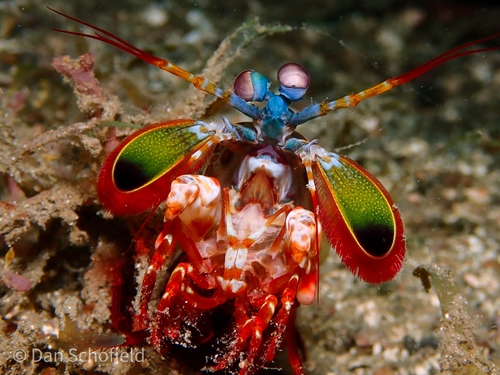
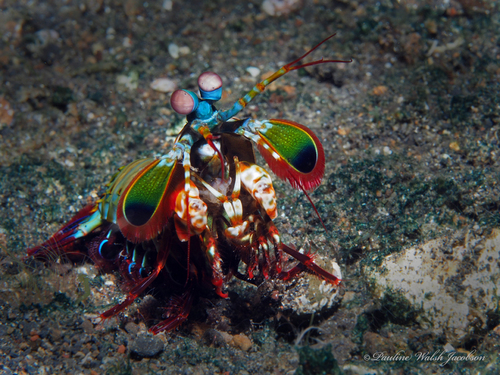
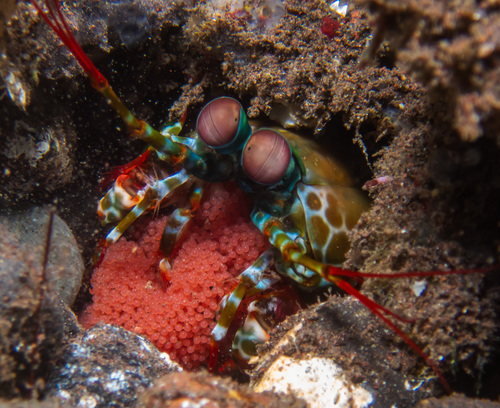
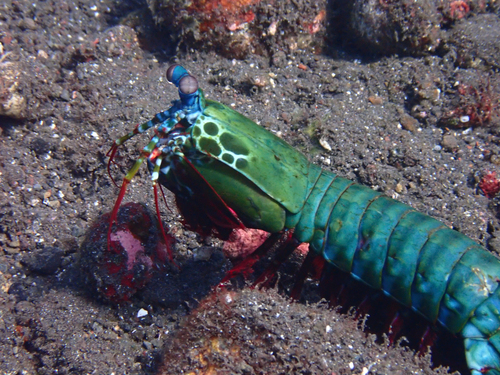
In pictures: the peacock mantis shrimp
SIGHTINGS
Where it has been recorded


WHERE TO SEE ONE
Where are mantis shrimps seen most?
Komodo National ParkIndonesia74 verified sightingsFlorida Keys National Marine SanctuaryUnited States62 verified sightingsMost sightings: May to JulNusa Penida Marine Conservation AreaIndonesia54 verified sightingsNingaloo Marine ParkAustralia22 verified sightings
Protected areas with the most research-grade sightings on iNaturalist, out of 6,123 worldwide. Bars show sightings by month.
QUIZ
Test yourself
How fast does a smasher mantis shrimp's club travel when it strikes?
Up to how many types of photoreceptor do a mantis shrimp's eyes carry?
What delivers the second blow in a mantis shrimp's strike?
SPECIES PROFILES
All 28 species profiles →More species profiles
BIRDS · HUMMINGBIRDSHummingbirdHovering, torpor, 366 speciesMAMMALS · MARSUPIALSKangarooHopping, pouch, mobsMAMMALS · SLOTHSSlothSlowness, fur, seven speciesMARINE LIFE · SEA TURTLESGreen sea turtleNavigation, grazing, recoveryMAMMALS · UNGULATESGiraffeNeck, blood pressure, speciesBIRDS · RAPTORSBald eagleNests, piracy, recoveryPETS · DOGSDomestic dogOrigins, nose, mind, breedsREPTILES · CROCODILIANSSaltwater crocodileBite, sea travel, recoveryPETS · CATSDomestic catDomestication, senses, purringEXTINCT · DINOSAURSTyrannosaurus rexBite, growth, extinctionREPTILES · MONITORSKomodo dragonVenom, iron teeth, islandsMARINE LIFE · WHALESBlue whaleSize, krill, song