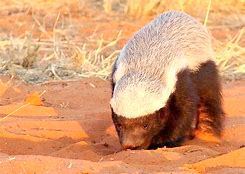
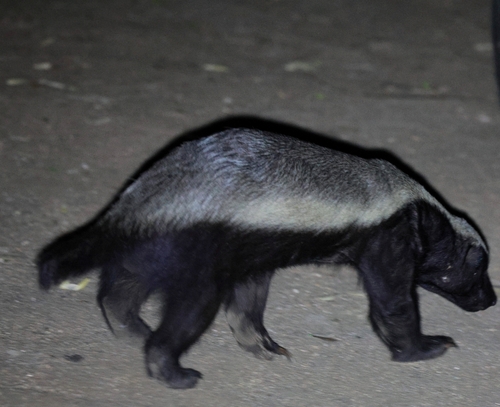
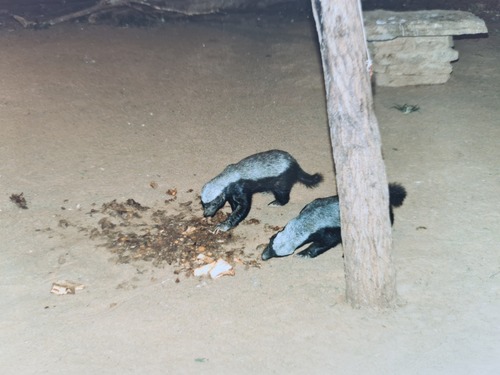
A stocky weasel relative that digs out scorpions, eats venomous snakes, raids bee nests and walks the Kalahari alone across territories bigger than some cities. Its reputation is earned. Much of the folklore around it is not.

FamilyMustelidae
Lives inAfrica to India
IUCN statusLeast Concern
DietAlmost anything
HONEY BADGER AT A GLANCE

The honey badger (Mellivora capensis) is a stocky member of the weasel family that lives across sub-Saharan Africa, the Middle East and the Indian subcontinent. It is the only living species in its genus. It digs out most of its food, from rodents and scorpions to venomous snakes, whose neurotoxins it partly resists thanks to changes in its muscle receptors. Its fearless reputation is real; the honeyguide partnership is not proven.

Figures graded and sourced in the fact sheet below.
KEY DISCOVERIES
1776NamedSchreber describes it as Viverra capensis. Storr adds the genus Mellivora, "honey eater", in 1780.
1785A myth beginsSparrman repeats local stories of honeyguide birds leading badgers to hives.
1990Myth testedDean, Siegfried and Macdonald find no confirmed sighting of a honeyguide guiding a badger.
2003-05Radio-trackedThe Beggs publish their 1996 to 1999 Kalahari tracking: diet, huge ranges, single cubs.
2014Escape artistThe BBC films Stoffel climbing out of enclosures using a rake, logs and stacked rocks.
2015Venom explainedDrabeck et al. find receptor mutations that stop cobra neurotoxins binding.
ONLY IN THE HONEY BADGER

What makes the honey badger unlike any other animal?

01Alone on its branchThe only living species in its genus and subfamily, Mellivorinae.Koepfli et al. 2008
02A pouch it turns inside outIt can turn its anal pouch inside out to release a strong-smelling secretion when threatened.Vanderhaar & Hwang 2003
03One cub, a long childhoodFemales usually raise a single cub for 12 to 16 months, very long for a carnivore its size.Begg et al. 2005
04Huge ranges for its sizeKalahari females range far wider than their body size predicts, likely because prey is scarce.Begg et al. 2005
05A rattling roarWhen defending itself it can give a loud rattling call and rush at the attacker.Kingdon 1977
06Venom resistance, evolved againIt changed the same muscle receptor as hedgehogs and pigs to resist cobra venom.Drabeck et al. 2015
FACT SHEET

How big is a honey badger, and how far does it roam?

Short answer: About the size of a small dog, 5 to 16 kg. Kalahari males cover home ranges of around 540 km².

MeasuredEstimatedQuoted, unverified
WeightMeasured5 to 16 kgMales9 to 16 kgFemales5 to 10 kgMales are much heavier than females. Vanderhaar & Hwang 2003
Head and bodyMeasured55 to 77 cm0255075100 cmPlus a 12 to 30 cm tail. Vanderhaar & Hwang 2003
Home range, KalahariMeasured~541 km²Adult males~541 km²Adult females~126 km²Radio-tracking of 25 badgers, southern Kalahari. Begg et al. 2005; ±93 and ±13 km²
Venom resistanceMeasuredReceptor mutationsChanges in the nicotinic acetylcholine receptor stop many cobra-type neurotoxins binding. Hedgehogs and pigs evolved near-identical changes; mongooses reached the same result a different way.Drabeck et al., Toxicon 2015
Cubs per litterMeasuredUsually 1The cub stays with its mother for 12 to 16 months.Begg et al. 2005, southern Kalahari
Neck skinMeasured~6 mm thickHoney badger neckHuman skinThroat skin measurement, Kingdon 1977, via Mammalian Species 721
Longest lifeMeasured~31 yearsIn captivity31.3 yrsTypical wildunder 7 yrsOldest captive record, 31.3 years, Weigl 2005 via AnAge. Kalahari badgers are predicted to live under 7 years, Begg et al. 2005
"Most fearless animal"Quoted, unverifiedn/aA title often credited to Guinness World Records. It makes a good headline but it is not a scientific measurement.Popular claim
Attacks lions for funQuoted, unverifiedn/aBadgers defend themselves fiercely, but lions and leopards do kill them. Fights are defence, not sport.Popular claim
DEFENCES

Why is a honey badger so hard to kill?

Short answer: Five layers at once: loose thick skin, partial resistance to snake venom, big claws, a stink gland and a stance that warns predators off.

Loose, thick skinHard for teeth and bee stings to get through, and loose enough that a held badger can twist round and bite.
Venom resistanceReceptor changes block many snake neurotoxins. Resistant is not immune: a puff adder bite has been filmed knocking one out for hours.
Digging clawsLong, curved front claws, up to about 4 cm, for tearing into burrows, termite mounds and hard ground.
Stink pouchAn anal pouch releases a strong-smelling secretion when it is threatened, and is used to scent-mark.
Warning coloursThe pale back and black body are classic warning colours: a signal that this animal is not worth the fight.
Same lock, changed four timesCobra neurotoxins jam a receptor on muscle cells. Honey badgers, hedgehogs and pigs swapped the same spot in that receptor for a charged amino acid. Mongooses changed the same sites differently, adding sugar groups that block the toxin.
Honey badgerMongooseHedgehogPig
DIET

What does a honey badger eat?

Short answer: Almost anything it can dig up or catch. In the Kalahari most meals are rodents, reptiles and scorpions; honey and bee larvae are a smaller part than the name suggests.

RodentsGerbils and mice dug from burrows.
SnakesIncluding cobras, mambas and puff adders.
Scorpions and spidersCaught at night, often while digging.
Lizards and frogsTaken above and below ground.
Bee larvae and honeyRaids wild nests and hives; larvae are the real prize.
Carrion and fruitScavenges kills and eats some plant food.
Diet varies by region and season, and males and females forage differently. Begg et al. 2003.
THE KALAHARI STUDYWhat thousands of watched meals showedThe Beggs watched nine habituated badgers from a vehicle in the Kgalagadi Transfrontier Park for over 5,400 hours. It was the first detailed study of wild honey badgers.Begg et al. 2003, Journal of Zoology →
59+prey species recorded~80%of prey items were small mammals and small reptiles under 100 g (prey of 5 to 100 g: 79.4% for females, 82.9% for males)< 5%of the diet was large mammalsSmall mammals and reptilesEverything elseLarge mammals
FORAGING

How does a honey badger hunt?

Short answer: Mostly by digging. It walks a zigzag route with its nose to the ground, checks holes, and digs dozens of times a night.

01Set outMostly at night where people are around; often by day in quiet areas.
02Nose downWalks a zigzag, sniffing burrows, logs and grass tussocks.
03DigMost hunts are digs; many end with nothing.
04StrikeGrabs whatever bolts, including snakes and scorpions.
05Move onKeeps walking; males can cover long distances in one night.
INTELLIGENCE

Are honey badgers intelligent?

Short answer: They appear to be good problem-solvers. The best-known evidence comes from captive animals like Stoffel, rather than controlled experiments.

Stoffel’s escapes, Moholoholo Wildlife Rehabilitation Centre1GateOpened the latch himself.2TreeClimbed out along a branch.3Rake and logsLeaned them against the wall and climbed.4Mud ballsRolled them into a pile to stand on.5Stacked rocksBuilt a step after everything else was removed.Filmed for the BBC, 2014. Anecdotal: one hand-reared animal, not a study.
Tool useMoving objects to climb is rare among carnivores.
TeamworkStoffel and a female, Hammy, appeared to cooperate on escapes.
PersistenceRepeated attempts with new methods after each failure.
What is missingFew controlled cognition studies exist for wild badgers.
FOLLOWERS

Do honeyguide birds lead honey badgers to bees?

Short answer: There is no confirmed sighting. Honeyguides do lead people to bee nests, and other animals really do follow badgers, but to catch what they flush out.

NOT PROVENGreater honeyguideLeads human honey-hunters to bees and eats the wax left behind (Spottiswoode et al. 2016). Badger guiding has never been confirmed by a biologist.
OBSERVEDPale chanting goshawkIn parts of Namibia and the Kalahari, goshawks follow digging badgers and snatch prey that escapes.
OBSERVEDBlack-backed jackalJackals also shadow foraging badgers for flushed rodents, keeping a respectful distance.
EVOLUTION

Is the honey badger really a badger?

Short answer: Not in the family-tree sense. "Badger" is a name for a body shape. The honey badger, the American badger and the Eurasian badger sit on three separate branches of the weasel family.

Where the honey badger sits in the weasel familyRelationships only, not to time scale
SkunksMephitidae, a separate familyAmerican badgerTaxidiinaebadgerHoney badgerMellivorinaebadgerEurasian badgersMelinaebadgerFerret-badgersHelictidinaebadgerWolverine and martensGuloninaeOttersLutrinaeWeasels and stoatsMustelinaeMustelidae
Topology after Koepfli et al. 2008. The honey badger is the only living member of its subfamily, Mellivorinae.
LIFE CYCLE

How do honey badgers raise their young?

Short answer: Slowly and alone. A female usually has a single cub and raises it for over a year, moving it between burrows every few days.

1MatingNo fixed season in the Kalahari; males roam to find females.
2BirthUsually one cub, born blind in a burrow.
3Den hoppingThe mother moves the cub to a new burrow every few days.
4LearningFrom about 3 months the cub follows her foraging.
5IndependenceLeaves at 12 to 16 months, nearly adult size.
6AdultMostly solitary; males range far wider than females.
RANGE

Where do honey badgers live?

Short answer: Across most of sub-Saharan Africa, through Arabia and the Middle East, to India and Nepal. Few carnivores cover so many habitats.

1Sub-Saharan AfricaMost of the range, from the Cape to the Sahel.
2Arabian Peninsula and Middle EastIncluding Saudi Arabia, Oman, Israel and Iran.
3Central AsiaSouth-western Turkmenistan and Afghanistan.
4Indian subcontinentIndia, Pakistan and Nepal; rarely seen.
Habitats
DesertSemi-desertSavannaDry woodlandRainforest edgeAfroalpine, recorded above 4,000 mFarmland
Absent from the driest centres of the Sahara and from dense equatorial forest interiors. High-altitude records come from the Ethiopian and East African mountains.See its range on the Animal Map →
Adult male · 541 km²Female
126 km²
HOW MUCH GROUND ONE BADGER NEEDSCircles drawn to scale, southern KalahariAdult males541 ± 93 km²Overlap each other and take in the ranges of up to 13 females.Young males151 ± 45 km²Space themselves more like females until they mature.Adult females126 ± 13 km²Five times larger than body size predicts, likely because prey is scarce and cubs depend on them for 12 to 16 months.Begg et al. 2005, Journal of Zoology →
THREATS AND CONSERVATION

Are honey badgers endangered?

Short answer: No. The IUCN lists them as Least Concern, but they are scarce in many areas and killed by beekeepers and farmers.

Endangered register →
Conflict with beekeepersHIGHBadgers wreck hives; they are shot, trapped and poisoned in return.
Poison baitsHIGHBaits set for jackals and other predators kill badgers too.
Bushmeat and traditional medicineMEDIUMBody parts are traded in parts of Africa and Asia.
Low density, slow breedingWATCHOne cub at a time means losses are slow to replace.
Badger-proof hivesHives raised on stands or strapped shut stop most raids, without killing the badger.
Badger-friendly honeyA South African labelling scheme rewards beekeepers who protect hives without killing badgers.
Least Concern (IUCN, 2016)Wide range keeps the global status secure.
Research in the fieldLong-term tracking in the Kalahari and Mozambique built most of what we know.
MYTH OR FACT

Six honey badger claims, checked

Short answer: Most of the famous stories are exaggerated. The animal is tough, but the internet version is a cartoon.

3Myths1Not proven1Half true1Fact
01NOT PROVEN“Honeyguide birds lead honey badgers to bee nests.”WHERE IT CAME FROMAnders Sparrman, 1785, retelling accounts he heard at the Cape. Repeated in field guides for two centuries.
WHAT THE EVIDENCE SAYSA 1990 review found no biologist had ever watched a honeyguide guide a badger. Badgers forage mostly at night, when honeyguides are inactive. A widely shared clip was staged with a stuffed bird.
WHAT IS TRUE INSTEADHoneyguides really do lead human honey-hunters, who answer with special calls.Sources: 05, 06
02MYTH“Honey badgers are immune to snake venom.”WHERE IT CAME FROMThe 2011 viral video and the "honey badger don’t care" meme.
WHAT THE EVIDENCE SAYSMutations in the muscle acetylcholine receptor block many cobra-type neurotoxins. They do nothing against the tissue-destroying venom of vipers. A puff adder bite has been filmed knocking a badger unconscious for about two hours.
WHAT IS TRUE INSTEADResistant to some venoms, not immune to any. Bites still kill some badgers.Sources: 04
03MYTH“Honey is their main food.”WHERE IT CAME FROMThe name: Mellivora means "honey-eater".
WHAT THE EVIDENCE SAYSIn the southern Kalahari, rodents, reptiles and scorpions make up most meals. Bee nests are raided, but larvae, not honey, are the prize.
WHAT IS TRUE INSTEADA generalist digger that eats almost anything small.Sources: 01
04HALF TRUE“Guinness named it the most fearless animal.”WHERE IT CAME FROMThe 2002 print edition of the Guinness Book of World Records.
WHAT THE EVIDENCE SAYSThe listing was real, but it was a print accolade, not a measured record, and no study measures fearlessness. Lions and leopards mostly kill older, weaker badgers.
WHAT IS TRUE INSTEADIt defends itself hard when cornered, which is a different thing.Sources: 12
05MYTH“It attacks large animals by going for the groin.”WHERE IT CAME FROMHunting stories from colonial Africa, retold online.
WHAT THE EVIDENCE SAYSNo documented observation in the long-term field studies we cite. Badgers bite whatever they can reach when attacked.
WHAT IS TRUE INSTEADFights with large predators are defensive, and the badger often loses.Sources: 01, 02
06FACT“Honey badgers can be a serious pest for beekeepers.”WHERE IT CAME FROMBeekeepers across southern Africa.
WHAT THE EVIDENCE SAYSBadgers tear open box hives for larvae and comb, and are shot, trapped or poisoned in return. Raised or strapped hives stop most raids.
WHAT IS TRUE INSTEADBadger-friendly honey labelling rewards keepers who protect hives without killing.Sources: 01, 09

OPEN QUESTIONS

What science still doesn’t know

Short answer: A lot. One of Africa’s most famous animals rests on a handful of field studies, most from a single park.

?How long do wild honey badgers live?Tooth wear suggests Kalahari badgers live under 7 years, but no other population has been aged. Captive records reach 31 years.
?How many honey badgers are there?There is no global count. They live at low density and are hard to survey, so the IUCN trend is a best guess.
?Do honeyguides ever guide badgers?No confirmed observation in over 200 years. A 2016 study showed the bird-human partnership is real; the badger link remains open.
?How does it survive viper bites?Receptor mutations explain cobra resistance, not tissue-destroying viper venom. One badger bitten by a puff adder recovered within five hours; nobody knows how.
?How smart are they?No controlled cognition experiment has been published. Everything we know comes from anecdotes.
?What about Asia?Almost all field research is from southern Africa. Populations in India, Iran and Arabia are barely studied.
FAQ

Frequently asked questions

Are honey badgers immune to snake venom?+

No, but they are resistant. Mutations in a muscle receptor stop many cobra-type neurotoxins binding (Drabeck et al. 2015). Bites can still knock a badger out, and some are fatal.

Do honey badgers really eat honey?+

Yes, but they are more interested in bee larvae, which are rich in protein. Honey and larvae are a small part of the diet in most studied areas.

How big is a honey badger?+

About 55 to 77 cm long plus the tail, and 5 to 16 kg. Males are much heavier than females.

Can a honey badger kill a lion?+

There is no reliable record of one doing so. Lions and leopards kill honey badgers, though badgers often fight back hard enough to be released.

Where do honey badgers live?+

Sub-Saharan Africa, the Arabian Peninsula, the Middle East, south-west Central Asia and the Indian subcontinent.

Can you keep a honey badger as a pet?+

It is illegal in many places and a bad idea everywhere. Hand-reared badgers like Stoffel become strong, destructive and impossible to contain.

COMPARE AND EXPLORE

How does it compare with other small fighters?

Short answer: Its closest match in temperament is the wolverine, a much larger weasel relative of the far north.

HOW WE KNOW

Sources and how we check

This page is written by Strange Animals and checked against primary research. Every figure carries a grade and a numbered source.

Cite this pageStrange Animals. (2026, November 13). Honey badger (Mellivora capensis): defences, diet, intelligence and myths. https://strangeanimals.info/mammals/predators/honey-badger
  1. 01Begg, C. M., Begg, K. S., Du Toit, J. T. and Mills, M. G. L. Sexual and seasonal variation in the diet and foraging behaviour of a sexually dimorphic carnivore, the honey badger. Journal of Zoology 260: 301-3162003
  2. 02Begg, C. M. et al. Spatial organization of the honey badger in the southern Kalahari: home-range size and movement patterns. Journal of Zoology 265: 23-352005
  3. 03Begg, C. M. et al. Life-history variables of an atypical mustelid, the honey badger. Journal of Zoology 265: 17-222005
  4. 04Drabeck, D. H., Dean, A. M. and Jansa, S. A. Why the honey badger don’t care: convergent evolution of venom-targeted nicotinic acetylcholine receptors in mammals that survive venomous snake bites. Toxicon 99: 68-722015
  5. 05Dean, W. R. J., Siegfried, W. R. and Macdonald, I. A. W. The fallacy, fact, and fate of guiding behavior in the greater honeyguide. Conservation Biology 4: 99-1011990
  6. 06Spottiswoode, C. N., Begg, K. S. and Begg, C. M. Reciprocal signaling in honeyguide-human mutualism. Science 353: 387-3892016
  7. 07Koepfli, K.-P. et al. Multigene phylogeny of the Mustelidae. BMC Biology 6: 102008
  8. 08Vanderhaar, J. M. and Hwang, Y. T. Mellivora capensis (incl. Kingdon 1977 skin measurement). Mammalian Species 721: 1-82003
  9. 09Do Linh San, E. et al. Mellivora capensis. IUCN Red List of Threatened Species. Least Concern2016
  10. 10BBC Honey Badgers: Masters of Mayhem. Natural World2014
  11. 11Begg, C. M. et al. Scent-marking behaviour of the honey badger in the southern Kalahari. Animal Behaviour 66: 917-9292003
  12. 12Guinness World Records Most fearless animal. Guinness Book of World Records (print)2002
WATCH

Three films worth your time

ClipBBCStoffel, the honey badger that can escape from anywhere!A hand-reared badger outwits every enclosure his keeper builds.Pairs with: Intelligence →
ClipNational Geographic UKA Week in the Life of a Honey BadgerBarry the honey badger shrugs off venom on his daily search for food.Pairs with: Defences →
ExplainerFamiliarity With AnimalsHoney badger and honeyguide: the mythWhere the famous partnership story came from, and what the evidence says.Pairs with: Followers →
PHOTOS

In pictures

Honey badger
Photo: Dave Brown, CC0, via iNaturalist
Honey badger
Photo: Miguel, CC BY-SA 4.0, via iNaturalist
Honey badger
Photo: Simon Tonge, CC0, via iNaturalist
SIGHTINGS

Where it has been recorded

Map of recorded Mellivora capensis occurrences, western hemisphereMap of recorded Mellivora capensis occurrences, eastern hemisphere
Each dot marks a georeferenced sighting or specimen record of Mellivora capensis, from 1,922 records shared through GBIF.org.
WHERE TO SEE ONE

Where are honey badgers seen most?

Protected areas with the most research-grade sightings on iNaturalist, out of 1,263 worldwide. Bars show sightings by month.

QUIZ

Test yourself

About how thick is the skin on a honey badger's neck?

What does Mellivora, the genus name of the honey badger, mean?

How long does a honey badger cub stay with its mother?

SPECIES PROFILES

More species profiles

All profiles →

All honey badger articles

2 articles