 Strange Animals
Full episodeNat Geo AnimalsThe Way of the CheetahA cheetah mother called Immani raises four cubs in Kenya, against lions, hyenas and rival males. The best film here on cub survival.Pairs with: Life cycle →
By Strange Animals · Updated 12 Nov 2026 · 14 sources
A cat built around a single trick. The cheetah gave up climbing, fighting and a strong bite to become the fastest animal on land, and now survives mostly outside protected areas, on farmland it shares with people and livestock.
FamilyFelidae
Lives inAfrica, Iran
IUCN statusVulnerable
ActiveBy day
CHEETAH AT A GLANCE
The cheetah (Acinonyx jubatus) is a slender, spotted cat of Africa and Iran and the fastest land animal, with a measured wild top speed of 93 km/h. It is the only living member of its genus, hunts by day, and kills with a suffocating throat bite. About 7,100 cheetahs remain in the wild, and the IUCN lists the species as Vulnerable.
Figures graded and sourced in the fact sheet below.WHAT’S NEWLatest five
27 Oct 2026IndiaA 19-month-old male, KNG22, died from firearm pellet wounds in Madhya Pradesh; poaching is suspected. India’s count stands at 58.Mongabay India ↗5 Oct 2026ZoosFive cubs born to Zura at the Smithsonian Conservation Biology Institute, Virginia, now streamed on a den cam.Smithsonian’s National Zoo ↗11 Aug 2026NamibiaNew population estimates for Namibia’s large carnivores call for coordinated action.Cheetah Conservation Fund ↗Apr 2026IndiaA young male, KP-2, walked over 150 km from Kuno into Ranthambore Tiger Reserve, a landscape crowded with tigers and leopards.Mongabay India ↗28 Feb 2026IndiaNine cheetahs from Botswana, six females and three males, arrive at Kuno National Park.News On AIR ↗ONLY IN THE CHEETAH
What makes the cheetah unlike any other animal?
01A cat that cannot roarThe only living Acinonyx. It purrs, and calls to cubs with a bird-like chirp instead of a roar.Mammal Species of the World
02Claws that never fully hideIts claws lack the full sheath other cats have, so they grip the ground like running spikes.Russell & Bryant 2001
03Skin grafts that are not rejectedGenetic diversity is so low that unrelated cheetahs accepted each other’s skin grafts, a sign of a population crash thousands of years ago.O’Brien et al. 1985
04A head that stays stillIts inner ear balance organ is unusually large, helping keep the head and eyes steady during a high-speed chase.Grohé et al. 2018
05A daytime hunterUnlike most big cats it hunts mainly by day, which helps it avoid lions and hyenas that steal kills.Durant 1998
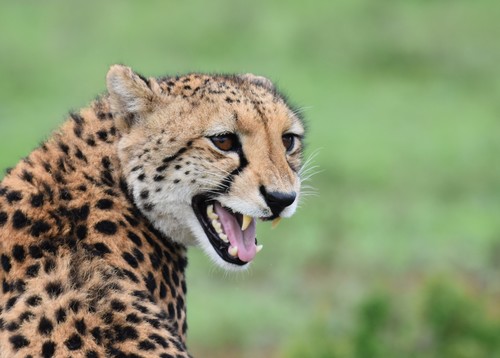
06Tear linesBlack lines from eye to mouth are thought to cut glare from the sun. The idea is plausible but untested.Hypothesis
FACT SHEET
How fast is a cheetah, and how big?
Short answer: The fastest measured wild cheetah ran 93 km/h. Adults weigh 35 to 65 kg and measure 1.1 to 1.5 m, plus the tail.
MeasuredEstimatedQuoted, unverified
Measured: timed, weighed or tracked on real animals. Estimated: a survey or model. Quoted: widely repeated, never confirmed with modern methods.
Top speed, wild huntMeasured93 km/hMeasured93Quoted112GPS collars, 5 wild cheetahs, Botswana. Wilson et al., Nature 2013
Top speed, often quotedQuoted, unverified112 km/h19 km/h faster than anything measured in the wild. Kept for reference, not used.Field guides since the 1960s; no modern telemetry has matched it
Fastest 100 mMeasured5.95 sCheetah5.95 sUsain Bolt9.58 sSarah, Cincinnati Zoo, timed 2012 for National Geographic
Stride at full sprintEstimated6 to 7 mHuman sprinter 2.4 m02 m4 m6 m8 mCommonly cited figure, not a direct measurement
Adult weightMeasured35 to 65 kgAdult human 70 kg0255075100 kgSpecies accounts; males heavier than females
Head and bodyMeasured1.1 to 1.5 mHead and bodyTail adds 65 to 85 cm00.511.522.5 mTail flattens toward the tip and works as a rudder
Lifespan in the wildEstimated8 to 12 yrsZoo 17+05101520 yrsLong-term field studies; zoo cats live longer
Cheetahs left in the wildEstimated≈ 7,100Each dot ≈ 100 cheetahs.Durant et al., PNAS 2017
Share of historical rangeEstimated≈ 9%91% of the land cheetahs once roamed, across Africa, Arabia and India, no longer holds them.Durant et al., PNAS 2017
FAMILY TREE
Is a cheetah a big cat?
Short answer: Not in the scientific sense. It is not a roaring cat of the genus Panthera; it is the only living Acinonyx, closest to the puma.
KingdomAnimalia→ClassMammalia→OrderCarnivora→FamilyFelidae→SubfamilyFelinae→GenusAcinonyx→SpeciesA. jubatus
The cheetah is the only living member of Acinonyx. Despite sharing the savanna with lions and leopards, it is not a "roaring" cat of the genus Panthera. Its nearest living relatives are the puma and the jaguarundi of the Americas, a split that DNA dates to several million years ago.
Living cheetahs are also unusually alike genetically, a sign of a population crash near the end of the last ice age. In the 1980s, researchers found skin grafts between unrelated cheetahs were accepted, something normally seen only in identical twins (O'Brien et al. 1985).
CheetahAfrica, Iran
PumaAmericas
Four subspecies recognised by the IUCN Cat Specialist Group (2017)
Southeast African A. j. jubatusHolds most living cheetahsSouthern and East Africa
Northeast African A. j. soemmeringiiPoorly surveyedEthiopia, South Sudan, Chad, northern Central African Republic
Northwest African A. j. heckiCritically EndangeredSahara and Sahel, scattered
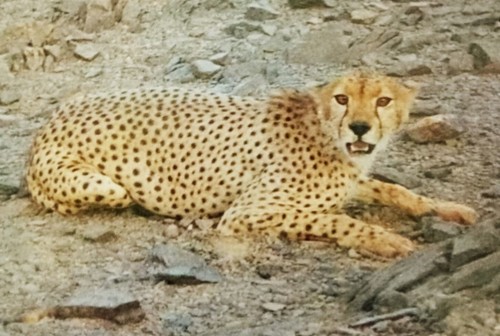
Asiatic A. j. venaticusCritically Endangered, fewer than 50 estimatedIran only
EVOLUTION
Cheetah lineExtinct †Mya = million years agoHow did the cheetah evolve?
Short answer: Its line split from the ancestors of the puma and jaguarundi roughly 5 million years ago, and nearly vanished at the end of the last ice age.
THE BOTTLENECKWhy every cheetah is almost a twinGenetic studies point to at least one severe population crash, and probably two. The survivors' descendants carry very little genetic variation, enough that unrelated cheetahs accepted each other's skin grafts (O'Brien et al. 1985).
Ancestral populationwide gene pool
Bottleneck ~100,000 years ago?migration out of the Americas into Eurasia and Africa
Bottleneck ~12,000 years agoend of the last ice age
Cheetahs todayvery low genetic diversity
CONVERGENT EVOLUTIONTwo sprinters, two originsNorth America's Miracinonyx looked so much like a cheetah that it was once classified with it. DNA and skull studies now place it on the puma's side: open grassland built the same body twice.
CheetahAcinonyx jubatus
Miracinonyx"American cheetah" †
Sprinting buildYesYes
Short face, high nasal openingYesYes
ContinentAfrica, Asia, once EuropeNorth America
Closest living relativePuma, via a shared ancestor ~5 MyaPuma, much more recently
StatusLivingExtinct ~12,000 years ago
~10.8 MyaThe cat family splitsThe roaring cats branch off first. Every other cat, cheetah included, descends from the second branch.
~4.9 MyaCheetah meets its cousinsThe cheetah line separates from the ancestors of the puma and jaguarundi, probably in North America, though where the split happened is still uncertain.
Pliocene to PleistoceneA giant relativeAcinonyx pardinensis ranged across Eurasia and parts of Africa and was significantly larger than today’s cheetah.
Ice-age AmericaA copy, not a cousinMiracinonyx evolved a cheetah-like sprinting build in North America, but sits closer to the puma: a case of convergent evolution.
ANATOMY
Tap a number to inspect each partWhat makes a cheetah so fast?
Short answer: A flexible spine, grippy semi-retractable claws, a rudder-like tail and a light frame, paid for with a weak bite and little stamina.
1
SkullSmall, light, with wide nasal passages
The skull is short and rounded, with oversized airways. That lets the cheetah breathe hard through its nose while its jaws stay clamped on a throat.
GAINSHuge airflow while holding a kill; less weight up front
COSTSLittle room for jaw muscles, so no crushing bite
1 of 9
Why it gives up its killsA cheetah weighs less than a spotted hyena and is built light. An injury that slows it down can mean starvation, so it walks away from fights it could survive.
Built like a greyhound, not a lionLong legs, a deep chest, a narrow waist and a small head. The cheetah shares more design with sighthounds than with the big cats it lives beside.
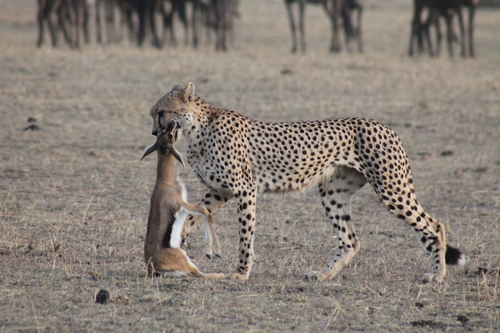
The bite is a hold, not a crushLions and leopards kill with crushing bites. The cheetah clamps the throat and suffocates its prey, breathing through wide nasal passages as it holds on.
All nine parts at a glancePart · what it is · gains · costs
| 1Skull | Small, light, with wide nasal passages. The skull is short and rounded, with oversized airways. That lets the cheetah breathe hard through its nose while its jaws stay clamped on a throat. | Huge airflow while holding a kill; less weight up front | Little room for jaw muscles, so no crushing bite |
| 2Eyes and tear lines | A horizontal band of dense receptors; black stripes to the mouth. A strip of high-acuity cells across the retina gives a sharp, wide view of the horizon. The tear lines probably cut glare, like eye black on an athlete. | Spots herds kilometres away across open plains | Suited to daylight; night belongs to lions and hyenas |
| 3Heart and lungs | A deep chest with an enlarged heart and airways. The deep, narrow chest holds a large heart and lungs that move oxygen fast during a sprint. | Fuel for a short, all-out burst | Little stamina: a chase must end quickly |
| 4Spine | Exceptionally flexible. The spine coils as the legs gather under the body and snaps straight as they stretch out, adding reach to each bound like a spring. | Longer strides at the same leg speed | A light, flexible frame that is poor at carrying or fighting |
| 5Coat | Solid black spots, not rosettes. Spots break up the outline in long grass. No two coats match, so researchers can recognise individual cheetahs from photos. | Camouflage for stalking adults and hidden cubs | Prized by poachers for skins |
| 6Claws and pads | Semi-retractable claws; hard, ridged pads. The claws stay partly out, gripping like running spikes, and the pads act like tyre tread during sharp turns. | Traction for acceleration and turning | Blunt claws: poor climbing and weak in a fight |
| 7Dewclaw | A sharp, hooked claw high on the front leg. Unlike the other claws, the dewclaw stays sharp. At the end of a chase the cheetah hooks a rear leg with it and trips the prey. | Topples prey at full speed | Must strike precisely at the right moment |
| 8Hind legs | Long, heavily muscled. Most of the push comes from the back legs, which carry more of the muscle mass than in other big cats. | Explosive launch from a standstill | Muscle that tires fast |
| 9Tail | Long, flattened toward the tip, ending in rings. The tail swings to counter the body during turns, acting as a rudder. The ring pattern at the tip is unique to each cat. | Sharp turns without losing balance | Little: one of the cheetah's few no-cost upgrades |
RANGE AND HABITAT
Open in Animal Map →Where do cheetahs live?
Short answer: Mainly in southern and East Africa, with scattered groups in the Sahara, a last Asiatic population in Iran, and a reintroduced population in India.
HABITAT
Open grassland, savanna, scrub and semi-desert: anywhere with long sightlines and room to sprint. Cheetahs avoid dense forest, where a chase cannot build speed.
They hunt mainly in daylight, at dawn and late afternoon, which keeps them out of the way of lions and hyenas that hunt at night.
GrasslandSavannaSemi-desertFarmlandMountain plateau
Southern AfricaStrongholdNamibia, Botswana, South Africa, Zimbabwe. Most cheetahs here live on private farmland, not in parks.
East AfricaStrongholdKenya, Tanzania. Serengeti-Mara is the best-studied population on Earth.
Sahara and SahelFragmentedAlgeria, Niger, Chad and neighbours. Counted mostly from camera traps and tracks.
IranLast Asiatic cheetahsCentral plateau. Losses to road traffic are a leading threat.
IndiaReintroduced 2022Kuno National Park. Cheetahs moved from Namibia and South Africa, 70 years after local extinction.
LIFE CYCLE
How do cheetahs raise their cubs?
Short answer: Mothers raise litters of 3 to 5 alone, moving dens to hide them, and teach hunting until cubs leave at 18 to 24 months.
0 days1BirthLitters of 3 to 5 cubs after about 3 months of pregnancy, born blind in tall grass or rock cover.
First weeks2Den hoppingThe mother moves the litter every few days so scent does not build up for lions and hyenas to find.
Up to 3 months3Smoky mantleCubs carry a long grey mane along the back. One idea is that it mimics the honey badger.
6 to 18 months4Hunting schoolThe mother brings live prey for cubs to practise on. Their first chases mostly fail.
18 to 24 months5IndependenceSiblings stay together a few months, then sisters leave. Brothers often stay together for life.
Adult6Two social worldsFemales live alone over huge ranges. Males form coalitions of two or three that hold territories.
~95%of cubs in the Serengeti died before independence in a long-term study, most killed by lions. Survival is far higher where lions are scarce. Laurenson, J. Zoology 1994 · Estimated
BEHAVIOUR
How do cheetahs behave and communicate?
Short answer: Females are solitary, males often live in coalitions, and they communicate with chirps, purrs and scent marks rather than roars.
FemalesSolitary, huge ranges that follow migrating herds
MalesCoalitions of 2 to 3 brothers defend a territory
Coalitions are rare among cats. Coalition males are heavier, hold territories longer and meet more females than loners (Caro 1994).
Marking posts. Trees, rocks and termite mounds act as message boards. Cheetahs scent-mark them, and males visiting the same "play tree" learn who passed by and when.
Daylight hunters. Most cats hunt at night. Cheetahs hunt mostly in daylight, relying on eyesight and avoiding the lions and hyenas that dominate after dark.
Vocal repertoire
Chirp · High, bird-like yelpMothers calling cubs; carries a long way
Churr · Staccato stutterGreeting and social contact
Purr · Continuous, in and outContentment, grooming; cheetahs purr but cannot roar
Bleat · Short, plaintiveDistress, often by cubs
Growl, hiss, spit · Low and harshWarning off rivals at a kill
Moan · Rising wailEscalating aggression before a fight
Waveforms are schematic, showing each call's rhythm.
FOOD WEB
What do cheetahs eat?
Short answer: Mostly medium antelope such as Thomson’s gazelle, impala and springbok, plus hares. Lions and hyenas often steal their kills.
HUNTSMedium antelope under about 40 kg, killed with a suffocating throat bite.
Thomson's gazelleMain prey in East Africa
Impala and springbokMain prey in southern Africa
Hares and young wildebeestTaken when antelope are scarce
LOSES KILLS TOToo light to defend a carcass, a cheetah usually walks away rather than risk an injury that would end its hunting.
LionAlso the main killer of cubs
Spotted hyenaArrives fast, often in groups
LeopardTakes kills, sometimes cubs
SHARES THE PLAINS WITHOther sprinters and pursuit hunters that solve the same problem differently.
African wild dogWins by stamina, not speed
WildebeestToo big for a lone cheetah as an adult
GreyhoundOur own sprinter, compared below
HUNTING
How does a cheetah hunt?
Short answer: By stalking close, sprinting for well under a minute, tripping the prey with its dewclaw and holding the throat until it suffocates.
Minutes to hours of patienceSeconds of speedMinutes to eat
01ScanFrom a termite mound or low branch, often for hours.
02SelectA young, isolated or distracted animal at the herd edge.
03StalkIn low and slow, freezing when the target looks up.
04SprintLaunches only when close; well under a minute.
05TripHooks the rear leg with the dewclaw to topple prey.
06HoldClamps the throat until the prey suffocates.
07Eat fastPants to recover, then eats before scavengers arrive.
GPS collar studies showed that turning and braking matter as much as straight-line speed: a cheetah decelerates and changes direction faster than its prey (Wilson et al. 2013). The physics is in the speed deep-dive.
FIELD ID
Try Animal Identifier →How do you tell a cheetah from a leopard?
Short answer: Look for solid round spots and black tear lines: cheetahs have both, leopards have rosettes and no tear lines.
| Feature | Cheetah | Leopard | Jaguar |
|---|---|---|---|
| Spots | Solid, round black dots | Rosettes: rings with open centres | Rosettes with a dot in the centre |
| Face | Black tear lines eye to mouth | No tear lines | No tear lines |
| Build | Slim, long-legged, deep chest | Stocky, muscular, short legs | Heaviest, broad head and chest |
| Head | Small and rounded | Medium | Large and blocky |
| Climbs trees | Rarely, low branches only | Expertly, caches kills there | Well |
| Where | Africa, Iran | Africa, Asia | Central and South America |
THE KING CHEETAH
What is a king cheetah?
Short answer: A normal cheetah with a rare recessive coat pattern of blotches and back stripes, caused by a single gene, Taqpep.
Since the 1920s, hunters in Zimbabwe reported cheetahs with blotches and three dark stripes down the back. They were called king cheetahs and briefly given their own species name. In 2012, geneticists showed the pattern comes from a recessive mutation in a single gene, Transmembrane aminopeptidase Q (Taqpep), the same gene that turns striped tabby cats into blotched ones (Kaelin et al., Science 2012).
A cub must inherit the variant from both parents, so king cheetahs are rare in the wild and have been recorded mainly in southern Africa.
Typical cheetahSolid round spots · Two normal copies of Taqpep
King cheetahBlotches, back stripes · Two copies of the recessive variant
Blotched tabby catSwirled pattern · Same gene, domestic cat
Swatches are simplified pattern keys, not photos.MYTH OR FACT
Three things people get wrong
MYTH“Cheetahs roar like lions.”They cannot roar. Cheetahs chirp, purr, yelp and growl. The high chirp, almost bird-like, is how mothers call their cubs.
MYTH“A cheetah can outrun anything over any distance.”A chase rarely goes beyond a few hundred metres. Over long distances, a pronghorn or even a greyhound would leave a cheetah behind.
FACT“Cheetahs were tamed and used for hunting.”Royal courts from Egypt to Mughal India kept cheetahs as hunting partners. The emperor Akbar was said to keep around a thousand.
THREATS AND CONSERVATION
Endangered register →Why are cheetahs threatened?
Short answer: Habitat loss, conflict with livestock farmers, loss of wild prey and the illegal cub trade. Guardian dogs and corridors are helping.
IUCN Red List statusVulnerable on every IUCN assessment since 1986. The dashed box marks Endangered, the listing Durant et al. (2017) argued the evidence already supports.
LCLeast Concern
NTNear Threatened
VUVulnerable
ENEndangered
CRCritically Endangered
EWExtinct in the Wild
EXExtinct
Two subspeciesCritically EndangeredNorthwest African and Asiatic
Lives outside parksMost cheetahsOn farmland and communal land
TrendDecreasingAcross most of the range
ReintroducedIndia, 2022After 70 years absent
01PressuresRanked by impact
AHabitat loss and fragmentation
Wide-ranging cats need huge, connected landscapes. Fences, farms and roads cut them into islands.HIGHBConflict with livestock farmers
Cheetahs are shot or trapped in retaliation for, or fear of, livestock losses.HIGHCLoss of wild prey
Bushmeat hunting and fencing remove the antelope cheetahs depend on.HIGHDIllegal cub trade
Cubs are smuggled from the Horn of Africa to be sold as pets. Many die in transit.MEDIUMERoad traffic
A leading recorded cause of death for the last Asiatic cheetahs in Iran.MEDIUMFLow genetic diversity
May reduce resilience to disease, though wild cheetahs still breed well.WATCH02ResponsesWhat is working, and which pressure it tackles
Guardian dogsNamibia, Botswana, South Africa
Anatolian and Kangal shepherds live with the herd and drive cheetahs off, so farmers stop trapping them.Conflict cut by over 80% on participating farmsTackles BEvidence Source: Cheetah Conservation FundWildlife corridorsKavango-Zambezi area
Linking reserves and farmland lets cheetahs move, find mates and mix genes.Largest effort spans several southern African countriesTackles AFEvidence Source: Peace Parks FoundationManaged metapopulationSouth Africa
Cheetahs on small fenced reserves are moved between sites and managed as one population.Fenced-reserve population has grown under the programmeTackles AFEvidence Source: Endangered Wildlife TrustAnti-traffickingSomaliland
Seizing smuggled cubs before they cross the Gulf of Aden and caring for them in safe houses.Confiscated cubs rescued and cared for each yearTackles DEvidence Source: Cheetah Conservation Fund03How we got hereFrom ice age to reintroduction
~12,000 BPBottleneckIce-age crash leaves living cheetahs genetically uniform.
1900~100,000Cheetahs across Africa, Arabia and India.
1952IndiaDeclared extinct within its borders.
1990CCF foundedNamibia; guardian-dog programme follows.
2015VulnerableIUCN Red List assessment.
2017Uplist callDurant et al. argue for Endangered.
2022KunoFirst cheetahs released in India.
OPEN QUESTIONS
What science still doesn’t know
?How many are really left?Most cheetahs live on unfenced private land at low density, where counts rely on camera traps and spoor surveys. Estimates for whole countries can be off by thousands.
?Will India’s reintroduction work?Kuno has seen births and deaths since 2022. Whether a self-sustaining wild population can form, with lions absent but leopards present, is still open.
?Why do they stop chasing?Overheating was the classic answer, but body-temperature loggers found little rise during hunts. Energy budgets and the odds of success now look more important.
?What does the bottleneck mean today?Low diversity is well documented. How much it actually limits survival in the wild, compared with habitat and conflict, is debated.
FAQ
Frequently asked questions
Is a cheetah a big cat?+
In everyday use, yes. Scientifically it is not in Panthera, the roaring cats, and it purrs like a house cat.
Can cheetahs climb trees?+
Only low, sloping trunks and branches. Their blunt claws make them poor climbers compared with leopards.
Are cheetahs dangerous to people?+
There is no reliable record of a wild cheetah killing a person. They usually flee from humans.
Can you keep a cheetah as a pet?+
No. Private ownership drives the illegal cub trade, which kills many cubs in transit, and cheetahs do not adapt to homes.
Why do cheetahs have spots?+
Spots break up their outline in long grass, helping both stalking adults and hiding cubs.
How many cubs survive?+
In lion-rich areas very few. Where lions are scarce, a much larger share reaches independence.
COMPARE AND EXPLORE
How the cheetah stacks up
CheetahVSGreyhound
FEATURED MATCHUP · SPRINT VS ENDURANCEFastest off the line, first to run out of road
Chase distance500 m at mostKilometresGreyhound
Verdict: under 30 seconds nothing on land beats a cheetah. After that, the dog wins.Full matchup →
Or pick a rivalOpen Animal vs Animal →
Cheetah vs LionSteals its kills and kills its cubs. Could a cheetah ever stand its ground?→Cheetah vs Spotted hyenaWhy a cheetah walks away from a carcass it just caught.→Cheetah vs LeopardSame plains, opposite plan: power and stealth against pure speed.→Cheetah vs African wild dogTwo daytime chasers. One sprints, the other runs prey into the ground.→Cheetah vs JaguarThey never meet in the wild. On paper, the bite gap is enormous.→
Explore the cheetah with our toolsAll tools →
CheetahGreyhound
TOOLSpeed RaceWho wins over 100 m, 1 km or 5 km?The cheetah owns the first few hundred metres. Stretch the race and watch the lead change hands.Race them→
Gridlines every 0.4 mShown to approximate scale
TOOLSize ComparisonHow big is a cheetah, really?Lower and longer than most people picture: about thigh-high at the shoulder, with a tail nearly as long as its body.Compare sizes→
✓Solid round spots✓Black tear lines✓Slim, long legs×RosettesMatch: Cheetah3 of 3 clues
TOOLAnimal IdentifierIs it a cheetah or a leopard?Answer a few clues about spots, face and build. The identifier narrows it down and explains why.Identify an animal→
Cheetah~475 PSILeopard~300 PSILion~650 PSIJaguar~1,500 PSIWidely quoted figures, unverified; the meter grades each one.
TOOLBite Force MeterWhy does the fastest cat have a weak bite?Compare the cheetah with other cats and see what it traded away for its light, speed-built skull.Compare bites→
HOW WE KNOW
Sources and how we check
This page is written by Strange Animals and checked against primary research, not other websites. Every figure carries a grade and a numbered source.
Published byStrange Animals
Last updated12 Nov 2026
Sources14
Cite this pageStrange Animals. (2026, November 12). Cheetah (Acinonyx jubatus): facts, speed, anatomy and conservation. https://strangeanimals.info/mammals/big-cats/cheetah
- 01Wilson, A. M. et al. Locomotion dynamics of hunting in wild cheetahs. Nature 4982013
- 02Durant, S. M. et al. The global decline of cheetah and what it means for conservation. PNAS 1142017
- 03Laurenson, M. K. High juvenile mortality in cheetahs and its consequences for maternal care. Journal of Zoology 2341994
- 04O'Brien, S. J. et al. Genetic basis for species vulnerability in the cheetah. Science 2271985
- 05Hetem, R. S. et al. Cheetah do not abandon hunts because they overheat. Biology Letters 92013
- 06IUCN Cat Specialist Group A revised taxonomy of the Felidae. Cat News, Special Issue 112017
- 07IUCN Red List Acinonyx jubatus assessment. Vulnerable2015
- 08Cheetah Conservation Fund Livestock guardian dog programme. Namibia2023
- 09National Geographic Sarah the cheetah, 100 m timing. Cincinnati Zoo2012
- 10Kaelin, C. B. et al. Specifying and sustaining pigmentation patterns in domestic and wild cats. Science 3372012
- 11Caro, T. M. Cheetahs of the Serengeti Plains: group living in an asocial species. University of Chicago Press1994
- 12Tricorache, P. et al. Pets and pelts: understanding and combating poaching and trafficking in cheetahs. Cheetahs: Biology and Conservation2018
- 13Johnson, W. E. et al. The late Miocene radiation of modern Felidae: a genetic assessment. Science 3112006
- 14Menotti-Raymond, M. and O'Brien, S. J. Dating the genetic bottleneck of the African cheetah. PNAS 901993
- 15Dobrynin, P. et al. Genomic legacy of the African cheetah, Acinonyx jubatus. Genome Biology 162015
WATCH
Three documentaries worth your time
Full episodeNat Geo AnimalsMan Among CheetahsFilmmaker Bob Poole follows a cheetah mother and her cubs through the Maasai Mara, with close detail on hunting and kill theft.Pairs with: Food web →
Short filmNational Geographic, 2012The Science of a Cheetah's SpeedSlow-motion footage from the shoot that timed Sarah at Cincinnati Zoo. Shows the spine flex and stride in detail.Pairs with: Anatomy →
PHOTOS
In pictures
LISTEN
Hear it
SIGHTINGS
Where it has been recorded


WHERE TO SEE ONE
Where are cheetahs seen most?
Serengeti National ParkTanzania674 verified sightingsKruger National ParkSouth Africa537 verified sightingsSabi Sands Game ReserveSouth Africa179 verified sightingsEtosha National ParkNamibia169 verified sightingsKgalagadi Transfrontier ParkSouth Africa and Botswana98 verified sightings
Protected areas with the most research-grade sightings on iNaturalist, out of 5,827 worldwide. Bars show sightings by month.
CONSERVATION TIMELINE
How it came to be protected
- 1952Declared extinct in IndiaIndia declared the cheetah extinct within its borders after the last known animals died and no more were sighted.Source: Wikipedia
- 1975Listed on CITES Appendix ICITES placed the cheetah on Appendix I, which prohibits international commercial trade in the species.Source: Cheetah Conservation Fund
- 1992Export quotas setCITES parties kept the cheetah on Appendix I and set annual export quotas of 150 for Namibia, 50 for Zimbabwe and 5 for Botswana.Source: Federal Register
- 2007Range-wide programme beginsThe Range Wide Conservation Program for Cheetah and African Wild Dogs began coordinating conservation across Africa.Source: Wikipedia
- 2014Trafficking made a priorityThe CITES Standing Committee recognised the cheetah as a species of priority in its work against wildlife trafficking.Source: Wikipedia
- 2021Assessed as VulnerableThe IUCN Red List assessment of 2021 classed the cheetah as Vulnerable.Source: San Diego Zoo Wildlife Alliance Library
- 2022Released in IndiaIndia released eight cheetahs flown from Namibia into Kuno National Park on 17 September 2022.Source: Wikipedia
QUIZ
Test yourself
What is the fastest speed ever measured for a wild cheetah?
Which of these cats is one of the cheetah's nearest living relatives?
What sound does a cheetah use to call its cubs?
SPECIES PROFILES
All 28 species profiles →More species profiles
BIRDS · HUMMINGBIRDSHummingbirdHovering, torpor, 366 speciesMAMMALS · MARSUPIALSKangarooHopping, pouch, mobsMAMMALS · SLOTHSSlothSlowness, fur, seven speciesMARINE LIFE · SEA TURTLESGreen sea turtleNavigation, grazing, recoveryMAMMALS · UNGULATESGiraffeNeck, blood pressure, speciesBIRDS · RAPTORSBald eagleNests, piracy, recoveryPETS · DOGSDomestic dogOrigins, nose, mind, breedsREPTILES · CROCODILIANSSaltwater crocodileBite, sea travel, recoveryPETS · CATSDomestic catDomestication, senses, purringEXTINCT · DINOSAURSTyrannosaurus rexBite, growth, extinctionREPTILES · MONITORSKomodo dragonVenom, iron teeth, islandsMARINE LIFE · WHALESBlue whaleSize, krill, song