Wombat: Why Its Droppings Are Cubes
Vombatus ursinusAn adult wombat leaves 80 to 100 cube-shaped droppings a night, each about two centimetres a side, and the northern hairy-nosed wombat numbers about 315.
 Strange Animals EditorialJanuary 1, 2025·13 min read·Editorial standards ↗
The wombat is one of Australia's strangest mammals, a barrel-shaped, short-legged, burrow-digging marsupial that looks like a small bear, blocks predators with its rear end, sleeps in burrows and produces the only genuinely cube-shaped droppings found anywhere in the animal kingdom.
Three living species make up the family Vombatidae: the common or bare-nosed wombat ( Vombatus ursinus ), the southern hairy-nosed wombat ( Lasiorhinus latifrons ), and the Critically Endangered northern hairy-nosed wombat ( Lasiorhinus krefftii ), which is one of the rarest large mammals on Earth with a total population of roughly 315 individuals.
This guide covers every aspect of wombat biology and ecology: size and anatomy, the famous cube poo, the backward-opening pouch, the bony rump defence, burrow architecture, digestion, reproduction, species differences, conservation status and the relationship between wombats and the humans who share their range in south-east Australia and Tasmania.
Etymology and Classification
The scientific name Vombatus ursinus pairs the Latinised form of the Dharug word wombat (from the Dharug people of the Sydney area) with the Latin adjective ursinus , meaning 'bear-like'. Early European colonists frequently described the animal as a 'badger' or 'small bear', and several places, such as Badger Creek in Victoria and Badger Corner in Tasmania, were named after the wombat as a result.
Wombats belong to the order Diprotodontia, the large group of Australian marsupials that includes kangaroos, possums and koalas. Within Diprotodontia they sit in the family Vombatidae, which today contains just two genera and three species:
- Vombatus ursinus : the common or bare-nosed wombat
- Lasiorhinus latifrons : the southern hairy-nosed wombat
- Lasiorhinus krefftii : the northern hairy-nosed wombat
Molecular studies consistently show that wombats are most closely related to the koala, their sister group within the suborder Vombatiformes. Kangaroos and possums sit on separate branches. Wombats are estimated to have diverged from other Australian marsupials as long as 40 million years ago.
Extinct wombats include Phascolonus , the largest known wombat, which went extinct approximately 40,000 years ago and is estimated to have weighed up to 360 kilograms.
Size and Physical Description
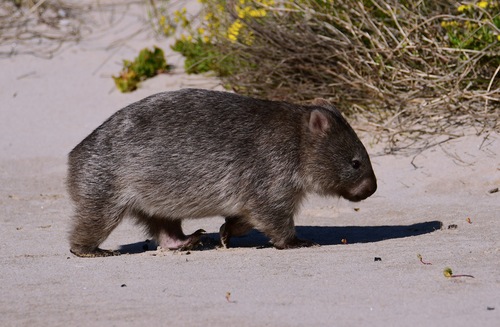
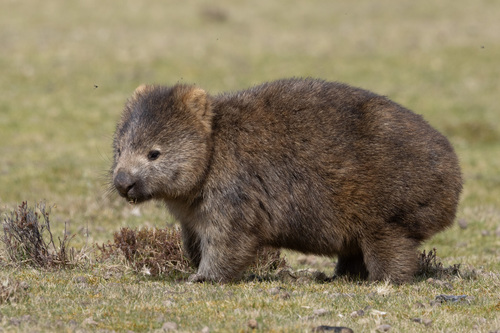
The common wombat is stocky, muscular and built low to the ground, every line of the animal optimised for burrowing rather than running.
Common wombat adults:
- Length: about 1 m
- Tail: a short, stubby tail
- Weight: typically 20-35 kg
Southern hairy-nosed wombat:
- The smallest of the three species, 77-93 cm
- Weight 19-32 kg
- Silky, greyish or tan fur
Northern hairy-nosed wombat:
- Critically Endangered
The body is shaped like a short cylinder with legs. Limbs are short, powerful and tipped with long curved claws built for digging in compacted clay, sandy loam, or quartz gravel. The front legs are noticeably more muscular than the back, reflecting a lifetime of scraping soil.
The face is flat, the nose prominent and the eyes small and dark. Hearing is acute, vision modest and scent is the dominant sense. The common wombat has a naked, leathery nose pad, the two hairy-nosed species are named for the fine fur covering theirs. Fur colour in the common wombat ranges from light brown to grey and black.
One feature of wombats is a toughened rear hide, made largely of cartilage, forming a natural shield. More on that below.
The Famous Cube-Shaped Droppings
If wombats are known for one thing outside Australia, it is their faeces. The common wombat is the only animal on Earth that produces genuinely cube-shaped droppings. Each cube is roughly two centimetres on a side, dry, dense and stacked neatly, an adult produces 80 to 100 cubes per night.
Research by Patricia Yang and David Hu examined how a round intestine produces a square output.
What they found was that the intestinal wall has two stiffer regions and two softer, more flexible regions. As the already-dry faecal mass is squeezed along this section by peristaltic contractions, the uneven stiffness flattens the sides while the corners hold their shape.
The work earned Yang and Hu the 2019 Ig Nobel Prize in Physics and was published in Soft Matter in 2021.
The behavioural purpose of the shape is just as unusual. Wombats are solitary and communicate largely through scent. They place their cubes on prominent objects, fallen logs, rocks, mushrooms, even piles of leaf litter, to mark territory and signal reproductive status. It is believed that the cubic shape makes the droppings more stackable and less likely to roll off those markers.
The Backward-Opening Pouch
Wombat mothers carry their joeys in a pouch, like other marsupials, but the opening of that pouch faces backward, toward the tail rather than toward the head.
In wombats the reason is direct and practical: a forward-facing pouch would fill with soil the first time the mother started excavating a burrow. By reversing the opening, she can dig through clay and gravel without burying her joey.
By the time a young wombat permanently leaves the pouch, at roughly five to seven months, it is a small, fully furred animal capable of following its mother on short foraging trips.
Reinforced Rump and Defence Behaviour
The wombat's most famous piece of anatomy, after the cube factory, is its rear end. The pelvic region is reinforced by a thick plate made mostly of cartilage, covered in tough skin and coarse fur.
Defence behaviour centres on the burrow. When a predator, historically the thylacine or the Tasmanian devil, today the dingo, red fox, or domestic dog, gives chase, a wombat sprints for the nearest burrow entrance and dives in head-first. It wedges its armoured rump firmly into the tunnel. Its cartilage-heavy rump and lack of a meaningful tail make it difficult for a predator following it into the tunnel to bite and injure it.
According to a popular story, wombats crush the skulls of predators against the tunnel roof, but there is no evidence to support this.
Bites to the rump itself rarely penetrate. Foxes and dogs that attempt to grab an exposed wombat tail or flank usually get a mouthful of hide and cartilage with little to no damage inflicted.
Burrows and Underground Architecture
Wombats are among Australia's most accomplished engineers. A single common wombat will maintain several burrows across a home range of up to 23 hectares, switching between them every few days.
Typical common wombat burrow system:
| Feature | Value |
|---|---|
| Total tunnel length | 2-20 m |
| Number of entrances | Often more than one |
Southern hairy-nosed wombats go further. They dig communal warrens that can house up to ten adults. These warrens concentrate in semi-arid country where soil allows stable tunnels and surface water is scarce. Northern hairy-nosed wombats survive in Epping Forest National Park in central Queensland.
Burrow temperature regulation is a major reason wombats thrive in climates ranging from Tasmanian alpine slopes to the arid interior. Surface temperatures swing widely over a year, but inside a wombat burrow conditions stay cool in summer and mild in winter, buffering the animal from both heat stress and cold exposure.
Wombat burrows also form crucial shelter for other species. Reptiles, rodents, rabbits, echidnas, wallabies, birds and koalas are known to use wombat burrows. During the 2019-2020 bushfires, viral stories claimed that wombats sheltered other wildlife, but experts said such animals usually enter wombat burrows uninvited.
Digestion, Diet, and Slow Guts
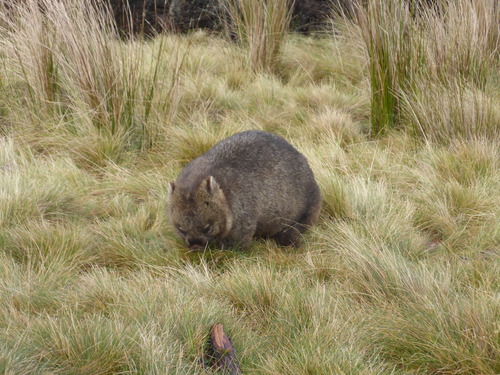
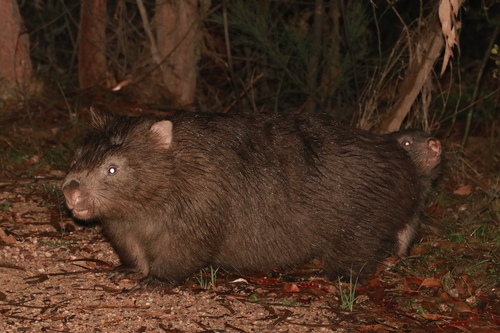
Wombats are strict herbivores. Their diet consists almost entirely of native grasses, sedges, rushes, roots and sometimes the inner bark of fallen trees. They forage mostly at night.
What makes wombats physiologically distinctive is not what they eat but how slowly they digest it. Digestion takes around 8 to 14 days, a very slow rate. Microbial fermentation in the colon helps wombats derive energy from fibrous, low-quality food.
Slow digestion and low metabolic rate combine to give wombats very modest water requirements. A common wombat in temperate forest will drink from surface water when it is available, but hairy-nosed species in semi-arid country conserve water by recycling urea to the colon. Their dry, dense cube-shaped faeces reflect this aggressive water-reclamation strategy.
Wombat teeth are another oddity. Unlike most marsupials, wombat teeth grow continuously throughout life, an open-rooted pattern otherwise associated with rodents. The abrasive silica content of native grasses and the frequency of accidental grit ingestion during grazing would quickly wear down conventional enamel, so wombats evolved teeth that keep replacing themselves.
Reproduction and Life Cycle
Wombats are sexually mature at about 18 months of age. The common wombat breeds mainly in winter.
Reproductive cycle:
- Gestation: 20-30 days
- Time in pouch: about 5-7 months
- Emergence weight: 3.5-6.5 kg
- Weaning: 12-15 months
- Sexual maturity: about 18 months
- Typical reproductive rate: one joey every 2 years
Newborn wombats crawl unassisted from the cloaca to the backward-facing pouch, latch onto a teat and remain attached for the next several months. Joeys leave the pouch after about five to seven months and follow their mother on foot for another several months while still returning to nurse. Females give birth to a single young.
The Three Living Species
| Species | Scientific name | Range | Population (est.) | IUCN status |
|---|---|---|---|---|
| Common wombat | Vombatus ursinus | SE Australia, Tasmania, Flinders Island | ~1.3 million (all subspecies) | Least Concern |
| Southern hairy-nosed wombat | Lasiorhinus latifrons | Arid SA, SW NSW, WA | ~1.3 million (2016 estimate) | Least Concern (Near Threatened in 2016) |
| Northern hairy-nosed wombat | Lasiorhinus krefftii | Epping Forest NP, QLD | ~315 | Critically Endangered |
The northern hairy-nosed wombat is one of the rarest large mammals on Earth. By the 1980s the species had fallen to a low of about 35 individuals.
Conservation work, including a second colony at the Richard Underwood Nature Refuge, has lifted numbers from a low of about 35 in the 1980s to around 315 by May 2021.
Conservation Status and Threats
The IUCN lists the common wombat as Least Concern. The species has declined since European settlement, and mainland populations are now largely fragmented and isolated. That headline figure hides real problems.
Main threats to common wombats:
- Sarcoptic mange. The introduced mite Sarcoptes scabiei causes severe skin disease, hair loss, blindness and eventual death. Treatment with topical moxidectin in wild populations is effective but labour-intensive.
- Vehicle strike. Wombats walk roads at dawn and dusk. Road kill is a significant ongoing cause of mortality near settled areas, and orphaned pouch young are a routine casualty.
- Habitat loss. Clearing for agriculture, urban expansion and forestry continues to reduce available range, particularly in the more fertile lowlands.
- Competition and persecution. Wombats are sometimes treated as pests by graziers whose fences they undermine. Control permits still exist in parts of Victoria.
- Drought and climate change. Extended dry spells diminish grass quality and make wombats travel farther from their burrows, which in turn boosts predation and road strikes.
For the southern hairy-nosed wombat, habitat fragmentation, drought and mange remain concerns. For the northern hairy-nosed wombat, the main risks are demographic, the small, concentrated population is vulnerable to disease outbreak, fire, flood, or predation by a single dingo incursion. A new insurance colony is crucial precisely because keeping the entire species in one place is bad risk management.
Wombats and Humans
Wombats feature in the stories, ceremonies and place-names of many Indigenous Australian nations across their range. They have been hunted as bush food. The word wombat itself comes from Dharug, the language of the Dharug people.
European settlers encountered wombats with a mixture of curiosity and hostility. Farmers resented the burrows, which undermined fences, naturalists found the animals fascinating. In the twentieth century wombats were classed as vermin and bounties were paid, which greatly reduced their numbers and range. All species are now protected in every Australian state.
Today wombats are broadly popular. They feature on currency, postage stamps, tourism branding and children's books. Wildlife carers who raise orphaned pouch young document the remarkable intelligence and individual personalities of hand-reared wombats, and animals like Patrick the Wombat, of Ballarat Wildlife Park in Victoria, reported as the longest-lived known captive wombat, became minor celebrities.
Responsible wombat encounters focus on observation rather than interaction. Adult wombats are strong, territorial and capable of inflicting serious bites and claw wounds if cornered or threatened. Approaching a wild wombat, especially near a burrow, is discouraged.
Supporting research into mange treatment, reporting mange-affected animals to local wildlife groups, slowing down at dawn and dusk on rural roads, and fencing farms in wombat-aware designs are the practical ways members of the public contribute to the species' long-term survival.
Frequently asked questions
The common wombat (Vombatus ursinus) produces distinctive cube-shaped faeces, roughly 80 to 100 pieces per night, each about 2 cm across. Research by Patricia Yang and David Hu, published in Soft Matter in 2021, found that the wombat’s intestine has two stiffer and two more flexible regions, which mould the corners of the faeces. The work won the 2019 Ig Nobel Prize in Physics. Wombats arrange the droppings to mark territory and attract mates, and the cubic shape is believed to make them more stackable and less likely to roll.
The wombat’s pouch opens toward the tail rather than toward the head. The advantage is practical: wombats dig extensive burrows with their powerful claws, and a backward-facing pouch means the mother does not gather soil over her young while digging.
A wombat’s primary defence is its toughened rear hide, with most of the posterior made of cartilage. When attacked, the wombat dives into a nearby tunnel and uses its rump to block a pursuing attacker. Combined with its lack of a meaningful tail, this makes it difficult for a predator following it into the tunnel to bite and injure it. A popular story says wombats crush predators’ skulls against the tunnel roof, but there is no evidence to support this.
Within its home range, a common wombat excavates a tunnel system featuring tunnels from approximately 2 to 20 m in length, numerous side tunnels and usually more than one entrance. The wombat maintains several burrows and moves to a different sleeping burrow every 1 to 9 days. Southern hairy-nosed wombats link their burrows into warrens with multiple entrances that up to 10 individuals share. Reptiles, rodents, rabbits, echidnas, wallabies, birds and koalas are known to use wombat burrows.
It depends which wombat. The common wombat (Vombatus ursinus) is listed as Least Concern by the IUCN, although it has declined since European settlement and remains threatened by habitat reduction, roadkill and sarcoptic mange. The southern hairy-nosed wombat (Lasiorhinus latifrons) is now Least Concern, having been listed as Near Threatened in 2016. The northern hairy-nosed wombat (Lasiorhinus krefftii) is Critically Endangered. From a low of about 35 in the 1980s its population had increased to around 315 by May 2021, in Epping Forest National Park and a second colony at the Richard Underwood Nature Refuge in Queensland.
Wombats typically live up to about 15 years in the wild, and can live past 20 and even 30 years in captivity. Patrick the Wombat of Ballarat Wildlife Park in Victoria is reported as the longest-lived known captive wombat.
Mostly a myth. During the 2019-2020 bushfires, viral stories claimed that wombats sheltered other wildlife in their burrows. Experts said such animals usually enter wombat burrows uninvited, and that wombats do not organise rescues. Wombats are generally solitary and tolerate non-threatening species in their burrows.
Wombats are herbivores. Their diet consists mostly of grasses, sedges, herbs, bark and roots and they forage mostly at night. They have an extraordinarily slow metabolism, taking around 8 to 14 days to complete digestion, which aids survival in arid conditions. Southern hairy-nosed wombats also conserve water by recycling urea to the colon and produce very dry faeces.
References
- Yang, P. J., Lee, A. B., Chan, M., et al. (2021). Intestines of non-uniform stiffness mold the corners of wombat feces. Soft Matter, 17(3), 475-488. View source
- Wombat. Wikipedia. View source