Platypus: 40,000 Sensors in Its Bill
Ornithorhynchus anatinusNearly 40,000 electroreceptors in a platypus bill sense the muscle twitches of prey in murky water. Male spurs carry venom whose pain resisted morphine.
 Strange Animals EditorialDecember 31, 2024·14 min read·Editorial standards ↗
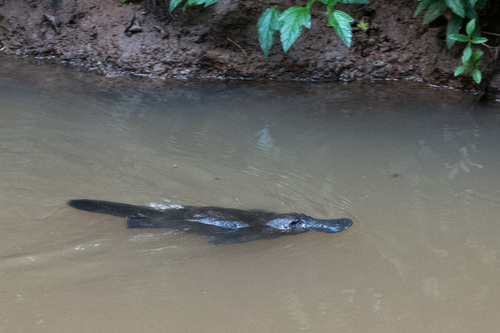
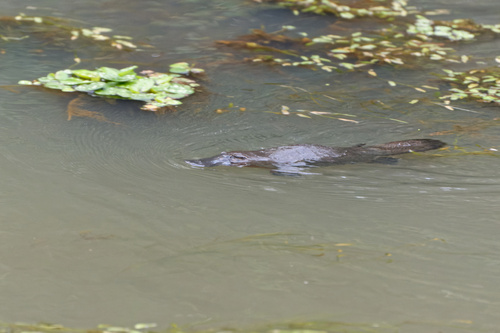
The platypus is one of the strangest mammals alive. It lays eggs instead of giving birth to live young, yet it nurses those young on milk. The males carry functional venom in spurs on their hind legs, which makes it one of the few venomous mammals. Its duck-like bill hides nearly 40,000 electroreceptors that detect the muscle twitches of invisible prey beneath murky water.
Its fur glows blue-green under ultraviolet light. It has no functional stomach, ten sex chromosomes and an evolutionary history that traces to an early branch of the mammal family tree.
A quick taxonomic note. The platypus is a monotreme, not a marsupial. Monotremes are a separate mammal lineage that diverged long before marsupials and placental mammals split from each other. Only five living species remain: the platypus and four echidna species. This guide is filed under the marsupials section for site navigation convenience only. Biologically the platypus belongs to its own order, Monotremata and nothing about its biology is marsupial.
This reference entry covers every major aspect of platypus biology: classification, anatomy, electroreception, venom, reproduction, genetics, habitat, conservation and the cultural place of Ornithorhynchus anatinus in Australia. Expect specifics, receptor counts, chromosome numbers, bill dimensions, river systems, rather than summaries.
Etymology and Classification
The genus name Ornithorhynchus combines the Greek words ornithos (bird) and rhynkhos (snout), literally meaning 'bird-snouted'. The species name anatinus means 'duck-like' in Latin. Together the scientific name translates roughly to 'duck-like bird-snout', a reflection of just how confused European naturalists were when the first specimens reached London in 1798.
That first preserved skin, sent by Governor John Hunter, was initially dismissed as a fraud. British zoologist George Shaw examined it for stitching, certain that a taxidermist had sewn a duck's bill onto the body of a beaver-like animal. No such stitches existed. Shaw published the species in 1799 under the name Platypus anatinus .
The genus name Platypus (Greek for 'flat-foot') was already in use for a beetle genus, so the animal was eventually renamed Ornithorhynchus anatinus , although the common name 'platypus' stuck in English.
Monotremes are the oldest surviving mammalian lineage. Modern monotremes are survivors of an early branching of the mammal family tree. Molecular clock and fossil dating suggest the platypus split from the echidnas around 19 to 48 million years ago. The platypus is the only living member of its family, Ornithorhynchidae and the only living species in its genus.
Size and Physical Description
Platypuses are small to mid-sized aquatic mammals. Platypuses tend to be larger the farther south they live, where the climate is colder and males are consistently heavier than females within any given population.
Adults:
- Average length (males): about 50 cm
- Average length (females): about 43 cm
- Average weight (males): about 1.7 kg
- Average weight (females): about 0.9 kg
Hatchlings:
- Blind and hairless at hatching, fed on the mother's milk
The platypus is a mosaic of features that do not normally appear together. The bill is soft, rubbery and superficially duck-like, but it is a mammalian structure covered in sensory skin, not a bird's keratin beak. The body is low-slung and streamlined, resembling a small otter. The tail is flat, broad and paddle-shaped, much like a beaver's, used as a rudder during swimming and as a fat-storage organ.
The feet are webbed, more extensively on the front and tipped with strong claws for digging. When walking on land, the platypus folds its webbing back under its feet, exposing the claws, in the water, the webbing extends for paddling.
The fur is extraordinarily dense. It is one of the most densely furred mammals, behind only otters. The coat consists of two layers: long, water-repellent guard hairs on the outside and an insulating undercoat beneath. Trapped air in the undercoat keeps the skin dry even during extended dives. The fur is a rich dark brown on the back and a paler cream on the underside, and it biofluoresces blue-green under ultraviolet light.
The Bill and Electroreception
The bill is the platypus's defining sensory organ. It is roughly the size and shape of a duck's bill but is a soft, rubbery, highly vascularised structure covered in tough skin and packed with sensory receptors. It is, in effect, a biological radar dish for detecting prey.
Sensory architecture of the bill:
- Approximately 40,000 electroreceptors arranged in rows from front to back
- Mechanoreceptors for touch distributed across the bill
The electroreceptors detect the faint electrical fields generated by muscle contractions in prey animals, freshwater shrimp, worm bodies wriggling in sediment, insect larvae, small fish.
The platypus can feel the direction of an electric source, perhaps by comparing signal strength across the array of electroreceptors, helped by its side-to-side head motion while hunting.
When the platypus dives, reflexes close the eyes, the ear openings and the nostrils. Vision, hearing and smell all become unavailable underwater. The platypus swings its head side to side across the substrate and relies entirely on the bill to locate prey.
The Guiana dolphin is the only other mammal known to have a sense of electroreception.
Venom and the Spur
Adult male platypuses carry a hollow spur on each hind ankle. The spur connects by a narrow duct to a crural venom gland in the thigh. Females are born with spur rudiments but shed them before reaching adulthood, and the venom gland is essentially absent.
Venom production spikes during breeding season. Males are the only ones that produce venom, and this seasonal pattern reinforces the view that platypus venom evolved as a weapon for male-on-male combat instead of for defence or hunting.
What the venom is:
- A complex cocktail of at least nineteen distinct peptides
- Includes defensin-like proteins, nerve growth factor and C-type natriuretic peptides
- The venom appears to have evolved from existing immune-system defensin genes, convergent with reptile venom genes
- Not primarily lethal, but extraordinarily painful
What it does in humans:
- Immediate, intense, burning pain at the puncture site
- Rapid localised swelling, sometimes spreading to the entire limb
- Chronic pain sensitivity (hyperalgesia) lasting weeks or months
- A 1992 clinical report found the pain did not respond to morphine
- No confirmed human fatalities
Venom can paralyze smaller animals, yet it is not lethal to humans. Platypus venom research has grown medically interesting since some components show promise as models for new pain-management drugs.
Hunting and Diet
Platypuses are opportunistic bottom-feeders that hunt primarily at dawn, dusk and through the night. They forage by diving to the bottom of streams and rivers and searching the sediment with the bill. In one study, dives lasted 35 seconds on average. Between dives they surface briefly to breathe, chew and swallow.
Typical prey items:
- Caddisfly, mayfly and dragonfly larvae
- Freshwater shrimp and yabbies
- Aquatic worms
- Small fish and fish eggs
- Freshwater molluscs and snails
- Occasional frogs and tadpoles
A platypus stores food in the cheek pouches during a dive, then chews and swallows at the surface. Because the adult platypus has no functional teeth, prey is ground between hardened keratin pads inside the cheeks. Platypuses regularly ingest small amounts of gravel, and this gravel helps pulverise harder-bodied prey like crustaceans.
The Missing Stomach
The platypus has no functional stomach. Genetic testing reveals it lacks the genes required to produce pepsin proteases, and its digestive system includes a pouch-like section in the intestines that helps absorb nutrients.
Adult platypuses have no teeth and instead grind food between keratinised pads.
Reproduction and Life Cycle
The platypus reproduces once a year. Breeding is seasonal, with more southerly populations breeding later in the year than those further north.
After mating, the female digs an elaborate nesting burrow, distinct from her ordinary resting burrow, in the bank. Nesting burrows can be up to 30 metres long and contain thin soil plugs along their length. Pushing past the plugs squeezes water from the female's fur and helps keep the burrow dry.
Reproductive timeline:
| Stage | Duration / detail |
|---|---|
| Gestation | ~28 days in utero |
| Egg incubation | ~10 days against the mother's belly |
| Eggs per clutch | Normally 2 |
| Egg size | About 17 mm long, leathery |
| Hatchlings | Blind and hairless |
| Weaning | Approximately 4 months |
| First emergence from burrow | Around 4 months after hatching |
| Sexual maturity | About 2 years |
Because the platypus has no nipples, milk is secreted through specialised patches of skin on the mother's belly. The milk pools in grooves in the fur, and the hatchlings lap it up. The milk is thicker than that of placental mammals and provides all the requirements for growth and development.
Females usually raise one litter annually. Males do not contribute to caring for the young.
Genetics and the Ten Sex Chromosomes
The platypus genome is one of the strangest in the animal kingdom. While most mammals have two sex chromosomes, XX in females and XY in males, the platypus has ten. Males carry 5X and 5Y chromosomes, females carry 10X chromosomes.
Stranger still, one of the platypus X chromosomes has close homology to the bird Z chromosome. The platypus also lacks the mammalian sex-determining gene SRY.
The full platypus genome was first sequenced in 2008 and re-sequenced at higher quality in 2021. It contains both reptilian and mammalian elements. Genes associated with venom show clear origins in standard mammalian defensin genes, recruited and duplicated for a new purpose. Genes for stomach function are absent or degraded.
Biofluorescence
Platypus fur glows cyan and green under ultraviolet light.
The function is not yet clear. One hypothesis is that it camouflages the animal in low light from UV-sensitive predators.
Habitat and Range
Platypuses live exclusively in eastern Australia. Their range extends from the tropical streams of far north Queensland southward through New South Wales and Victoria, and throughout Tasmania. A small introduced population exists on Kangaroo Island, South Australia.
Habitat preferences:
- Freshwater streams, rivers and lakes, never saltwater, rarely brackish
- Stable earthen banks suitable for burrowing
- Year-round water availability
- Moderate flow with deeper pools and shallower feeding runs
- Abundant aquatic invertebrate prey
Home ranges differ by sex and habitat, with a platypus ranging across up to 7 kilometres of waterway. Males overlap the home ranges of three to four females. Platypuses are typically solitary and use individual burrows except when mating and raising young.
The platypus is native to eastern Australia only, and has almost disappeared from the Murray-Darling Basin.
Conservation Status and Threats
The IUCN lists the platypus as Near Threatened with a decreasing population trend. Regional assessments within Australia are often more severe, the species is listed as Vulnerable in some states and Endangered in localised ranges.
Primary threats:
- Climate-driven drought and altered river flow. Platypuses cannot survive in waterways that dry out seasonally. Prolonged droughts, amplified by climate change, are reducing habitat in marginal areas.
- Dams, weirs and fragmentation. Physical barriers prevent platypuses from moving between river reaches, isolating populations and reducing genetic diversity.
- Water extraction and pollution. Agricultural extraction reduces flow, and runoff introduces sediment, pesticides and fertilisers that damage invertebrate prey.
- Land clearing along riverbanks. Burrow sites and shade depend on both bank stability and overhanging vegetation remaining intact.
- Entanglement. Platypuses perish when they enter illegal yabby traps (opera-house traps) looking for prey. Discarded fishing line and plastic also injure the animals.
- Introduced predators. Foxes prey on platypuses.
- Bushfires. In the 2019-2020 Australian bushfire season, large portions of Kangaroo Island, home to an introduced platypus population, burned.
Conservation responses include trap regulations, riparian restoration programmes and captive breeding programmes. The platypus is not covered by the federal EPBC Act, although a November 2020 report recommended listing it as a threatened species.
Platypuses and Humans
The platypus has occupied a central place in Australian cultural and scientific identity since colonisation. It has appeared on stamps and currency and was a mascot of the 2000 Sydney Olympics.
Indigenous Australian cultures across the platypus's range have long recognised the animal. Recorded Aboriginal names for the platypus include boondaburra and mallingong , varying by language and region. Several Aboriginal creation stories explain the platypus as the offspring of a duck and a water-rat, neatly capturing the mosaic appearance that confused European naturalists.
Modern scientific interest in the platypus is intense. Researchers study the animal for insights into mammal evolution, the origin of venom systems, electroreception, genome architecture and antimicrobial milk chemistry.
Zoos outside Australia have almost never been permitted to keep platypuses, they are extremely difficult to maintain in captivity, and Australian law tightly restricts export. Three platypuses were given to the Bronx Zoo in 1947, and as of 2019 the only platypuses in captivity outside Australia were at the San Diego Zoo Safari Park.
References
Explore more about unique egg-laying mammals in our monotremes section.
Frequently asked questions
No. The platypus (Ornithorhynchus anatinus) is a monotreme, not a marsupial. Monotremes are a separate and much older lineage of mammals that lay eggs rather than give birth to live young. Only five living species qualify: the platypus and four echidna species. Marsupials such as kangaroos, koalas and opossums give birth to live but undeveloped young that finish development in a pouch.
Monotremes are survivors of an early branching of the mammal family tree, before marsupials and placental mammals diverged. The platypus is filed alongside marsupials here only for site navigation convenience. Biologically it belongs to its own order, Monotremata.
The platypus hunts with its bill. When it dives, its eyes, ears and nostrils are closed. The bill contains approximately 40,000 electroreceptors arranged in rows, along with mechanoreceptors for touch. Electroreceptors detect the tiny electrical fields generated by muscle contractions in prey like shrimp, worms and insect larvae.
The platypus sweeps its head side to side through the sediment at the bottom of streams. It can feel the direction of an electric source, perhaps by comparing signal strength across the array of electroreceptors.
Yes, but only the males. Each adult male platypus has a hollow spur on each hind ankle, connected by a duct to a crural venom gland in the thigh. Venom production rises during the breeding season, which suggests the venom is used as a weapon in male-on-male competition.
The venom contains at least nineteen peptides. In humans, a spur strike produces extreme pain, swelling and a long-lasting hyperalgesia that can persist for weeks or months. A 1992 clinical report found the pain did not respond to morphine. The venom is not lethal to humans, but it can paralyse smaller animals.
Platypuses live in freshwater systems of eastern Australia, from Queensland down through New South Wales and Victoria and across Tasmania. They prefer streams, rivers and lakes with stable banks where they can excavate burrows, moderate flow, reliable year-round water and abundant invertebrate prey. A platypus may range over up to 7 kilometres of waterway.
The platypus is native to eastern Australia only, and has almost disappeared from the Murray-Darling Basin. A small introduced population exists on Kangaroo Island. They are sensitive to drought, habitat fragmentation and water pollution.
Platypuses reproduce once a year, and breeding is seasonal. After mating in the water, the female digs an elaborate nesting burrow up to 30 metres long in the riverbank, with thin soil plugs along its length. She normally lays two small, leathery eggs, curls around them and incubates them for about 10 days after about 28 days in the uterus. The hatchlings are blind and hairless.
Because the platypus has no teats, the mother releases milk through pores in the skin of her belly, and the young lap it up from her fur. The young are milk-fed for around four months and emerge from the burrow at about that age.
The platypus lacks a functional stomach because it lacks the genes needed to make and secrete pepsin proteases. Its digestive tract does have a pouch-like section that assists with nutrient absorption in the intestines.
Adult platypuses have no teeth. They store food in cheek pouches and grind it between keratinised pads.
The IUCN lists the platypus as Near Threatened. A November 2020 report found that platypus habitat in Australia had dropped by 22 per cent over the previous thirty years, with declines mostly in the Murray-Darling basin and New South Wales, and recommended listing the species as threatened under the federal EPBC Act.
Primary threats include drought and altered river flows linked to climate change, habitat fragmentation from dams and weirs, water extraction, pollution, land clearing along riverbanks and drowning in illegal yabby traps. Foxes prey on platypuses.
In the 2019-2020 bushfire season, large portions of Kangaroo Island, home to an introduced platypus population, burned. The platypus is listed as endangered in South Australia, and Victoria adopted a vulnerable designation in January 2021.
In captivity, platypuses have survived up to thirty years, and wild individuals have been recaptured at twenty-four years old. Platypuses are difficult to keep in captivity, and few have been successfully bred.
Known predators include goannas, Murray cod, carpet snakes, eagles, saltwater crocodiles and red foxes.