Koala: Sleeping 18 to 22 Hours a Day
Phascolarctos cinereusKoala fingerprints are hard to tell from human ones under a microscope, and a newborn joey weighs no more than 0.5 g after a 33 to 35 day pregnancy.
 Strange Animals EditorialApril 11, 2025·18 min read·Editorial standards ↗
The koala is one of the most specialised mammalian herbivores on Earth. It is not a bear, not a primate and not closely related to any other living animal except the wombat. It is the only surviving member of the family Phascolarctidae, the last twig on a branch of the marsupial family tree that once included several larger, stranger relatives now extinct. Its entire life revolves around a single genus of plant, Eucalyptus, that is poisonous to almost every other mammal on the continent.
This guide covers every aspect of koala biology and ecology: size and physical description, the eucalyptus diet that shapes its entire anatomy, the famous 18-22 hour sleep cycle, reproduction, the downward-opening pouch inherited from a burrowing ancestor, human-like fingerprints, the chlamydia epidemic devastating wild populations, the 2019-2020 Black Summer bushfires and the koala retrovirus that is rewriting the species' genome in real time.
It is a reference entry for readers who want specifics: grams of leaves per day, percentages of populations infected, hectares of habitat burned, species of eucalyptus eaten.
Etymology and Classification
The scientific name Phascolarctos cinereus combines Greek phaskolos (pouch) and arktos (bear) with Latin cinereus (ash-coloured), literally 'ash-grey pouched bear'. The name was assigned by German naturalist Georg August Goldfuss in 1817, only a few decades after Europeans first recorded the animal.
Early colonial naturalists called it the 'native bear' or 'tree bear' because of the superficial resemblance to a small bear, a nickname that persists in casual use. Koalas are not bears. They are marsupials, and their closest living relatives are wombats.
The common name 'koala' comes from the Dharug word gula , meaning 'no water'. Koalas do drink water, although rarely and they gain most of their moisture from the eucalyptus leaves they eat.
Koalas sit in the order Diprotodontia, the largest and most diverse order of marsupials, which also contains kangaroos, wallabies, possums and wombats. Within that order they form the family Phascolarctidae. Every other member of that family is extinct.
Fossil relatives include Litokoala , Nimiokoala , and the enormous Phascolarctos stirtoni , which shared its forests with the modern koala during the Pleistocene.
Today only one genus and one species remain, although some biologists still debate whether the three regional populations, Queensland, New South Wales and Victoria, should be treated as separate subspecies ( P. c. adustus , P. c. cinereus , and P. c. victor respectively).
Size and Physical Description
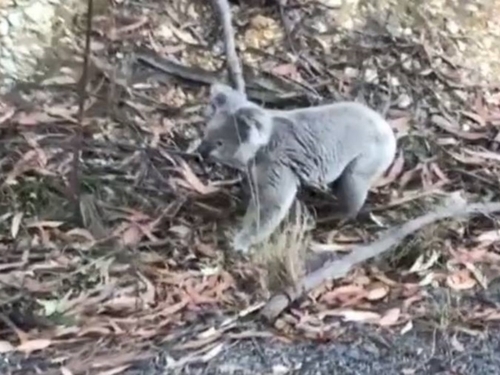
Koalas are medium-sized marsupials built entirely for slow life in the treetops. Unlike most tree-dwelling mammals they have no tail, a feature they share with their nearest relatives the wombats.
Body dimensions:
- Head-body length: 60-85 cm
- Tail: vestigial, a small cartilage nub hidden under fur
Weight by region:
- Overall range: 4-15 kg. Northern (Queensland) koalas are smaller, and Victorian koalas are about twice as heavy as Queensland ones
The size gradient from north to south follows Bergmann's rule, mammals tend to be larger in colder climates because larger bodies conserve heat more efficiently. Southern koalas also have noticeably thicker, shaggier, darker fur. Queensland koalas are shorter-haired, greyer and look almost sleek in comparison.
The koala's most distinctive external features are its rounded fluffy ears, broad leathery nose and hands. Each hand has five digits arranged in an unusual pattern: two opposable 'thumbs' and three fingers, all tipped with strong curved claws. This double-thumbed grip lets the koala wrap its hand around a branch from both sides simultaneously, allowing it to hang by a single arm while feeding.
The hindfeet are equally unusual, the second and third toes are fused into a single digit used as a grooming comb, and the first toe is large and clawless for gripping bark.
Male koalas are roughly 50% heavier than females and carry a prominent dark scent gland on the centre of the chest. They rub this gland on tree trunks to mark territory. Females lack this gland. Both sexes have fingerprints on the pads of their fingers.
Human-Like Fingerprints
Koala fingerprints are so structurally similar to human prints that they can be hard to tell apart under a microscope.
The evolutionary explanation is convergence. Humans and koalas are only very distantly related. Koalas independently evolved the same fine ridge pattern. The functional reason appears to be the same in both species, repeated gripping of irregular surfaces with fine tactile feedback. Humans grip tools, food and rocks.
Koalas grip bark and pluck individual eucalyptus leaves one at a time. Both tasks benefit from increased friction, improved mechanoreceptor sensitivity and the ability to feel fine differences in surface texture.
The Eucalyptus Diet
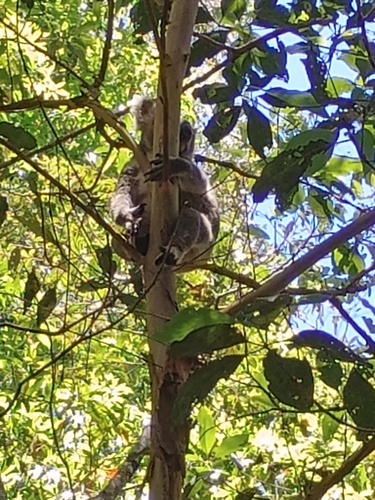
Koalas eat the leaves, shoots and bark of eucalyptus trees and almost nothing else. This is one of the most extreme dietary specialisations documented in any mammal.
Foliage from more than 600 species of Eucalyptus is available. Koalas show a strong preference for roughly 30 of them. Favourite species across the range include Eucalyptus camaldulensis (river red gum), E. microcorys (tallowwood), E. tereticornis (forest red gum), E. punctata (grey gum), E. viminalis (manna gum), and E. ovata (swamp gum).
Koalas select individual trees, individual branches and individual leaves based on nutrient content, moisture and toxin levels, a single koala will walk past many eucalyptus trees that other koalas eat from simply because the chemistry is wrong.
Daily intake:
| Metric | Value |
|---|---|
| Leaves consumed per day | Up to about 400 grams |
| Feeding sessions per day | 4-6 bouts, mostly at night |
| Water consumption | Occasional, mostly from leaves |
| Preferred eucalyptus species | Roughly 30 of 600+ available |
| Caecum length | Up to 2 metres, possibly the largest for an animal of its size |
Eucalyptus leaves are an extraordinarily difficult food. They are low in protein, low in calories, high in indigestible fibre and contain a suite of defensive chemicals including terpenes, phenolics, tannins and cyanogenic glycosides. Most of these compounds are toxic or lethal to mammals. Koalas survive on them through an impressive set of adaptations working in parallel.
First, a very long caecum filled with specialised bacteria ferments fibre and partially neutralises toxins. Second, a modified liver produces an unusual set of cytochrome P450 enzymes that metabolise terpenes and phenolics at far higher rates than most mammals. Third, the koala maintains an extremely low metabolic rate, so the small amount of energy extracted from a slow, sparse diet is enough.
Fourth, koalas have cheek pouches and cusped molars that break tough leaves into small particles.
Why Koalas Sleep 18-22 Hours a Day
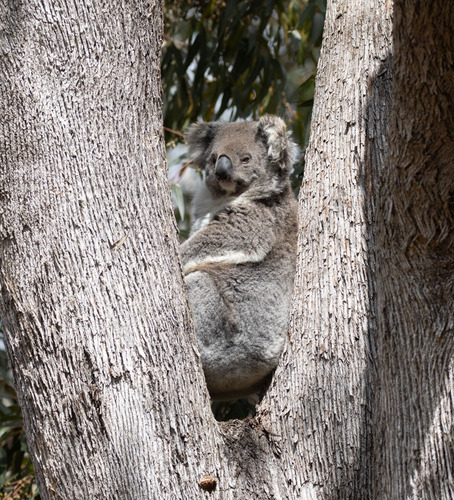
Koalas are famous for sleeping more than almost any other mammal. Most wild adults sleep between 18 and 22 hours out of every 24, split across multiple bouts wedged in tree forks. This is not laziness or a quirk of personality. It is the mathematical consequence of the eucalyptus diet.
Eucalyptus leaves provide very little digestible energy compared to fruits, grains, or meat. Extracting that energy requires hours of slow caecal fermentation, and processing the toxins simultaneously demands continuous liver work. Any unnecessary movement is energetically expensive.
The koala has responded by evolving a metabolic rate only about 50% of the typical mammalian rate, and by turning extreme stillness into a survival strategy.
Sleeping koalas pick a comfortable tree fork, wedge their body in place and let their long curved claws anchor them. Active time is used almost entirely for feeding, with short periods for grooming, social interaction during the breeding season, and movement between trees.
Brain anatomy supports the low-energy life. Koalas have one of the smallest brains relative to body size of any mammal. The brain is about 60% smaller than that of a typical diprotodont and does not fill the braincase, which is partly filled with cerebrospinal fluid. This reduced brain is not a sign of stupidity so much as another energy-saving adaptation: nervous tissue is extremely expensive to maintain, and the koala has evolved to spend as little energy on it as possible.
The Downward-Opening Pouch
Koalas are marsupials, which means their young complete most of their development attached to a nipple inside the mother's pouch rather than in a long-gestation placental womb. Koala pregnancy lasts only 33-35 days. A newborn joey weighs no more than 0.5 g, but its lips, forelimbs and shoulders are developed enough to crawl into the pouch.
What is unusual about the koala pouch is that it opens downward, toward the mother's hind legs. Upward-opening pouches are more familiar from kangaroos and wallabies, and they seem more intuitive for animals that spend time upright. A downward-opening pouch in a tree-climbing mammal looks like a design flaw.
The explanation is evolutionary. Koalas and wombats share a common ancestor within the order Diprotodontia, and that ancestor may have been a burrower, similar in lifestyle to modern wombats, which are the koala's closest living relatives. For a digging animal, a downward-opening pouch makes sense because it stays clear of soil, leaf litter and debris kicked up during excavation.
The koala's ancestors kept this anatomical layout even after moving into the trees, long enough ago that reshaping the pouch would have required major structural evolution.
To keep the joey safely inside a downward pouch, the koala has powerful sphincter muscles around the pouch opening that contract to form a seal. Once joeys are old enough to leave the pouch, around six to seven months, they cling to the mother's back or belly until about 12 months of age.
Pap: The Strangest Meal in Mammal Parenting
Mammalian milk contains a standard package of fats, sugars, protein and antibodies. Koala milk does too, but milk alone cannot transfer the bacteria a joey needs to digest eucalyptus. Newborn koalas have sterile guts, and without the right microbes they cannot survive weaning.
The solution is pap. Around the time a joey first pokes its head out of the pouch and starts sampling leaves, the mother produces a special soft, moist form of her own faeces called pap. The joey eats it directly from the mother's cloaca over a period of several weeks. This inoculates the joey's caecum with the bacterial community needed to ferment and detoxify eucalyptus, including microbes that break down specific terpenes in the leaves.
Pap is not regular faeces. It is softer, richer in bacteria and chemically different, a specialised excretion produced only during the weaning period. The habit looks unappealing from the outside, but it is a clean solution to a real problem: passing gut bacteria vertically from mother to young.
Joeys continue to feed on both milk and pap during the transition phase, then on milk and leaves and finally on leaves alone. Full independence from the mother typically occurs between about 1.5 and 2 years of age, at which point young koalas disperse to find their own home ranges.
Life Cycle and Reproduction
Koalas breed seasonally, with births from October to May. Females reach sexual maturity at about 3 years of age and males at about 4 years. Females can breed every year, but the long dependence of the young usually leads to year-long gaps in births.
Reproductive milestones:
- Gestation: 33-35 days
- Birth weight: no more than 0.5 g
- Pouch life: 6-7 months
- Back-riding phase: 6-12 months
- Weaning: completed around 12 months
- First dispersal from mother: about 1.5-2 years
Male competition for mates takes the form of vocal displays instead of physical combat. The dominant male generates a long, deep rattling bellow that propagates far through the forest. Visitors expecting a soft sound are startled by the result, which sounds more like a pig, a cow or a drunk horse than anything small and fuzzy. The call serves to advertise size (larger males produce lower frequencies) and to deter rivals.
Mating is brief, sometimes forceful and takes place in a tree. Gestation is among the shortest in mammals at scarcely over a month. Newborn joeys crawl unassisted from the birth canal through the mother's fur into the pouch, where they latch onto one of two teats. The teat swells inside the joey's mouth, forming a near-permanent connection until the joey is old enough to release voluntarily.
Populations and Range
Koalas are restricted to eastern and southeastern Australia. Estimates of the total wild population vary widely: the Australian Government's Threatened Species Scientific Committee estimated about 92,000 in 2021, the Australian Koala Foundation estimated 43,000-100,000 in 2022, and the CSIRO's National Koala Monitoring Program, using improved detection methods, estimated 729,000-918,000 in 2025.
Population distribution:
| State/Territory | Population share | Notes |
|---|---|---|
| Queensland | No reliable figure | Listed Endangered 2022 |
| New South Wales | No reliable figure | Listed Endangered 2022, fire-hit |
| Victoria | No reliable figure | Larger-bodied, thicker-furred |
| South Australia | No reliable figure | Includes Kangaroo Island refuge |
| ACT | No reliable figure | Small relict populations |
In February 2022, the Australian federal government formally upgraded koalas in Queensland, New South Wales and the Australian Capital Territory from Vulnerable to Endangered under the Environment Protection and Biodiversity Conservation Act. Victorian and South Australian populations remain classified separately and in some locations are locally abundant, or even overabundant on small islands, where koalas were introduced historically and now browse eucalypt stands to destruction.
Conservation Status and Threats
Koalas appear on the IUCN Red List as Vulnerable globally, with populations trending downward. Australian state and federal classifications are more severe, reflecting recent declines and the distinctive pressures facing northern populations.
Primary threats:
- Habitat loss. Land clearing for agriculture, grazing, urban development and infrastructure is the single largest driver of long-term koala decline. Many local populations are now confined to fragments of forest separated by roads, farms and suburbs.
- Vehicle strikes. Thousands of koalas are killed on Australian roads each year. Wildlife corridors, rope bridges and underpasses help but are not widely implemented.
- Dog attacks. Domestic dogs in semi-rural and suburban areas kill large numbers of koalas that move between tree fragments on the ground.
- Bushfires. The 2019-2020 Black Summer fires killed or displaced an estimated 60,000 koalas. Recovery is slow because koalas are site-faithful and rebuilding requires both surviving animals and intact feed trees.
- Chlamydia. Koala strains of Chlamydia pecorum and Chlamydia pneumoniae cause blindness, urinary tract disease and infertility.
- Koala retrovirus (KoRV). A retrovirus currently inserting itself into the koala germline, weakening immunity and interacting with chlamydia to accelerate disease progression.
- Climate change. Heatwaves cause direct mortality, and rising atmospheric CO2 reduces the protein content of eucalyptus leaves, worsening an already marginal diet.
- Inbreeding on small populations. Island refuges and isolated fragments show reduced genetic diversity and increased disease susceptibility.
Conservation responses include protected reserves, wildlife hospitals (notably the Port Macquarie Koala Hospital and Magnetic Island sanctuaries), captive breeding, habitat restoration, anti-chlamydia vaccine trials, and translocation of animals between fragmented populations. None of these individually addresses the scale of decline, and long-term survival of the species in the wild will depend on large, connected habitat networks that do not currently exist at the required scale.
The Chlamydia Pandemic
Chlamydia is the defining disease crisis in modern koala conservation. Unlike the human sexually transmitted infection caused by Chlamydia trachomatis , koala chlamydia is caused mainly by Chlamydia pecorum , with some contribution from Chlamydia pneumoniae . Both are bacterial pathogens adapted to koalas and spread through sexual contact, birth and close contact during grooming or fighting.
Symptoms include chronic conjunctivitis that progresses to blindness, cystitis that soaks the rump with urine and produces the condition colloquially called 'dirty tail', pneumonia and reproductive tract damage leading to infertility. In pregnant females infection can cause miscarriage or transmit directly to joeys during birth.
Treatment is difficult. Antibiotics that kill chlamydia also destroy the gut flora koalas need to digest eucalyptus, and many treated animals die of starvation or metabolic failure even when the infection clears.
Efforts are underway to use vaccination to try to stem the epidemic. Scaling vaccination to wild populations is logistically expensive and politically contested.
The Koala Retrovirus
Koalas are currently host to a retrovirus known as KoRV, the koala retrovirus, that is in the process of integrating itself permanently into the species' genome. This is unusual to witness. Most endogenous retroviruses colonised their host genomes millions of years ago and are detected today only as fossilised DNA. KoRV is doing it now.
Retroviruses insert their RNA genome into host DNA as part of their reproductive cycle. When a retrovirus infects a germline cell, a sperm or egg precursor, the inserted sequence can be passed to the next generation and becomes part of every cell of that offspring. Enough germline insertions over enough generations and the virus transitions from an infectious pathogen to a permanent resident of the genome.
Northern koala populations in Queensland appear to be further along this transition than southern populations. Most northern koalas carry KoRV in every cell, with multiple insertion sites in their chromosomes. Southern populations show a mix of infected and uninfected animals. The virus also appears to weaken immune function, possibly contributing to the severity of chlamydia in the same populations.
Scientists studying KoRV have a rare opportunity to observe genome colonisation as it happens, offering direct insight into processes that shaped every mammal genome, including ours, roughly 8% of human DNA is derived from ancient endogenous retroviruses.
Koalas and Humans
Human relationships with koalas span tens of thousands of years of Aboriginal custodianship and just a few centuries of European contact, with very different outcomes for the species.
Aboriginal peoples across the koala's range hunted and ate koalas in small numbers, wove stories around them and respected their presence in the forests.
European colonisation was catastrophic. Between 1888 and 1927, roughly 8 million koalas were hunted for their pelts, and Australia exported as many as two million pelts by 1924. Koalas were eradicated from South Australia, reduced almost to extinction in Victoria and sharply reduced in New South Wales. Public outcry eventually led to protections, though not before many regional populations had been lost entirely.
Modern Australia generally regards koalas as a national icon. Tourism centred on wildlife parks, zoos and sanctuaries generates meaningful income. Wildlife hospitals treat thousands of sick, injured, or burned koalas each year. Rehabilitation and release programmes return survivors to the wild where possible.
At the same time, land clearing for urban expansion and agriculture continues to destroy koala habitat, and conflicts between development and conservation remain unresolved in courts, planning bodies and state parliaments.
Koalas are also one of the most intensely studied marsupials, with dedicated research teams investigating chlamydia vaccines, KoRV biology, population genetics, habitat modelling and fire recovery. The combination of public affection, scientific attention and political leverage has kept koalas on the conservation agenda even as populations have declined.
Illustration.
Frequently asked questions
Adult koalas (Phascolarctos cinereus) measure 60-85 cm head-body with almost no visible tail. They weigh 4-15 kg. Northern koalas in Queensland are smaller, and Victorian koalas are about twice as heavy as Queensland ones, with thicker, shaggier fur. Males are roughly 50% heavier than females and have a dark scent gland on the chest used to mark trees.
Newborn joeys weigh no more than half a gram and crawl unaided from the birth canal into the pouch.
Koalas are among the most extreme dietary specialists in the mammal world. They eat eucalyptus leaves and almost nothing else. Foliage from more than 600 Eucalyptus species is available, but koalas show a strong preference for only about 30. An adult eats up to about 400 grams of leaf per day.
Eucalyptus leaves are low in protein, low in calories, high in fibre and loaded with oils, phenols and cyanogenic compounds that are toxic to most mammals. Koalas survive on this diet through a long caecum full of symbiotic bacteria, a liver that produces detoxifying enzymes, and a lifestyle that minimises energy demand.
Koalas live exclusively in eastern and southeastern Australia, across Queensland, New South Wales, the Australian Capital Territory, Victoria and parts of South Australia. They require eucalypt forests and woodlands with a continuous canopy and a selection of preferred feed trees. Historically koalas occupied a much larger range, land clearing, logging, urban sprawl and fire have fragmented their habitat into increasingly isolated patches.
They do not naturally occur in Western Australia, the Northern Territory, or Tasmania, although small introduced populations exist on Kangaroo Island and several Victorian islands used as historical refuges.
Koalas sleep between 18 and 22 hours a day, longer than almost any other mammal. The reason is dietary. Eucalyptus leaves provide very little digestible energy per gram, and extracting that energy requires a long, slow fermentation in the caecum. At the same time, the leaves contain toxins that the liver must constantly break down.
To survive on this diet, the koala has a low metabolic rate and a lifestyle built around minimising movement. Sleeping wedged in a tree fork is not laziness, it is the energy budget working exactly as evolved.
Koala fingerprints are so similar to human prints that they can be hard to tell apart under a microscope. Koalas and humans are only very distantly related, so the similarity is not inherited: it is convergent evolution. Both species grip irregular surfaces repeatedly with their fingertips: koalas grasping eucalyptus bark and leaves, humans grasping tools and food.
The whorls, loops and arches appear to improve grip and increase tactile sensitivity.
The IUCN lists koalas as Vulnerable across their global range, but national listings are more severe. In February 2022 Australia upgraded the koala from Vulnerable to Endangered under the EPBC Act in Queensland, New South Wales and the Australian Capital Territory. Koalas are over-abundant in parts of Victoria and South Australia, and small isolated populations face their own threats, including inbreeding.
Major pressures include habitat loss from clearing and development, vehicle strikes, dog attacks, chlamydia infection, koala retrovirus and catastrophic bushfires. The 2019-2020 Black Summer fires killed or displaced an estimated 60,000 koalas.
At first glance, the koala pouch opening toward the mother’s hind legs seems maladapted for a tree-dwelling animal. Evolution provides the likely answer. Koalas and wombats trace back to a common ancestor in the order Diprotodontia. That ancestor probably burrowed, and a downward-opening pouch would have kept dirt out while digging.
Even after koalas adapted to life in trees, they retained this pouch orientation. A strong muscle at the pouch opening ensures the joey cannot fall out.
Chlamydia is a serious infectious disease in koalas caused by Chlamydia pecorum and Chlamydia pneumoniae. These bacterial strains are different from the human sexually transmitted infection but cause comparable pathology: conjunctivitis leading to blindness, urinary tract infections known as ‘dirty tail’, pneumonia and infertility. Infection is common on the mainland but absent in some island populations.
Transmission occurs during mating, birth and close contact. Wildlife hospitals treat chlamydia with antibiotics, but the drugs can disrupt gut flora in the same animals that depend on microbes to digest eucalyptus. Efforts are underway to use vaccination to stem the epidemic, though scaling it to wild populations remains a major conservation challenge.
References
- Relevant peer-reviewed and governmental sources consulted for this entry include the IUCN Red List assessment for Phascolarctos cinereus (2020, 2024), the Australian Department of Climate Change, Energy, the Environment and Water EPBC Act listing documents (2022), the New South Wales Koala Strategy, published research in Australian Mammalogy, Conservation Genetics, Virology, Wildlife Research, and Proceedings of the Royal Society B, and technical reports from the University of the Sunshine Coast KoRV and chlamydia research programmes.