Orchid Mantis: A Flower That Beats Flowers
Hymenopus coronatusA 2014 study found pollinators landed on orchid mantises more often than on real flowers nearby. Males can be less than half the size of the females.
 Strange Animals EditorialJuly 26, 2025·14 min read·Editorial standards ↗
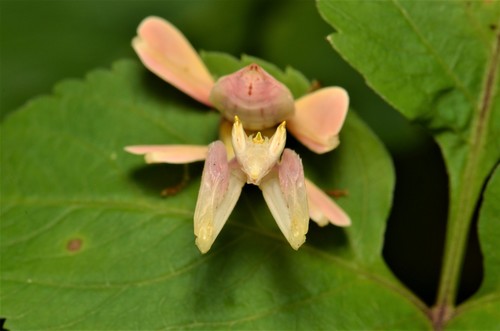
The orchid mantis is one of the most deceptive predators in the rainforest. Unlike most insects that evolve to look like their backgrounds in order to hide, Hymenopus coronatus evolved to look like a flower in order to attract prey. Flying pollinators, bees, wasps, butterflies and flies, land directly on the mantis thinking it is a blossom, and are seized and eaten. This behaviour is called aggressive mimicry.
This guide covers every aspect of orchid mantis biology and ecology: size, sexual dimorphism, colour change, hunting behaviour, diet, reproduction, the 2014 research that overturned what biologists thought they knew about the species, and the strange facts that make this small Southeast Asian insect one of the most interesting mantises alive.
Etymology and Classification
The scientific name Hymenopus coronatus combines two Greek-derived elements. Hymenopus means "membrane foot" or "hymen-footed", a reference to the flattened, leaf-like expansions on the walking legs. Coronatus means "crowned". The species was formally described by Manuel in Olivier in 1797.
In English the orchid mantis is also called the "walking flower mantis" and the "orchid-blossom mantis".
Taxonomically, the orchid mantis sits within the family Hymenopodidae, a group sometimes called the "flower mantises". Related species in genera such as Creobroter and Pseudocreobotra show similar floral colouration and flattened body shapes, though none match the extremity of H. coronatus in form or behaviour. The species belongs to the order Mantodea, the praying mantises.
Size and Sexual Dimorphism
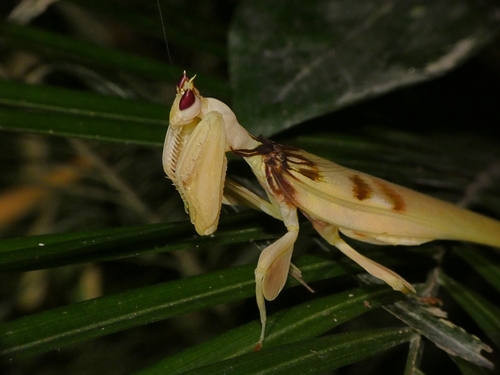
Orchid mantises show one of the most extreme size differences between sexes of any mantis.
Females:
- Size: considerably larger than the male
- Femoral lobes: broad, petal-like, prominent on all four walking legs
Males:
- Size: can be less than half the size of the female
Nymphs at hatching:
- Colouration: black body with bright red and orange markings, a mimic of assassin bugs, not flowers
Males can be less than half the size of females. A 2016 study by Svenson and colleagues concluded that selection for predation, rather than female fecundity, best explains the size difference in orchid mantises.
The Flower That Isn't a Flower
For a long time, biologists assumed the orchid mantis was a specialised mimic of a particular orchid flower. The assumption made intuitive sense, the insect clearly looks like a flower and the pink-and-white colouring fits the palette of many tropical orchids. It was repeated in field guides, popular books and documentary films for decades.
The problem is that nobody ever identified the orchid being mimicked. Researchers searched. No orchid matched the mantis in shape, proportion, or colour distribution. The assumption persisted anyway, bolstered by the force of repetition.
James O'Hanlon, an Australian biologist working in 2014 and his team published in American Naturalist findings that overturned the established narrative. They examined two competing ideas. One was the standard view: orchid mantises mimic a particular flower and conceal themselves within it. The other was more provocative: orchid mantises look like a generic, idealized flower and deliberately attract pollinators that mistake them for any blossom.
O'Hanlon's team measured how often pollinators landed on orchid mantises compared to real flowers nearby. The result was startling. Pollinators were attracted to the mantises more often than to real flowers in the same environment. The mantis did not need to hide inside a blossom, it was the blossom and in fact a better one than any specific real flower.
This is a biological phenomenon called supernormal stimulus: a signal that exaggerates or combines features of a natural signal in ways that trigger a stronger response than the natural version. The classic example involves gulls preferring to retrieve artificial eggs that are larger and more speckled than their own. Orchid mantises appear to do the same thing with flowers.
They combine the features of a generic attractive flower, symmetry, pale-but-contrasty colour, UV-absorbing white colouring, into a stimulus that pollinators find more compelling than any actual flower in the habitat.
Colour Change and Colour Matching
Orchid mantises can change colour between pink and brown according to the colour of the background.
Hunting and Diet
Orchid mantises are sit-and-wait predators. They perch on a flower, stem, or bare leaf, raise their bodies into a flower-like posture, and wait. When a pollinator approaches and lands, the mantis strikes with the raptorial forelegs, the long, spined front limbs that are the mantis's primary weapon.
Primary prey:
- Bees, including the oriental honeybee
- Small wasps
- Flies, including fruit flies
- Butterflies (including species much larger than the mantis)
- Moths and caterpillars
Secondary and occasional prey:
- Crickets
- Beetles
- Other smaller mantises (cannibalism)
Hunting technique sequence:
- Perch selection. A mantis moves to a perch near active pollinator traffic, sometimes a real flower, often a nearby stem or leaf.
- Postural display. The mantis raises its body, spreads the four petal-shaped femurs and holds the forelegs folded in the classic "praying" position.
- Waiting. The mantis remains motionless.
- Strike. When a pollinator lands within reach, the raptorial forelegs extend rapidly and clamp onto the prey. The spined inner edges prevent escape.
- Feeding. The mantis brings the prey to its mandibles and begins to eat.
Life Cycle and Reproduction
The orchid mantis life cycle runs from egg through nymph stages to a winged adult.
Life stages:
- Egg. Eggs are laid inside an ootheca, a frothy protein case produced by the female.
- Hatching. Nymphs emerge from the ootheca. The newly hatched nymphs are black and red, a pattern that mimics assassin bugs (Reduviidae), which are foul-tasting.
- Nymph. Nymphs moult several times. The flower-like form emerges gradually.
- Adult. Final moult produces a winged adult.
- Mating. Sexual cannibalism is a risk for males.
- Ootheca production. Mated females produce one or more oothecae.
- Egg guarding. Females have been reported to guard their eggs, a form of parental care noted in mantises.
Sexual Cannibalism and Mating Risk
Sexual cannibalism, the female eating the male before, during, or after mating, is a well-known feature of many mantis species. In orchid mantises the large size gap likely makes escape difficult once a male is caught.
From the female's perspective, eating a male provides a significant protein and fat bonus that supports egg production. Whether cannibalism is adaptive for the male, in the sense that being eaten improves his reproductive success, is debated. In some mantis species there is evidence that cannibalised males produce more offspring. In orchid mantises specifically the question is unsettled. What is clear is that the risk is real.
Habitat and Distribution
Orchid mantises inhabit the tropical forests of Southeast Asia. Recorded populations include:
- Malaysia
- Indonesia
- Thailand
- Cambodia , Laos , Myanmar , Singapore and Vietnam
- Possibly far eastern India and Bangladesh
They are not strictly associated with orchids. A historic account describes them hunting on the flowers of the Straits rhododendron ( Melastoma polyanthum ).
Conservation Status
The orchid mantis is favoured by insect breeders and is reported to be rare and expensive in the trade. Like other tropical forest invertebrates, it depends on intact habitat and on the flowering plants and insects found there.
Orchid Mantises and Humans
Orchid mantises have no significant negative impact on humans. They do not bite effectively, do not damage crops and are not vectors of disease. Their relationship with humans is primarily cultural and commercial.
The species has become a minor icon of evolutionary biology: appearing in documentaries, biology textbooks and popular accounts of mimicry and deception in nature.
In the exotic pet trade, the orchid mantis is favoured by insect breeders but is reported to be rare and expensive. Captive care requires a tall, well-ventilated enclosure with live or artificial flowers for perching and a diet of small insects such as flies. Handling should be minimal.
Breeding in captivity is possible but requires careful introduction of males to females to manage sexual cannibalism risk, and successful rearing of nymphs requires separating them quickly to avoid cannibalism among siblings.
Exotic invertebrate legal status divides by region. Ecological concerns have led some areas to restrict imports of exotic invertebrates. Prospective keepers must consult local regulations before obtaining specimens.
Research History and Ongoing Questions
The 2014 O'Hanlon study was a turning point for orchid mantis research. Before it, the species was treated as a curious example of conventional camouflage mimicry. After it, the orchid mantis became a flagship case study for aggressive mimicry and supernormal stimulus in invertebrates. The study opened several new research directions that remain active.
Ongoing and open questions include:
- What is the precise visual signal? Which specific features of the orchid mantis's form, colour and UV pattern drive the pollinator attraction?
- Does colour flexibility matter? Do pink individuals attract different pollinator species than white ones?
- How widespread is supernormal stimulus in predatory mimicry? Are other flower-mimic invertebrates using the same trick, or is H. coronatus exceptional?
- What explains the extreme sexual dimorphism? A 2016 study by Svenson and colleagues concluded that selection for predation, not female fecundity, explains the size difference, though the topic continues to be studied.
- How do nymphal mimicry transitions work? The shift from assassin-bug mimicry in hatchlings to flower mimicry later in life is not fully understood.
These questions make the orchid mantis a living laboratory for biologists interested in evolution, perception and deception.
Frequently asked questions
Orchid mantises (Hymenopus coronatus) show some of the most pronounced size differences between the sexes of any mantis. Males can be less than half the size of females. A 2016 study concluded that selection for predation, not female fecundity, best explains this size difference.
Newly hatched nymphs are black and red and mimic assassin bugs. The flower-like form develops gradually as the nymphs moult.
Orchid mantises live in the tropical forests of Southeast Asia. Recorded populations include Cambodia, Indonesia, Laos, Malaysia, Myanmar, Singapore, Thailand and Vietnam. They may also extend into far eastern India and Bangladesh.
They are not strictly associated with orchids. One historic account describes them hunting on the flowers of the Straits rhododendron (Melastoma polyanthum).
Orchid mantises are ambush predators that mainly catch insects. Their diet includes flies, bees, small wasps, beetles, crickets and butterflies and they prefer lepidopteran prey in the laboratory. They can ambush butterflies, which are fairly large prey. Some are cannibalistic.
The 2014 research by O’Hanlon and colleagues found that orchid mantises attract more pollinators than real flowers do. This turns the mantis from a camouflaged hider into an active lure.
Not exactly. For a long time biologists assumed the orchid mantis mimicked a specific real orchid. There is no evidence that it mimics any particular orchid. Instead it resembles flowers in general, including their UV-absorbing white colouring, which makes it look flower-like to UV-sensitive pollinators.
The 2014 study by James O’Hanlon and collaborators showed that pollinators were attracted to the mantis in greater numbers than to real flowers. In effect, the mantis is a fake flower that attracts more visitors than the real thing.
No reliable lifespan figures were confirmed for this article. Like other mantises, the orchid mantis passes through egg, nymph and adult stages and the nymph stage involves several moults before the winged adult appears.
Yes, but slowly. Orchid mantises can change colour between pink and brown according to the colour of the background. This is not a rapid change like that of a chameleon.
Sexual cannibalism is common in many mantis species, and orchid mantises are no exception. Females are much larger than males, so a male who is caught probably has little chance of escape. From the female’s perspective, a male can be both a mate and a protein-rich meal that supports egg production.
Whether cannibalism increases male reproductive success in orchid mantises specifically is still debated, but the risk is real.
Yes. The orchid mantis is favoured by insect breeders, though it is reported to be rare and expensive.
A captive orchid mantis needs a tall, well-ventilated enclosure with live or artificial flowers for perching and a diet of small insects such as flies. Handling should be minimal. Breeding in captivity requires careful introduction of the sexes to manage sexual cannibalism.
Legal status varies by country, and some regions restrict import of exotic invertebrates.
References
- Relevant peer-reviewed sources consulted for this entry include O'Hanlon, J. C., Holwell, G. I., and Herberstein, M. E. (2014) "Pollinator deception in the orchid mantis" published in The American Naturalist, which found that orchid mantises attract more pollinators than real flowers. Additional material draws on Svenson, G. J., and Whiting, M. F.
- (2009) "Reconstructing the origins of praying mantises" in Cladistics.
- Svenson, G. J., Brannoch, S. K., Rodrigues, H. M., O'Hanlon, J. C., and Wieland, F. (2016) "Selection for predation, not female fecundity, explains sexual size dimorphism in the orchid mantises", Scientific Reports 6: 37753.
- O'Hanlon, J. C., Li, D., and Norma-Rashid, Y. (2013) "Coloration and Morphology of the Orchid Mantis Hymenopus coronatus (Mantodea: Hymenopodidae)", Journal of Orthoptera Research 22(1): 35-44.