European Praying Mantis: Sees in 3D
Mantis religiosaUnlike almost every other insect, this mantis sees in stereo, shown in 1983 and in 2016 with a 3D insect cinema. Only about 10% survive the first instar.
 Strange Animals EditorialMay 29, 2025·15 min read·Editorial standards ↗
The European praying mantis has traits that make it one of the most specialised ambush predators in the animal kingdom and the insect most frequently compared, with some justification, to a miniature vertebrate. Unlike almost every other insect, Mantis religiosa has binocular stereoscopic vision, a head that rotates nearly 180 degrees and a rapid raptorial strike.
It hunts other insects, and with surprising regularity it kills small vertebrates: lizards, frogs, even small birds. It is alert, cryptic, patient and uncommonly responsive to the movement of a human hand.
This guide covers the European praying mantis, the representative species for the roughly 2,400 mantises that make up the order Mantodea, in full: anatomy, vision, the raptorial strike, diet, the overstated but real story of sexual cannibalism, reproduction via the foam ootheca, distribution, cultural history in Chinese medicine and martial arts, and the conservation status that separates the abundant European mantis from its more fragile tropical relatives.
As with every entry in this series, this is a reference page rather than a summary, and it carries the specifics: millimetres, milliseconds, egg counts and dates.
Etymology and Classification
The scientific name Mantis religiosa was assigned by Carl Linnaeus in 1758. Mantis is a Greek word meaning 'seer' or 'prophet', and religiosa refers to the insect's distinctive posture: forelegs folded together in front of the thorax in a pose that early naturalists compared to prayer.
Common names in most European languages reflect the same idea, Gottesanbeterin ('God-worshipper') in German, mante religieuse in French, mantide religiosa in Italian. The posture has nothing to do with devotion. It is the ambush position. A mantis holding its arms in the prayer fold is loaded and waiting.
The order Mantodea contains approximately 2,400 described species distributed across every continent except Antarctica, organised into roughly 30 families. Mantises are most closely related to cockroaches (Blattodea) and termites, mantises are thought to have evolved from cockroach-like ancestors, and the earliest confidently identified mantis fossils date to the Early Cretaceous. Mantis religiosa itself belongs to the family Mantidae, the largest and most widely distributed mantis family.
The species was introduced to North America. It is now found across much of the northeastern United States, Ontario, Quebec and parts of the west coast, where it coexists with the also-introduced Chinese mantis ( Tenodera sinensis ) and the smaller native Carolina mantis ( Stagmomantis carolina ).
Size and Physical Description
Sexual dimorphism appears strongly in praying mantises with females markedly larger and heavier than males. Mantis religiosa females measure roughly 6-8 cm long while males are about 5-7 cm.
Females:
- Body length: about 6-8 cm
- Broad, heavy abdomen that holds the developing eggs
- Winged, but adult females are generally too large and heavy to take off
Males:
- Body length: about 5-7 cm
- Slender abdomen
- Full-length wings, males are usually more active and agile than females
Other key anatomical features shared by both sexes:
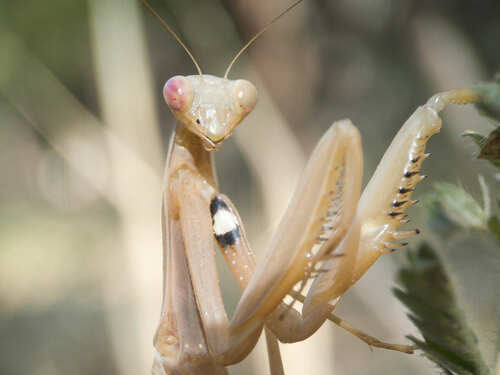
- Triangular head with two large compound eyes
- Three ocelli (simple eyes) arranged in a triangle between the antennae
- Elongated prothorax that functions mechanically like a neck
- Two raptorial forelegs covered in opposed rows of sharp spines
- Four walking legs
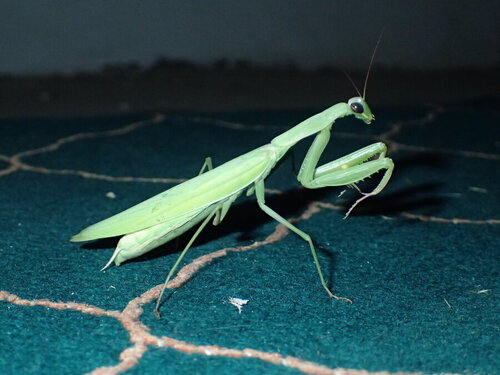
- Colour morphs: shades of yellow, brown, green and sometimes black
The cause of the colour variation has been debated for over a century and no generally accepted explanation exists, but observations in 1904 found green mantises on fresh grass and brown ones on sun-scorched grass, suggesting a camouflage function. A distinguishing mark of the species is the black eyespot with a yellow or white centre at the base of each foreleg, which is used to tell it from other species.
Vision: Stereoscopic Sight in an Insect
Mantises have true stereoscopic, binocular vision, which they use specifically for spotting and capturing prey. Their two large compound eyes are widely spaced on the sides of a wide triangular head, giving a wide binocular field and precise stereoscopic vision at close range.
Stereopsis in mantises was first demonstrated by Samuel Rossel in 1983, and in 2016 Nityananda and colleagues showed it again using a 3D insect cinema (Scientific Reports).
Mantises also use side-to-side peering movements, which are believed to help in measuring distance.
A triangular head sits atop the long flexible prothorax. Some mantises can rotate the head nearly 180 degrees to track prey while the rest of the body stays almost immobile.
The Raptorial Strike
Once prey is within reach, the mantis strikes rapidly, snapping the spiked raptorial forelegs shut around it.
The mechanics are elegant. The raptorial foreleg is divided into three working segments: the elongated coxa that projects forward like a forearm, the femur lined on its inner edge with paired rows of sharp spines, and the tibia which folds back against the femur to form a snap-shut trap. When the mantis strikes, the tibia closes against the femur and the two rows of spines interlock, pinning prey in place with no possibility of wriggling free.
Hunting and Diet
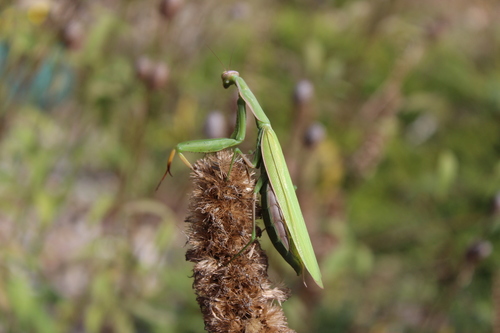
Praying mantises are strict carnivores and obligate ambush predators. They do not use venom. The hunt is always the same: hold position on a plant stem matching the mantis body colour, lock the eyes onto a moving target, wait, strike, hold and eat.
Primary prey, insects:
- Flies and midges
- Crickets and grasshoppers
- Moths and butterflies
- Bees and wasps
- Beetles
- Other mantises
Secondary prey, small vertebrates:
- Lizards
- Frogs
- Small birds
Prey is gripped by the spined forelegs and eaten while still alive, starting with whichever body part is closest to the mouth.
Sexual Cannibalism: The Overstated Story
Few animal behaviours have generated more folk mythology than the female praying mantis eating her mate. The image is almost universally known: the female begins feeding on the male's head during copulation, the decapitated male continues mating, the female finishes him after fertilisation is complete. The physiology is real, but the behaviour is far from universal.
A 1992 field study of Mantis religiosa by Lawrence found cannibalism in 31 per cent of natural pairings and 24 per cent of manipulated pairings, which showed that the behaviour is not just an artefact of captivity. Laboratory conditions can intensify it: females starved for more than three days were more likely to attack males, even before copulation.
Why the behaviour occurs at all has been studied since the 1930s. Current evidence supports several partly overlapping explanations:
- Nutritional subsidy. A male represents a substantial protein meal at the exact moment the female is provisioning eggs. The meal may allow faster production of a large ootheca with large eggs.
- Opportunistic predation. The female is an obligate predator, and a nearby moving insect, even a conspecific male, triggers the strike response unless he approaches correctly.
- Paternal investment. From the male's perspective, being eaten passes on substantial biomass to his own offspring, which may be adaptive under some models.
The headless-mating phenomenon is genuine and well understood. The copulatory reflex is controlled by a ganglion in the abdomen, not the brain, so decapitation does not stop sperm transfer and can even release inhibition, prolonging copulation. This neurological decoupling is the reason the behaviour ever became folklore in the first place, it is spectacular, but not universal.
Reproduction and the Ootheca
Reproduction in Mantis religiosa is keyed to a single-season annual cycle. Adults mature in summer, mate in autumn and die before winter. Only the eggs, wrapped inside the foam ootheca, survive the cold months.
Seasonal cycle:
- Spring: eggs hatch, nymphs emerge
- Summer: nymphs pass through up to eight moults, females usually needing one more than males
- After the final moult: adults emerge with wings
- September to October: mating season, males approach females by sight
- Autumn: females lay oothecae
- Winter: adults die, eggs overwinter
The ootheca is the distinguishing reproductive structure of all mantises. The female secretes a liquid protein foam from specialised glands near the ovipositor and whips it into a froth while depositing eggs in orderly chambered rows inside. The foam hardens into a tough, weatherproof, insulating capsule attached to a plant stem, rock, or wall.
A single M. religiosa ootheca contains around 100 to 200 eggs. Most eggs from one ootheca hatch at the same time in spring, always in the morning.
| Reproductive metric | Value |
|---|---|
| Eggs per ootheca | 100-200 |
| Nymph instars to adult | Up to 8 moults |
Nymphs are miniature, wingless versions of the adult and begin hunting on their first day. Only about 10 per cent survive the first instar, because of a lack of suitably sized food, low temperatures or low humidity.
Distribution, Habitat, and Introduced Range
Mantis religiosa is native to southern and central Europe, North Africa and parts of temperate Asia. In recent years it has been reported further north in Latvia and Estonia, and it breeds on the Channel Islands.
Preferred habitat:
- Warm, dry, sunny grassland and meadow
- Pasture edges, vineyards, orchards, abandoned lots
- Low shrubland and tall herbaceous vegetation
- Suburban gardens with mixed structure and sunlit borders
The mantis depends on vertical stems and leaves as ambush perches and on direct solar radiation to warm its flight muscles. It does not thrive in dense closed-canopy forest, marshland, or high mountain environments.
Introduced populations:
- North America sees operations in the northeastern United States, Ontario, Quebec and portions of the west coast established.
In North America it is the official state insect of Connecticut despite being introduced. Globally it is assessed as Least Concern, although it is listed as endangered on the German Red List.
Cultural and Historical Significance
Few insects carry the cultural weight of the praying mantis. Across recorded history the species has been a figure in medicine, martial arts, religion and folklore.
Chinese traditional medicine. Mantis oothecae are described in early Chinese texts: the ancient dictionary Erya contains one of the earliest mantis references, and a medical text of 1108 gives accurate details of the egg packages.
Kung fu mantis style. Northern Praying Mantis ( tanglangquan ) is one of the traditional Chinese martial arts, from Shandong province, said in folk tradition to have been created by Wang Lang, whom most legends place in the late Ming or early Qing dynasty (around 1650), though many martial scholars doubt he existed. The style takes its inspiration from the aggressiveness of the insect.
Southern Praying Mantis is a separate style that developed independently in southern China. Both styles emphasise short, fast, simultaneous attack-and-block movements that mirror the mantis raptorial strike.
Western folk symbolism. European folklore cast the mantis variously as a hermit, a prophet, a guide for lost travellers, or a pious creature in prayer. The Greek etymology of the genus name encodes this last reading. None of these interpretations has any basis in the animal's actual behaviour, which is essentially ambush predation.
Indigenous African symbolism. Among San and Khoekhoe peoples of southern Africa, the mantis appears as Kaggen, a trickster-creator figure in cosmological stories, though the species referenced is usually an African mantis rather than M. religiosa .
The Single Ear: Ultrasonic Bat Detection
Mantis religiosa has a single ear, an unpaired structure on the ventral midline of the thorax between the hind legs. It is sensitive across a wide range of frequencies including ultrasound, and many mantises use hearing to detect the echolocation calls of hunting bats.
When a flying mantis detects an approaching bat, it stops flying horizontally and begins a descending spiral toward the ground, often preceded by an aerial loop or spin.
Conservation Status
The IUCN Red List classifies Mantis religiosa as Least Concern . The species is widespread across Europe, North Africa, temperate Asia and its introduced range in North America, with no overall population decline. In Germany it is listed as endangered on the national Red List, based on a 1998 assessment and it may not be caught or kept as a pet, but it is not considered globally threatened.
Threats at the local level:
- Intensive agriculture and broad-spectrum pesticide use reduce insect prey
- Loss of unmown grassland and meadow habitat
- Habitat fragmentation between suitable sunlit patches
Praying Mantises and Humans
The European praying mantis is broadly welcomed by humans. As a general predator of garden pests, it is tolerated or actively encouraged in vineyards, orchards and vegetable gardens across its range, and oothecae are sold commercially in the United States for garden release.
The mantis is not dangerous to people and has no venom. The species is commonly kept as a household pet, especially by entomology enthusiasts and is one of the easier insects to maintain because it requires only a perch, a mist of water and live insect prey.
Gardeners occasionally find the species controversial because it consumes bees and other pollinators alongside pest insects, a non-selectivity that reflects its generalist feeding.
Frequently asked questions
The European praying mantis (Mantis religiosa) shows sexual dimorphism. Females are usually larger and heavier than males, roughly 6 to 8 cm long against 5 to 7 cm. Females are also broader across the abdomen, which carries the developing eggs. Both sexes have the same basic shape: a triangular head, an elongated prothorax that works almost like a neck, and two large raptorial forelegs folded in the prayer position.
Colour varies between shades of yellow, brown and green and sometimes black.
Praying mantises are carnivorous ambush predators. The bulk of the diet is other insects: flies, crickets, grasshoppers, moths, butterflies, bees, wasps, beetles and other mantises.
A mantis will also kill and eat small vertebrates when the opportunity arises: documented prey includes lizards, frogs and small birds. The mantis relies on vision and the raptorial strike, and it does not use venom. Prey is held in place by the spined forelegs and eaten alive, starting with the body part closest to the mouth.
Sometimes, but the reputation is overstated. Field observations suggest that about a quarter of male-female encounters end with the male being eaten, and a 1992 field study of Mantis religiosa found 24 to 31 per cent. Captivity and hunger can intensify the behaviour: females starved for more than three days were more likely to attack males.
Headless males can continue copulation because the copulatory reflex is controlled by a ganglion in the abdomen, and removing the head can even remove inhibition and prolong mating. When cannibalism does occur, the female gains a substantial meal that may support faster production of a large ootheca with large eggs, which may be why the behaviour persists despite the cost to males.
Mantis religiosa is found throughout Europe, Asia and Africa. It was introduced to North America, where it is now found across much of the northeastern United States, Ontario, Quebec and parts of the west coast. Preferred habitat is warm, dry, sunny grassland: meadows, pasture edges, shrubland, vineyards, abandoned lots and suburban gardens with tall herbaceous plants.
The mantis depends on vertical stems and leaves for ambush perches and on solar heat to power its muscles. Gardeners often tolerate or encourage it as a general insect predator.
In Mantis religiosa males live about 7 to 8 months and females about 11 to 12 months. Eggs are laid in autumn inside an ootheca, overwinter and hatch in spring as miniature wingless nymphs. The nymphs pass through up to eight moults, called instars, before the winged adult emerges and females usually need one more moult than males. Adults mate in autumn and do not survive the winter.
Only the eggs inside the ootheca survive winter, so the next generation starts again each spring.
Three features make Mantis religiosa an effective ambush predator. First, stereoscopic vision: the two widely spaced compound eyes give a wide binocular field and precise depth perception at close range.
Second, a triangular head on a long flexible prothorax can rotate nearly 180 degrees, letting the mantis track prey without moving its body and losing its camouflaged outline.
Third, the raptorial forelegs strike rapidly and trap prey between rows of spines on the femur and tibia.
Mantis religiosa is listed as Least Concern by the IUCN. The species is widespread across Europe, Asia, Africa and the introduced range in North America. In Germany it is listed as endangered on the national Red List (a 1998 assessment) and may not be caught or kept as a pet, but it is not considered globally threatened.
Pesticide use and intensive agriculture reduce prey and local populations, as does loss of unmown grassland.
An ootheca is the protein foam egg case produced by female mantises. The female secretes a froth from glands in the abdomen and deposits eggs in orderly rows inside. The foam hardens into a tough, weatherproof, insulating capsule attached to a stem, wall, or rock.
A single Mantis religiosa ootheca contains around 100 to 200 eggs. The eggs overwinter, and the following spring most of the nymphs hatch at the same time, always in the morning.