Alligator Snapping Turtle: Up to 80 kg
Macrochelys temminckiiNorth America's largest freshwater turtle generally weighs 8.4-80 kg and lures prey with a worm-like tongue. It matures at about 12 years and is Endangered.
 Strange Animals EditorialMay 3, 2025·16 min read·Editorial standards ↗
The alligator snapping turtle is the largest freshwater turtle in North America, a prehistoric-looking reptile whose spiked shell, hooked beak and worm-like tongue lure make it one of the most unusual predators on the continent. Macrochelys temminckii lives almost its entire life underwater in the rivers, bayous and swamps of the southeastern United States.
It rarely chases prey. It rarely moves. Instead, it sits on the river bottom, opens its jaws and waits for fish to swim directly into its open mouth.
This guide covers every aspect of alligator snapping turtle biology and ecology: taxonomy, size, anatomy, the famous tongue lure, diet, reproduction, temperature-dependent sex determination, longevity, the disputed 2014 species split and the long history of human exploitation that has left the species listed as Endangered by the IUCN.
Etymology and Classification
The genus name Macrochelys is built from Greek roots meaning 'large turtle'. The species epithet temminckii honours the nineteenth-century Dutch zoologist Coenraad Jacob Temminck. The species name dates to Troost in Harlan, 1835 (as Chelonura temminckii ).
Alligator snapping turtles belong to the family Chelydridae , which contains only two living genera: Macrochelys and Chelydra . The latter contains the more widespread and much smaller common snapping turtle ( Chelydra serpentina ), with which alligator snappers are often confused.
Despite the superficial resemblance the two species differ in almost every life-history detail: common snappers are active foragers, alligator snappers are sit-and-wait ambushers, common snappers tolerate cool water and northern winters, alligator snappers are tied to the warm southeast, common snappers have smooth carapaces, alligator snappers have three prominent keels running the length of the shell.
The fossil record for Macrochelys extends back to the Miocene.
The 2014 Species Split
In 2014, a combined morphological and mitochondrial DNA study by Thomas et al. proposed splitting what had long been considered a single species into three distinct species, each associated with a different major river drainage:
- Macrochelys temminckii. The nominate form, covering the Mississippi River drainage and most of the historic western and central range
- Macrochelys suwanniensis. The Suwannee snapper, endemic to the Suwannee River drainage of northern Florida and southern Georgia
- Macrochelys apalachicolae. The Apalachicola snapper, endemic to the Apalachicola-Chattahoochee-Flint system of Florida, Georgia and Alabama
The Suwannee split has been broadly accepted, and the Suwannee snapping turtle is recognised as a separate species.
The Apalachicola split has proved more controversial. Follow-up nuclear DNA analyses have argued that the genetic distance between apalachicolae and temminckii is below the threshold normally used for species recognition, and that the morphological differences can be explained by clinal variation.
The Apalachicola snapping turtle is generally not recognised as a valid species.
For the purposes of this entry, 'alligator snapping turtle' refers to the broader Macrochelys temminckii sensu lato, with the Suwannee form treated as a separate species where data permit that distinction.
Size and Physical Description
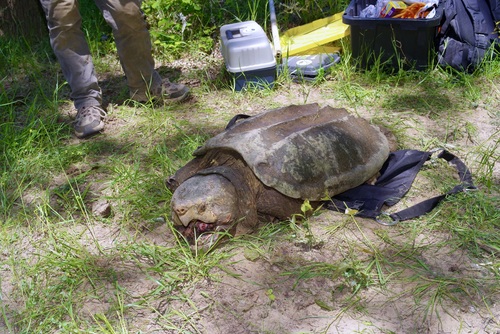
Alligator snapping turtles are the largest freshwater turtles native to North America. Sexual dimorphism is strong, with males growing substantially larger than females.
Adults:
- Carapace length: generally 35-80.8 cm
- Weight: generally 8.4-80 kg, specimens over 45 kg are usually very old males. The heaviest verifiable captive specimen weighed about 113 kg, and an unverified 183 kg turtle was reported from Kansas in 1937
- Males are typically larger than females
Sex differences:
- A mature male has a thicker tail base than a female
Hatchlings:
- Hatchlings are far smaller than adults
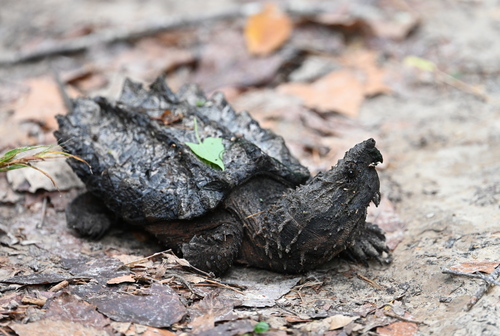
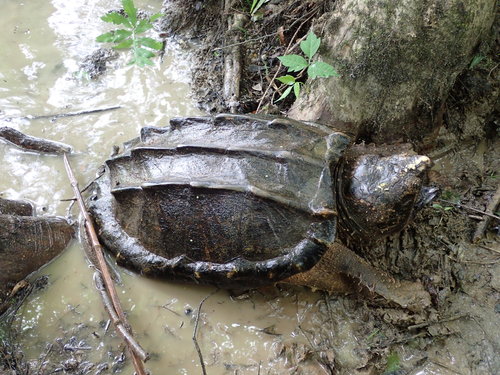
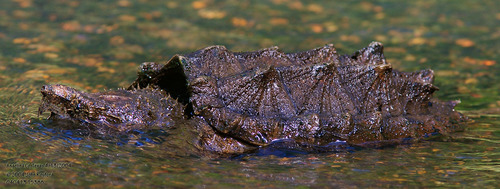
The shell is unmistakable. The carapace carries three prominent, lengthwise keels of sharp-pointed scutes, making the turtle look superficially like a spiked sandstone boulder. Colouration ranges from dark grey-brown to nearly black, and in wild adults the keels are almost always coated in algae. The plastron (lower shell) is reduced and cross-shaped, leaving large areas of flesh exposed, a trade-off that allows the long neck and big head the manoeuvring room they need to strike.
The head is enormous and triangular, dominated by a strongly hooked beak. The eyes sit on the side of the head and are surrounded by fleshy dermal projections that break up the outline underwater. The skin of the neck, legs and tail carries additional fleshy tubercles that enhance the overall effect of being a submerged root mass rather than an animal.
Most turtles can pull their head completely inside the shell, but the alligator snapper cannot. Its head is too big and its neck muscles too developed for the hinge-and-fold mechanism that smaller turtles use. Defence comes from the bite instead.
The Tongue Lure and Ambush Hunting
The defining feature of alligator snapping turtle biology is the lingual lure: a small, bright pink, worm-shaped appendage attached to the tongue floor. Hunting proceeds in a simple but remarkable sequence.
- The turtle settles on the bottom, often near sunken logs or the base of a cutbank.
- It opens the jaws wide, holding them open.
- Muscles in the tongue base contract rhythmically, making the lure wriggle in a motion that mimics an earthworm or small leech.
- A fish investigates, aiming for what looks like easy prey.
- The jaws close with great speed.
This is one of the few documented examples of aggressive mimicry in reptiles, a hunting strategy where the predator imitates something of interest to its prey.
Not every meal involves the lure. Adults also grab water snakes, ducks swimming at the surface, smaller turtles and carrion that drifts within reach. When prey is present but unsuspecting, the turtle may simply ambush with the mouth closed, striking as a snake would.
Diet
Alligator snapping turtles are opportunistic feeders that are almost entirely carnivorous. In one Louisiana study, 79.8 per cent of the stomach contents of adults was other turtles, although hard shell fragments may stay in the gut longer than other items.
Primary prey:
- Fish, catfish, bass, sunfish, gar, buffalo fish, minnows
- Freshwater mussels and clams
- Crayfish
Secondary and opportunistic prey:
- Water snakes
- Frogs and large tadpoles
- Smaller turtles
- Ducks and other waterfowl swimming near the bottom
- Small mammals that fall into the water (nutria, muskrat)
- Carrion
Plant matter is also recorded in the wild, including seeds, tubers and acorns. In one study of 65 turtles, acorns made up 56 per cent of the stomach contents by volume.
Life Cycle and Reproduction
Alligator snapping turtle reproduction is a once-a-year event with a long, slow cadence. Mating takes place yearly, in early spring in the southern part of the range and later in spring in the north.
Females emerge from the water about two months after mating to build nests by digging. Only nesting females are seen venturing onto open land. Each nest site is chosen at least 50 yards from the water to avoid flooding.
Nesting cycle:
- About two months after mating: female hauls out and digs a nest cavity
- 10-50 eggs laid per clutch
- Incubation: 100-140 days
- Hatching: early fall
- Hatchlings dig out and make their way to water
Some females lay eggs every year and others every other year. Maturity is reached at around 12 years of age.
Predators pose the greatest threat to the species during hatching and the very early stages that follow. Bird or mammal eggs are vulnerable to predation, and the risk declines as the turtle develops. Northern river otters are the main predator of juvenile turtles across much of the species' range.
Temperature-Dependent Sex Determination
Alligator snapping turtles have temperature-dependent sex determination (TSD): the sex of the young depends on the temperature at which the eggs are incubated. In this species, higher temperatures produce more males in a clutch.
Longevity
The potential lifespan of the alligator snapping turtle in the wild is unknown. It is believed capable of living to 200 years, but 80 to 120 is more likely. In captivity it typically lives between 20 and 70 years.
Because the species matures late, at around 12 years of age, the removal of breeding adults can strongly affect populations.
Movement, Range, and Behaviour
Alligator snapping turtles are nearly sedentary by turtle standards. A study in Oklahoma found an average home range of about 750 m, with females having larger home ranges than males. The turtles use core sites with cover such as cut banks, root balls and submerged trees.
Winter behaviour is marked by a reduction in feeding activity. In the northern parts of the range, alligator snappers brumate on river bottoms, often under overhanging banks or in log jams, breathing infrequently and essentially never feeding for weeks at a time. In the southern parts of the range, mild winters allow year-round activity at reduced pace.
Populations and Range States
The historic range of Macrochelys temminckii sensu lato covered most of the Mississippi River drainage and associated Gulf coast rivers, from southeastern Iowa and western Illinois through eastern Texas and east to the Florida Panhandle.
Some states have banned collection from the wild. The species is endangered in several states, including Indiana, Illinois, Kentucky and Missouri, where it is protected by state law.
Conservation Status and Threats
The IUCN Red List (2025 assessment) lists Macrochelys temminckii as Endangered , and the species is listed in CITES Appendix II.
Primary threats:
- Historical commercial harvest. Populations in the US are at historic lows, mainly because of harvesting the turtles for their meat.
- Habitat loss. Habitat destruction has contributed to the decline.
- Illegal collection. Collection for the exotic pet trade has contributed to the decline.
Turtle Soup and Cultural History
Harvesting the turtles for their meat is the main reason populations are now at historic lows.
Alligator Snapping Turtles and Humans
Outside of direct harvest, human interactions with alligator snappers are relatively rare. The species' aquatic lifestyle and preference for deep, structured water mean most swimmers, boaters and anglers will never see one. Anglers working the lower Mississippi and its tributaries occasionally hook them on trotlines or jug lines, at which point the safest response is to cut the line rather than attempt to bring the turtle into the boat.
Alligator snappers are handled by wildlife professionals using technique-specific grips that keep fingers safely distant from the head. Raising the animal by the tail, although appearing in some old photographs, is strongly discouraged since it causes vertebral injury to the turtle and places the handler's legs within striking distance.
For people who encounter an alligator snapping turtle crossing a road during the nesting season, the correct response is to move the turtle across the road in the direction it was already heading, using a shovel or wide board, without flipping the animal or holding it by the tail. The turtle will nest successfully on its own given a chance to continue its journey.
Photo: Peter Paplanus, Alligator snapping turtle, CC BY 2.0, via Wikimedia Commons.
Frequently asked questions
Adult alligator snapping turtles (Macrochelys temminckii) generally have a carapace length of 35 to 80.8 centimetres and weigh 8.4 to 80 kilograms. Males are typically larger than females, and specimens over 45 kilograms are usually very old males. The heaviest verifiable specimen, a captive turtle, weighed about 113 kilograms. A 183-kilogram turtle reported from Kansas in 1937 was never verified.
The species continues to grow throughout life.
The turtle sits motionless on the bottom with its mouth open. On the tongue is a small, pink, worm-shaped appendage that imitates the movements of a worm. Fish that come to investigate what looks like easy prey are caught when the mouth closes with tremendous speed and force.
This is a form of aggressive mimicry. Small fish such as minnows are often caught this way by younger turtles, while adults must eat more and forage more actively.
The species is endemic to freshwater habitats in the United States. It is found from the Florida Panhandle west to East Texas, and north to southeastern Kansas, Missouri, southeastern Iowa, western Illinois, southern Indiana, western Kentucky, Louisiana and western Tennessee. It is generally found only in bodies of water that flow into the Gulf of Mexico and usually does not occur in isolated wetlands or ponds.
It favours places with cover such as cut banks, root balls, submerged trees and overhanging vegetation.
Alligator snapping turtles must be handled with extreme care. They are typically not prone to biting, but if provoked they can deliver a powerful bite that can amputate fingers or cause other serious injuries. A 2023 study found bite force ranging from 8.2 to 1,872 newtons, depending heavily on body size.
No human deaths are known to have been caused by an alligator snapping turtle. Handling them by the tail is discouraged because it can injure the turtle, and hands should be kept clear of the head.
The potential lifespan in the wild is unknown. The species is believed capable of living to 200 years, but 80 to 120 years is more likely. In captivity it typically lives between 20 and 70 years.
Maturity is reached at around 12 years of age. Because the species matures late, the removal of breeding adults can strongly affect populations.
Alligator snapping turtles are opportunistic feeders that are almost entirely carnivorous. Their diet consists mainly of fish, mollusks, carrion and amphibians, and they also eat snakes, snails, crayfish, water birds, other turtles and occasionally aquatic rodents such as nutria and muskrat. Fish are caught partly by tongue luring.
Plant matter is also recorded in the wild, including seeds, tubers and acorns.
The IUCN Red List (2025 assessment) lists Macrochelys temminckii as Endangered. Populations in the US are at historic lows, mainly because of harvesting the turtles for their meat. Collection for the exotic pet trade and habitat destruction have also contributed.
Some states have banned collection from the wild, and the species is endangered in several states, including Indiana, Illinois, Kentucky and Missouri. It is listed in CITES Appendix II.
In 2014, a morphological and genetic study by Thomas et al. proposed splitting the species into three: Macrochelys temminckii, the Suwannee snapping turtle (Macrochelys suwanniensis) of the Suwannee River drainage, and the Apalachicola snapping turtle (Macrochelys apalachicolae).
The Suwannee snapping turtle is generally recognised as a separate species. The Apalachicola form is generally not recognised, and follow-up analyses have questioned whether it is distinct enough to merit species rank.
References
- Taxonomic details follow Thomas et al. (2014) with caveats discussed above regarding the disputed Apalachicola species status.