Jackson's Chameleon: Horned and Born Live
Trioceros jacksoniiMale Jackson's chameleons carry three forward-pointing horns, and females give birth to 8 to 30 live young. A 1972 release seeded the species in Hawaii.
 Strange Animals EditorialApril 25, 2025·13 min read·Editorial standards ↗
Jackson's chameleon is the lizard that looks like it borrowed its face from a dinosaur. Adult males carry three forward-pointing horns, one above each eye, one jutting from the snout, which is why it is often compared to the dinosaur Triceratops.
Trioceros jacksonii is tiny, moves deliberately, is startlingly coloured and ranks as one of the world's best-known chameleons. A 1972 pet-shop release in Hawaii unleashed a thriving feral population across the islands.
This guide is a working reference entry on the species. It covers taxonomy, range, anatomy, horn biology, the peculiar live-bearing reproduction that sets Jackson's chameleons apart from most of their relatives, diet and hunting mechanics, thermoregulation tricks, subspecies, conservation status, the invasive Hawaiian population and the species' relationship with the people who collect, keep and study it.
Include specifics such as measurements in centimetres and grams, elevations in metres, litter sizes and dates for the major events in the species' recent history.
Etymology and Classification
The scientific name Trioceros jacksonii means, literally, "Jackson's three-horn". The genus name Trioceros comes from the Greek tri (three) and keras (horn), a direct reference to the triple-horned males that dominate the genus.
The specific epithet jacksonii honours Frederick John Jackson, a British explorer, colonial administrator and keen amateur ornithologist who served in East Africa during the 1880s and 1890s. Jackson collected the holotype specimen, and the Belgian-British zoologist George Albert Boulenger formally described the species in 1896.
For most of the twentieth century the species was placed in the genus Chamaeleo . A 2009 revision elevated Trioceros to a full genus, and Jackson's chameleon was reassigned to it. Older literature and many hobbyist websites still use Chamaeleo jacksonii , which is now technically a synonym.
Three subspecies are currently recognised:
- T. j. jacksonii: the nominate form, from the highlands of central Kenya.
- T. j. merumontanus: a smaller subspecies restricted to the slopes of Mount Meru in Tanzania.
- T. j. xantholophus: the yellow-crested Jackson's chameleon from the slopes of Mount Kenya. This is the largest subspecies and the one almost universally traded as a pet. It is also the ancestor of the invasive Hawaiian population.
Kikuyu and other East African communities living within the species' range have their own long-standing names for the animal, and local folklore around chameleons generally is rich and often unflattering, chameleons are widely considered bad omens in the region.
Size and Physical Description
Jackson's chameleons are medium-sized by chameleon standards. Adult males reach up to 38 centimetres in total length, including a long prehensile tail that accounts for roughly half of that measurement. Females are shorter, reaching up to about 25 centimetres.
Males:
- Total length: up to 38 cm (including tail)
- Three forward-pointing horns (one preocular horn above each eye, one rostral horn)
- Raised dorsal crest along the back
- More vivid colouration: greens, yellows, blues and turquoise tints during display
Females:
- Total length: up to about 25 cm
- Smooth snout or very small nub remnants where horns would grow
- Lower dorsal crest
- Generally duller brown or olive-green baseline colouration
Neonates at birth:
- Length: about 5 cm
- Fully formed, mobile and feeding within twenty-four hours
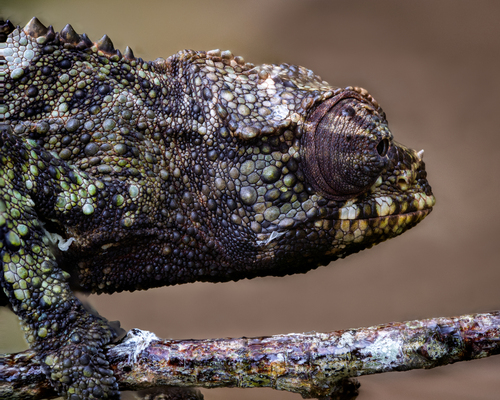
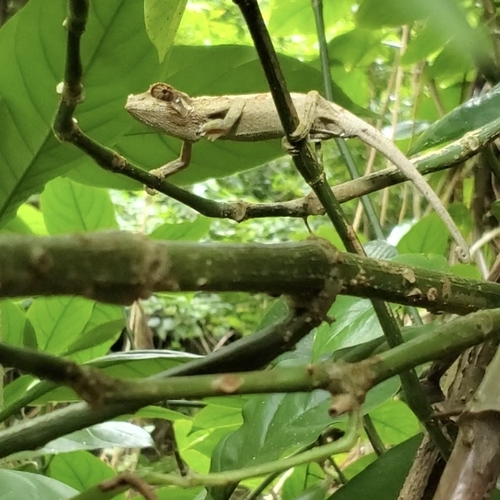
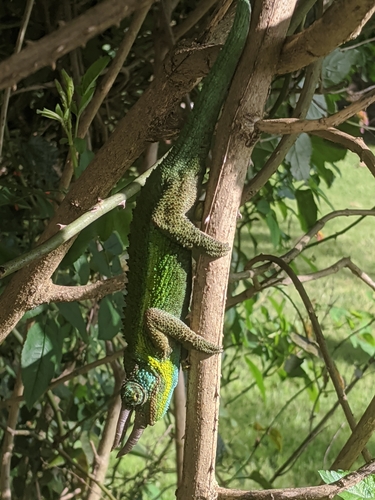
Body shape is classic chameleon: laterally flattened, crested along the spine, with a casque (a raised bony projection) on the back of the head. The eyes are set in turret-like conical sockets that rotate independently. The feet are zygodactyl, each foot splits into two opposed bundles of fused toes, two fingers gripping one way and three the other, forming a pincer ideal for wrapping around narrow branches. The tail is prehensile and strong enough to hold the animal's full body weight.
Greens shift across a range of colours with individuals moving through turquoise, yellow, brown and near-black depending on temperature, mood, reproductive state and social situation. Colour change is not camouflage in straightforward terms, it combines signalling, thermoregulation and stress response in operation.
The Three Horns
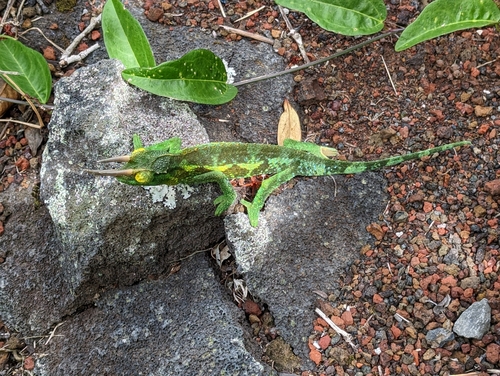
The horns are the feature that everyone remembers, and they deserve a closer look. In males, three keratin-sheathed bony projections grow from the front of the skull. Two are preocular, growing above and slightly forward of the eye sockets. The third, the rostral horn, projects straight forward from the front of the snout.
The horns are not used for hunting, nor for defence against predators. They are combat weapons used in ritualised male-male contests over territory and mates. Adult males may challenge equal-sized rivals to a horn-to-horn pushing duel, and the weaker individual eventually retreats. Males mainly assert dominance through colour displays and posturing, usually without serious physical fights. These contests resemble the horn-wrestling seen in deer or beetles more than a predator-prey clash.
Females, by contrast, are almost hornless. In T. j. xantholophus they usually have no horns, while females of T. j. jacksonii and T. j. merumontanus can show traces of the rostral horn. The evolutionary reasoning is straightforward: horns are expensive to grow and maintain, they would be wasted on females who do not fight, and the energy that would go into them is redirected into producing eggs and nourishing live young.
Built for the Cool Highlands
Most people picture chameleons in sweltering jungles. Jackson's chameleons live somewhere very different: the cool, misty, high-elevation forests of central Kenya and northern Tanzania, at altitudes between 1,600 and 2,440 metres. Daytime temperatures are typically 16 to 27 degrees Celsius, and nighttime temperatures 4 to 18. The animals' anatomy and behaviour reflect that climate.
Thermoregulation techniques:
- Turning darker, brown, nearly black, in the early morning to absorb more solar radiation and warm up quickly.
- Turning paler green during the hottest part of the day to reflect light and avoid overheating.
- Bask with the body flattened laterally and the broad side facing the sun to expose the maximum surface to warmth.
- Moving into deep shade or the undersides of broad leaves during midday peaks.
This is why Jackson's chameleons are fundamentally bad pets for warm, humid apartments. Without a cool nighttime drop, consistent moderate humidity and strong UVB, they develop metabolic bone disease, respiratory infections and early death. Captive animals need markedly cooler nights and high humidity, conditions closer to a misty Kenyan hillside than a tropical terrarium.
Hunting and Diet
Jackson's chameleons are insectivores, and the star of their feeding apparatus is the projectile tongue. At rest the tongue sits folded inside the mouth around the hyoid bone. The tongue can extend up to 1.5 body lengths, and the sticky tip can reach prey in about 0.06 seconds before the tongue is retrieved with the insect attached.
Typical wild prey:
- Crickets and grasshoppers
- Caterpillars and moth larvae
- Beetles, including weevils
- Flies, wasps and bees
- Small land snails (swallowed shell-and-all)
- Millipedes and centipedes
- Occasionally small lizards, including hatchlings of other species
Eye movement is the setup to every strike. Each eye rotates independently of the other in its conical turret. A hunting Jackson's chameleon will typically track prey with one eye, scan for threats with the other and then swivel both eyes forward for binocular depth perception just before firing the tongue. This is one of the few vertebrate systems in which both monocular and binocular vision are used seamlessly in sequence.
In Hawaii the invasive population has added native arthropods, spiders, and, most damagingly, native land snails to its diet. Several Hawaiian endemic snail species are critically endangered, and predation by feral Jackson's chameleons is one of the documented pressures on their remaining populations.
Reproduction and Live Birth
Most chameleons lay eggs. Jackson's chameleons do not. Instead the species is ovoviviparous: the eggs develop inside the mother's body and hatch either just before or during delivery. The neonates emerge wrapped in thin transparent membranes that the babies wriggle free from.
Reproductive cycle:
- Courtship and mating. In captivity, courtship has been described as one animal circling the other, jerking the head to one side and walking forward in a rocking pattern.
- Gestation. Pregnancy lasts about five to six months.
- Birth. The female gives birth to 8-30 live young. Each newborn is about 5 centimetres long and able to catch small insects from the day of birth.
- No parental care. Postpartum parental care seems not to occur.
The live-birth adaptation almost certainly evolved in response to the cool highland habitat. The relatively cold highland climate slows the development of eggs laid in the ground. Carrying embryos internally allows the female to bask and actively regulate their temperature via her own body.
Typical reproductive data:
| Metric | Value |
|---|---|
| Age at sexual maturity | About 5 months |
| Gestation length | 5-6 months |
| Litter size | 8-30 neonates |
| Neonate length | About 5 cm |
| Feeding | From the day of birth |
| Interval between litters | As short as six months |
| Parental care | None observed |
Range, Habitat, and Subspecies
Native Jackson's chameleons occur across a relatively narrow band of East African highlands. The nominate T. j. jacksonii is found in the highlands of central Kenya, including wooded areas of some Nairobi suburbs. T. j. merumontanus is restricted to Mount Meru in northern Tanzania.
T. j. xantholophus , the yellow-crested Jackson's chameleon, is tied closely to the slopes of Mount Kenya itself.
Outside Africa, Jackson's chameleons occur as introduced feral populations:
| Location | Status | Origin year | Source |
|---|---|---|---|
| Oahu, Hawaii | Established | 1972 | Release of stressed imports at a pet store owner's property |
| Maui, Hawaii | Established | 1980s | Secondary spread from Oahu |
| Hawaii (Big Island) | Established | Later | Secondary spread |
| Kauai, Hawaii | Established | Most recent | Secondary spread |
| California (scattered) | Localised | Various | Pet releases and escapes |
| Florida (scattered) | Localised | Various | Pet releases and escapes |
The Hawaiian story is worth telling in full. In 1972 some chameleons ( T. j. xantholophus ) reached Oahu legally under a pet store import permit. A second shipment arrived in poor condition, and those animals were released to recover on the property of the Kaneohe pet store owner. They went on to form a free-ranging population.
Because females give birth to live young, a single pregnant female is enough to found a new population. The species reached Maui by the early 1980s and is now established on all main Hawaiian islands.
Hawaii prohibits their transport between islands.
Conservation Status
The IUCN Red List assessment lists Jackson's chameleon overall as Least Concern . The species remains common within most of its native range, tolerates moderate human habitat modification, and persists on farms, in gardens, hedgerows and coffee orchards.
That said, regional and subspecies-level concerns exist:
- T. j. xantholophus has been heavily exported for the pet trade. Thousands of Jackson's chameleons were shipped out of Kenya for the pet trade during the 1970s.
- Habitat loss. Conversion of montane forest into farmland and settlements reduces suitable habitat locally.
- Invasive status in Hawaii. The species is invasive in Hawaii, where it preys on endangered native snails.
The Hawaiian feral population was historically the primary source of Jackson's chameleons in the United States pet trade, but exports from Hawaii are now illegal.
Chameleons and Humans
Jackson's chameleons have a complex relationship with the people who share their range. In much of East Africa chameleons are regarded with suspicion, sometimes fear and are the subject of folklore that portrays them as unlucky or supernatural.
Outside Africa, the species is one of the most recognisable reptiles in the pet trade. It became popular in the international pet trade in the 1970s.
Enthusiast communities developed around keeping and breeding the species, and modern hobbyist knowledge of chameleon husbandry owes a great deal to the lessons learned, sometimes painfully, by keepers of Jackson's chameleons. The species remains common in captivity today, although the trade has shifted heavily toward captive-bred stock rather than wild-caught imports.
In Hawaii the relationship is ecological and political rather than cultural. Conservation agencies view the species as a problematic invasive. Transport between islands is illegal, and exports from Hawaii are now illegal as well.
Frequently asked questions
Only male Jackson’s chameleons (Trioceros jacksonii) grow the three forward-facing horns that lead to comparisons with Triceratops. One horn sits above each eye (the preocular horns) and a third projects forward from the snout (the rostral horn). The horns are keratin-sheathed bony projections.
Their main function appears to be combat: adult males may challenge equal-sized rivals to a horn-to-horn pushing duel, and the weaker individual eventually retreats.
Usually not. Females of T. j. xantholophus typically have no horns or greatly reduced ones, while females of T. j. jacksonii and T. j. merumontanus can show traces of the rostral horn. Horns are a male combat trait, so they are largely absent in females.
Jackson’s chameleons are native to woodlands and wet forests of Kenya and northern Tanzania, at elevations of roughly 1,600 to 2,440 metres above sea level. In Kenya they occur across the central highlands, including wooded areas of some Nairobi suburbs, and in the Mount Kenya region. In Tanzania they are known only from Mount Meru.
Outside Africa, introduced populations exist in Hawaii and the species has also been introduced to California and Florida. The Hawaiian population traces back to a 1972 introduction and is now established on all main islands.
The IUCN Red List classifies Jackson’s chameleon as Least Concern. The species persists on farms, in gardens, hedgerows and coffee orchards as well as in forest.
The subspecies T. j. xantholophus was exported from Kenya for the pet trade, with thousands shipped in the 1970s. In Hawaii the introduced population is invasive and preys on endangered native snails.
The Hawaiian population is descended from Trioceros jacksonii xantholophus brought to Oahu in 1972 under a pet store import permit. A second shipment arrived in poor condition, and those animals were released to recover on the property of the Kaneohe pet store owner. They became a free-ranging population.
Because females give birth to live young, a single pregnant female can found a new population. Today Jackson’s chameleons are established on all main Hawaiian islands. They are considered invasive, preying on native snails and insects and transporting them between islands is illegal.
Jackson’s chameleons are ovoviviparous: eggs develop inside the mother’s body and hatch just before or during delivery. This is unusual among chameleons, most of which lay eggs. Live-bearing is likely an adaptation to temperature, since it is found mainly in highland species.
The relatively cold highland climate slows the development of eggs laid in the ground. By retaining the eggs inside her body, a female can bask to keep the embryos warm. After a gestation of five to six months, she gives birth to 8-30 young, each encased in a membrane that the baby frees itself from.
In captivity, Jackson’s chameleons can be expected to live between five and ten years. Lifespan is variable, and males generally live longer than females. Poor husbandry, such as incorrect temperature or humidity, can shorten life.
Jackson’s chameleons feed mainly on small insects, which they capture with a rapidly extensible tongue that can reach up to 1.5 body lengths. They also prey on centipedes, millipedes, spiders, lizards and snails, and small snails are swallowed shell and all.
They hunt visually, and each eye moves independently until a target is found, after which both eyes orient on it. In Hawaii the diet includes native land snails, which is a serious concern for endangered endemic snails.
References
- Relevant peer-reviewed and governmental sources consulted for this entry include the IUCN Red List assessment for Trioceros jacksonii, Tilbury's Chameleons of Africa: An Atlas (2nd edition), Hawaii Department of Land and Natural Resources invasive species reports, the 2009 Tilbury and Tolley systematic revision that reassigned the species to Trioceros, and field observations published in African Journal of Herpetology and Salamandra.