Parson's Chameleon: 781 Days in the Egg
Calumma parsoniiParson's chameleon eggs usually take 400 to 660 days to hatch, longer than any other known reptile, and one took 781. Adult males weigh 500 to 700 g.
 Strange Animals EditorialFebruary 24, 2025·13 min read·Editorial standards ↗
Parson's chameleon is usually considered the largest chameleon by weight and is one of the longest-lived chameleons. Unlike the flashy, fast-breeding veiled or panther chameleons familiar from the pet trade, Calumma parsonii lives slowly, grows slowly, matures slowly and reproduces rarely.
An adult male can reach about 65 centimetres from snout to tail tip, weigh 500-700 grams and take two to five years to reach sexual maturity.
It lives high in the canopy of Madagascar's eastern rainforests, hunts with a ballistic tongue and watches the world through two independently steerable eyes.
This guide covers every aspect of Parson's chameleon biology and ecology: taxonomy and subspecies, size and anatomy, habitat and range, hunting and diet, reproduction and the extraordinary egg incubation period, lifespan and conservation status.
Etymology and Classification
The species was first described by the French naturalist Georges Cuvier in 1824 and named in honour of the British physician James Parsons.
Parson's chameleon sits within the family Chamaeleonidae, which is found across Africa, Madagascar, southern Europe, south Asia and the Middle East.
Two subspecies are currently recognised:
- Calumma parsonii parsonii. The giant form. Males display the classic turquoise-green body with bright yellow eyelids and prominent rostral warts.
- Calumma parsonii cristifer. The smaller crested form. Generally reaches up to about 50 centimetres (occasionally reported up to 60) and shows a pronounced dorsal crest with more muted green and brown colouration.
Size and Physical Description
Parson's chameleon is usually considered the heaviest chameleon on Earth. It is also one of the longest, but is surpassed in length by the Malagasy giant chameleon ( Furcifer oustaleti ).
Males (C. p. parsonii):
- Length: up to about 65 cm from snout to tail tip (larger reports are unverified)
- Weight: typically 500-700 g
- Body distinguishing features: bright yellow eyelids, rostral warts above each nostril, broad turquoise or green body with orange and yellow highlights
Females:
- Smaller than males and usually plainer and greenish, with a smaller casque and no or only tiny nose projections
Hatchlings:
- Length: roughly 7-11 cm
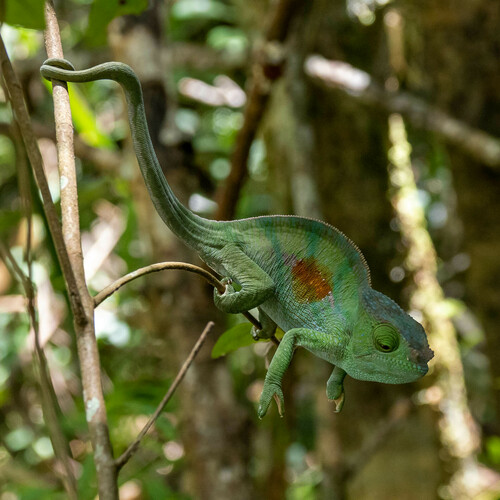
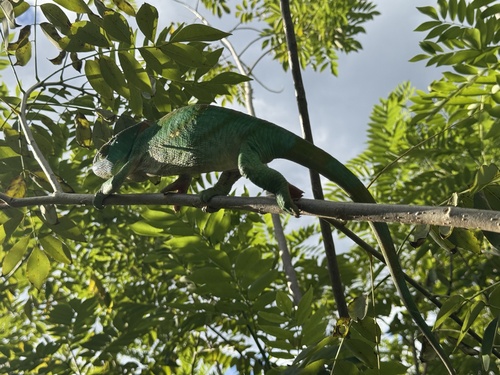
The body is laterally compressed into a deep keel shape, which makes the animal look narrower from the front than it actually is. This silhouette is an effective anti-predator adaptation: seen against a slender branch, Parson's chameleon looks like a leaf. The feet are zygodactyl, with two toes fused on one side and three on the other, forming pincer-like grips perfectly suited to grasping twigs. The prehensile tail acts as a fifth limb.
The most remarkable feature is the eye. Each turret rotates independently, producing a combined field of view that approaches 360 degrees. The animal can watch two different moving prey items at once before committing both eyes forward for binocular ranging.
Colour and the Myth of Camouflage
Popular culture persistently misrepresents chameleon colour change. Parson's chameleon cannot blend into any background on command. The species does not mimic patterns. It does not turn into a tartan to sit on a plaid shirt. What it can do is adjust its colouration rapidly based on internal state, temperature, mood, social display and on environmental lighting.
The mechanism involves two layers of specialised pigment cells in the dermis. The upper layer contains melanophores with black pigment. The lower, structural layer contains guanine nanocrystals arranged in a lattice. The chameleon can contract or relax tiny muscles around each cell to alter the spacing of the crystal lattice, which shifts which wavelengths of light are reflected back through the skin. A tight lattice reflects blue, a loose lattice reflects yellow, orange and red.
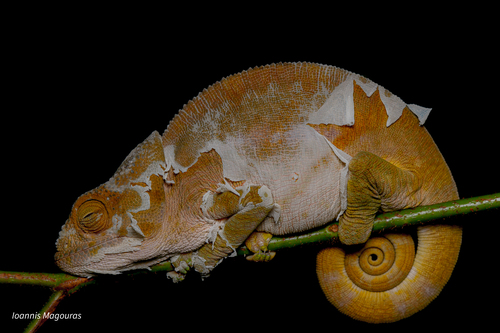
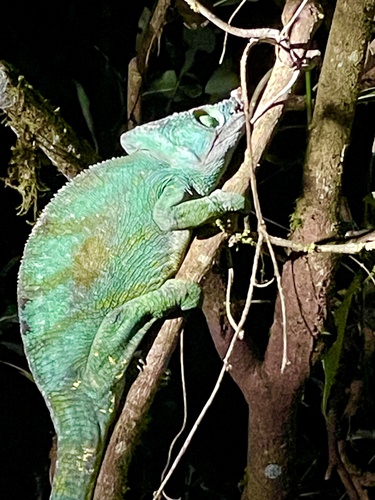
Resting adult males of C. p. parsonii are typically a vivid turquoise or green with an orange underside and a bright yellow eyelid that is visible across the canopy. Courting males add brighter yellows and deeper blues. Stressed or threatened animals go dark green with black crossbars. Female colour is generally muted: olive green to mottled brown, with more dramatic shifts during gravidity.
Habitat and Range
Endemic to eastern and northern Madagascar, Parson's chameleon prefers humid primary forest throughout the lowlands and up to approximately 1,195 metres above sea level. The species also appears in disturbed habitats with trees and occurs in the Andasibe and Ranomafana regions.
Preferred habitat features:
- Elevation: lowlands up to about 1,195 metres
- Canopy structure: roosts high in the forest canopy
Adults are solitary and highly territorial. A male defends a canopy territory against other males through visual display, body flattening, colour flares and head bobbing, rather than physical combat.
Diet and Hunting
Parson's chameleon is an opportunistic predator that feeds mainly on invertebrates, especially insects.
Primary prey:
- Large beetles
- Orthopterans, grasshoppers, katydids, giant crickets
- Phasmids (stick insects)
- Cicadas and large moths
- Spiders
Secondary prey:
- Small lizards
- Small birds
- Possibly leaves, flowers and pollen (reports are unverified)
The tongue strike is a spectacle of biomechanics. At rest the tongue is folded inside the mouth around a specialised hyoid bone. To strike, the chameleon contracts a ring of accelerator muscles along the tongue shaft. Because the tongue is loaded with elastic collagen layers before the strike, energy is released in a single ballistic burst.
Reproduction and Egg Incubation
The reproductive cycle of Parson's chameleon is slow, and the species is a slow breeder that is vulnerable to habitat loss and collection.
Timeline:
- Age at sexual maturity: about 3 years on average (2-5 years)
- Breeding frequency: once per year, but often every other year
- Clutch size: 20-60 eggs per clutch
- Egg incubation: usually 400-660 days (one case of 781 days)
- Lifespan: estimated 10-12 years in the wild, up to 14 years recorded in captivity
After mating, the gravid female leaves the canopy and travels down the trunk to the forest floor. She buries the eggs in a hole about 30 centimetres deep and then climbs back into the canopy.
The eggs usually take 400 to 660 days to hatch, longer than known from any other reptile species, and one healthy juvenile hatched after 781 days. Warmer temperatures appear to shorten incubation.
Life Cycle and Lifespan
Parson's chameleon is one of the longest-lived chameleon species. Captive records are the most reliable source because wild animals are nearly impossible to track for full lifespans, and field mark-recapture studies are limited.
| Life stage | Duration | Notes |
|---|---|---|
| Egg | About 13-22 months | Subterranean, temperature-dependent |
| Adult | From maturity (about 3 years on average) | Breeding, territorial |
In captivity, individuals of 14 years have been recorded, older than confirmed in any other chameleon species. Wild males are known to have reached at least 9 years and females at least 8, and wild longevity is estimated at 10 to 12 years.
The ecological consequence of this long lifespan paired with slow maturity is straightforward: Parson's chameleon populations cannot rebound quickly. A forest patch that loses its adult breeders will take many years to recover even if habitat is restored.
Sexual Dimorphism and Social Behaviour
Males and females of C. parsonii differ clearly. Key male-specific features include:
- Rostral warts, paired fleshy bumps above each nostril
- Bright yellow eyelids that flash during display
- Larger casque and more pronounced dorsal ridge
- Substantially larger body
- More saturated colouration, especially blues and yellows
Social interaction in this species is low-intensity yet highly visual. Adults remain solitary and defend loose territories within the canopy. Visual displays, body flattening, gular extension, colour flares and slow head-bobs form the sequence through which males assess each other without fighting. Physical altercations are rare and brief.
Males display to females using the same visual vocabulary inverted: exaggerated colour saturation, slow bobbing and careful lateral approach.
Parson's chameleons do not vocalise meaningfully. Communication is almost entirely visual, supplemented by posture and substrate vibration at close range.
Conservation Status and Threats
The IUCN Red List classifies Parson's chameleon as Near Threatened The species is listed on CITES Appendix II, which regulates international trade under export quotas. The species occurs in several protected areas.
Primary threats:
- Deforestation. The main threat is ongoing habitat loss, especially from slash-and-burn agriculture (tavy) and logging, as the species mostly depends on primary forest.
- Pet trade collection. Unregulated collection for the pet trade is a secondary threat, as the species breeds slowly. It was collected at high levels in the past. Legal export is restricted to a yearly quota, but some illegal trade has occurred in years when the quota was zero.
- Slow reproduction. The long egg incubation and slow maturity mean that Parson's chameleon populations recover slowly from any local decline.
Cultural Significance
The broader international public knows Parson's chameleon mainly from wildlife documentaries and the exotic pet trade.
Frequently asked questions
Parson’s chameleon (Calumma parsonii) is usually considered the largest chameleon by weight and one of the largest by length, though the Malagasy giant chameleon surpasses it in length. Adult males typically weigh 500-700 grams. The nominate subspecies, C. p. parsonii, reaches up to about 65 centimetres in total length, and larger reports are unverified. Females are smaller than males. Hatchlings are roughly 7-11 centimetres long.
The smaller crested form, C. p. cristifer, generally reaches up to about 50 centimetres, with occasional reports of 60 centimetres.
Parson’s chameleon is endemic to eastern and northern Madagascar. It mainly inhabits humid primary forest from the lowlands up to about 1,195 metres above sea level, but it can also occur in disturbed habitats with trees. It prefers to roost high in the forest canopy. Habitat loss is the main threat to remaining populations.
Parson’s chameleons are opportunistic predators that feed mainly on invertebrates, especially insects such as beetles, grasshoppers and moths, along with spiders. They sometimes take small vertebrates such as lizards and small birds. There are unverified reports of occasional plant material in the diet.
The tongue is launched ballistically using elastic energy stored in the tongue apparatus, and it captures prey with a combination of suction and sticky mucus.
Parson’s chameleon is one of the longest-lived chameleon species. Wild males are known to have reached at least 9 years and females at least 8 years, and wild longevity is estimated at 10 to 12 years. In captivity, individuals of 14 years have been recorded, which is older than confirmed in any other chameleon species.
Sexual maturity is reached at about 3 years of age on average, but it can happen as early as 2 years or as late as 5. This slow life cycle makes the species vulnerable to habitat loss and collection.
Breeding is seasonal. Mating takes place at the start of the rainy season, and the female lays a single clutch about three to five months later. A female can breed once per year but often skips a season and breeds every other year. She lays 20 to 60 eggs and buries them in a hole about 30 centimetres deep.
The eggs usually take 400 to 660 days to hatch, which is longer than known from any other reptile species. In one case a healthy juvenile hatched after 781 days. Warmer temperatures appear to shorten incubation.
The IUCN classifies Parson’s chameleon as Near Threatened. The main threat is ongoing habitat loss, especially from slash-and-burn agriculture (tavy) and logging, because the species mostly depends on primary forest. A secondary threat is unregulated collection for the pet trade, as the species breeds slowly.
The species is listed on CITES Appendix II, and legal exports from Madagascar are restricted to a yearly quota. Some illegal trade has still occurred in years when the quota was zero. The species occurs in several protected areas.
Like other chameleons, Parson’s chameleon has eyes set in conical turrets that rotate independently, giving a combined field of view that approaches 360 degrees. The animal can watch two different targets at once, then bring both eyes forward for binocular ranging when it commits to a prey item.
While chameleons can change colour, Parson’s pet does not shift into any background at will, contrary to cartoon depictions. Colour shifts in the chameleon come from mood, temperature, light and social environment rather than from matching its surroundings.
Guanine nanocrystals in the skin control the colour change, with the animal adjusting nanocrystal spacing to alter which light wavelengths get reflected. Males appear mainly green or turquoise, and stressed males grow duller or darker with darker spotting and bars becoming more pronounced. Females are typically overall greenish and stressed females show some yellowing.
References
- Relevant peer-reviewed and governmental sources consulted for this entry include the IUCN Red List assessment for Calumma parsonii, CITES trade data reports, Madagascar National Parks population surveys, and published research in Salamandra, Journal of Herpetology, Zootaxa, and Molecular Phylogenetics and Evolution.
- Jenkins, R.K.B. et al. (2011). Calumma parsonii. The IUCN Red List of Threatened Species 2011: e.T172896A6937628.
- Tessa, G., Glaw, F., Andreone, F. (2017). Longevity in Calumma parsonii, the World's largest chameleon. Experimental Gerontology 89: 41-44.
- Laube, A., Negro, T., Augustin, A. (2020). 781 days in the egg: Prolonged incubation time in Calumma parsonii parsonii. Herpetology Notes 13: 425-428.