Perentie: A Mildly Venomous 2.5 m Lizard
Varanus giganteusAustralia's largest lizard reaches up to 2.5 m, possibly 3 m, and research published in Nature in 2006 showed perenties are mildly venomous.
 Strange Animals EditorialApril 30, 2025·15 min read·Editorial standards ↗
The perentie is the largest lizard in Australia and the fourth-largest living lizard on Earth, surpassed in length and mass only by the Komodo dragon of Indonesia, the Asian water monitor and the crocodile monitor of New Guinea.
Varanus giganteus is a desert-country apex predator, a Gondwanan relic, a venom-producing reptile and one of the most culturally significant animals in the Aboriginal Dreamtime traditions of Central Australia. For a species this large, this long-lived and this ecologically important, the perentie remains surprisingly little known outside its arid homeland.
This guide covers every major aspect of perentie biology: taxonomy and evolution, size and anatomy, hunting strategies, venom, reproduction, behaviour, range and habitat, cultural meaning and conservation.
Etymology and Classification
The scientific name Varanus giganteus was assigned by the English zoologist John Edward Gray in 1845, who described it as Hydrosaurus giganteus . Varanus derives from the Arabic waran , the root word for monitor lizards across much of the Old World, and giganteus is Latin for "gigantic", an apt epithet for the largest member of an already oversized genus on the Australian continent.
The common name "perentie" is adapted from Aboriginal languages of Central Australia. The Pitjantjatjara and Yankunytjatjara peoples of the Western Desert call the animal Ngintaka .
Within the genus Varanus , the perentie belongs to the subgenus Varanus .
Size and Physical Description
Perenties are large, long, heavily muscled lizards built for sprinting, digging and wrestling prey.
Adults:
- Total length: up to 2.5 metres, possibly up to 3 m
- Body mass: up to 20 kg, possibly up to 40 kg
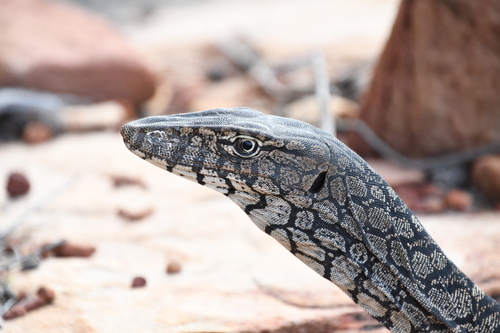
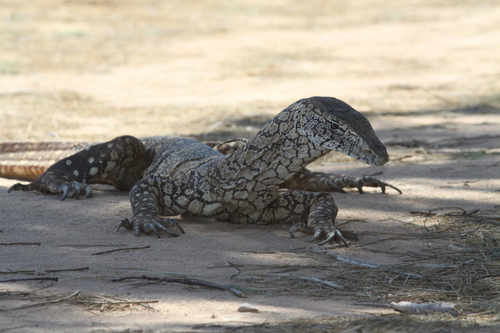
The perentie's body is powerful and elongate, supported on comparatively long limbs that lift the belly clear of the hot desert substrate during locomotion. The head is triangular and narrow at the snout, widening to strong jaw muscles behind the eye.
The body is yellow or cream with brown rosettes on the back, the head and neck are creamy-white with black lines and flecks, and the limbs are dark with white spots.
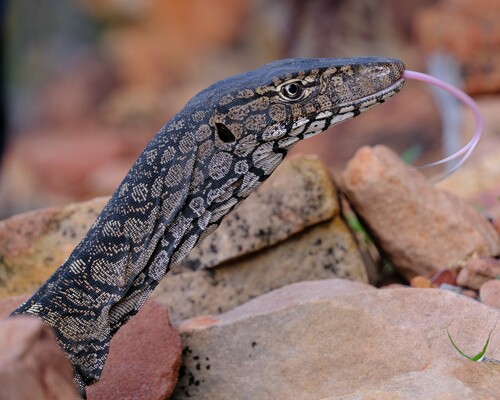
The tongue is deeply forked, and the forked tip is flicked constantly during active foraging. Chemical particles collected on the tongue are transferred to the paired openings of the vomeronasal (Jacobson's) organ in the roof of the mouth, giving the perentie an extraordinarily sensitive stereochemical sense.
Built for the Red Centre
Perenties live at the limits of what any large animal can tolerate. Summer days in the central deserts are extremely hot, and rainfall is unreliable.
Thermoregulation strategies:
- Basking in the early morning to raise body temperature after cool nights
- Shuttling between sun and shade throughout the day, using spinifex clumps, rocks and shrub cover
- Retreating to burrows during the hottest part of the day
Perenties dig their own burrows when they have to, and they can excavate a burrow for shelter in only minutes.
Water requirements are low. Perenties obtain most of their moisture from prey tissue and opportunistic drinking at waterholes and cattle troughs.
The Tripod Stance
One of the most distinctive behaviours of Varanus giganteus is the tripod stance: the lizard rears up on its hind legs and braces on its tail, lifting its head clear of the ground. This posture is used to see over spinifex hummocks, survey for rivals or predators, assess distant movement and occasionally to intimidate other perenties.
Tripoding is quite common among monitor species.
The tripod stance serves surveying and something else. Male perenties rear and grapple chest-to-chest during the breeding season in ritualised combat, each lizard trying to unbalance the other while biting and clawing.
Hunting and Diet
Perenties are opportunistic apex predators. Diet studies from stomach-content analysis and scat sampling across central Australia show a remarkably broad menu that includes almost any animal small enough to be subdued.
Primary prey:
- European rabbits, introduced in 1859 and now a major food source across much of the perentie's range
- Small kangaroos, wallabies and juvenile euros
- Other monitor lizards, goannas and large skinks
- Snakes, less often than lizards
- Nesting birds, fledglings and eggs
- Carrion, including road-kill
Juvenile prey:
- Insects, particularly grasshoppers and centipedes
- Small skinks, geckos and dragons
- Nestling birds and eggs
Hunting techniques:
- Active foraging. This perentie moves across its range while flicking its tongue constantly to detect scents. Promising trails lead the lizard to burrows, nests or carcasses.
- Burrow excavation. Strong claws and powerful forelimbs let the perentie tear open rabbit warrens and small mammal burrows, reaching prey that cannot be caught in the open.
- Scavenging. Road-killed kangaroos and natural carcasses attract perenties from long distances.
Venom
Until 2005, monitor lizards were generally considered non-venomous. Their occasional role in fatal bites, particularly bites by Komodo dragons, was attributed to septic infection from bacteria in the mouth. Work by Bryan Fry and colleagues at the University of Melbourne, first reported in 2005 and published in Nature in 2006, showed that monitors including the perentie are mildly venomous.
Confirmed venom effects:
- Anticoagulation, wounds bleed profusely and do not clot normally
- Localised swelling and inflammation
The venom is delivered through grooves along the perentie's recurved teeth rather than through specialised fangs.
In practical terms for humans, a perentie bite causes deep puncture wounds, prolonged bleeding and significant pain, but envenomation is not medically serious for healthy adults.
This discovery had major implications beyond monitor biology. It fed into a broader reassessment of reptile venom evolution, including the theory that a single ancestral toxicofera clade gave rise to snake, lizard and some archaic reptile venoms.
Reproduction and Life Cycle
Nesting:
The perentie can lay its eggs in termite mounds or in soil.
Juvenile survival and growth:
Young perenties eat mostly arthropods, especially grasshoppers and centipedes and adults sometimes eat smaller perenties.
Range, Habitat, and Home Ranges
Perenties are found west of the Great Dividing Range in the arid areas of Western Australia, South Australia, the Northern Territory and Queensland.
Habitat preferences:
| Habitat feature | Role in perentie ecology |
|---|---|
| Rocky outcrops | Shelter, nesting, basking, predator avoidance |
| Deep sandy substrates | Burrowing, thermoregulation, egg chambers indirectly |
| Spinifex grasslands | Cover while hunting, lizard and small-mammal prey habitat |
| Termite mounds | Egg incubation sites |
| Desert waterholes | Drinking, ambush opportunities on visiting prey |
Perenties are rarely seen because of their shyness and the remoteness of much of their range from human habitation.
Behaviour, Climbing, and Swimming
Although built for running, perenties are surprisingly versatile. Their long claws enable them to climb trees easily.
Perenties have occasionally been seen foraging in shallow water.
Defensive behaviour is graded by the severity of the threat. Like most goannas, a perentie that has been detected either freezes or runs. If cornered, it inflates its throat, hisses and relies on its claws, teeth and whip-like tail.
Cornered animals bite, claw and lash the tail, and the combination of venom, serrated teeth and sharp claws makes a defensive perentie genuinely dangerous to dogs, feral cats and unwary humans.
Cultural Significance
The perentie holds a central place in the Dreamtime traditions of many Aboriginal peoples of Central Australia. In Pitjantjatjara and Yankunytjatjara oral traditions, Ngintaka is a creator being: a giant perentie who journeyed across vast stretches of the desert, whose actions shaped waterholes, rocky ranges and landmarks that remain sacred places today.
The Ngintaka Tjukurpa is one of the long song-cycles that record and transmit this story, and it anchors land rights, ceremonial obligations and detailed geographical knowledge across generations.
The perentie was also a favoured food among desert Aboriginal peoples, and its fat was used for medicinal and ceremonial purposes.
Contemporary Aboriginal artists continue to depict the perentie and Ngintaka in painting, carving and ceremony.
Conservation Status and Threats
The IUCN Red List classifies the perentie as Least Concern , reflecting the species' broad distribution across arid Australia.
Current threats:
- Feral predators. Foxes and feral cats take juvenile perenties and deplete shared prey.
- Habitat modification through pastoral grazing changes spinifex structure and cuts small mammal diversity, which in turn limits perentie prey options across grazed landscapes.
- Road mortality. Remote highways cross key perentie habitat. Large adults basking on warm bitumen are often killed by road trains and tourist vehicles.
- Wildfire regimes. Changing fire regimes in spinifex country, particularly larger and more intense fires following long droughts, can eliminate cover and concentrate prey in ways that affect lizard populations at the landscape scale.
- Climate change. Projections for Central Australia include more frequent heatwaves, compressed activity windows and longer droughts between rainfall pulses. The long-term impact on perentie populations is uncertain but probably negative.
No Varanus giganteus subpopulations appear on the threatened species list under Australian law right now, although data on population trends remains sparse.
Perenties and Humans
Human encounters with perenties are mostly cultural or incidental, because the species is shy and much of its range is remote.
Incidental encounters are common. Tourists driving the Great Central Road, the Tanami Track, or the Gunbarrel Highway often see perenties basking on road edges or crossing in front of vehicles. Outback campsites occasionally attract bold individuals, especially near bins or butchered carcasses. Responsible behaviour is the same as with any large wild predator: do not approach, do not feed, store food and waste securely and give the animal a clear escape route.
Illustration.
Frequently asked questions
Perenties can grow to about 2.5 metres in length and weigh up to 20 kg, possibly reaching 3 m and 40 kg. This makes the perentie the largest lizard in Australia and the fourth-largest living lizard, after the Komodo dragon, the Asian water monitor and the crocodile monitor.
Perenties live in the arid desert areas of Western Australia, South Australia, the Northern Territory and Queensland, west of the Great Dividing Range. Their habitat includes rocky outcrops and gorges, with hard-packed soil and loose stones. They are rarely seen because they are shy and much of their range is remote.
Perenties are opportunistic apex predators. Adults eat mostly reptiles and small mammals, and less often birds. They also eat other monitor lizards and sometimes smaller perenties, and they scavenge carrion. They can kill young kangaroos and dismember carcasses too large to swallow whole. Young perenties eat mostly arthropods, especially grasshoppers and centipedes.
Mildly. In 2005 researchers at the University of Melbourne found that monitors, including the perentie, are somewhat venomous. This overturned the older idea that bites were harmful only because of bacteria in the mouth. A bite can cause swelling within minutes, disrupted blood clotting and shooting pain, but it is not medically serious for healthy adults.
The perentie, known as Ngintaka in Pitjantjatjara, features in the Ngintaka dreaming of Central Australian Aboriginal peoples and has totemic significance in many Aboriginal cultures. It was also a favoured food among desert Aboriginal peoples, and its fat was used for medicinal and ceremonial purposes.
Perenties typically avoid people and often retreat before they are seen. If cornered, a perentie can defend itself with its claws, teeth and whip-like tail and its bite can do considerable damage. The venom is not medically serious for healthy adults.
Across arid Australia, the perentie spans a wide distribution, which the IUCN Red List reflects by classifying the species as Least Concern.
References
- Relevant peer-reviewed and governmental sources consulted for this entry include the IUCN Red List assessment for Varanus giganteus, the Australian Government Department of Climate Change, Energy, the Environment and Water species profile, Fry et al.
- (2006, 2009) on monitor venom systems published in Nature and the Proceedings of the National Academy of Sciences, Pianka and King (2004) Varanoid Lizards of the World, and long-term field studies published in the Australian Journal of Zoology, Herpetologica, and Wildlife Research.
- Cultural material is drawn from published accounts of the Ngintaka Tjukurpa prepared with and by Pitjantjatjara and Yankunytjatjara knowledge holders, including works held by the South Australian Museum and Ara Irititja.