Nile Monitor: Africa's Largest Lizard Species
Varanus niloticusThe Nile monitor is Africa's largest lizard, known for its impressive size and adaptability to various habitats across the continent.
 Strange Animals EditorialAugust 24, 2025·14 min read·Editorial standards ↗
The Nile monitor is the largest lizard in Africa and one of the most widely distributed reptiles on the continent. Reaching lengths of more than two metres, swimming like a crocodile, climbing like a goanna and wrestling rivals, Varanus niloticus is a predator that does not fit neatly into any single ecological box. It hunts in water, digs on land, raids nests in trees, and, most famously, places its own eggs inside living termite mounds and walks away.
This guide covers every major aspect of Nile monitor biology and behaviour: size and anatomy, habitat and range, diet and hunting, reproduction, intelligence, defence, the species' invasive population in Florida, and the relationship between Nile monitors and humans.
Etymology and Classification
The scientific name Varanus niloticus was formally assigned by Linnaeus in 1766. The genus name Varanus derives from the Arabic waral , meaning monitor. The species name niloticus means simply of the Nile.
Nile monitors sit inside the family Varanidae, which contains around 80 living species of monitor lizards distributed across Africa, Asia and Australia. Their closest African relatives include the West African Nile monitor Varanus stellatus , which was separated from V. niloticus in 2016 based on genetic and morphological evidence, and the savannah monitor Varanus exanthematicus .
Within the global monitor radiation, Nile monitors belong to the African subclade rather than to the Asian dragons or Australian goannas.
Modern taxonomic work suggests the species complex is more diverse than once thought. Populations in West Africa differ genetically and morphologically from those in East and southern Africa, and the taxonomy continues to be revised as new molecular data accumulates.
Size and Physical Description
Nile monitors are the largest lizards in Africa.
Adult dimensions:
- Total length: 120-220 centimetres (tip of snout to tip of tail)
- Snout-to-vent length: around 50 centimetres in an average specimen
- Tail length: usually about 1.5 times the body length
- Maximum recorded length: over 240 centimetres
Hatchlings:
- Length at hatching: about 30 centimetres
- Weight at hatching: about 26 grams
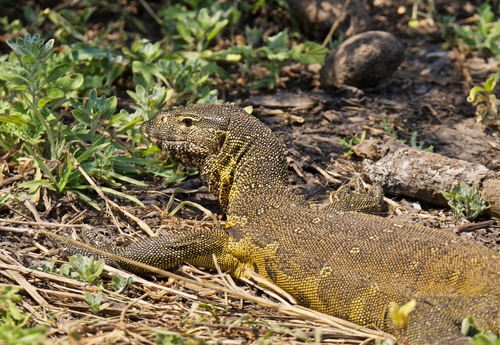
The body is long, muscular and low-slung. The head is narrow and strongly pointed, with a deeply forked tongue used to sample the air for scent cues in the manner of a snake. The tail is laterally compressed, flattened side to side, which makes it an effective sculling organ for swimming and, in adults, a defensive weapon.
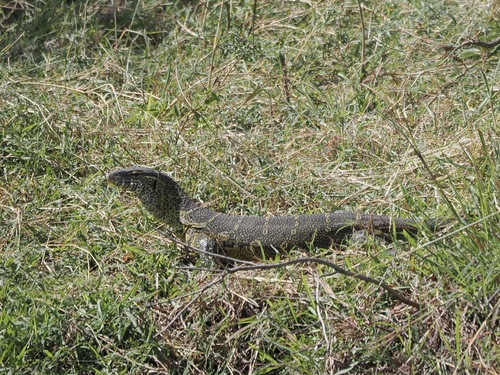
Nile monitors are typically olive to blackish brown on top, patterned with bands of yellow or cream spots that form rings around the tail. The belly is pale yellow or whitish, sometimes with dusky markings. Juveniles are more vividly marked than adults, with bright yellow spots and crisper banding that fade gradually with age.
Claws are long, sharp and curved, suited to climbing, digging and grasping prey. The teeth are curved and blade-like in the front of the mouth and more crushing in the rear, an arrangement that handles everything from eggshell to fish vertebrae to small-mammal bones.
How does the Nile monitor compare in size with the Komodo dragon and the Asian water monitor?
The Nile monitor is among Africa's largest lizards, but both Asian giants reach greater lengths. Nile monitors grow to about 2.4 m (7.9 ft). The largest verified Komodo dragon measured 3.13 m (10.3 ft) and weighed 166 kg (366 lb), and wild Komodo dragons typically weigh about 70 kg (154 lb). The largest Asian water monitor on record, from Sri Lanka, measured 3.21 m (10.5 ft), although adults rarely exceed 1.5 to 2 m (4.9 to 6.6 ft).
Their native ranges do not overlap. Nile monitors live across most of sub-Saharan Africa, Komodo dragons only on a few islands of Indonesia's Lesser Sunda group, and Asian water monitors across South and Southeast Asia, from India to Indonesia.
Habitat and Range
The native range of the Nile monitor covers almost all of sub-Saharan Africa. Populations extend from Senegal in the west to Somalia in the east and south to South Africa, with a strip along the Nile into Egypt. They are absent from desert regions such as the Sahara and the Kalahari.
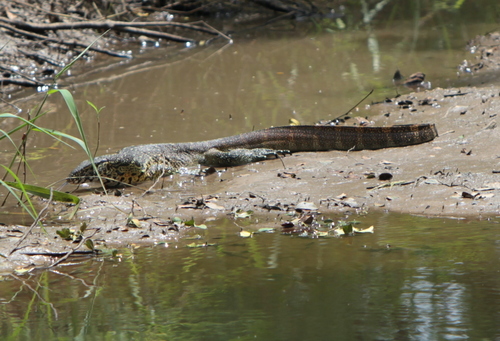
Nile monitors are strongly water-associated. Preferred habitats include:
- Large river systems and their tributaries
- Lake shores and lagoons
- Swamps, marshes and floodplains
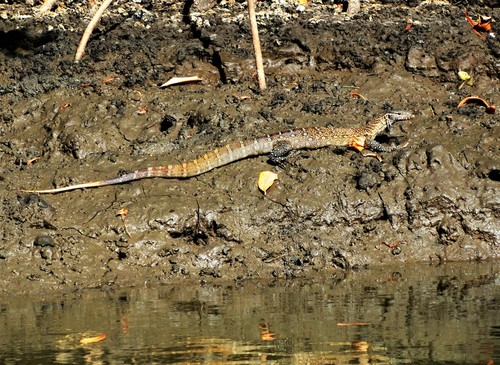
- Mangrove forests and estuaries
- Coastal plains and beaches
- Irrigation canals, reservoirs and fishponds
They tolerate brackish and even saline water better than most large reptiles, which is one reason they have been able to colonise islands and coastal ecosystems beyond their native range. They are also unusually tolerant of human-modified habitat, thriving around rice paddies, drainage canals and suburban ponds as long as a water source and basking substrate are present.
An invasive population exists outside Africa:
- Southern Florida, USA. A breeding population established around Cape Coral in the 1990s after pet-trade releases. It has since spread along canals and waterways and is regarded as an ecological threat to native wildlife.
Diet and Hunting
Nile monitors are opportunistic hypercarnivores. Their diet is broader than that of most reptile specialists and shifts substantially with body size, habitat and season.
Typical prey items include:
- Fish
- Frogs, toads, tadpoles
- Freshwater crabs and shrimp
- Insects and arachnids (especially in juveniles)
- Snakes, including venomous species
- Turtle eggs and hatchlings
- Bird eggs and nestlings
- Small mammals up to the size of domestic cats
- Crocodile eggs, a signature food source
- Carrion and fisheries bycatch
Hunting techniques:
- Aquatic ambush. The monitor swims slowly along the bottom or hangs in submerged vegetation, then lunges at fish or ducklings from below. Dives of several minutes allow long stalks.
- Shoreline foraging. This lizard works bankside, its forked tongue picking up scents of amphibians, nests and carrion as it patrols.
- Nest raiding. Nile monitors are notorious nest raiders. They target the nests of crocodiles, turtles, ground-nesting birds and colonial waterbirds. Crocodile egg raids are particularly famous: the monitor digs into the clutch while the mother is distracted or absent.
- Scavenging. Large carrion is readily exploited.
- Paired raids. On occasion, Nile monitors team up in pairs to raid a crocodile nest.
Swimming, Diving, and Climbing
Nile monitors are among the most versatile locomotors in the reptile world. They swim with their legs folded against the body and propulsion generated by side-to-side sculling of the laterally compressed tail, essentially the same technique used by crocodiles.
Typical locomotion data:
| Metric | Value |
|---|---|
| Typical swimming speed | Relaxed cruise, fast burst strikes |
| Dive time | Several minutes submerged |
| Climbing ability | Excellent; juveniles often in trees and bushes |
| Home range | Fairly large; no figures available |
Juveniles spend much of their time in trees and bushes, where they hunt insects, tree frogs and bird nests and escape terrestrial predators. Adults are less arboreal but still climb readily: there are many accounts of Nile monitors raiding village chicken coops.
Their tolerance for salt water, combined with strong swimming, means that Nile monitors can disperse between islands, up and down coastlines and across estuaries. This ecological flexibility is part of why the species has been so successful in establishing invasive populations.
Reproduction and the Termite Mound
Nile monitor reproduction is one of the strangest in the entire vertebrate world.
Annual cycle:
- Courtship and mating: late wet season, varying by region
- Egg laying: mid wet season, when termite mounds are softest
- Incubation: up to about 10 months, inside the termite mound
- Emergence: timed to the following wet season
After mating, a gravid female searches for a suitable nest site. The chosen site is often an active termite mound, though some females dig a hole in the ground instead.
The female excavates a hole into the side of the mound using her claws. Inside she deposits a clutch of 20 to 60 leathery-shelled eggs, then departs. The termites respond to the breach by doing what termites always do: they seal it. The termites repair the hole, and the eggs develop inside the mound.
Incubation may take about ten months in the wild (eggs in captivity have hatched in as few as 129 days), and is timed so that hatchlings emerge during the next wet season, when water, invertebrate prey and soft ground make dispersal feasible. When hatchlings are ready, they face a final obstacle: the mound wall. Hatchlings may have to wait for rain to soften the hard nest.
Females reportedly sometimes return to the mound around hatching time and open it to free the hatchlings.
The termite mound protects the eggs during development. The tradeoff is the long development time and the risk of hatchlings being unable to escape.
Intelligence and Behaviour
Nile monitors are active foragers with good eyesight and a well-developed sense of smell.
Documented behaviour includes:
- Occasional paired raids on crocodile nests
Wild Nile monitors bask in prominent spots such as logs, rocks and waterside vegetation, and live in burrows that they excavate themselves or expand from existing ones.
Defence and Fighting
When cornered, a Nile monitor is a formidable opponent. Its defensive toolkit is one of the most varied among lizards.
Primary defences:
- Tail whip. The laterally compressed tail is lashed sideways and can inflict a painful wound.
- Bite. The jaws are fast and strong. Bites and scratches can inflict moderate to serious wounds.
- Claws. Long and sharp. Used for climbing, digging, and, when grappling, for raking opponents' flanks.
- Threat display. Hissing, inflation of the throat and arching the back to appear larger.
- Escape into water. Nile monitors are usually wary and will run away or jump into water, often from a considerable height.
During the breeding season, males engage in fierce wrestling competitions with one another for mating opportunities.
Invasive Populations
One established invasive population of Nile monitors exists beyond the native African range.
Florida, USA
In the 1980s and 1990s the United States imported Nile monitors in large numbers for the pet trade. Many were released by owners who underestimated the species' adult size, appetite and temperament. By the late 1990s a breeding population was established around Cape Coral on the Gulf Coast of Florida, and the monitors have since spread into surrounding canal systems and conservation lands.
Ecological impacts include:
- Predation on burrowing owls (a state-designated Threatened species)
- Predation on gopher tortoise eggs and hatchlings
- Raiding of American crocodile nests in the southern range
- Competition with native reptiles for shelter and prey
- Colonisation of storm-drain and canal systems that connect large areas of urban and wild habitat
Florida classifies Nile monitors as a prohibited nonnative species. Agencies run trapping, euthanasia, public reporting and control research programmes. Complete eradication is generally considered impossible given the extent of the canal network, but local suppression can benefit vulnerable native species.
Conservation Status
The IUCN Red List currently classifies the Nile monitor as Least Concern . The species is abundant, ecologically flexible and occupies a vast native range across sub-Saharan Africa. That said, it faces several pressures that vary by region.
Threats across the native range:
- Skin trade. Nile monitor hides are sold as exotic leather. The species is among the most exploited reptiles in Africa, used for food and leather. Trade is regulated under CITES Appendix II and national laws.
- Habitat drainage. Loss of wetlands, river modification and dam construction reduce prime habitat.
- Persecution. Farmers and fishers often kill Nile monitors on sight due to perceived threats to livestock, poultry and fish stocks. In many communities monitors are also eaten as bushmeat.
- Roadkill. Major roads through wetland habitat cause significant local mortality.
The species persists widely and commonly despite these pressures. Large clutches, long-lived adults and flexible diet enable reproductive output that supports persistence even at moderate harvest levels.
Nile Monitors and Humans
Members of the Nile monitor group were already well known to Africans in ancient times and were commonly caught, likely as food, in the Djenné-Djenno culture at least a thousand years ago.
In modern Africa the Nile monitor occupies a mixed niche in human culture. It is hunted for meat and skin, persecuted as a poultry raider, feared as a bite hazard, tolerated as a rat and snake control, and, in a growing number of ecotourism destinations, appreciated as a charismatic river animal.
In the global pet trade Nile monitors have had a troubled history. Their large adult size, rapid growth, defensive aggression and specialised care requirements make them unsuitable for most casual keepers. Releases of unwanted pets are the direct cause of the Florida invasion. Responsible reptile-keeping organisations now discourage first-time keepers from acquiring any large monitor, and several jurisdictions restrict or ban ownership.
Illustration.
Frequently asked questions
Adult Nile monitors (Varanus niloticus) typically reach 120 to 220 centimetres from snout to tail tip, with an average snout-to-vent length of around 50 centimetres. The largest specimens reach about 244 centimetres. This makes the Nile monitor the largest lizard in Africa. The tail is usually about 1.5 times the length of the body and is laterally flattened for swimming, and in adults it is a defensive weapon.
Hatchlings emerge from the egg at about 30 centimetres long and about 26 grams, more vividly marked than adults with bright yellow spots and crisp banding.
Nile monitors are opportunistic hypercarnivores. Their diet shifts with size, habitat and season but includes fish, frogs, toads, tadpoles, freshwater crabs, insects, snakes, turtle eggs and hatchlings, bird eggs, nestlings, small mammals up to the size of domestic cats, carrion, and, most famously, the eggs of crocodiles. They are notorious nest raiders, digging into a crocodile clutch while the mother is distracted or absent.
In Florida, where the species is invasive, it may affect burrowing owls, gopher tortoises and American crocodile nests.
The native range of the Nile monitor covers most of sub-Saharan Africa, from Senegal in the west to Somalia in the east and south to South Africa, with a strip along the Nile into Egypt. They are strongly associated with water: rivers, lakes, swamps, floodplains, mangroves, estuaries, coastal plains, canals, reservoirs and fishponds. They are absent from desert regions such as the Sahara and the Kalahari.
Outside Africa, an invasive breeding population is established in southern Florida, centred on Cape Coral, which dates to pet-trade releases in the 1990s. They tolerate brackish and even saline water and human-modified habitat better than most large reptiles.
A cornered Nile monitor can defend itself with a tail lash that inflicts a painful wound, long sharp claws and a strong bite, and bites and scratches can cause moderate to serious wounds. Before fighting, it hisses, inflates its throat and arches its back to look larger.
Its usual response to a threat is to run away or jump into water.
Nile monitor reproduction is one of the strangest in the vertebrate world. After mating, a gravid female often locates an active termite mound. She digs into the side, lays a clutch of 20 to 60 eggs inside the mound, and leaves.
The termites repair the hole, and the eggs develop inside the mound. Incubation may take about ten months in the wild, and hatchlings may have to wait for rain to soften the hard nest. Females reportedly sometimes return to open the nest and free the hatchlings.
Nile monitors are active foragers with good eyesight and a well-developed sense of smell. They may occasionally work in pairs to raid crocodile nests, with one lizard distracting the guarding mother while the other takes eggs.
In the wild they bask in prominent spots and live in burrows that they excavate themselves or expand from existing ones.
Nile monitors were imported into the United States in large numbers during the 1980s and 1990s as pets. Many owners underestimated their adult size, appetite and temperament and released unwanted animals. A breeding population became established around Cape Coral by the late 1990s and has since spread into surrounding canal systems and conservation lands.
The Florida population may threaten native species including burrowing owls, gopher tortoises and American crocodile nests. Florida classifies the species as a prohibited nonnative and runs trapping, euthanasia, public reporting and control research programmes to suppress it.
References
- Relevant peer-reviewed and governmental sources consulted for this entry include IUCN SSC Monitor Lizard Specialist Group assessments, the Florida Fish and Wildlife Conservation Commission nonnative species reports, CITES Appendix II trade summaries for Varanidae, and published research in Herpetological Monographs, Journal of Herpetology, Copeia, and African Journal of Herpetology.
- Specific behavioural and cognitive findings reflect field and captive studies on Varanus niloticus and closely related varanid species through the early 2020s.
- Szczepaniuk, K. (2011). Varanus niloticus. Animal Diversity Web. View source
- Byers, D. (2000). Varanus salvator. Animal Diversity Web. View source
- Smithsonian's National Zoo and Conservation Biology Institute. Komodo dragon. View source