Giant Oceanic Manta: Dives to 1,250 m
Mobula birostrisGiant oceanic mantas reach about 7 m across, one tag logged dives of at least 1,250 m, and about 73% of their diet comes from the deep mesopelagic zone.
 Strange Animals EditorialAugust 15, 2025·13 min read·Editorial standards ↗
The giant oceanic manta ray is the largest ray species in the world, a circumglobal filter feeder with a wingspan that is typically four to five metres and can reach about seven.
It is a plankton eater with the largest brain of any fish, a habit of returning to specific cleaning stations, and a reproductive rate so slow that losing one adult to a fishing net costs the population years of recovery.
Mobula birostris occupies a strange position in marine biology: it is vast, gentle, cognitively sophisticated and catastrophically vulnerable all at once.
This guide covers every aspect of giant manta biology and ecology: size, taxonomy, feeding, behaviour, cognition, migration, cleaning stations, reproduction, conservation status and the human pressures that have driven the species from Vulnerable to Endangered within a single generation of research.
Etymology and Classification
The species was first described as Raja birostris by Johann Julius Walbaum in 1792. The name birostris refers to the paired cephalic lobes that project forward from the head like a second pair of horns. Older literature places the animal in its own genus, Manta , as Manta birostris .
A 2017 molecular phylogenetic study by White and colleagues demonstrated that the Manta genus was nested inside Mobula and could not stand alone, so the entire genus was collapsed. The correct modern name is Mobula birostris , though Manta birostris persists in older sources and popular writing.
Two long-established species of manta ray are recognised:
- Mobula birostris. The giant oceanic manta, pelagic, circumglobal, typically 4-5 m wingspan and up to about 7 m
- Mobula alfredi. The reef manta, coastal, typically 3-3.5 m wingspan
A third species, long known only as a candidate from the tropical western Atlantic including the Caribbean, was formally described in 2025 as the Atlantic manta ray ( Mobula yarae ). All mantas belong to the family Mobulidae, which also contains the smaller devil rays.
In European maritime tradition, giant mantas were once called devil fish: not because they were dangerous but because the forward-curling cephalic lobes looked disturbingly like horns. The name survives in the family's common name (devil rays).
Taxonomy and Relatives
Mantas are cartilaginous fish, cousins of sharks rather than bony fish and they sit within the order Myliobatiformes, which contains stingrays and their allies. Despite this shared lineage, mantas look and behave almost nothing like a typical stingray. They are pelagic, not benthic. They filter feed, rather than hunt crustaceans on the sea floor. Their tails carry no functional sting.
Their body form is an aerofoil optimised for powered gliding through open water, while stingrays are flat-bottomed discs adapted to seabed life.
The closest relatives of mantas are the other members of Mobulidae, the smaller devil rays of the genus Mobula (as it stood before 2017), which share the same filter-feeding mouth architecture and open-ocean lifestyle.
Size and Physical Description
Giant oceanic mantas are the largest rays on Earth. Size differences between the sexes are modest but measurable, with females running slightly larger than males on average.
Adults:
- Wingspan (disc width): 4-5 metres typical
- Largest: about 7 metres in disc width (some sources cite up to 9 metres)
- Weight: up to around 3,000 kg
- Disc length (nose to tail base): approximately half the wingspan
Newborn pups:
- Wingspan: about 1.4 metres
- Weight: about 9 kg
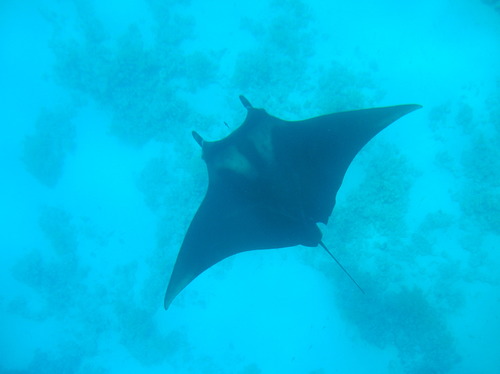
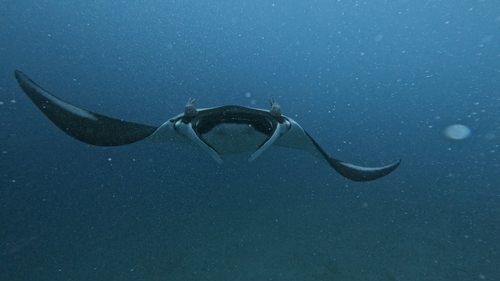
The body plan is unmistakable. A broad triangular disc is fringed with two enormous pectoral fins that function as wings. The head is flattened and flanked by the cephalic lobes, which the animal rolls into horn-like tubes when swimming normally and unfurls into paddle shapes during feeding.
The mouth is terminal (at the front, not underneath), which is unusual among rays and reflects the switch to filter feeding in open water. The tail is a slender whip carrying no functional barb in M. birostris , though a small non-venomous spine is present in some individuals.
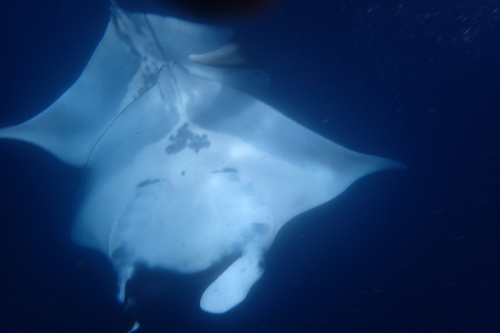
Coloration is counter-shaded. The dorsal (upper) surface is dark, black, charcoal, or deep navy and the ventral (lower) surface is white with a constellation of dark spots. Two common colour morphs exist: the typical "chevron" morph with a white ventral surface, and a rare "black" morph in which both sides are dark. The belly spots are the most important feature for researchers, because the pattern is unique to each individual and stable throughout life, serving as a biological fingerprint.
Cephalic Lobes and the Feeding Apparatus
The defining feature of a manta is the pair of cephalic lobes that extend forward from either side of the head. These lobes are modified sections of the pectoral fin that, during embryonic development, separate out and migrate to the head. In cruising swim they are rolled up into neat spirals, which reduces drag. During feeding they unfurl into flat paddles that act as funnels, directing water into the mouth and trapping plankton against the gill rakers.
The gill rakers themselves are delicate plate-like structures lining each of the five gill slits. They form a fine mesh that strains zooplankton out of the water while letting water pass. Unlike baleen in whales, which is keratin, manta gill rakers are cartilaginous.
It is these gill rakers that are targeted by the traditional Chinese medicine trade.
Feeding and Diet
Mantas are filter feeders that also take small to medium-sized fish at depth, and much of their feeding depends on finding water rich enough in plankton to make filtration energetically worthwhile.
Primary prey:
- Copepods and other small crustaceans
- Krill (euphausiids)
- Mysid shrimps
- Decapod larvae
- Small schooling fish on occasion
Feeding techniques:
- Straight swimming feed. The manta cruises in a straight line through a dense plankton patch with its mouth open and cephalic lobes unfurled. The simplest and most common method.
- Somersault feeding. When a plankton patch is thick, the animal performs tight backward loops, passing through the same patch repeatedly.
- Chain feeding. Multiple mantas line up nose-to-tail and feed through a corridor, each benefiting from the wake and turbulence created by the one in front.
- Cyclone feeding. In particularly rich conditions dozens of mantas may circle together, creating a vortex of water that concentrates plankton in the middle of the spiral.
- Deep feeding. Tagging studies have shown mantas diving to 400 metres or more, and one satellite-tag project recorded depths of at least 1,250 metres, with feeding on mesopelagic prey that is invisible from the surface.
The discovery that mantas feed heavily at depth has reshaped scientific understanding of the species. For decades they were considered shallow surface feeders. Research published in 2016 indicated that about 73% of the diet of the giant oceanic manta comes from mesopelagic sources, including fish.
Cognition and the Mirror Test
Manta rays have one of the highest brain-to-body mass ratios of any fish and the largest brain of any fish, weighing up to about 200 g.
A 2016 study by Csilla Ari and Dominic D'Agostino reported that captive giant mantas presented with a mirror exhibited behaviour consistent with self-recognition: unusual, contingent movements in front of the mirror, and behaviours not directed at the reflection as though it were a conspecific.
If correct, this would make mantas one of the few animals that might pass the mirror test.
Field observations consistently support the idea of a cognitively sophisticated animal. Mantas often revisit the same cleaning stations and feeding areas, and reef mantas have been shown to form bonds with specific individuals.
Cleaning Stations and Social Behaviour
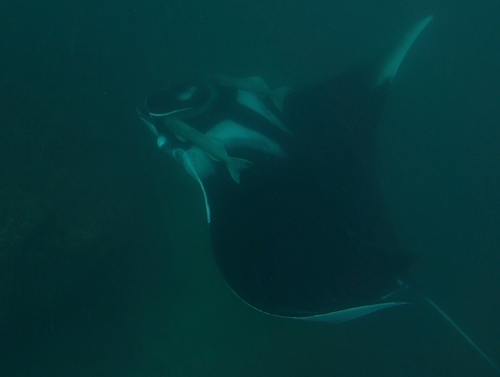
Cleaning stations are one of the most important social features of manta life. A cleaning station is a specific location on a coral reef where cleaner fish remove parasites and loose skin from larger fish that visit. Mantas adopt a near-stationary position close to the coral surface for several minutes while the cleaner fish feed.
Individual mantas may revisit the same cleaning station repeatedly.
| Behaviour | Typical duration / distance |
|---|---|
| Cleaning session | Several minutes |
| Cleaning station visits | Repeat visits by the same individuals |
| Site fidelity | Individuals often revisit the same stations |
| Aggregation size | Up to about 50 animals at a feeding site |
Mantas also form loose social associations. Stable pairs and small groups are observed at feeding sites. Adults aggregate seasonally to feed and to court, with mating trains in which a female is followed by a chain of up to about twenty males.
Reproduction and Life Cycle
Manta reproduction runs on one of the slowest schedules of any large marine vertebrate. Courtship, mating, gestation and parental investment are all drawn out, and the resulting reproductive rate is so low that population recovery after any significant loss takes decades.
Courtship:
- Mating trains form with one female leading multiple males
- Courtship ends with the leading male grasping the female's pectoral fin with his mouth and mating upside down beneath her
Gestation and birth:
- Fertilisation is internal via paired claspers on the male
- Pregnancy lasts approximately 12-13 months
- Mantas are ovoviviparous: the embryo develops inside a thin egg capsule within the mother's uterus, then hatches internally and is born live
- Litter size is almost always one pup, rarely two
- Females typically reproduce every 2-3 years, sometimes less often
Maturation:
- Females mature at 8-10 years or more
When the baseline reproductive rate is combined with late maturity and high adult mortality from fishing, the mathematics of population growth turn sharply negative very quickly.
Migration, Movement, and Range
Mantas are capable of sustained long-distance travel. Tagged mantas have been recorded travelling as far as 1,000 km from where they were caught. Migration is driven primarily by plankton productivity, which depends on water temperature, upwelling and seasonal currents.
| Metric | Value |
|---|---|
| Speed of a female leading a mating train | ~10 km/h |
| Maximum speed | Up to 24 km/h |
| Distance travelled from capture site (radio-tagged) | Up to about 1,000 km |
| Recorded maximum depth | At least 1,250 m (satellite-tag project) |
| Reef manta dives recorded | Over 400 m |
Movement patterns differ between the oceanic ( M. birostris ) and reef ( M. alfredi ) mantas. Oceanic mantas spend most of their time offshore and only aggregate predictably at a small set of productive sites such as seamounts, upwelling zones and island wakes. Reef mantas are more resident, with shorter seasonal migrations than oceanic mantas.
Populations and Conservation Status
Giant oceanic mantas are globally distributed but nowhere abundant. Population estimates are difficult because the species is pelagic, widely distributed and difficult to survey, but populations at most key aggregation sites are estimated at fewer than 1,000 individuals, and the species has declined drastically in recent decades due to overfishing.
IUCN status timeline:
- 2011: Listed as Vulnerable
- 2020: Uplifted to Endangered following new assessments
- CITES Appendix II: listed to regulate international trade
Primary threats:
- Targeted fishery for gill rakers. Demand from the traditional Chinese medicine market for gill raker products (often sold as "peng yu sai") drove targeted fisheries in Indonesia, Sri Lanka, India and parts of East Africa. Peak catches at some sites ran to thousands of animals per year.
- Bycatch. Mantas are caught as bycatch in gillnets and other fishing gear.
- Boat strikes. Collisions with tourism vessels and fishing boats at aggregation sites leave characteristic scars on many individuals and kill an unknown but non-trivial fraction.
- Fishing gear entanglement. Mantas frequently trail monofilament line, ropes and nets that cut into the skin and slowly starve or infect the animal.
- Climate change. Shifts in upwelling patterns and plankton productivity affect the locations and timing of aggregations.
- Tourism disturbance. Mantas are major tourism drawcards at sites such as Kona (Hawaii) and Manta Point in Indonesia. Well-managed tourism is broadly positive, but crowding, touching and poorly controlled boat traffic cause stress and injury.
Conservation measures include CITES listing, national protection laws (for example in Ecuador and Indonesia), designated marine protected areas at key aggregation sites, and international efforts under the Convention on Migratory Species.
The long-term outlook depends on sustained pressure against the gill raker trade, continued reduction of bycatch and careful management of the tourism industry that now depends on the species.
Mantas and Humans
Human relationships with giant mantas are contradictory. The animal has no defensive weapons, no teeth capable of serious harm, no aggressive behaviour toward swimmers and a long record of calm, curious encounters with divers. Despite this gentle reality, sailors long feared them as "devil fish" believed able to pull ships out to sea by the anchor, and the name persists.
Modern non-commercial encounters with mantas are almost universally positive. Divers at sites such as the Kona night-feeding stations report close, prolonged interactions in which individual mantas circle, hover and appear to examine the humans in the water.
Commercial pressure tells the opposite story. Targeted gill-raker fisheries have reduced manta populations in several regions, driven by demand from the traditional Chinese medicine market. Ongoing reductions in demand, combined with targeted bycatch mitigation, are the best available levers for population recovery.
Illustration.
Frequently asked questions
Adult giant oceanic mantas (Mobula birostris) are typically 4-5 m across from wingtip to wingtip, and the disc can reach about 7 m, with some sources citing up to 9 m. Weights of up to around 3,000 kg have been reported. This makes the species the largest ray in the world. Females are slightly larger than males on average.
Newborn pups are about 1.4 m in disc width and weigh roughly 9 kg.
Manta rays are mainly filter feeders. They cruise through plankton-rich water with their mouths held open, using a pair of forward-projecting cephalic lobes to funnel seawater into the mouth, where the tissue between the gill arches sieves out food particles. Their diet consists mainly of copepods, krill, mysid shrimp and decapod larvae, with small to medium-sized fish taken on occasion.
Research published in 2016 indicated that about 73% of the diet of the giant oceanic manta comes from deeper, mesopelagic sources, which shifts earlier assumptions about them as purely surface feeders.
The giant oceanic manta inhabits tropical, subtropical and temperate oceans worldwide, and is circumglobal. It is an ocean-going species that spends most of its life far from land, travelling with the currents and migrating to areas where upwellings of nutrient-rich water increase the availability of zooplankton. It is often found near offshore oceanic islands.
The smaller reef manta (Mobula alfredi) is more resident and coastal.
Yes. The IUCN Red List uplifted the giant oceanic manta from Vulnerable to Endangered in 2020, and the reef manta was listed as Vulnerable in 2019. The primary threat is fishing driven by demand for gill rakers in the traditional Chinese medicine market. Mantas are also caught as bycatch in gillnets, struck by boats and entangled in fishing gear.
Their very slow reproductive rate, usually one pup every two to three years, means a population can take decades to recover from heavy fishing pressure.
Manta rays may live as long as 50 years, according to Manta Trust figures. Exact maximum ages are hard to determine because few individuals have been followed from birth.
Mantas also mature slowly: females appear to mature at 8-10 years.
No. Manta rays have no functional stinging barb, no teeth capable of serious harm and no aggressive behaviour toward swimmers. Encounters are almost universally calm and often curious, with individual mantas circling, hovering and examining divers. The old ‘devil fish’ reputation comes from the cephalic lobes resembling horns and from the animal’s sheer size, not from any real threat.
The opposite is the larger concern: mantas at popular tourism sites can be disturbed, crowded, or injured by poorly managed boat traffic.
Manta rays and stingrays belong to the same order (Myliobatiformes) but occupy very different ecological roles. Stingrays are usually smaller, bottom-dwelling and armed with one or more venomous barbs used for defence. Mantas are pelagic filter feeders, have no functional sting and are much larger.
Manta rays also have the forward-projecting cephalic lobes that give the head its distinctive horn-like appearance, a structure absent in true stingrays. A 2017 genetic study placed the former Manta genus within Mobula, alongside the devil rays.
Nobody knows for certain. Mantas sometimes launch themselves out of the water, and individuals in a group may make aerial jumps in succession. They may re-enter head first or tail first, or make somersaults. Proposed explanations include communication and the removal of parasites and remoras.
The behaviour probably serves several functions depending on context.
References
- Population figures and conservation status reflect the most recent consolidated assessments available.
- White, W. T.; Corrigan, S.; Yang, L.; Henderson, A. C.; Bazinet, A. L.; Swofford, D. L.; Naylor, G. J. P. (2018). Phylogeny of the manta and devilrays (Chondrichthyes: Mobulidae), with an updated taxonomic arrangement for the family. Zoological Journal of the Linnean Society 182(1): 50-75. View source
- Ari, C.; D'Agostino, D. P. (2016). Contingency checking and self-directed behaviors in giant manta rays: do elasmobranchs have self-awareness? Journal of Ethology 34(2): 167-174. View source
- Marshall, A. et al. (2022) [amended version of 2020 assessment]. Mobula birostris. IUCN Red List of Threatened Species. e.T198921A214397182.