Spotted Eagle Ray: Leaping Reef Glider
Aetobatus narinariUplisted to Endangered by the IUCN in 2020, the spotted eagle ray reaches a 3 m disc width and a published maximum of 230 kg. Females carry up to 4 pups.
 Strange Animals EditorialFebruary 20, 2025·13 min read·Editorial standards ↗
One of the most distinctive members of the Atlantic ray family is the spotted eagle ray.
Unlike the flat, disc-shaped stingrays that rest motionless on sandy bottoms, Aetobatus narinari is an active, open-water swimmer that glides through coastal channels with slow wingbeats, hunts hard-shelled invertebrates on the seabed, and, most famously, launches itself clear of the water in explosive leaps.
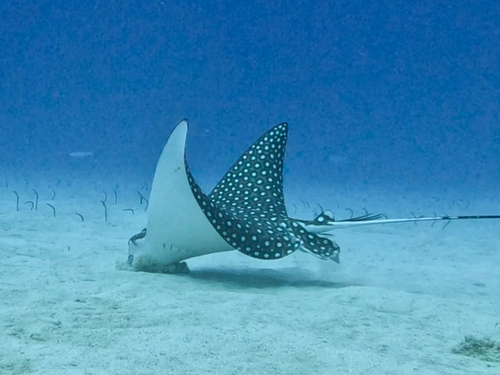
Across a dark background, each ray displays a distinctive arrangement of white spots that researchers use to identify specific animals, functioning much like an individual fingerprint and allowing them to track the animals over years.
This guide covers every aspect of spotted eagle ray biology and ecology: size and anatomy, habitat and range, diet and feeding mechanics, leaping behaviour, reproduction, conservation status and the reasons the IUCN uplifted the species to Endangered in 2020.
Etymology and Classification
The scientific name Aetobatus narinari combines two older roots. The genus name Aetobatus is derived from the Greek words for 'eagle' ( aetos ) and 'ray' ( batis ), a direct reference to the soaring flight-like swimming style and the dramatic mid-air leaps. The species was first described in 1790 by the Swedish naturalist Euphrasén.
Taxonomy has shifted repeatedly. For most of the twentieth century the spotted eagle ray was treated as a single circumglobal species found throughout the world's tropical oceans. Genetic and morphological work published between 2009 and 2014 showed that this supposedly cosmopolitan fish is in fact several distinct species separated by major ocean barriers.
The most important split recognised the eastern Pacific population as Aetobatus laticeps and the Indo-West Pacific population as Aetobatus ocellatus , leaving A. narinari as a strictly Atlantic species. Genus-level classification has also moved: the family Aetobatidae was separated from the Myliobatidae to better reflect the group's distinct evolutionary history.
In the current arrangement the spotted eagle ray sits in:
- Kingdom: Animalia
- Phylum: Chordata
- Class: Chondrichthyes (cartilaginous fish)
- Order: Myliobatiformes
- Family: Aetobatidae
- Genus: Aetobatus
- Species: A. narinari
Size and Physical Description
Spotted eagle rays are large but not giant. The maximum published disc width is about three metres, and total length including the long whip-like tail can reach about five metres. The maximum published weight is 230 kilograms.
Adult dimensions:
- Disc width: up to 3.0 m maximum
- Wingspan: up to 3.0 m maximum
- Total length including tail: up to about 5.0 m
- Weight: up to 230 kg maximum published
Newborn pups:
- Disc width at birth: 17-35 cm
- Born as fully formed miniature adults
The body shape is unmistakable. The pectoral fins, the 'wings' of the ray, form sharply angled, almost triangular points rather than the rounded disc of a stingray. The head protrudes clearly from the front of the disc, terminating in a flat, duck-bill-shaped snout that curves downward into a distinct hook. This snout is the primary tool for excavating buried prey.
Behind the body the tail extends up to two to three times the length of the disc and carries up to six venomous spines clustered near its base.
The dorsal surface is dark, ranging from black to dark grey or brown and patterned with white spots or rings. The ventral side is white, with darkly shaded disc and fin margins.
How is the ornate eagle ray different from the spotted eagle ray?
They are separate species in different genera. The spotted eagle ray ( Aetobatus narinari ) of the tropical Atlantic carries a spotted pattern of light markings on a dark back, and its tail bears two to six short venomous spines. The ornate eagle ray ( Aetomylaeus vespertilio ) is an Indo-West Pacific species known from Taiwan, Indonesia and northern Australia. Instead of spots it has a complex pattern of lines and reticulations across the disc, and its tail lacks a spine.
The Australian Museum gives the ornate eagle ray a size of 1.6 m (5.2 ft) across the disc and 3.85 m (12.6 ft) in total length, while noting that larger individuals have been reported. The spotted eagle ray reaches a published maximum disc width of 3 m (9.8 ft).
Habitat and Range
The spotted eagle ray is a tropical Atlantic species. Its range extends along the western Atlantic from approximately North Carolina in the United States south through the Gulf of Mexico, around the Caribbean basin and down to southern Brazil. The species also occurs across the central and eastern Atlantic along the coast of tropical West Africa from Mauritania to Angola. Records from Bermuda show that the species can cross long stretches of open water.
Preferred habitats:
- Coral reefs and associated sand flats
- Seagrass beds rich in bivalves
- Sheltered lagoons and bays
- Sand-bottom channels and passes between reefs
- Estuaries with moderate salinity
The species occurs in inshore waters to depths of about 60 to 80 metres, but spends much of its time swimming in open water near the surface.
Eagle rays can travel long distances in a day, and their daily movements are influenced by the tides. They prefer water of about 24 to 27 degrees Celsius.
Can you see spotted eagle rays in Costa Rica?
On the Caribbean side, yes. Costa Rica's Caribbean coast lies inside the western Atlantic range of the spotted eagle ray, which runs from North Carolina through the Gulf of Mexico and the Caribbean to Brazil. The white-spotted eagle rays of the Pacific coast are now classified as a separate species, Aetobatus laticeps , whose range runs from the Gulf of California south to Peru.
Feeding and Hunting
Spotted eagle rays are specialised molluscivores. Their anatomy is built for finding, excavating and crushing hard-shelled prey that most fish cannot exploit.
Core prey items:
- Bivalves: clams, oysters
- Gastropods: conch, whelks
- Crustaceans: crabs, hermit crabs, shrimp
- Cephalopods: small octopus and squid
- Polychaete worms
- Small benthic bony fish (occasional)
The hunt begins with detection. The ventral surface of the snout is packed with ampullae of Lorenzini, the electroreceptive organs shared by all cartilaginous fish, which detect the weak bioelectric fields of invertebrates buried in the sediment. When a target is located, the ray lowers its snout and digs into the sand.
Excavation uses the hooked snout as a shovel. Prey is drawn into the mouth by suction and, if armoured, crushed between upper and lower tooth plates.
Each jaw carries a single row of broad, flat teeth that combine into one crushing plate.
Papillae in the mouth help separate the shell from the flesh before the prey is swallowed, and a cloud of sand spews from the gills while the ray digs.
The Famous Leaping Behaviour
The defining behaviour of the spotted eagle ray, the one that gave the species its common name, is its tendency to launch itself clear of the water in full leaps.
Leap characteristics:
- Two main types: a vertical leap and a leap at about 45 degrees
- Leaps at an angle are often repeated several times in a row
- Rays also perform dips, diving and returning to the surface rapidly
- Rays are reported to leap when pursued
Proposed explanations fall into several categories:
- Parasite removal. Leaping and slamming back onto the surface may dislodge copepods, remoras and other external parasites.
- Predator escape. Eagle rays fall prey to large sharks including bull sharks, hammerheads and tiger sharks.
- Communication. Other rays might detect presence through the loud slap of re-entry.
- Pure locomotion or play. Some leaps occur without obvious cause and may simply be incidental or exploratory.
A single explanation is unlikely. The behaviour probably serves multiple functions depending on context, age and season. What is certain is that the silhouette of a ray in mid-air, wings spread and tail trailing, looks strikingly like a bird in flight.
Reproduction and Life Cycle
Spotted eagle rays reproduce through a strategy called ovoviviparity (also known as aplacental viviparity). Fertilised eggs develop inside protective capsules retained within the mother's body. Embryos draw nourishment first from yolk and later from secretions produced by the uterine lining, a structure called histotroph or 'uterine milk'. When development is complete the eggs hatch inside the mother and the pups are born live. There is no true placenta linking mother and offspring.
Reproductive parameters:
| Metric | Value |
|---|---|
| Reproductive mode | Ovoviviparous (aplacental) |
| Gestation | ~12 months |
| Litter size | Up to 4 pups |
| Development | Eggs hatch inside the mother; young are born live |
| Sexual maturity (females) | 4-6 years |
| Sexual maturity (males) | 4-6 years |
| Pup disc width at birth | 17-35 cm |
Mating occurs after a conspicuous courtship ritual. One male, or sometimes several, pursues a female and the male uses a clasper on one of his pelvic fins to transfer sperm.
After birth, juveniles receive no parental care.
The combination of late maturity, small litter size and a long gestation period produces a very slow intrinsic population growth rate. Even a population protected from all fishing would take decades to rebuild from a major decline. This demographic profile is the central reason the species is so vulnerable to sustained bycatch pressure.
How do male and female spotted eagle rays differ?
Only males have claspers, the paired mating organs on the pelvic fins, so the underside is the quickest way to sex a ray. Females also grow larger. In a study of a small fishery off Margarita Island, Venezuela, female disc widths ranged from 64 to 226 cm (25 to 89 in) and male widths from 97 to 190 cm (38 to 75 in), so the biggest rays in the catch were all female.
Females in that study matured at a slightly larger size, about 135 cm (53 in) disc width against about 129 cm (51 in) for males, and carried an average of 3.09 embryos. The catch was strongly skewed toward females, 846 against 321 males, with landings peaking from February to May. The length-weight relationship did not differ significantly between the sexes, so a male and a female of the same width weigh about the same.
Social Behaviour and Movement
Spotted eagle rays are most commonly seen alone, but they also form loose aggregations of roughly 3 to 16 rays and schools of six or more rays swimming in the same direction.
The species shows high site fidelity, with individuals often staying in or returning to the same location.
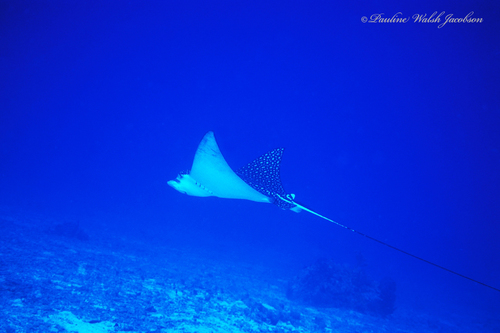
The ray swims by 'flying' through the water with undulations of its pectoral fins.
Conservation Status and Threats
The IUCN Red List classifies Aetobatus narinari as Endangered following a reassessment completed in 2020. Before the reassessment the species had been listed as Near Threatened.
Primary threats:
- Fisheries bycatch. Trawls, trammel nets and longlines catch eagle rays, and the species is often eaten after being caught unintentionally.
- Fishing for food. There are no target fisheries, but rays caught as bycatch are often eaten, and the species is also fished as a gamefish and used for fishmeal and oil.
- Coastal habitat loss. Seagrass beds and mangrove estuaries, critical nursery and feeding habitats, are being lost to dredging, pollution and coastal development across the tropical Atlantic.
- Reef degradation. Declines in Caribbean coral reefs have lowered habitat quality for rays and their prey.
- Climate change. Adult bivalves and their prey base face impacts from ocean warming, acidification and changing storm patterns across both groups.
- Aquarium and live trade. Eagle rays are sometimes taken for public aquariums.
Protection measures:
- National protection in parts of the range: harvest, possession and sale are prohibited in Florida state waters
- Inclusion in regional fishery management plans for shark and ray bycatch
- Marine protected areas that cover portions of nursery and aggregation habitat
No comprehensive recovery plan exists across the whole Atlantic range, and enforcement of existing protections is uneven. The species' slow life history means that even well-designed protection measures will take years or decades to produce measurable population recovery.
Ecological Role
Spotted eagle rays occupy an ecological role that few other predators in the tropical Atlantic can fill. As specialist shell-crushers, they regulate populations of bivalves and large gastropods on sand flats, reef margins and seagrass beds. Their feeding activity physically disturbs the sediment, exposing buried invertebrates to other predators.
Eagle rays are themselves prey for several large sharks, most consistently bull sharks ( Carcharhinus leucas ), tiger sharks ( Galeocerdo cuvier ), and great hammerheads ( Sphyrna mokarran ). The great hammerhead in particular is a ray specialist: its flattened, wing-shaped head has been observed pinning rays against the seabed. Sharks also reportedly follow eagle rays during the birthing season to feed on newborn pups.
Eagle Rays and Humans
Cultural attitudes toward eagle rays are mixed across their range. The species is often eaten when caught as bycatch, but there are no target fisheries for it.
In Florida, Bermuda and much of the tourism-focused Caribbean, eagle rays are valued as a charismatic species that draws snorkellers and divers.
Human injuries from spotted eagle rays are very rare. The venomous tail spines represent a genuine defensive weapon, and envenomation can be medically serious, but eagle rays prefer to flee rather than stand their ground. The best-known fatal incident involved a ray that leapt into a boat in the Florida Keys, rather than active stinging.
Responsible eagle ray tourism follows straightforward rules: no chasing, no touching, maintain distance, never block the ray's escape path and avoid feeding or baiting. These practices preserve the natural behaviour that draws visitors in the first place and reduce the risk of boat collisions and stress to the rays.
Illustration.
Frequently asked questions
Spotted eagle rays (Aetobatus narinari) reach a maximum published disc width of about 3 m, with a maximum published weight of 230 kg. Total length including the long whip-like tail can reach about 5 m.
Newborn pups measure 17-35 cm across the disc and are born as fully formed miniature adults. In a study of a fishery in Venezuela, females grew larger than males.
Spotted eagle rays are specialised molluscivores. Their diet is dominated by hard-shelled invertebrates (clams, oysters, conchs, whelks, crabs, hermit crabs and shrimp), supplemented by octopus and squid, polychaete worms and occasional small bony fish. They detect buried prey with the electroreceptive ampullae of Lorenzini on the snout.
Once a target is detected the ray uses its snout as a shovel to dig into the seabed, then crushes the shell with its plate-like teeth. Papillae in the mouth help separate the shell from the flesh before the prey is swallowed.
Aetobatus narinari is a tropical Atlantic species. Its range stretches from North Carolina in the United States south through the Gulf of Mexico and Caribbean to southern Brazil, and across to tropical West Africa from Mauritania to Angola, with records from Bermuda. The species prefers coral reefs, sand flats, seagrass beds, sheltered lagoons and estuaries and occurs in inshore waters to depths of about 60-80 m.
Pacific and Indo-Pacific populations once lumped under this name are now recognised as separate species, Aetobatus laticeps in the eastern Pacific and Aetobatus ocellatus in the Indo-West Pacific, which restricts A. narinari to Atlantic waters.
Yes. The IUCN Red List now classifies the spotted eagle ray as Endangered, having previously listed it as Near Threatened. The main threat is fisheries bycatch: trawls, trammel nets and longlines catch eagle rays, and the species is often eaten after being caught unintentionally.
Coastal habitat loss, reef degradation, climate change and slow reproduction (litters of up to four pups after about a year of gestation) compound the pressure. Fishing, landing, purchasing and trading of the species are prohibited in Florida, but enforcement of protections remains uneven across much of the Atlantic.
The reasons are not settled, and the behaviour probably serves multiple functions depending on context, age and season. Proposed explanations include dislodging parasites and remoras, escaping predators such as large sharks, communicating through the loud slap of re-entry, and simple play. Rays are reported to leap when pursued.
In mid-air the pectoral wings spread wide and the silhouette looks strikingly like a bird in flight.
Very rarely. Spotted eagle rays are shy and prefer to flee. The tail carries up to six venomous spines near its base, and envenomation can be medically serious, but the rays almost never use them against people.
The best-known fatal incident involved a ray that leapt into a boat in the Florida Keys, rather than active stinging. For snorkellers and divers who keep their distance and never block the ray’s escape path, most sightings end with the ray gliding calmly away.
Stingrays are flat, disc-shaped rays with a rounded outline that spend much of their time resting motionless on sandy bottoms. Spotted eagle rays are active, open-water swimmers that glide through coastal channels with slow wingbeats, and their sharply angled, almost triangular wings set them apart from the stingray’s rounded disc.
Eagle rays also carry a head that protrudes clearly from the disc, ending in a duck-bill-shaped snout used to dig up buried shellfish, and plate-like teeth for crushing shells.
References
- Tagliafico, A., Rago, N., Rangel, S., & Mendoza, J. (2012). Exploitation and reproduction of the spotted eagle ray (Aetobatus narinari) in the Los Frailes Archipelago, Venezuela. Fishery Bulletin, 110(3), 307-316.
- McGrouther, M. Ornate Eagle Ray, Aetomylaeus vespertilio. Australian Museum. View source
- Florida Museum of Natural History. Spotted Eagle Ray, Aetobatus narinari. Discover Fishes species profile. View source
- Eschmeyer's Catalog of Fishes: Aetobatus laticeps (Gill 1865). California Academy of Sciences.
- Florida Administrative Code, Rule 68B-44.008 (prohibited species). View source
- Department of Environment and Natural Resources, Bermuda. Spotted Eagle Ray (Aetobatus narinari). View source
- FishBase. Aetobatus narinari, Whitespotted eagle ray. View source