Leopard Seal: Antarctica's Top Seal Predator
Hydrurga leptonyxUp to 78% of crabeater seals that survive their first year bear leopard seal scars. This Antarctic hunter also filter-feeds krill, and females outgrow males.
 Strange Animals EditorialDecember 29, 2024·16 min read·Editorial standards ↗
The leopard seal is the apex pinniped predator of Antarctic waters. Only the orca ranks above it in the Southern Ocean food web, and only the southern elephant seal grows larger among Antarctic seals.
Hydrurga leptonyx is a solitary, cold-adapted hunter with a long reptile-like skull, canine teeth up to 2.5 centimetres long, and a diet that swings between filter-fed krill and warm-blooded vertebrates: including penguins, fish and other seals.
It is a top order predator, and the first recorded human fatality attributed to a leopard seal occurred in 2003.
This guide covers every aspect of leopard seal biology and ecology: size, habitat, hunting, diet, vocalisations, reproduction, conservation and the two famous human encounters, the 2003 death of marine biologist Kirsty Brown and the photographic encounter between Paul Nicklen and a female leopard seal who tried to feed him penguins.
Etymology and Classification
The scientific name Hydrurga leptonyx was coined by French naturalist Henri Marie Ducrotay de Blainville in 1820. Hydrurga derives from the Greek for 'water worker', a nod to the species' fully aquatic hunting life, while leptonyx means 'slender-clawed', describing the unusually delicate foreclaws compared to other seals.
The animal is also called the 'sea leopard' because of the dark grey mottled spots scattered across its silver-grey flanks, a pattern that remains the species' most recognisable feature.
Leopard seals sit within the family Phocidae, the true or earless seals, distinguished from fur seals and sea lions (family Otariidae) by the absence of external ear flaps and by hind flippers that cannot rotate forward to support terrestrial locomotion. Within Phocidae they belong to the southern lineage, the Monachinae, alongside the crabeater seal, Weddell seal, Ross seal, southern elephant seal and monk seals.
Its closest living relatives are the other Antarctic seals of the tribe Lobodontini: the Ross, crabeater and Weddell seals.
Hydrurga is a monotypic genus: H. leptonyx is the only living species. No recognised subspecies have been described, despite the enormous circumpolar range.
Size and Physical Description
Leopard seals are the second-largest seal species in the Antarctic, after the southern elephant seal, whose males can reach about 4,000 kg. Within the species, females are larger than males by up to 50 per cent.
Females:
- Length: adults of the species measure 2.4-3.5 metres
- Weight: 200-600 kg across the species
- Sexually mature between about age 3 and 7
Males:
- Length: smaller than females
- Weight: lighter than females
- Sexually mature at around age 6-7
Pups:
- Born on the pack ice, one pup per female
- Weight at birth: roughly 30 kg
- Weaned at about 4 weeks
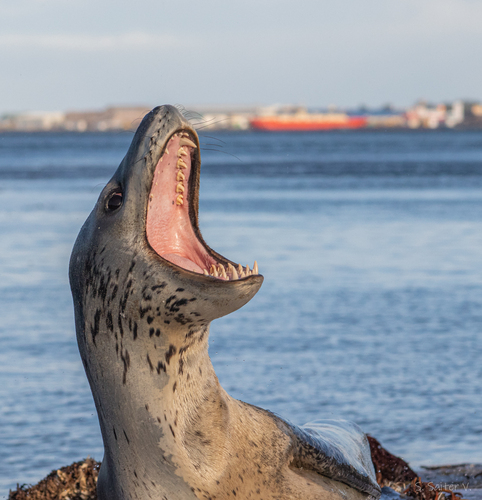
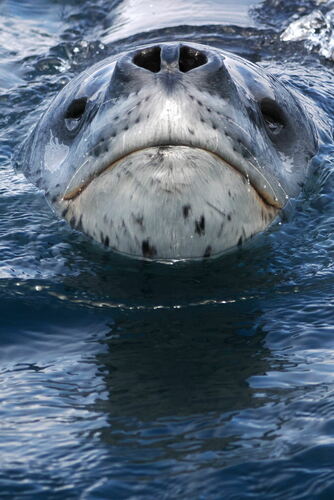
The leopard seal body plan is unmistakable once you have seen it. The torso is long and serpentine rather than barrel-shaped, the neck is notably elongated compared with other seals, and the head is large, flat, and distinctly reptilian in profile.
To many watchers, a leopard seal opening its jaws appears more crocodilian or snake-like than mammalian, and this appearance strengthens from the seal's wide gape.
The fur is short, dense and countershaded: a dark silver-grey dorsal surface shades into a pale silver-white belly. Scattered dark spots and blotches across the flanks give the species its common name.
Teeth, Skull, and Jaws
The leopard seal's dentition is one of the most specialised in the mammalian world. The canine teeth are up to 2.5 cm long and sharp, like those of other carnivores. The cheek teeth, however, are not simple carnivore shears. Each postcanine tooth is tricuspid, with three interlocking cusps that mesh with those of the opposing jaw to form a sieve, a trait shared with the crabeater seal.
This dual-purpose dentition is the anatomical expression of the species' unusual diet. The canines grip and tear warm-blooded prey, penguins, seals and occasionally fish, while the tricuspid sieve filters Antarctic krill from mouthfuls of seawater. Few large carnivores carry tools for both hypercarnivory and filter feeding in the same skull.
The leopard seal is best known for its massive jaws.
Habitat and Range
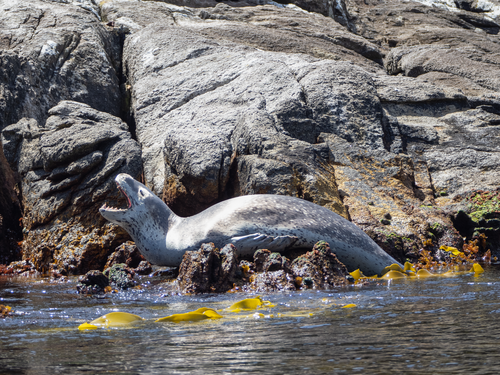
Leopard seals are circumpolar in the Southern Ocean. Their core habitat is the seasonal pack ice that encircles Antarctica, where they haul out on ice floes between hunts and give birth in early austral summer. Most remain within the pack ice throughout the year, though some move north in the austral winter to sub-Antarctic islands and the coastlines of the southern continents.
Vagrants appear surprisingly far from Antarctica. Individuals have been recorded in Western Australia, New Zealand (including the foreshore of Auckland), Argentina, Brazil, Uruguay and South Africa, and extreme wanderers have reached Pitcairn Island and Easter Island. A population also appears to be resident in Patagonia.
Seasonal pattern:
| Season (Southern Hemisphere) | Typical distribution |
|---|---|
| Spring (Sep-Nov) | Pack ice; male calling begins late in spring |
| Summer (Dec-Feb) | Pack ice; males call underwater; pups are born |
| Autumn (Mar-May) | Most seals remain within the pack ice |
| Winter (Jun-Aug) | Some seals move north to sub-Antarctic islands |
Unlike walruses or fur seals, leopard seals are almost entirely solitary. Aggregations form only at prey hotspots, a colony of fledging penguins, a carcass, a breach in the ice that funnels prey. Even then, individuals tolerate one another at a distance rather than socialising. Mothers with pups briefly form the only stable social unit in the species.
Hunting and Diet
Leopard seals are opportunistic apex predators, and their prey spectrum is among the broadest of any marine mammal. Stomach content studies, stable isotope analysis and direct observation give a consistent picture of mixed feeding that shifts with season, age and local prey availability.
Main prey groups:
- Antarctic krill ( Euphausia superba ): a major food, especially for young seals
- Penguins (Adelie, chinstrap, gentoo, king, emperor, rockhopper): famous prey of adults
- Fish
- Squid and other cephalopods
- Other seals (crabeater, Weddell, Ross, young southern elephant seals, fur seal pups)
- Other seabirds such as petrels
Krill feeding. During krill swarms, a leopard seal swims open-mouthed through dense aggregations, closes its jaws and forces water out between the interlocking tricuspid cheek teeth, retaining the krill inside. It is a filter mechanism shared with crabeater seals.
Penguin hunting. The species' most famous behaviour. A leopard seal patrols the submerged edge of an ice shelf or the access channel below a fledging penguin colony, then strikes upward as birds enter or leave the water. Once caught, the penguin is usually carried back to the surface and thrashed violently from side to side.
Earlier reports that the seal skins its prey before feeding have been found to be incorrect, lacking teeth suited to slicing, it tears the carcass into smaller pieces by flailing it from side to side.
Seal hunting. Leopard seals are among the very few mammals that routinely prey on other members of their own family. The most common victims are crabeater seal pups, whose distinctive scars, often from non-fatal attacks survived in early life, are seen on up to 78 per cent of crabeaters that survive their first year. Weddell seal pups and young Antarctic fur seals are also taken. Adult seals are rarely targeted, presumably because the energetic cost and risk of injury are too high.
Vocalisations and the Underwater Song
Leopard seals are among the most vocal of all seals, and their underwater song is one of the strangest sounds in the natural world. Males sing during the austral spring and summer, and calling coincides with the breeding season between November and early January.
A singing male hangs vertically in the water column, head down and produces a stereotyped set of calls on repeat. Typical elements include:
- Trills. Bird- or cricket-like pulse sequences
- Low moans. Low, haunting tones
- Double trills. Stylised calls such as the high double trill and the low double trill
- Hoots. A hoot combined with a single low trill
Males produce loud calls for many hours each day, and the calls make passive acoustic monitoring a useful way to survey the species.
Signature call structure is individual. Each male arranges a few call types into individually distinctive sequences. The function of the song is not fully resolved, but it is believed to serve mate attraction and territorial advertisement.
Life Cycle and Reproduction
Leopard seal reproduction is tied to the Antarctic ice cycle. Females give birth on the pack ice in the late austral spring, usually from November through early January. Each female produces a single pup.
Breeding cycle:
- Nov-Jan: Pup birth on pack ice; weaning after approximately 4 weeks
- Dec-Jan: Mating occurs in water shortly after weaning
- Following months: Gestation lasts about 274 days on average
- Nov-Jan: The next pup is born
Average gestation is about 274 days.
Pups are weaned after about a month, and the male takes no part in raising the pup. First-year pup mortality is close to 25 per cent.
Females reach sexual maturity between three and seven years, males at around six or seven. In the wild, leopard seals can live up to 26 years.
The Kirsty Brown Fatality (2003)
In 2003, biologist Kirsty Brown of the British Antarctic Survey was snorkelling near Rothera Research Station on the Antarctic Peninsula during an underwater survey. A leopard seal held her underwater for around six minutes at a depth of up to 70 metres. She was recovered by colleagues but could not be resuscitated. The incident was the first recorded human fatality attributed to a leopard seal.
The precise motive is unknown. At the inquiry, Professor Ian Boyd of the University of St Andrews said the seal may have mistaken her for a fur seal, or been frightened by her presence and attacked in defence. The coroner recorded the death as accidental, caused by drowning due to a leopard seal attack.
The Paul Nicklen Encounter
National Geographic photographer Paul Nicklen photographed a female leopard seal that repeatedly approached him over four days. She brought him live penguins, then injured penguins.
Then dead ones, possibly in an attempt to nurture the photographer.
The behaviour was possibly an attempt to nurture the photographer.
The episode shows that leopard seals do not always respond to a large swimmer with aggression.
Leopard seals nonetheless remain large predators, and the 2003 fatality shows that the species is capable of killing a human.
Movement and Swimming
Leopard seals are agile swimmers and use their large front flippers to steer. Tagging studies show that they are primarily shallow divers but capable of diving deeper than 80 metres.
Key measurements:
| Metric | Value |
|---|---|
| Typical dive depth | Primarily shallow |
| Deeper dives | Beyond 80 m recorded |
| Adult body length | 2.4-3.5 m |
| Adult weight | 200-600 kg |
| Newborn pup weight | About 30 kg |
One female, named Owha, has been tracked around the coast of New Zealand's North Island from 2012 to at least 2022.
Predators and Mortality
The only natural predator of the leopard seal is the orca.
Natural mortality causes include:
- Injuries during prey handling (penguin bones and beaks, seal bites)
- Parasitic infections
- Fungal and bacterial infections in wounds
- Cookiecutter shark bites, recorded on vagrants washed up in Australia
- Canine distemper virus
Direct mortality from humans is minimal. Marine debris entanglement is documented, but hunting does not currently occur.
Conservation Status and Threats
The IUCN Red List classifies the leopard seal as Least Concern , reflecting a widespread and abundant species with no major threats from human activity. Population estimates range from a 2012 survey figure of 35,000, which the IUCN notes is likely a substantial underestimate, to 220,000-440,000 individuals, the species is difficult to survey.
Long-term threats:
- Sea ice loss. Leopard seals are limited to a subpolar distribution and may be at risk as polar ice diminishes with global warming. They use ice for pupping and resting.
- Krill declines. Krill is an important food, especially for younger leopard seals, so any sustained collapse would force dietary shifts.
- Krill fishery expansion poses an additional threat. Commercial harvesting of krill is one of the threats noted for this species. Fishing concentrated near predator foraging areas can exhaust local prey supplies.
- Penguin colony changes. Penguins are a key prey of adult leopard seals, so changes in penguin colonies would alter where the seals forage.
- Disease. Increased tourism activity and canine distemper virus are listed among the threats.
- Marine debris. Entanglement in marine debris is a recorded threat.
Hunting of leopard seals is regulated by the Convention for the Conservation of Antarctic Seals, and no hunting currently occurs.
Leopard Seals and Humans
Human attacks by leopard seals are uncommon. Most perceptions of these animals come from encounters during the early era of Antarctic exploration.
Modern contact falls into four categories:
- Antarctic research. Scientists work alongside leopard seals at stations such as Rothera, where the 2003 Kirsty Brown fatality occurred.
- Wildlife photography and tourism. Photographers and divers sometimes enter the water with leopard seals, as in the Paul Nicklen story.
- Sub-Antarctic vagrants. Individuals hauled out on New Zealand, Australian, or South American beaches often attract public attention. Marine rescue groups have learned to treat these animals as dangerous large carnivores and keep people and dogs at a safe distance.
- Indirect human impact. Climate change, krill fishing and marine debris reach leopard seal habitat even without direct human presence in the Southern Ocean.
Early Antarctic accounts, such as the attack on Thomas Orde-Lees during Shackleton's Imperial Trans-Antarctic Expedition, portrayed leopard seals as dangerous, while the Nicklen encounter shows that they do not always respond to humans with aggression.
Frequently asked questions
Adult leopard seals (Hydrurga leptonyx) measure 2.4-3.5 m and weigh 200-600 kg, with females larger than males by up to 50 per cent. This makes the leopard seal the second-largest seal species in the Antarctic, after the southern elephant seal. Pups weigh about 30 kg at birth.
Leopard seals are opportunistic apex predators with a broad diet. Younger seals eat mostly krill, squid and fish, while adults take penguins (including emperor, king, Adelie, gentoo and chinstrap) and other seals such as crabeater and Weddell seals and fur seal pups. Krill are strained through the interlocking cheek teeth.
Leopard seals are circumpolar in the Southern Ocean, with their core habitat in the pack ice around Antarctica. Most stay within the pack ice throughout the year, though some move north to sub-Antarctic islands and the coastlines of southern continents. Vagrants have been recorded in Western Australia, New Zealand, Argentina, Brazil, Uruguay and South Africa.
Attacks on humans are rare but have occurred. The first recorded human fatality attributed to a leopard seal was biologist Kirsty Brown of the British Antarctic Survey, who was held underwater and drowned while snorkelling near Rothera Research Station in 2003. Leopard seals do not always respond to humans with aggression: photographer Paul Nicklen was approached by a female that brought him penguins over four days.
Over four days a female leopard seal brought National Geographic photographer Paul Nicklen live penguins, then injured penguins, then dead ones. The behaviour was possibly an attempt to nurture the photographer. The episode shows that leopard seals do not always respond to a large swimmer with aggression.
In the wild, leopard seals can live up to 26 years. Their only natural predator is the orca. Females reach sexual maturity between three and seven years, and males at around six or seven.
Yes. Male leopard seals produce loud underwater calls for many hours each day, and calling coincides with the breeding season between November and early January. The calls include trills and low moans, and each male arranges a few call types into individually distinctive sequences. The song is believed to serve mate attraction and territorial advertisement.
The IUCN Red List classifies the leopard seal as Least Concern. The species is widespread and abundant with no major threats from human activity. Population estimates range from a 2012 survey figure of 35,000, likely a substantial underestimate, to 220,000-440,000 individuals. Possible long-term threats include loss of sea ice, commercial krill harvesting, tourism, entanglement in marine debris and canine distemper virus.
References
- Population figures reflect the wide uncertainty inherent to surveying a solitary, ice-associated predator across the circumpolar Southern Ocean.