Emperor Penguin: Breeding in Antarctic Winter
Aptenodytes forsteriThe emperor is the only bird that breeds through the Antarctic winter, with solid bones built for deep dives. One colony watched since 1948 has vanished.
 Strange Animals EditorialJuly 3, 2025·16 min read·Editorial standards ↗
The emperor penguin is the largest living penguin and the only bird on Earth that breeds through the Antarctic winter. Everything about Aptenodytes forsteri is tuned to conditions that would kill almost any other warm-blooded animal within hours: sea ice at minus forty degrees Celsius, katabatic winds of up to two hundred kilometres per hour, and months of polar darkness broken only by starlight and aurora.
Emperors lay their eggs as winter begins, incubate them through its deepest cold and rear chicks on a narrow window of Antarctic summer that has become shorter and less predictable with each passing decade.
All major dimensions of emperor penguin biology and ecology appear in this guide, including size and physical structure, thermoregulation, diving physiology, diet and foraging, the remarkable breeding cycle, colony dynamics, movement on and under ice, conservation status and the interaction between emperors and the humans expanding presence in the Antarctic.
Etymology and Classification
The scientific name Aptenodytes forsteri honours Johann Reinhold Forster, the naturalist aboard Captain James Cook's second voyage (1772-1775) who officially named five other penguin species. The genus name Aptenodytes comes from the Greek for "without-wings-diver".
The emperor was formally described by George Robert Gray in 1844, and it shares its genus with the king penguin ( Aptenodytes patagonicus ) as the only living members.
Penguins as a group split from their closest living relatives, the tubenosed seabirds (albatrosses and petrels), around sixty million years ago. The emperor's own lineage is ancient by bird standards. Genetic analyses place the split between Aptenodytes and the other penguin genera at around forty million years ago.
That evolutionary depth matters: emperors are not a recently adapted species chasing the edge of a warming climate but a deeply specialised lineage tied to polar sea ice for millions of years.
Between seventeen and nineteen living penguin species are recognised depending on taxonomic authority. Emperors almost always breed on sea ice rather than on land or on subantarctic tussock slopes. This single habit shapes almost everything else about the species.
Size and Physical Description
The emperor penguin is the tallest and heaviest penguin alive. Adults measure about one hundred and ten to one hundred and twenty centimetres from bill to tail, and weigh between twenty-two and forty-five kilograms depending on the time of year. Males and females are similar in size.
Males:
- Weight entering winter: about 38 kg
Females:
- Size and plumage similar to males
Chicks at hatching:
- Weight: approximately 315 grams
- Down coat: grey with black head and white mask
The emperor's body is a tapered cylinder built for diving rather than flying. Bones that in most birds are hollow and air-filled are here dense and solid, reducing buoyancy at depth. The wings have evolved into stiff, flattened flippers powered by large pectoral muscles. Under the water these flippers drive the bird at an average of six to nine kilometres per hour, even against the pressure of several hundred metres of ocean.
The feet are short, wide and webbed, set far back on the body to provide steering underwater. On land they force the emperor into its characteristic upright waddle. The tail is stubby and stiff, used as a prop when the bird stands on the ice and as a rudder during dives. The bill is about eight centimetres long, with a black upper mandible and a pink, orange or lilac lower mandible.
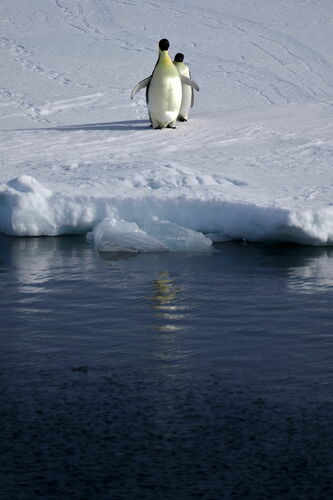
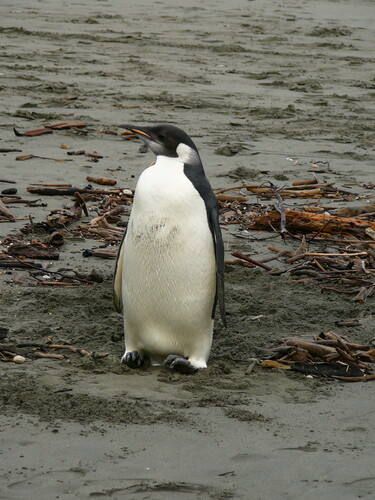
Plumage is unmistakable. Adults show a black head, dark grey-black back and flippers, white chest and belly and a vivid yellow-orange patch on each side of the neck that fades to pale yellow across the upper chest. Juveniles are greyer with white faces, and chicks wear a soft silver-grey down with a black head and white mask around the eyes.
Built for the Antarctic
Emperor penguins are adapted to the coldest sustained conditions any bird endures. Every aspect of their anatomy keeps heat in, produces heat efficiently, or reduces heat loss at critical extremities.
Insulation layers:
- Outer contour feathers: short, stiff and tightly overlapping, effectively scale-like
- Inner down layer: dense and fluffy, trapping a still layer of warm air
- Afterfeather and filoplume layers: additional fine feathers between down and contour layers
- Subcutaneous fat: up to 3 cm thick before breeding season
Emperor feathers are not arranged like those of most birds. Rather than sprouting in discrete tracts with bare skin between them, the feathers grow in an approximately even carpet across nearly the whole body. Contour feather density is only about nine per square centimetre, but dense afterfeathers and down plumules add much of the insulation. Each feather has a stiff outer shaft that blocks wind and a downy base that traps air. The overall result is a windproof shell backed by an insulating duvet.
Thermal regulation features:
- Counter-current blood flow in the legs: cools blood heading to the feet so heat stays in the core
- Short extremities: compact bill, small wings relative to body, reduced surface area
- Nasal heat exchangers: recapture heat and moisture from exhaled breath
- Behavioural huddling: the collective temperature-control strategy described below
Counter-current heat exchange is a recurring theme in polar endotherms and emperors use it dramatically. Warm arterial blood flowing toward the feet passes alongside cold venous blood returning from the feet. Heat transfers from artery to vein, so the foot itself operates close to freezing while the core stays at around thirty-nine degrees Celsius. This stops the feet from melting the ice underneath them and from bleeding heat into the ground.
When the wind picks up, emperors tip forward slightly onto their heels and tails, raising their feet off the ice and presenting the densely feathered belly to the ground. Combined with a slow metabolic shift into a calmer, energy-conserving state, this lets incubating males hold their body core temperature steady for months.
The Huddle
The most famous of all emperor penguin adaptations is social rather than anatomical. During the winter incubation, hundreds of males press together into a single dense mass called a huddle.
Huddles are not static. Birds on the windward edge gradually work their way around to the leeward side, and from there toward the warm core, birds at the core eventually rotate outward.
Over hours and days every bird spends time in every part of the huddle. The effect is a living, breathing thermodynamic engine with no leader and no permanent losers.
Combined with a metabolic slowdown, huddling is what lets a male survive roughly 120 days without food.
Diving and Underwater Life
Emperor penguins are the deepest-diving birds. The deepest recorded dive reached about five hundred and sixty-four metres below the surface, and the longest recorded dive lasted about twenty-two minutes. Routine foraging dives are less extreme, with regular dives to around one hundred and fifty metres.
Several adaptations stack together to make these dives possible.
Oxygen storage:
- Muscle myoglobin concentration much higher than in land birds, storing oxygen directly in the muscle tissue
- Larger blood volume per kilogram than non-diving birds
- Hemoglobin chemistry tuned to release oxygen efficiently under pressure
Cardiovascular response:
- Heart rate drops to as low as 15 to 20 beats per minute during dives.
- Blood flow shuts down to non-essential tissues, prioritising brain and heart
- Recovery tachycardia at the surface rapidly reloads oxygen stores
Mechanical adaptations:
- Dense, nearly solid bones reduce buoyancy
- Collapsible rib cage accommodates compression of air-filled spaces
- Feathers work by trapping a thin layer of air for insulation, though this layer is released at depth.
Vision:
- Flattened cornea that works in both air and water
- Enlarged retina with rod-dominated photoreceptors for low light
- Colour sensitivity shifted toward blue-green wavelengths that penetrate deepest
In water, emperors are astonishingly fast and agile. They hunt by pursuit, cruising horizontally at depth until prey is detected, then accelerating with sharp flicks of the flippers. Exit from the water is explosive: a feeding or returning bird rockets upward through a crack in the ice, compressing its plumage to release stored air bubbles that lubricate the ascent, and shoots out onto the ice surface.
Diet and Foraging
Emperor penguins eat fish, krill and squid. The ratios vary between colonies and seasons but the core prey is consistent.
Primary prey:
- Antarctic silverfish ( Pleuragramma antarctica ), the single most important prey at most colonies
- Antarctic krill ( Euphausia superba ), important seasonally and for juveniles
- Glacial squid, especially Psychroteuthis glacialis : energetically valuable when available
Secondary prey:
- Other nototheniid fishes
Chicks begin eating partially digested fish regurgitated by their parents within days of hatching and progress to larger, whole prey items as they grow.
Foraging trips can last several days and cover hundreds of kilometres. Parents alternate trips once the chick has hatched, with one adult remaining on the ice guarding and feeding while the other walks, swims, or toboggans out to open water. A male returning to the sea after incubation heads for open water around one hundred kilometres from the colony.
Life Cycle and Breeding
Emperor reproduction runs on an inverted calendar compared with most birds. The cycle begins as Antarctic summer ends rather than as it starts.
Annual cycle:
| Month | Stage |
|---|---|
| March-April | Birds return to the colony and pair up |
| May-June | Female lays a single egg, transfers it to the male |
| June-August | Male incubates alone for 65-75 days through midwinter |
| Late July-Aug | Chick hatches, female returns with food |
| Sep-November | Parents alternate foraging; chick grows rapidly |
| Sep-October | Chicks form creches |
| December-Jan | Chicks moult into juvenile plumage and fledge to sea |
Pairing is seasonal rather than lifelong. Emperors usually re-pair with a new partner each year, although a minority of pairs do reunite. Courtship involves elaborate mutual displays, trumpeting calls and slow circular walks on the ice.
The female lays a single egg weighing around four hundred and fifty grams. She transfers it to the male almost immediately, balancing it on her feet, inching it across to his and tucking it under the brood pouch, a flap of featherless, vascularised belly skin that drapes over the egg and keeps it close to body temperature. A mistimed transfer, a stumble, or a cracked shell can end the year's breeding effort in seconds.
Once the egg is safely on his feet, the female heads back to the ocean. The male incubates for sixty-five to seventy-five days through the coldest and darkest part of the Antarctic year. He does not eat. He drinks only the meltwater and snow he can access without leaving the huddle. During this fast he may lose as much as twenty kilograms.
Chicks hatch in late July or August. For the first days the male feeds the newly hatched chick a protein-rich secretion produced by glands in the oesophagus, sometimes called "penguin milk." The female, timed almost perfectly, returns from the sea with fresh fish and krill. She relieves the male, who then walks or toboggans to open water to feed for the first time in months.
Through spring and early summer, parents alternate foraging trips. As chicks grow they become too large to shelter in the brood pouch and eventually gather in creches that can contain thousands of juveniles. Creches provide shared warmth and safety from skuas and giant petrels, which prey on unguarded chicks. Both parents can forage simultaneously once their chick is in a creche.
Chicks fledge in December or January when they have moulted into a waterproof juvenile plumage. Fledging often involves simply walking to the edge of the receding sea ice and entering the water for the first time. Mortality in the first year at sea is high, only about nineteen per cent of chicks survive their first year, and survivors returning to a colony to breed for the first time at roughly five years old.
Movement and Travel
Emperor penguins travel on foot, on their bellies and in the water. Flying is of course impossible.
Travel data:
| Metric | Value |
|---|---|
| Distance walked to colony | 50-120 km |
| Distance to open water for a male after incubation | about 100 km |
| Average swimming speed | 6-9 km/h |
| Foraging range from colony | up to 500 km |
| Typical foraging trip (return) | 82-1,454 km |
| Maximum recorded dive | 564 m |
| Maximum recorded dive duration | 22 minutes |
Tobogganing, sliding forward on the belly while pushing with the feet and flippers, saves energy compared with walking on smooth ice. Emperors choose to toboggan on flat or gently sloping surfaces and walk where the ice is rough or broken.
On many breeding colonies the walk between the colony and the nearest open water stretches fifty to one hundred and twenty kilometres. Birds returning with food make the journey in a few days, sometimes navigating under conditions where visibility is effectively zero. Their navigation cues are not fully understood but likely combine star position, magnetic orientation and memorised landscape features.
Populations and Colonies
Emperor penguins are spread around the Antarctic coast in about sixty-six known breeding colonies as of 2022. Many of them have been identified through satellite imagery, because even a large emperor colony is invisible from a ship and nearly impossible to reach overland.
Population summary:
| Measure | Estimate |
|---|---|
| Global breeding pairs | ~278,000 |
| Total individuals | ~595,000 adults (2009 estimate) |
| Number of colonies | 66 (as of 2022) |
| Major colony sites | Cape Washington, Coulman Island, Halley Bay |
| Range | Circumpolar Antarctic coastline |
Colony locations shift year to year as sea ice conditions change. Some colonies have moved tens of kilometres or split into daughter colonies when their usual ice platform failed. The Dion Islands colony, studied since 1948, disappeared entirely in the first decade of this century.
Conservation Status and Threats
The IUCN listed the emperor penguin as Least Concern until 2012, then as Near Threatened and reassessed it as Endangered in 2026.
Primary threats:
- Sea ice loss. Emperors breed on fast ice that must form early enough in autumn to support a colony, hold stable through winter and only break up after chicks have fledged. Climate-driven changes to Antarctic sea ice directly determine breeding success. Several colonies have suffered complete breeding failure in recent years when fast ice broke up before chicks could fledge.
- Changes in prey availability. Antarctic krill populations are sensitive to sea ice because krill larvae feed on algae attached to the underside of ice. A reduction in winter ice cascades into reduced krill, which affects fish and squid populations as well.
- Commercial fisheries. Krill fishing around the Antarctic Peninsula has expanded sharply in recent decades. Competition at critical foraging grounds is a growing concern.
- Human disturbance. Research stations, fishing vessels and tourism are concentrated in a few parts of the continent, but where they overlap with colonies they can disrupt breeding behaviour and introduce disease risks.
- Emerging disease. Avian influenza and other pathogens have begun to reach Antarctic seabirds. Dense colonies with limited genetic diversity are particularly exposed.
A 2023 study found that climate change could cause more than ninety per cent of emperor penguin colonies to face quasi-extinction from breeding failures as sea ice is lost.
Conservation measures to date include the Antarctic Treaty System's general protection of the continent, Antarctic Specially Protected Areas near some colonies, and species-specific status changes under national laws. None of these addresses the core driver, which is global greenhouse gas concentration. As with other high-latitude specialists, the long-term outlook for the emperor penguin depends far more on atmospheric chemistry than on any local intervention.
Emperor Penguins and Humans
Emperors had no meaningful contact with humans until the nineteenth century. The first specimens reached European science through the voyages of Ross, d'Urville and later Scott and Shackleton. Scott's 1911 expedition famously sent three men on a midwinter trek to Cape Crozier to collect emperor eggs, a journey Apsley Cherry-Garrard later described in The Worst Journey in the World .
Modern contact is limited but growing. Research stations hold long-term ecological monitoring programmes that include colony censuses, tagging studies and diet analyses. Expedition tourism brings a small but increasing number of visitors to select colonies, although emperors are far less frequently encountered than the more coastal Adelie and gentoo species. Industry contact is concentrated in the krill fishery, which shares foraging grounds with penguins, seals and whales.
Cultural attention is enormous. Documentaries including March of the Penguins (2005) and the Frozen Planet series brought emperor breeding behaviour to global audiences. Children's books, animated films and mascots have made the emperor one of the most recognised birds in the world. That recognition provides political and financial support for Antarctic research and conservation, which matters as the species' future becomes less certain.
Illustration.
Frequently asked questions
The emperor penguin (Aptenodytes forsteri) is the tallest and heaviest penguin species alive today. Adults measure about 110-120 cm from bill to tail and weigh between 22 and 45 kilograms depending on the time of year. Males and females are similar in size.
Weight fluctuates dramatically across the annual cycle: a male may enter the winter fast at around 38 kg and lose as much as 20 kg before it ends. Chicks hatch at around 315 grams and reach roughly half adult weight before fledging in summer.
Emperor penguins live in the Antarctic, in a circumpolar distribution around the continent. They almost always breed on stable sea ice near the coast rather than on land, and walk 50-120 km over the ice to reach their colonies. Outside the breeding season they range across the pack ice and into the Southern Ocean.
About 66 breeding colonies are known as of 2022, many of them identified from satellite imagery of guano stains on the ice. Lone vagrants have occasionally been seen on subantarctic islands and in New Zealand, but the species lives in Antarctica.
Emperor penguins are marine carnivores that hunt fish, Antarctic krill and squid. Antarctic silverfish (Pleuragramma antarctica) make up the bulk of the diet, supplemented by krill (Euphausia superba) and glacial squid (Psychroteuthis glacialis). They hunt in open water or through tidal cracks in the pack ice.
Regular foraging dives reach around 150 metres, and the deepest recorded dive was about 564 metres, lasting about 22 minutes.
Emperor penguins are the only bird species that breeds through the Antarctic winter, when air temperatures can reach minus 40 degrees Celsius and winds can reach 200 km/h. Survival depends on several adaptations. First, dense feathers provide 80-90% of the bird’s insulation. Second, a thick subcutaneous fat layer, up to 3 cm, builds up before breeding.
Third, counter-current blood flow keeps the feet cold while preserving core heat. Fourth, and most famous, is the huddle, where hundreds of males press together and take turns on the cold outer edge and in the sheltered middle.
Emperor penguins breed on a schedule that runs opposite to most birds. Pairs form in March-April as Antarctic winter begins. The female lays a single egg in May or June, then transfers it to the male and heads back to the sea to feed. The male balances the egg on his feet under a flap of belly skin called the brood pouch and incubates for 65-75 days through the darkest, coldest part of winter.
He eats nothing during this period, surviving on stored fat and losing as much as 20 kg. The chick hatches in late July or August. The female returns with food, and parents alternate foraging trips until the chick joins a creche and eventually fledges in December or January.
Emperor penguins are the deepest-diving birds. The deepest recorded dive was about 564 metres, and the longest recorded dive lasted about 22 minutes. Regular foraging dives are shallower, around 150 metres. Several adaptations make these dives possible. Their bones are solid rather than air-filled, which removes the risk of barotrauma.
They can lower their heart rate to as few as 15-20 beats per minute during dives, cutting oxygen demand. Their haemoglobin and myoglobin bind oxygen at very low concentrations, and non-essential organs are shut down.
The IUCN listed emperor penguins as Least Concern until 2012, then as Near Threatened and reassessed them as Endangered in 2026. The global population was estimated at about 278,000 breeding pairs in around 61 colonies after satellite surveys. The primary threat is the loss of stable sea ice driven by climate change.
Several colonies have already suffered near-total breeding failure when ice broke up early. A 2023 study found that climate change could cause more than 90% of colonies to face quasi-extinction. Secondary threats include fisheries competition, disturbance near research stations and disease.
Emperor penguins recognise their mate and chick almost entirely by voice, because the species has no fixed nesting sites. In a colony of thousands of almost identical birds, visual identification is effectively impossible. Instead, each adult uses a complex call that combines two frequency bands at once, creating an acoustic signature unique to that individual.
Parents learn their partner’s and chick’s calls. Chicks in creches listen for their parent’s call when adults return from the sea with food.
References
- Relevant peer-reviewed and governmental sources consulted for this entry include IUCN Red List assessments (2012, 2020), the U.S.
- Fish and Wildlife Service Endangered Species Act listing (2022), the Committee for Environmental Protection reports to the Antarctic Treaty Consultative Meeting, and published research in Global Change Biology, Proceedings of the National Academy of Sciences, Journal of Experimental Biology, Marine Ecology Progress Series, and PLoS ONE.
- Specific population estimates reflect satellite census work led by the British Antarctic Survey and consolidated figures as of the most recent range-wide assessment.