Ostrich: Two Toes and a 70 km/h Sprint
Struthio camelusOstriches can run for long spells at about 55 km/h with bursts near 70 km/h, and each egg weighs about 1.4 kg, over 20 times the weight of a chicken egg.
 Strange Animals EditorialJanuary 5, 2025·13 min read·Editorial standards ↗
The ostrich is the largest living bird on Earth and the fastest animal on two legs. A mature male common ostrich stands up to about 2.75 metres tall, weighs 100-130 kg and lays the largest eggs of any living bird. It is also the only bird in the world with exactly two toes, a structural oddity that mirrors the hooves of horses and antelope rather than the claws of any other feathered animal.
This guide covers every aspect of ostrich biology and ecology: size, speed, anatomy, diet, reproduction, communal nesting, defence, conservation status and the relationship between ostriches and humans.
Etymology and Classification
The scientific name Struthio camelus combines two Greek and Latin roots. Struthio comes from the Late Latin struthio, meaning 'ostrich'. Camelus alludes to strouthokamelos, the ancient Greek name for the ostrich, meaning 'camel-sparrow'; the 'camel' part refers to the bird's dry habitat.
The ostrich belongs to the ratites, a group of large flightless birds with flat breastbones and no keel to anchor flight muscles. Other ratites include the emu, the rhea, the cassowary and the kiwi, along with several extinct species such as the moa of New Zealand and the elephant bird of Madagascar. Ratites are not a single clean lineage, molecular evidence shows they share a common ancestor with flying tinamous and that flight was lost several times independently across the group.
Ostriches themselves were long considered a single species with four living subspecies. In 2014, after genetic and morphological study, the Somali ostrich ( Struthio molybdophanes ) was formally elevated to full species status, leaving the remaining three living subspecies under Struthio camelus . A fifth subspecies, the Arabian ostrich ( Struthio camelus syriacus ), was hunted to extinction in the mid-twentieth century.
Size and Physical Description
Ostriches are the largest living birds by every standard measure: height, weight, egg size, leg length and stride. Sexual dimorphism is significant, particularly in plumage colour.
Males:
- Height: 2.1-2.75 metres at top of head
- Weight: typically 100-130 kg, exceptionally up to about 157 kg
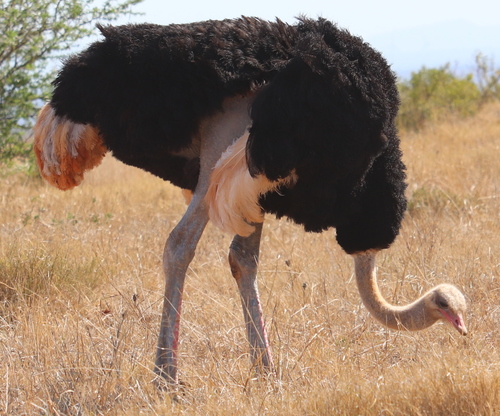
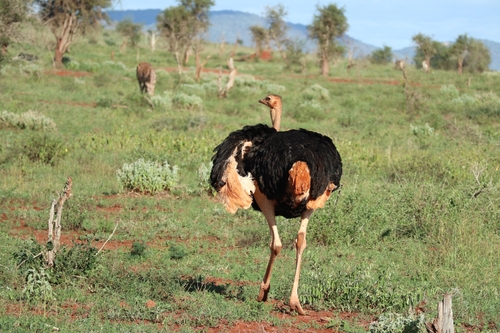
- Plumage: jet black body feathers with white wing and tail plumes
Females:
- Height: 1.75-1.9 metres
- Weight: typically 90-120 kg
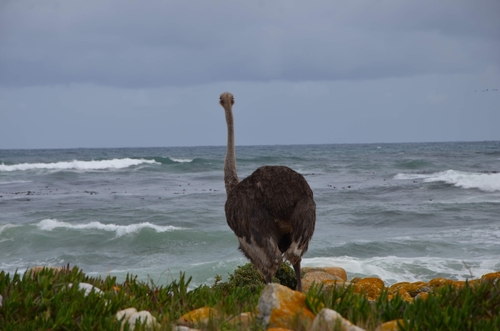
- Plumage: uniform grey-brown, camouflaged for incubation
Chicks at hatching:
- Colour: fawn with dark brown spots
The ostrich body plan is built entirely around running. The legs are long, heavily muscled at the thigh and very slender at the shin and foot. Almost all the mass is concentrated close to the hip, which reduces the rotational inertia of each stride and allows extremely rapid leg cycling.
The wings are large but flightless and are used for balance, shade, courtship display and thermal regulation.
The feet are perhaps the most striking feature of ostrich anatomy. Every other bird on Earth has three or four toes. The ostrich has two. The outer toe is small and claw-less, the inner toe is massively enlarged and carries a hoof-like nail. The foot as a whole functions more like a hoof than a typical bird foot.
Built for Speed
Ostriches are the fastest running birds and the fastest bipeds alive today. Ostriches can run for a long time at about 55 km/h, with short bursts up to about 70 km/h.
Speed adaptations:
- Two-toed feet: reduced ground contact area, reduced weight
- Long slender lower legs: low rotational inertia
- Concentrated thigh musculature: the 'drumstick' is enormous relative to body size
A sprinting ostrich covers 3 to 5 metres with each stride.
Speed is the ostrich's primary defence, and a bird that has detected a predator is almost impossible to catch. Tests have shown that the wings are actively involved in rapid braking, turning and zigzag manoeuvres.
The Largest Egg and Communal Nesting
Ostriches lay the largest eggs of any living bird. A single egg measures roughly 15 cm long, 13 cm wide and weighs about 1.4 kg, over 20 times the weight of a chicken egg.
Despite their size, ostrich eggs are actually the smallest bird eggs relative to the body mass of the parent, a female ostrich's egg is only 1 to 4 per cent of her body weight.
Ostrich breeding biology is more complex than that of most birds and involves communal nesting. A territorial male establishes a shallow sand scrape as a nest. He then courts and mates with a single dominant major hen , which is his primary partner, as well as several additional minor hens . The major hen lays her eggs first. Minor hens add theirs over the following days.
Only about 20 eggs are typically incubated, the dominant female discards the extra eggs from the weaker females.
Incubation is shared. The major hen sits by day, using her grey-brown plumage as camouflage against the sand. The black-plumaged male sits by night, invisible in darkness. Incubation lasts 42-46 days. Eggs are turned regularly using the beak, which is a possible origin of the 'head in the sand' myth, observers see ostriches repeatedly lowering their head and neck into the nest scrape to rotate and check the eggs, which at a distance looks like burial.
Chicks are precocial. Multiple clutches of chicks often merge into mixed creches guarded by a few dominant adults, producing the impression of enormous ostrich families. First-year mortality is extremely high, around 85 per cent, due primarily to predation by jackals, hyenas, lions, cheetahs and eagles.
Diet and Digestion
Ostriches are omnivores with a strong plant bias. The core of the diet is grasses, shrubs, seeds, flowers and fruit, with insects, small reptiles and carrion taken opportunistically.
Typical diet breakdown:
| Food category | Role in the diet |
|---|---|
| Grasses, leaves, shrubs | Main part of the diet |
| Seeds, roots, flowers, fruit | Common |
| Insects and small vertebrates | Occasional |
Ostriches have no teeth. To break down tough plant material the birds swallow stones. These gastroliths sit permanently in the gizzard and act as a mechanical grinder, reducing fibrous vegetation to a digestible paste. The gizzard can hold up to about 1.3 kg, of which up to 45% may be sand and pebbles.
The digestive tract is unusual for a bird in several respects. Ostriches have a large caecum where bacterial fermentation breaks down cellulose, a process more typical of grazing mammals than of birds. Their urinary system is also mammalian-like: urine is separated from faeces rather than expelled together as in almost every other bird.
Ostriches can go for extended periods without drinking, producing metabolic water from food and reducing water loss through concentrated urine and dry faeces. When free water is available, however, they drink deeply.
Defence and the Lion-Killing Kick
Running is the ostrich's first and preferred defence. When flight is impossible, a cornered bird, a defending parent, or a trapped animal, the ostrich turns to its second defence, which is the kick.
The kick:
- Delivered forward and downward only
- Powered by heavily muscled thighs
- Leads with the inner toe and its hoof-like nail
- Delivers force of about 225 kgf
- Can kill humans, hyenas and even lions
Ostriches can cause serious injury and death with kicks from their powerful legs, and are capable of killing humans, hyenas and even lions, especially when defending chicks.
The kick is a strictly forward defence: the legs can only kick forward. Most predators try to ambush an unsuspecting bird using vegetation or other cover.
Eyes and Senses
The ostrich has the largest eye of any land animal, roughly 5 cm across, which helps the bird see predators at a great distance.
This long-distance early warning system is why ostriches often share feeding areas with zebras, wildebeest and antelope, which helps the animals detect predators more efficiently.
Ostriches also have acute hearing.
Range, Habitat, and Subspecies
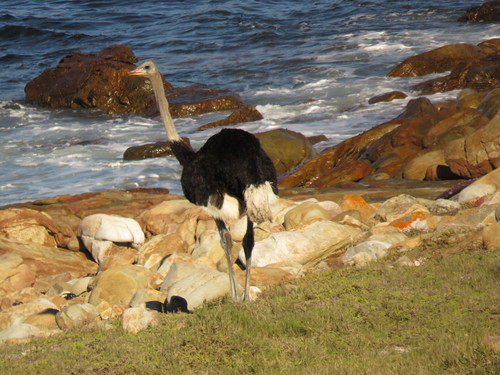
Wild common ostriches live across sub-Saharan Africa in a wide variety of open habitats: savanna grassland, semi-arid shrub, open woodland and desert edge. They avoid dense forest and closed canopy habitat, which their running-based ecology cannot use. The North African subspecies historically ranged across the Sahel into the southern Sahara, it now remains in only six of the 18 countries where it originally occurred.
Living subspecies of Struthio camelus:
| Subspecies | Range | Conservation status |
|---|---|---|
| S. c. camelus (North African) | Sahel, southern Sahara | Considered Critically Endangered by some |
| S. c. massaicus (Masai) | Kenya, Tanzania | Least Concern |
| S. c. australis (Southern) | Southern Africa | Least Concern |
The separately recognised Somali ostrich ( Struthio molybdophanes ) lives across the Horn of Africa, Somalia, Ethiopia and northern Kenya, and is distinguished by a bluish neck and thighs, a genetically distinct lineage and a slightly different behavioural repertoire. It is listed as Vulnerable by the IUCN.
Conservation Status and Threats
The common ostrich as a species is listed as Least Concern on the IUCN Red List. Ostriches are farmed worldwide for leather, meat and feathers, South Africa produces about 70% of global ostrich products, with significant industries also in the Philippines and Namibia.
Outside these strongholds the picture is harsher. The North African subspecies has disappeared from large parts of its range, leading some to consider it Critically Endangered . The Arabian subspecies is already extinct, it became extinct around 1966. The Somali ostrich is Vulnerable and declining due to uncontrolled hunting for meat, medicinal products and eggs.
Primary threats to wild ostriches:
- Poaching for meat, feathers, leather and eggs
- Habitat loss to agriculture and grazing
- Drought and desertification in the Sahel
Ostriches and Humans
Ostrich eggs and meat have been used by humans for millennia, and the eggshells have a long history of use as containers and decorative objects. The large feathers are used as plumes for decoration.
Oudtshoorn, a town in South Africa, houses the bulk of the modern ostrich industry, which has centred there.
Ostrich leather is a lucrative commodity. Ostrich meat is sold commercially, with its leanness a common marketing point.
Ostriches are farmed worldwide, and escaped farm ostriches have established a small feral population in Australia.
Human-ostrich conflict occurs in farming regions and among tourists who underestimate the danger of a territorial adult.
Frequently asked questions
Adult male common ostriches (Struthio camelus) stand 2.1-2.75 m tall and weigh 100-130 kg, with exceptional males reaching about 157 kg, making them by a wide margin the largest living bird. Females are smaller at 1.75-1.9 m and 90-120 kg. The long neck and legs keep the head up to about 2.8 m above the ground. Newly hatched chicks are fawn-coloured with dark brown spots.
The Somali ostrich is similar in size to other ostriches and is the other of the two largest living bird species.
Ostriches are the fastest running birds and the fastest bipedal animals. They can run for a long time at about 55 km/h, with short bursts up to about 70 km/h and cover 3 to 5 m in a single stride.
The reduced number of toes appears to aid running, and the wings help with rapid braking, turning and zigzag manoeuvres. Speed is the ostrich’s primary defence, since a bird that has spotted a predator is almost impossible to catch.
Most birds have three or four toes per foot. The ostrich is the only living bird with just two. The larger inner toe carries a hoof-like nail, while the outer toe has no nail.
The reduced number of toes is an adaptation that appears to aid running, useful for getting away from predators.
An ostrich egg is the largest egg of any living bird, on average 15 cm long, 13 cm wide and about 1.4 kg in weight, over 20 times the weight of a chicken egg. Relative to the size of the female, however, it is the smallest egg of any bird, at only 1 to 4% of her size.
Eggs are laid in a single communal nest, a shallow pit scraped in the ground by the male. The dominant female lays her eggs first and discards extra eggs from weaker females, leaving about 20 in most cases. Females incubate by day and males by night, and incubation lasts 42-46 days.
No. The ‘head in the sand’ behaviour is a myth. A possible origin is that ostriches keep their eggs in holes in the sand and rotate them with their beaks, so digging the hole, placing the eggs and turning them can be mistaken for burying the head.
When hiding from predators, ostriches lie with their head and neck flat on the ground, which makes them look like a mound of earth from a distance.
They can be. Ostriches usually run from threats, but they can cause serious injury and death with kicks from their powerful legs, and are capable of killing humans, hyenas and even lions, especially when defending chicks. A kick can deliver about 225 kgf.
The legs can only kick forward.
Among those common ostriches that survive to adulthood, the species is one of the longest-living bird species, and captive birds have lived to 62 years and 7 months. Mortality is highest early on: only about 15% of chicks survive to one year of age, and most chick mortality is caused by predation.
Common ostriches become sexually mature at 2 to 4 years old.
The common ostrich as a species is listed as Least Concern on the IUCN Red List. The North African subspecies (Struthio camelus camelus) has disappeared from large parts of its range and remains in only six of the 18 countries where it originally occurred, leading some to consider it Critically Endangered. The Arabian subspecies became extinct around 1966.
The Somali ostrich (Struthio molybdophanes), identified as a distinct species in 2014, is listed as Vulnerable, with numbers shrinking due to uncontrolled hunting for meat, medicinal products and eggs.