Jaguar: The Big Cat That Hunts in Water
Panthera oncaJaguars reach up to 158 kg and take prey up to 130 kg; capybaras and giant anteaters top their menu across 53 diet studies. Many black panthers are jaguars.
 Strange Animals EditorialApril 7, 2025·12 min read·Editorial standards ↗
The jaguar is the apex predator of the Americas and the only living big cat native to the New World. Heavier than a leopard, smaller than a tiger and far more powerfully built than either, Panthera onca rules the rainforests, wetlands and gallery forests that stretch from the forests of northern Mexico to the subtropical scrub of northern Argentina.
It kills with an unusual skull-piercing technique and is a strong swimmer that hunts in and around water.
This entry is a reference guide to the species itself: its classification, size, senses, hunting behaviour, diet, life cycle, distribution and conservation. Where the companion article on the jaguar's bite focuses narrowly on jaw mechanics and kill technique, this page steps back and covers the animal in full.
Etymology and Classification
The scientific name Panthera onca combines panther , from the ancient Greek, with onca , from the Portuguese onça , a spotted cat larger than a lynx. The English word 'jaguar' is possibly derived from the Tupi-Guarani word yaguara , meaning 'wild beast that overcomes its prey at a bound'.
In Spanish the species is el tigre across much of Latin America, a name that has nothing to do with real tigers. The Mayans called it b'alam , the Nahuatl-speaking Aztecs called it ocelotl , the same root from which the English word 'ocelot' descends.
Jaguars sit firmly inside the genus Panthera , alongside the lion, tiger, leopard and snow leopard. Some genetic analyses place the jaguar as a sister species to the lion, with the two diverging roughly 1.2 to 3.5 million years ago. The jaguar's ancestors entered the Americas from Eurasia via Beringia during the Early Pleistocene, and the oldest fossils of modern jaguars in North America date to about 850,000 to 820,000 years ago.
Nine subspecies were considered valid by 2005, but morphological and genetic research found no evidence for subspecific differentiation. Since 2017 the jaguar has been treated as a monotypic taxon, with two extinct fossil subspecies recognised.
Size and Physical Description
Jaguars are the third largest cat in the world, ranking behind the tiger and the lion in absolute mass but well ahead of the leopard and the puma. Size varies dramatically across the range.
Males:
- Length: up to 1.85 metres body, plus 45 to 75 centimetre tail
- Shoulder height: 57 to 81 centimetres
- Weight ranges across most areas from 56 to 96 kilograms, with an average of about 95 kg in Venezuela and Brazil. Exceptionally large males have been documented at up to 158 kg.
Females:
- Weight: about 36 kilograms for the smallest Middle American females, 56 to 78 kilograms in Venezuela and Brazil
- Generally 10 to 20 per cent smaller than males in the same region
Cubs at birth:
- Eyes open after about two weeks
The jaguar's build is unmistakable. The body is compact and heavy, with short thick legs, a broad chest and a disproportionately large head.
Limbs are short relative to body length, a configuration that favours raw power and swimming endurance over sprint speed.
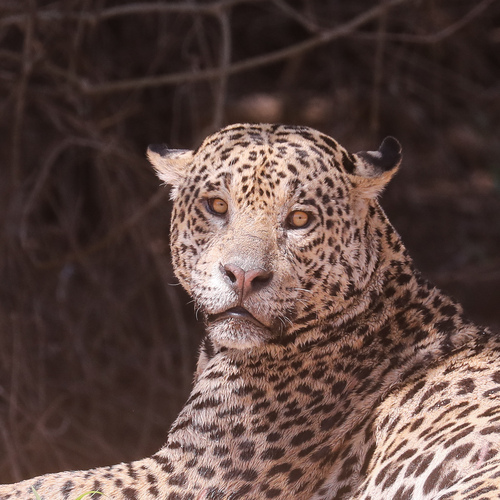
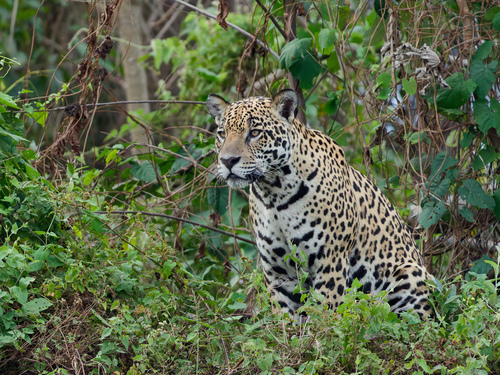
The coat is the second great trademark. Background colour ranges from pale yellow to tan or reddish-yellow. The pattern consists of large, widely spaced rosettes: irregular black rings, each typically containing one or more small interior dots. This interior spotting is the easiest way to tell a jaguar from a leopard.
The belly and inner limbs are white with bold black blotches. Melanistic jaguars, often called black panthers, carry a dominant allele that overlays the entire coat in black, the rosettes remain visible as ghost patterns in strong light.
Melanism and the Black Panther
There is no such species as a black panther. Every black panther in the Americas is a melanistic jaguar, and every black panther in Africa and Asia is a melanistic leopard. Melanism in jaguars is caused by deletions in the MC1R gene and inherited through a dominant allele, meaning a single copy of the gene is enough to produce a black cat.
The black morph is less common than the spotted one, and black jaguars occur at higher densities in tropical rainforest.
Black jaguars are more active during the daytime, which suggests that melanism provides camouflage in the deep shadows of dense, brightly lit vegetation.
Black jaguars interbreed freely with spotted jaguars and a single litter can contain both colour morphs. A cub's eventual colour is determined at conception rather than by parental phenotype.
Senses, Strength, and Bite Mechanics
Jaguars are mostly active at night and during twilight. Their eyes contain a tapetum lucidum that reflects light back through the retina.
The defining physical trait of the species is jaw power. The jaguar has the third-highest bite force of all felids, after the tiger and the lion, a 100 kg jaguar can bite with a force of about 1,110 pounds-force at the canines and 1,556 at the carnassial notch.
The jaguar's hunting technique matches that biology: rather than suffocating prey via throat or muzzle hold, a jaguar typically bites directly through the skull or the cervical vertebrae, killing instantly. This unusual behaviour is what lets jaguars safely exploit prey with dangerous defences, including caimans, peccaries and large rodents. For a deeper treatment of the mechanics, see our companion guide on the jaguar's bite force.
Habitat and Distribution
Jaguars occupy a remarkably wide band of environments, but all of them share two traits: dense cover and reliable prey. The core habitat types are tropical rainforest, flooded wetland, gallery forest along rivers, dry tropical forest and dense scrubland. Jaguars avoid montane forests, although they have been recorded at elevations up to 3,800 metres.
Major regional strongholds:
- Amazon basin. By far the largest remaining population. Stretches across Brazil, Peru, Colombia, Ecuador, Bolivia, Venezuela, Guyana, Suriname and French Guiana.
- Pantanal. The Brazilian, Bolivian and Paraguayan wetlands have recorded densities of about six to seven jaguars per 100 square kilometres in GPS telemetry studies.
- Gran Chaco. A dry forest mosaic across Paraguay, Bolivia and Argentina, under heavy pressure from agricultural expansion.
- Mesoamerica. Yucatan, Belize, Guatemala, Honduras, Nicaragua, Costa Rica and Panama hold important smaller populations, increasingly dependent on forest corridors.
- Atlantic Forest. Brazil's coastal forest, once continuous, is now a shredded patchwork, jaguars persist in only a few strongholds.
In the 19th century jaguars were still sighted in Colorado, coastal Louisiana and northern Arizona and New Mexico. The present range is less than half of the early 20th century extent. The jaguar is locally extinct in Uruguay and El Salvador, and was thought to be extirpated from the United States by the late 1960s, though vagrant individuals have since been recorded in the southwest.
The Jaguar Corridor Initiative aims to maintain connectivity by protecting forest links between the remaining strongholds.
Diet and Prey
Jaguars are obligate carnivores and generalist hunters. An analysis of 53 diet studies found prey ranging from 1 to 130 kilograms, with a preference for animals of 45 to 85 kilograms and the capybara and giant anteater the most selected.
Jaguars will also take giant anteaters, fish, turtles, anacondas and the occasional domestic animal where ranching overlaps with jaguar range. In the Brazilian Pantanal, jaguars feed primarily on aquatic reptiles and fish.
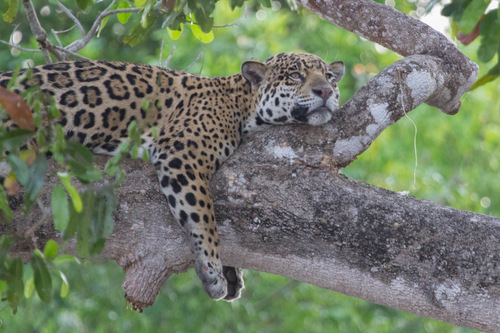
The daily food requirement of a captive jaguar weighing 34 kilograms was estimated at 1.4 kilograms of meat. After a kill, a jaguar drags the carcass to a thicket or other secluded spot, and it is strong enough to haul a carcass as large as a heifer up a tree to avoid flood levels.
Water, Swimming, and Aquatic Hunting
The jaguar is a good swimmer that plays and hunts in the water, possibly more than tigers do. It has been recorded swimming distances of at least 1.3 kilometres between islands and the shore. The old schoolroom claim that cats fear water is demonstrably false for this species.
Observed aquatic behaviour:
- Wading in shallow rivers and oxbows to ambush capybaras and fish
- Swimming between flooded forest islands during wet season
- Leaping into water after prey
Life Cycle and Reproduction
Outside mating season, jaguars live solitary lives. Male and female home ranges separate by sex, with male ranges spanning about 25 square kilometres in the Pantanal, around 180 in the Amazon and several hundred in the Atlantic Forest and Cerrado areas, and these larger male ranges often overlap several female home ranges. Spacing maintains itself through scent marking and roars.
Unmated females enter oestrus approximately every six to seven weeks. Mated pairs remain together for just a few days, mating repeatedly before permanent separation. Birth occurs 91 to 111 days after conception in a secluded den that may be a hollow tree, rock overhang or dense thicket.
Cub development:
- Birth: one to two cubs in the Pantanal, eyes closed
- Week 2: eyes open
- Month 3: cubs weaned
- Month 6: cubs leave the birth den to accompany the mother on hunts
- Up to 2 years: cubs remain with the mother
- Year 2.5 to 4: sexual maturity (about 2.5 years for captive females, 3 to 4 years for males)
Male jaguars have been recorded killing cubs, including a case in Emas National Park in 2001. Jaguars appear to rarely live beyond 11 years in the wild, but captive individuals may live 22 years.
Populations and Conservation
The IUCN classifies the jaguar as Near Threatened , a status it has held since 2002, as the population has probably declined by 20 to 25 per cent since the mid-1990s. The Amazon rainforest is the only remaining stronghold.
Principal threats:
- Deforestation. Conversion of forest to cattle pasture, soy and infrastructure is the single largest driver of range loss. Pasture expansion also raises the frequency of livestock predation and retaliatory killing.
- Fragmentation. Remaining forest blocks are increasingly isolated by roads, dams and cleared agricultural corridors. Isolated jaguar subpopulations face inbreeding and demographic collapse over timescales of decades.
- Retaliatory killing. Ranchers shoot, trap and poison jaguars blamed for livestock losses, sometimes pre-emptively.
- Poaching. Jaguar fangs, skins and other body parts are traded illegally, for example, 760 jaguar fangs originating in Bolivia and destined for China were seized between 2014 and early 2019.
- Prey depletion. Subsistence and commercial hunting of peccaries, tapirs, capybaras and deer reduces the prey base below levels that can sustain resident jaguars.
- Infrastructure. Road construction and tourism infrastructure fragment habitat and give hunters access to forests.
Conservation responses:
- Corridors identified between Jaguar Conservation Units aim to connect breeding populations from Mexico to Argentina.
- National parks in Brazil, Peru, Bolivia and Colombia together protect several of the largest contiguous habitat blocks.
- Conservation efforts often focus on educating ranch owners and promoting ecotourism.
- CITES Appendix I listing prohibits international commercial trade in jaguar parts, though enforcement varies by country.
The outlook is mixed. The Amazon rainforest is the last stronghold, but it is rapidly being fragmented by deforestation.
Jaguars and Human Culture
Few animals loom larger in the symbolism of the Americas than the jaguar. Olmec, Maya, Aztec, Moche, Inca and dozens of Amazonian cultures placed the jaguar at the centre of their spiritual hierarchies. The Maya believed the jaguar carried the sun across the underworld each night. Aztec warriors were ranked as ocelotl , jaguar warriors and elite units wore jaguar pelts into battle.
Olmec stone sculpture depicts the 'were-jaguar' transformation, a shaman crossing into jaguar form. Modern Indigenous communities in the Amazon still frame jaguars as spiritual equals and practise jaguar-specific hunting taboos that date back centuries.
European contact changed the equation. Colonial and post-colonial hunting, bounty programmes and the twentieth-century fur trade drove jaguar populations down sharply. In the 1960s more than 15,000 jaguars were killed each year for their skins in the Brazilian Amazon alone, and the trade declined after CITES took effect in 1973.
Contemporary ecotourism, especially boat-based jaguar viewing in the northern Pantanal, has created a new economic model in which a live jaguar generates more revenue than a dead one, and local attitudes in tourism-exposed communities have shifted accordingly.
See also: Cougar vs Jaguar
Illustration.
Frequently asked questions
Jaguars (Panthera onca) normally weigh 56 to 96 kilograms in most regions, with males in Venezuela and Brazil averaging about 95 kilograms. Exceptionally big males have been recorded at up to 158 kilograms, while the smallest females from Middle America weigh about 36 kilograms. Body length reaches up to 1.85 metres, with a 45 to 75 centimetre tail and shoulder height is 57 to 81 centimetres. Females are typically 10 to 20 per cent smaller than males.
Jaguars in forests are often darker and considerably smaller than those in open areas. The species is the third largest cat on Earth after the tiger and lion, and the largest cat in the Americas.
Jaguars are the only living member of the genus Panthera native to the Americas. Their present range extends from Mexico through Central America and the Amazon rainforest to Paraguay and northern Argentina, with the Amazon the only remaining stronghold. Other important regions include the Pantanal, the Gran Chaco and the Yucatan.
They occupy tropical rainforest, flooded wetlands, gallery forest along rivers, dry forest and dense scrub. In the 19th century jaguars were still sighted in Colorado, coastal Louisiana and northern Arizona and New Mexico. The present range is less than half of the early 20th century extent, and the species is locally extinct in Uruguay and El Salvador.
Jaguars are obligate carnivores and opportunistic hunters. An analysis of 53 diet studies found prey weighing 1 to 130 kilograms, with the capybara and giant anteater the most selected. They also take marsh deer, collared peccaries, agoutis, and, in floodplains, reptiles such as anacondas, caimans and turtles. In the Brazilian Pantanal they feed primarily on aquatic reptiles and fish. They also prey on livestock where wild prey is scarce.
A captive jaguar weighing 34 kilograms was estimated to need about 1.4 kilograms of meat per day. Their powerful bite lets them pierce the carapaces of turtles and tortoises.
No. In the Americas, every ‘black panther’ is a melanistic jaguar, and in Asia and Africa every ‘black panther’ is a melanistic leopard. There is no distinct black panther species. Melanism in jaguars is caused by deletions in the MC1R gene and inherited through a dominant allele, the familiar rosettes remain visible under bright light as ghost patterns.
The black morph is less common than the spotted one, and black jaguars occur at higher densities in tropical rainforest. They are more active during the daytime, which suggests that melanism provides camouflage in the deep shadows of dense vegetation.
Black jaguars interbreed freely with spotted jaguars, and a single litter can contain both colours.
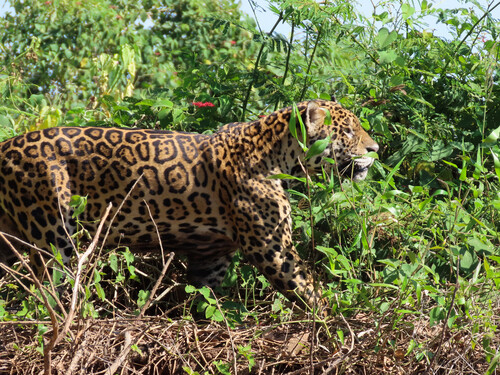
Jaguars are stalk-and-ambush predators that rely on dense cover, water and a quick pounce rather than a long chase. They walk slowly along forest paths, listening for and stalking prey, then attack from cover, usually from the target’s blind spot. The ambush may include leaping into water after prey.
Unlike the throat or muzzle hold used by many big cats, a jaguar typically bites mammalian prey directly through the skull between the ears to deliver a fatal bite to the brain. This unusual method relies on a powerful bite that also lets jaguars pierce the shells of turtles and tortoises. Jaguars are good swimmers and hunt in and around water.
The IUCN Red List classifies the jaguar as Near Threatened, a status it has held since 2002, as the population has probably declined by 20 to 25 per cent since the mid-1990s. The range is now less than half of its early 20th century extent, and the Amazon rainforest is the only remaining stronghold.
Primary threats include deforestation and habitat fragmentation, retaliatory killing by ranchers, poaching for the trade in body parts such as fangs and skins, some of it destined for China and depletion of prey. The jaguar is listed on CITES Appendix I, which prohibits international commercial trade. Corridors between Jaguar Conservation Units aim to keep breeding populations connected from Mexico to Argentina.
Attacks on people by wild jaguars are rare. The first official record of a jaguar killing a human in Brazil dates to June 2008, and the majority of known attacks happened when the jaguar had been cornered or wounded.
The danger runs mostly the other way: jaguars are killed in retaliation for livestock predation and for the illegal trade in their body parts. Reducing that conflict, for example by educating ranch owners and promoting ecotourism, is central to jaguar conservation.
Jaguars (Panthera onca) and leopards (Panthera pardus) are both members of the genus Panthera and look similar, but they live on separate continents. The jaguar is generally more robust than the leopard, with stockier limbs and a more square head.
The simplest field mark is the rosette pattern: jaguar rosettes are larger, darker, fewer in number and have thicker lines with a small spot in the middle, while leopard rosettes are smaller and have empty centres. Behaviourally, jaguars hunt readily in and around water and kill by biting through the skull, while leopards are known for hauling kills into trees. The two species do not overlap in the wild today.
References
- Population estimates reflect the most recent consolidated assessment by the IUCN Cat Specialist Group. Cultural material draws on Miller and Taube's Illustrated Dictionary of the Gods and Symbols of Ancient Mexico and the Maya and the archaeological literature on Olmec, Maya, and Aztec iconography.