Snow Leopard: Built for Vertical Stone
Panthera unciaIn a Gobi study, adult male snow leopards used home ranges of 144 to 270 square kilometres. The fat-thickened tail alone is 0.8 to 1.05 metres long.
 Strange Animals EditorialFebruary 6, 2025·13 min read·Editorial standards ↗
The snow leopard is the most vertically adapted of the world's big cats, a mid-sized predator tuned for one narrow environment, the bare, thin-aired, almost vertical stone of Central Asia's highest mountains.
Unlike the lion of the savanna or the tiger of the subtropical forest, Panthera uncia lives where oxygen is scarce, winters are severe and the ground itself is usually sliding or crumbling. It cannot roar, and it is listed as Vulnerable on the IUCN Red List.
All dimensions of snow leopard biology and ecology appear in this guide, including size and proportions, cold-adaptations, hunting patterns, diet, reproductive cycle, range extent, conservation status and the evolving relationship between snow leopards and the mountain communities that coexist within their range.
Etymology and Classification
The scientific name Panthera uncia carries its own small history. Panthera is the cat genus that holds lions, tigers, jaguars, leopards, and, since modern genetic work, the snow leopard. Uncia is an old European word for a lynx-like cat; it survives in the archaic English word 'ounce'.
For most of the twentieth century the snow leopard was placed in its own genus Uncia , partly because it cannot roar and partly because of perceived anatomical quirks. Molecular phylogenetic studies placed it inside Panthera , as the sister lineage of the tiger.
The snow leopard is the sister lineage to the tiger within Panthera . It is not a subspecies of the common leopard ( Panthera pardus ), despite the English name and the two species do not overlap ecologically in most of their range.
Size and Physical Description
Snow leopards are mid-sized big cats. They look heavier than they are because of an unusually dense coat and a long tail.
Adults:
- Head-and-body length: 0.75-1.5 metres
- Tail length: 0.8-1.05 metres
- Shoulder height: up to about 56 centimetres
- Weight: males average 45-55 kg, females 35-40 kg
Cubs at birth:
- Weight: 320-567 grams, about the size of a small kitten
The muzzle is short, and the large nasal openings warm cold, dry air before it reaches the lungs.
The fur is pale smoky grey to cream across the back and flanks, patterned with dark rosettes and spots that break up the cat's outline against lichen-streaked rock and patchy snow. The belly is nearly pure white. The fur is thick, with hairs 5 to 12 centimetres long.
The tail is the single most striking anatomical feature. In most big cats the tail is used mainly for balance during fast turns. In the snow leopard the tail performs at least four distinct jobs: in-air counterweight during long jumps, balance during cliff traverses, a fat reserve for lean winters, and, most famously, a cold-weather face wrap.
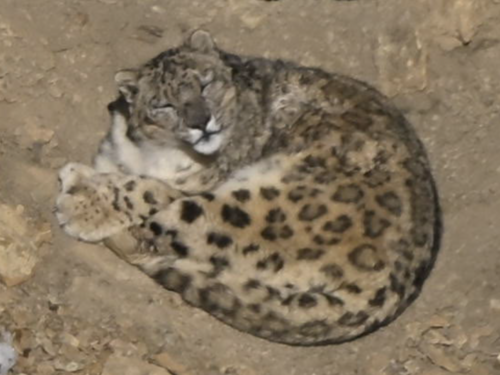
A resting snow leopard curls into a tight ball with the tail drawn across the face like a blanket.
Paws are broad, heavy and fur-covered underneath. The broad paws work as natural snowshoes, spreading the cat's weight across snow and the fur on the undersides helps grip steep, unstable surfaces.
Built for High, Cold, Thin Air
All aspects of snow leopard physiology support one of two objectives: retaining heat or moving efficiently over unstable, near-vertical terrain.
Thermal adaptations:
- Double-layer coat with long guard hairs and dense woolly underfur
- Fur-padded paws for insulation against cold rock and snow
- Small rounded ears that minimise exposed surface area
- Fat stored in the thick tail
- Compact body plan with shorter legs than most other Panthera species
Altitude adaptations:
- Large nasal openings that warm cold, dry air
Terrain adaptations:
- Long hind legs with heavy thigh musculature
- Flexible lumbar spine allowing extreme arching during leaps
- Long counterbalancing tail
- Broad paws with gripping pads and strong curved claws
The famous tail-around-the-face sleeping posture uses the thick, furred tail as a blanket to protect the face while the cat sleeps.
Hunting and Diet
Solitary ambush predators, snow leopards do not form social hunting groups like lions nor rely on speed over open ground like cheetahs. They employ vertical terrain as a hunting landscape works for a lion in tall grass: it provides cover, concealment and a geometric pattern that channels prey into ambush areas.
Primary prey:
- Blue sheep, or bharal ( Pseudois nayaur )
- Asiatic ibex ( Capra sibirica )
- Himalayan tahr ( Hemitragus jemlahicus )
- Argali sheep ( Ovis ammon )
- Markhor ( Capra falconeri )
Secondary prey:
- Marmots, pikas and hares
- Game birds including snowcocks and chukar
- Young yaks, goats, or sheep from domestic herds
A single adult needs roughly 20 to 30 adult blue sheep per year, and one blue sheep can sustain it for about two weeks. The cat drags its kill to a safe location and consumes all edible parts of the carcass.
Hunting technique:
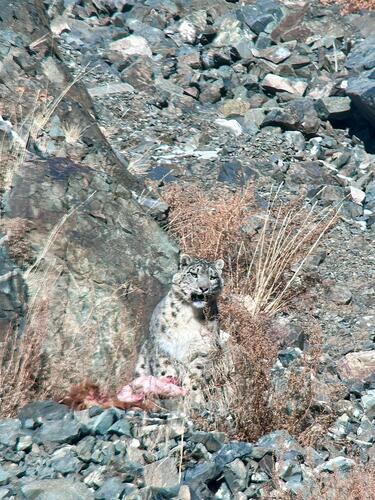
- Stalking and ambush. The cat uses terrain, ridges, gullies and boulder fields, to close the distance unseen, then launches a short, explosive sprint.
- Downhill pursuit. The cat uses the momentum of its initial leap to chase prey down steep mountainsides for up to 300 metres.
- Feeding. After killing, the cat drags the prey to a safe location and consumes all edible parts of the carcass.
Life Cycle and Reproduction
Snow leopard reproduction is tightly keyed to the short mountain growing season. Mating occurs in late winter, marked by a noticeable increase in marking and calling. Males tend not to seek out another partner after mating.
Gestation lasts 90 to 100 days. Females give birth between April and June in a rocky den or crevice lined with fur shed from the mother's own belly. A litter usually consists of two to three cubs. Cubs are born blind and dependent, weighing 320 to 567 grams.
Cub development:
- About 7 days: eyes open
- About 10 weeks: fully weaned
- 2-4 months: leave the den
- About 20-23 months: begin to separate from the mother
Snow leopards become sexually mature at two to three years and normally live 15 to 18 years in the wild.
Movement, Range, and Density
Snow leopards live at extraordinarily low densities compared with other Panthera species. Recent surveys report densities from about 0.1 to 2 individuals per 100 square kilometres. Home ranges vary with prey abundance: in a Gobi study, adult males used 144 to 270 square kilometres and adult females 83 to 165. Ranges overlap, but individuals rarely meet.
Movement data:
| Metric | Value |
|---|---|
| Typical elevation | 3,000-4,500 m |
| Upper summer elevation | Up to about 6,000 m |
| Home range, male | 144-270 km^2 (Gobi study) |
| Daily movement | 0.2-5.45 km in a straight line; up to 7 km in one night |
| Typical winter elevation, northern range | 1,200-2,000 m |
| Snow depth it can move through | About 85 cm |
Range, Populations, and Genetic Structure
Snow leopards are present across 12 range countries in Central and South Asia. The species has a large geographic footprint but lives at very low density, so the global population is small.
Approximate distribution:
| Country | Estimated share of global population |
|---|---|
| China | About 4,500 (2016 estimate) |
| Mongolia | About 1,000 (2016 estimate) |
| India | 718 (2024 estimate) |
| Nepal | 300-400 individuals |
| Pakistan | 250-420 individuals |
| Kyrgyzstan | 300-400 individuals |
| Tajikistan | 250-280 individuals |
| Others | Remainder spread across Afghanistan, Bhutan, Kazakhstan, Russia, Uzbekistan |
Camera-trap surveys and non-invasive genetic sampling from scat have made modern population estimates more reliable than earlier ones.
Conservation Status and Threats
The IUCN Red List classifies the snow leopard as Vulnerable with a decreasing population trend. It is listed on CITES Appendix I, which bans international commercial trade, and legally protected in most of its range countries. The Global Snow Leopard and Ecosystem Protection Program, signed in Bishkek in 2013, commits range states to coordinated conservation across borders.
Primary threats:
- Poaching. Snow leopards are killed for pelts and bones, the latter used in traditional medicine. In China alone an estimated 103 to 236 animals are poached every year.
- Retaliatory killing. Snow leopards killing livestock can wipe out a herder family's entire annual income. Shooting, snaring or poisoning in retaliation continues to be a primary mortality factor across parts of the leopard's range.
- Prey depletion. Overhunting of blue sheep, ibex and argali reduces the food base. Conservation programmes increasingly treat prey recovery as inseparable from cat recovery.
- Habitat fragmentation. Mountains that were once continuous are now divided by roads, mining, hydro reservoirs and pasture expansion into smaller habitat islands, and genetic diversity suffers as a result.
- Climate change. Warming is pushing treelines upward and shrinking high alpine zones. Over decades this compresses available snow leopard habitat against the physical ceiling of ridgelines.
How a community fares over the long term depends less on any single intervention and more on combining community-level incentives, anti-poaching enforcement, prey management and cross-border cooperation.
Snow Leopards and Humans
The snow leopard's cultural status across its range is unusually strong. In Kyrgyzstan it is considered sacred and appears in the emblem of the capital, Bishkek. It is also the state animal of Ladakh and Himachal Pradesh in India.
Modern conservation increasingly relies on this cultural weight. Community-based programmes across the range build on local pride and aim to compensate herders for livestock losses, reducing the incentive to retaliate.
The Camera-Trap Revolution
For most of the twentieth century, what biologists knew about snow leopards was cobbled together from pugmarks in fresh snow, scrapes on ridgelines, bones in middens and the occasional pelt confiscated at a border post. Direct observation by researchers was rare.
This changed as digital camera traps became widely deployable in cold, remote terrain and surveys began returning large bodies of consistent snow leopard imagery.
The effects were immediate. Individual cats could be identified by rosette patterns, which are unique like fingerprints. Capture-recapture statistics produced real density estimates. Presence at previously uncertain sites was confirmed or ruled out.
The revolution is ongoing.
Non-invasive genetic sampling from scat, combined with camera-trap imagery, now produces the most reliable snow leopard population estimates available.
Evolution and Close Relatives
The snow leopard's place in the Panthera family tree was debated for most of the twentieth century. Early morphologists, impressed by its inability to roar and by its short rounded skull, placed it in its own genus Uncia .
Later molecular work settled the question: the snow leopard is a full member of Panthera , sister to the tiger and the genetic divergence of the pair is estimated at between about 1.8 and 4.6 million years ago.
The snow leopard is therefore more closely related to the tiger than the common leopard is. This is one reason the name 'snow leopard' is taxonomically misleading. It is not a high-altitude race of Panthera pardus; it is a separate species whose closest living cousin stalks the tropical and temperate lowland forests of South and East Asia.
References
See also: Snow Leopard vs Tiger
Frequently asked questions
Snow leopards (Panthera uncia) are mid-sized big cats. Head-and-body length is about 0.75 to 1.5 metres, with a tail of 0.8 to 1.05 metres, so the tail is nearly as long as the body. Males average 45 to 55 kilograms and females 35 to 40 kilograms. Shoulder height is up to about 56 centimetres. They look bulkier than they are because of a thick coat of pale grey fur patterned with dark rosettes.
Cubs weigh 320 to 567 grams at birth and are fully weaned by about 10 weeks.
Snow leopards inhabit the mountains of Central and South Asia across 12 range countries: Afghanistan, Bhutan, China, India, Kazakhstan, Kyrgyzstan, Mongolia, Nepal, Pakistan, Russia, Tajikistan and Uzbekistan. Their range covers the Himalaya, Karakoram, Hindu Kush, Pamir, Tien Shan, Altai and the Tibetan Plateau.
They live mainly in alpine and subalpine zones at 3,000 to 4,500 metres, though in summer they can occur from about 2,700 to 6,000 metres. In winter, or in the northern part of the range, they descend to lower elevations of roughly 1,200 to 2,000 metres. They prefer rocky, broken terrain.
Snow leopards are carnivores that hunt mainly mountain ungulates. Preferred wild prey includes blue sheep (bharal), Asiatic ibex, Himalayan tahr, argali sheep and markhor. They also take smaller animals such as marmots, pikas and hares, and they prey on domestic livestock.
One adult apparently needs 20 to 30 adult blue sheep per year, and a single blue sheep can sustain a snow leopard for about two weeks before it hunts again.
Snow leopards cannot roar even though they belong to the genus Panthera. Despite a partly ossified hyoid bone, their short vocal folds, about 9 millimetres long, provide little resistance to airflow, so they cannot produce a roar.
Their vocalisations include meowing, grunting, a puffing sound called prusten and moaning. They can also purr when exhaling.
Snow leopards are agile climbers and leapers, but this article does not give a verified jump distance. They actively pursue prey down steep mountainsides, using the momentum of an initial leap to chase animals for up to 300 metres.
Their long, flexible tail helps them balance on rocky terrain.
Snow leopards have thick fur, with hairs 5 to 12 centimetres long and small rounded ears that minimise heat loss. Their broad paws spread their weight on snow, and fur on the undersides of the paws helps grip and limits heat loss. Their large nasal openings warm the cold, dry air they breathe.
The tail is very thick because it stores fat, and it is covered in dense fur. A sleeping snow leopard uses it like a blanket to protect its face.
The global population is estimated at fewer than 10,000 mature individuals, and the IUCN expects it to decline by about 10% by 2040. Uncertainty is high because the species is so hard to survey. Recent national estimates include about 4,500 in China (2016), about 1,000 in Mongolia (2016), and 718 in India (2024).
The IUCN Red List classifies the snow leopard as Vulnerable, the status assigned in the 2017 assessment.
Snow leopards normally live 15 to 18 years in the wild. In captivity they can live up to 25 years.
They become sexually mature at two to three years. Gestation lasts 90 to 100 days, and cubs are born between April and June, usually in litters of two to three.