Vampire Bat: Living on Blood Alone
Desmodus rotundusCommon vampire bats drink about 20 ml of blood in a 20-minute feed, roughly half a 40-gram female's weight, and they share blood meals with roost-mates.
 Strange Animals EditorialJuly 31, 2025·14 min read·Editorial standards ↗
The vampire bat is the only mammal on Earth that feeds on a diet of pure blood. Three species live this way, the common vampire bat ( Desmodus rotundus ), the white-winged vampire bat ( Diaemus youngi ), and the hairy-legged vampire bat ( Diphylla ecaudata ), and all three are native to the warm forests and grasslands of the Americas.
Of the more than 1,400 bat species currently described, these three are the only mammals that derive all of their calories from blood. The biology required to make that diet work is extraordinary at every level, from infrared-sensing facial pits, to anticoagulant saliva, to colony-wide food-sharing networks.
This guide covers vampire bat biology and ecology in depth: anatomy, sensory systems, hunting, feeding mechanics, social structure, reproduction, rabies ecology, medical research applications and conservation status. Expect specifics, grams, millilitres, minutes and the names of real researchers, rather than general claims.
Etymology and Classification
The common vampire bat was first described as Phyllostoma rotundum by Étienne Geoffroy Saint-Hilaire in 1810. The genus Desmodus was erected by Maximilian Wied in 1826, and the current name Desmodus rotundus was given by Oldfield Thomas in 1901.
The anticoagulant draculin in vampire bat saliva is named after Count Dracula.
All three vampire bat species sit within the family Phyllostomidae, the New World leaf-nosed bats, in a subfamily called Desmodontinae. Molecular phylogenetics confirms that the three species share a single common ancestor, and the vampire bat lineage diverged from the rest of its family roughly 26 million years ago. Hematophagy appears to have arisen only once in bats, not multiple times.
The nearest non-blood-feeding relatives of vampire bats include fruit bats, nectar bats and insect-eating bats of the broader Phyllostomidae family. Dietary evolution in this family is one of the most dramatic among mammals: from insect-feeders ancestrally, leaf-nosed bats diversified into fruit, nectar, pollen, meat and finally blood specialists.
Vampire Bat Size and Physical Description
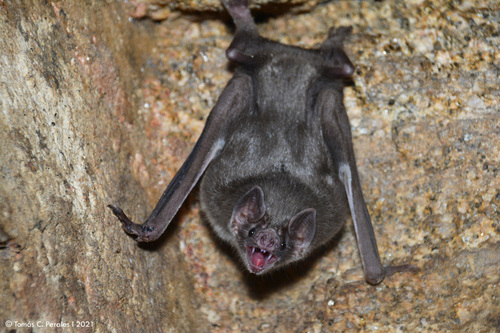
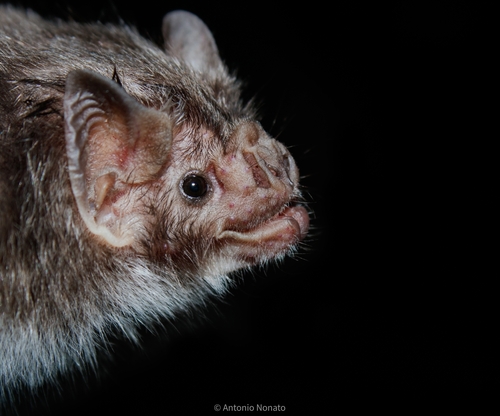
Vampire bats are small. A common vampire bat weighs between 25 and 40 grams, roughly the weight of a slice of bread and measures about 9 centimetres long. Wingspan is about 18 centimetres. Males and females are similar in size, with females sometimes slightly heavier when pregnant or lactating. Their fur is short, dense and a dark grey-brown with a paler belly. The face is short and blunt compared to other leaf-nosed bats, with a reduced nose-leaf.
Distinctive anatomical features:
- Upper incisors: large, razor-edged, triangular, effectively built-in scalpels
- Cheek teeth: reduced in size and number because blood requires little chewing
- Tongue: grooved along the underside to work like a drinking straw through capillary action.
- Pit organs: three heat-sensitive depressions around the nose-leaf
- Thumbs: elongated and powerful, used to walk and hop on the ground
- Ground gait, which vampires alone perform, requires hind legs proportionally strong throughout their anatomy.
- Stomach: elongated, tubular, highly distensible to accommodate a full blood meal
The reduction of cheek teeth is so extreme that vampire bats have the fewest teeth of any bat: 18 teeth in total in the common vampire bat. Chewing is unnecessary when food arrives pre-liquefied. The upper incisors lack enamel, which keeps them permanently razor sharp. The cut they make is about 7 millimetres wide and 8 millimetres deep.
Built for a Blood-Only Diet
Blood is an energy-poor food relative to its volume. It contains little fat or carbohydrate. To extract enough calories to survive, a vampire bat has to drink a truly enormous quantity relative to its size and then offload the unwanted water as fast as possible.
Feeding and digestion adaptations:
- A full feeding lasts about 20 minutes and takes in around 20 millilitres of blood.
- That is roughly half the weight of a typical 40-gram female.
- Specialised kidneys produce dilute urine within 2 minutes of feeding, offloading the water fraction.
- Iron overload, a hazard of a blood-only diet, is managed in part through the loss of the REP15 gene, which enhances iron secretion.
- Digestion is aided by the gut microbiome.
Even after shedding water, a fed vampire bat has added roughly 20 to 30 per cent of its body weight in blood, and it crouches and flings itself into the air to take off.
A less obvious adaptation sits in the genome. Vampire bats have lost the taste receptor genes for umami and sweet flavours. Their metabolism has shifted away from carbohydrates, which blood does not provide. Sweet taste is useless to an animal whose only food contains no sugar.
Sensing Heat, Sound, and Breath
The pit organs in a vampire bat's face are sometimes compared to those of pit vipers, but the molecular machinery is different. Vampire bats use a truncated version of TRPV1, a temperature-sensing protein that other mammals (and humans) use to feel the burn of chilli peppers. In vampire bats this protein is tuned to fire at temperatures around 30 degrees Celsius instead of the usual 43.
That makes the bats exquisitely sensitive to slight warm spots on a larger animal's skin, which correspond to blood vessels passing close to the surface. Armed with this 'blood-vessel vision', the bat can land and bite in exactly the right place without trial and error.
Vampire bats also have acute low-frequency hearing. They can identify the breathing rhythms of sleeping mammals, which likely helps them confirm that a target animal is asleep and vulnerable. Their echolocation calls are unusually quiet compared to those of insect-hunting bats, they do not need loud pulses to chase agile prey. A softer call keeps the bat acoustically inconspicuous as it closes in on a sleeping animal.
Smell and social recognition also matter. Captive experiments show that vampire bats recognise individual roost-mates by scent and by call, and they can track social history (who has shared with them, who has groomed them) over long time spans.
Hunting and Feeding Behaviour
Vampire bats emerge after full darkness has fallen and typically hunt within 5 to 8 kilometres of the day roost. They are not pursuit predators, they are stalkers and landing specialists.
Typical feeding sequence:
- Fly silently to the vicinity of a sleeping host.
- Land on the ground or on a low branch nearby.
- Walk, hop, or climb the last few metres to the host.
- Use pit organs to locate a warm vessel under the skin.
- Groom away fur or feathers from the chosen bite site.
- Shave a shallow wound with the upper incisors.
- Lap the flowing blood for about 20 minutes.
- Urinate to shed water weight before taking off.
- Fly back to the roost to groom, rest and possibly share with hungry colony members.
Common vampire bats prefer large mammalian hosts. Wild prey includes animals such as tapirs, but common vampire bats seem to prefer domesticated animals. Livestock such as cattle and horses are now a main food source.
White-winged and hairy-legged vampire bats feed primarily on the blood of birds.
Most feeding events go unnoticed by the host. The bat's weight is negligible and the wound is small. In cattle the only sign may be a small crust of dried blood on the neck or shoulders by morning. Heavy infestations in a herd, however, can leave animals anaemic, stressed and vulnerable to infection.
Cooperative Food Sharing
The most striking thing about vampire bat social life is that they regurgitate blood to feed hungry roost-mates. Field work by Gerald Wilkinson in Costa Rica from 1978 to 1983 showed that common vampire bats share blood with kin and with unrelated roost-mates, and that among familiar bats the amount given is best predicted by the amount received.
Later captive and field studies by Gerald Carter and colleagues refined the picture: bats in a colony build long-term social bonds through grooming, and those grooming partners are the most likely donors of blood when one of them returns to the roost hungry.
Why food sharing matters:
| Factor | Typical value |
|---|---|
| Time to starvation | About two days without a blood meal |
| Donor behaviour | Donors are more likely to approach starving bats and initiate sharing |
| Most common sharing | Mothers feeding pups (70% of sharing observed in one Costa Rican field study) |
| Typical shared volume | A small amount of regurgitated blood |
| Sharing partners | Grooming associates, kin, and long-term 'friends' |
This makes vampire bat food-sharing one of the clearest and most quantifiable examples of reciprocal altruism in any mammal, and a model system for evolutionary biologists studying the emergence of cooperation.
Running, Climbing, and Flying
Most bats are extremely awkward on the ground. Their hind legs are rotated backwards to support hanging posture, and their wing bones are long and fragile. Vampire bats are a striking exception. They are one of only a few bat lineages that can locomote confidently on land, and they can run using a unique bounding gait.
A vampire bat on the ground plants its powerful thumbs, throws its body forward and lands on its hind legs, then repeats.
This ability is directly linked to feeding strategy: a vampire bat often lands nearby and walks up to the animal rather than approaching on the wing, which would wake the host. Climbing up a hanging chicken's leg or a tethered cow's flank requires the same versatile limb mechanics.
In flight, vampire bats are unremarkable. They are slow, manoeuvrable fliers with broad wings, well suited to flying through cluttered vegetation at low speeds.
Reproduction and Life Cycle
Vampire bats breed year-round in most of their range, with peaks that vary by region and rainfall. Gestation is unusually long for such a small bat, about seven months. Litter size is one.
Life history features:
- Gestation: about seven months
- Lactation: 9 months
- Lifespan: about nine years on average in the wild
The combination of long gestation, a single pup and 9 months of nursing results in a slow reproductive rate for such a small mammal. Female offspring usually remain in their natal groups into adulthood, while males tend to leave by about one to two years old. Several matrilines can be found in a group, and food-sharing networks build on these social ties.
Rabies and Public Health
Throughout much of Latin America, vampire bats carry rabies virus in their saliva. The same saliva that allows them to feed can transmit lyssaviruses to both livestock and humans. Livestock face a greater danger from this threat than people do.
While human rabies from vampire bat bites occurs less frequently than in livestock, dogs across Latin America are now widely immunized, which means vampire bats transmit more human rabies cases than dogs do. In 2005, there were 55 documented cases attributed to vampire bats.
Rabies control strategies have evolved over the decades. Mass culling of vampire bat colonies is discouraged because it kills non-target bat species that provide valuable ecosystem services. The current best practice targets individual bats with an anticoagulant paste called vampiricide.
Captured bats are smeared with the paste and released. Back at the roost, grooming behaviour transfers the paste to colony-mates. The anticoagulant kills only those bats that have been in close social contact with the treated individual, sparing non-vampire species that share the same roost.
Human cases should be treated as a medical emergency. Any bite from a bat, including a vampire bat, should prompt immediate post-exposure rabies prophylaxis. With proper treatment, rabies is preventable after exposure, without treatment, it is almost always fatal once symptoms appear.
Saliva Pharmacology and Medical Research
Because vampire bats depend on blood flowing freely from small wounds, their saliva contains anticoagulants to prevent clotting and compounds that prevent the constriction of blood vessels near the wound.
Notable compounds:
- Draculin. A glycoprotein that inhibits Factor IX and Factor X in the coagulation cascade, named for its species and its folklore.
- Desmoteplase. A plasminogen activator similar to the clot-busting drug alteplase, but with greater fibrin specificity and a longer half-life. Investigated for stroke therapy with a longer treatment window.
- DSPA alpha-1, alpha-2, beta, gamma. Four plasminogen activators are present in the saliva, desmoteplase is a recombinant form of the alpha-1 isoform.
- Platelet-inhibitor peptides. Small molecules that block platelet aggregation at the wound site.
- Vasodilators. Compounds that prevent the constriction of blood vessels near the wound.
Clinical development of desmoteplase as a stroke therapy has had a mixed trajectory. Early trials showed promise for extending the treatment window out to 9 hours after stroke onset, compared to the standard 4.5-hour window for alteplase. The phase-three DIAS-3 trial gave neutral results, DIAS-4 was terminated and the developer stopped work on desmoteplase in 2014.
A safer, longer-window stroke drug would save many lives in a condition where minutes matter. Regardless of the drug's eventual fate, the work demonstrates how useful predator saliva can be as a source of pharmaceutical leads.
Conservation Status and Human Impact
The IUCN classifies all three vampire bat species as Least Concern. The common vampire bat has a wide distribution and a presumed large population, and it feeds mainly on livestock. It has been recorded as far north as about 280 kilometres south of the US border.
Population pressure on vampire bats comes almost entirely from livestock disease control rather than habitat loss. Even so, vampire bats benefit from the same forest protection that shelters thousands of other Neotropical species. Cave conservation, in particular, matters. Large vampire bat roosts in caves often coexist with insectivorous and frugivorous bat species that provide major ecosystem services, and indiscriminate cave destruction is a significant threat to bat biodiversity as a whole.
Scientific study of vampire bats has become easier as captive colonies have been established. These colonies have made it possible to run careful experiments on social behaviour, sensory biology and physiology that would be impractical in the field. Vampire bats can be kept in captivity with access to cattle blood and an appropriate social structure.
Frequently asked questions
Yes. Vampire bats feed only on blood. Of more than 1,400 bat species, only three live this way: the common vampire bat (Desmodus rotundus), the white-winged vampire bat (Diaemus youngi), and the hairy-legged vampire bat (Diphylla ecaudata). All three are native to Central and South America.
A bat can take in around 20 millilitres of blood in a feeding of about 20 minutes, roughly half the weight of a typical 40-gram female. They do not suck blood. Razor-sharp incisors cut a small wound in the victim’s skin and the grooved tongue laps up the blood while anticoagulants in the saliva keep it flowing.
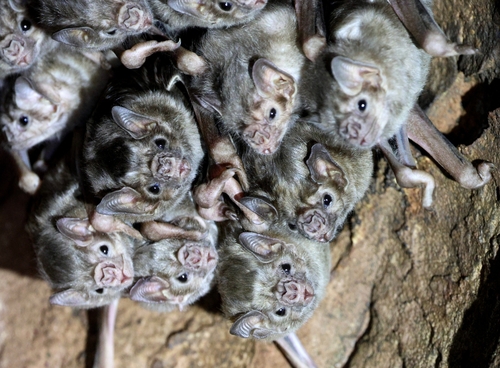
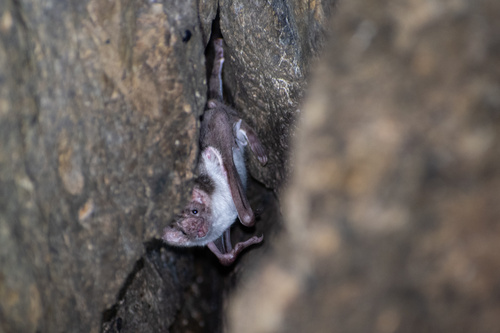
Vampire bats live in parts of Mexico, Central America and South America. The common vampire bat ranges south to Uruguay, northern Argentina and central Chile. Day roosts include caves, hollow trees, mine shafts, old wells and abandoned buildings.
Colony sizes range from single digits to hundreds of bats. Common vampire bats often share roosts with other bat species.
Vampire bats operate with a multilayered sensory system. Echolocation and low-frequency hearing let them find sleeping animals, and they can discern the breath sounds of sleeping mammals. Close in, they land and move toward the host on the ground. Heat-detector pit organs near the nose pick up infrared radiation, guiding the bat to areas where blood vessels lie close to the skin.
Infrared detection sets vampire bats apart among mammals and depends on a TRPV1 protein variant that other species use to sense painful heat. Common vampire bats prefer the rump, flank or neck of livestock, whereas white-winged and hairy-legged vampire bats target birds for their blood meals.
The bite itself is small and often goes unnoticed. The real risk is disease. Vampire bats carry rabies virus in Latin America. The danger is greater to livestock than to people, but because dogs are now widely immunized, vampire bats cause more human rabies transmissions there than dogs, with 55 documented cases in 2005.
Any bat bite should be treated as a potential rabies exposure and reported to a medical provider for post-exposure prophylaxis.
A vampire bat can survive only about two days without feeding, and it cannot be sure of finding food every night. That risk has driven the evolution of a well-studied food-sharing system. A fed bat returning to the roost will often regurgitate a small amount of blood into the mouth of a hungry roost-mate.
Research by Gerald Wilkinson and later Gerald Carter has shown that among familiar bats, reciprocal help predicts sharing better than relatedness does, although most sharing observed in the wild was between close kin, mostly mothers feeding pups. Bats that groom one another also share food. This is one of the clearest non-human examples of reciprocal altruism.
Vampire bat saliva contains anticoagulants and compounds that stop blood vessels near the wound from constricting. The most famous is draculin, a glycoprotein named after Count Dracula. Desmoteplase is a recombinant form of a plasminogen activator from D. rotundus saliva and was developed as a stroke therapy.
Desmoteplase has greater fibrin specificity and a longer half-life than the stroke drug alteplase, and early trials suggested it might extend the treatment window to 9 hours, compared with 4.5 hours for alteplase. The phase-three DIAS-3 trial gave neutral results and the developer stopped work on the drug in 2014.
Common vampire bats live about nine years on average in the wild. Pups are usually born singly after a gestation of about seven months, a long pregnancy for such a small bat. Young bats accompany their mothers on hunts at about six months and are not fully weaned until nine months.
Female offspring usually remain in their natal groups into adulthood, while males tend to leave at about one to two years old. This is one reason long-term social relationships and food-sharing networks can persist across years in a single roost.
No. The IUCN lists all three species as Least Concern. The common vampire bat in particular has a wide distribution and a presumed large population, and it feeds mainly on livestock such as cattle and horses.
In many countries vampire bats are actively controlled because of rabies transmission to livestock, usually by capturing bats, applying an anticoagulant paste to their fur, and releasing them to transfer the paste to roost-mates through grooming. Broad-spectrum poisoning of colonies is discouraged because it kills non-target bat species that provide major ecosystem services like insect control and pollination.