Mexican Free-Tailed Bat: 160 km/h Flyer
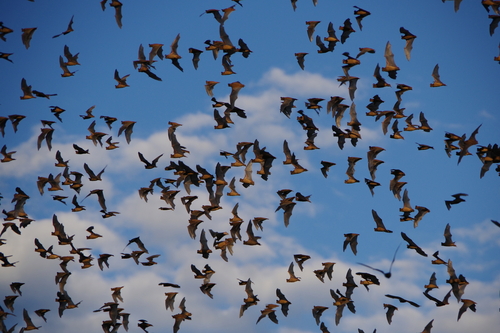
Tadarida brasiliensisRecorded at up to 160 km/h, the fastest bat in level flight also fills Bracken Cave, Texas, with about 20 million bats, the largest known mammal gathering.
 Strange Animals EditorialApril 5, 2025·13 min read·Editorial standards ↗
The Mexican free-tailed bat is the fastest bat in the world in level flight, and has been claimed to be the fastest horizontally flying animal on the planet. It also forms some of the largest known mammal aggregations on Earth, with Bracken Cave in Texas holding an estimated 20 million individuals.
A colony that size can turn the evening sky over a hill country ridge into a living river. Despite all this, Tadarida brasiliensis is a palm-sized insectivore weighing roughly 7 to 12 grams that most people have never seen up close.
This guide covers the Mexican free-tailed bat in full detail: anatomy, flight performance, echolocation, hunting, mega-colonies, migration, maternity behaviour, ecological value to agriculture and the strange facts that have turned this unassuming species into a subject of serious scientific attention.
Etymology and Classification
The scientific name Tadarida brasiliensis was established in 1824 from specimens collected in Brazil, which is why the species is also called the Brazilian free-tailed bat. The two common names refer to the same species.
The genus Tadarida sits within the family Molossidae , a global family of about 110 species collectively called free-tailed bats. They are named for an anatomical feature shared across the family: a mouse-like tail that extends well beyond the edge of the tail membrane instead of being fully enclosed by it.
Within Tadarida brasiliensis , biologists recognise multiple subspecies across the Americas. The one most studied scientifically is T. b. mexicana , the strongly migratory subspecies that forms the giant maternity caves of Texas and the desert southwest. Other subspecies inhabit Florida, the Caribbean, Central America and the southern cone of South America.
Size and Physical Description
Mexican free-tailed bats are small, aerodynamic and built for sustained high-speed flight over open country.
Adult measurements:
- Total length: roughly 9 cm from nose to the tip of the tail
- Weight: roughly 7-12 g, with females tending to be 1-2 g heavier than males
Proportions:
- Wings: long, narrow and pointed, an aerodynamic profile associated with fast, straight flight rather than tight manoeuvring
- Tail: almost half of the animal's total length, projecting beyond the tail membrane
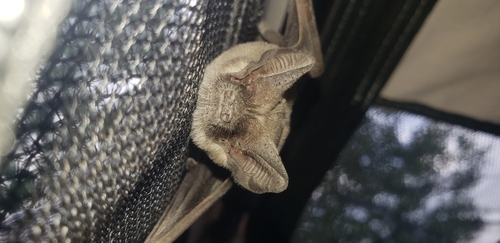
- Ears: large and wide, nearly meeting at the front of the face but not joined at the midline
Their fur is short, dense and dark brown to gray. The family name Molossidae comes from the type genus Molossus, which in turn is named after the Molossus breed of dogs.
Their large feet have long, white bristles, which are photoluminescent under ultraviolet light. The function of this trait, if any, is unknown.
Flight Performance
Flight is the single most remarkable feature of this species.
In November 2016 a team led by Gary McCracken published a paper in Royal Society Open Science reporting ground speeds of Mexican free-tailed bats in Texas, measured with an aircraft tracking device. The fastest individual they measured was moving at 160 kilometres per hour (roughly 100 mph).
Since the study did not log wind speed along with ground speed, critics pointed out that top speeds could have come from local gusts and the bats' maximum air speed remains unclear.
Why so fast?
- Wing shape. Long, narrow, high-aspect-ratio wings are the aerodynamic equivalent of a glider or jet fighter wing. They minimise drag and allow efficient cruising at speed.
Peregrine falcons achieve speeds of 300+ km/h during dives, and gravity assists them in that feat.
Echolocation and Sensory World
Mexican free-tailed bats are highly vocal, producing ultrasonic echolocation calls and a remarkably varied repertoire of social calls.
Echolocation:
- Frequency: typically 49-70 kHz, with modulated calls between 40 and 75 kHz when the bat detects something
A 2014 study led by Aaron Corcoran reported in Science that free-tailed bats emit ultrasonic jamming calls that interfere with the echolocation of rival bats hunting moths, reducing their chance of catching prey.
Their social calls are equally interesting. Earlier researchers identified some 15 types of social calls, and mothers use vocalizations and scent to identify their own pups in crowded creches.
Hunting and Diet
Mexican free-tailed bats are primarily insectivores. They usually catch flying prey in flight and take a wide variety of insects, including moths.
Typical prey:
- Noctuid moths (corn earworm, cotton bollworm, fall armyworm)
- Beetles
- Flying ants, flies, wasps and dragonflies
- True bugs
The bat colony under the Congress Avenue Bridge in Austin eats an estimated 10,000 to 30,000 pounds (4,500 to 13,600 kg) of insects each night.
High-altitude hunting:
This species flies the highest among bats, at altitudes around 3,300 metres, based on radar observations. Large numbers fly hundreds of metres above the ground in Texas to feed on migrating insects.
Ecological value:
Research conducted in 2006 estimated that the bats of Bracken Cave save cotton farmers in south central Texas approximately $1.2 million a year.
Life Cycle and Reproduction
Free-tailed bats have a tightly seasonal reproductive cycle timed to the warm season in their maternity range.
Mating: Females enter estrus once a year, typically for about five weeks in spring. The species is promiscuous, and both sexes mate with multiple partners.
Gestation: Roughly 11-12 weeks. Pregnant females migrate north to maternity caves, arriving in March and April.
Birth: Each mother gives birth to a single pup.
Nursing: Pups are deposited on a ceiling nursery area called a creche. In Bracken Cave, as many as 500 pups have been recorded clinging to a single square foot of cave wall (roughly 5,000 per square metre). A mother nurses her young daily, and a genetic study of Texas colonies found that nursing is only partly selective, with about 17 percent of mothers nursing pups that were not their own. By 4 to 7 weeks of age pups are full grown, fully weaned, and independent.
Maturity: Females become sexually mature at about 9 months, while males take about two years.
One individual was recorded to have lived eight years, based on dentition.
Migration and Movements
The US population of T. b. mexicana is strongly migratory. Some bats summering in Kansas, Oklahoma, eastern New Mexico and Texas migrate south to South Texas and Mexico. The bats at Bracken Cave fly as much as 1,600 kilometres (1,000 miles) from Mexico each spring.
Migration data:
| Metric | Value |
|---|---|
| Longest one-way migration | ~1,600 km (Mexico to Bracken Cave) |
| Spring return to maternity cave | March to April |
Bats ranging eastward from East Texas do not migrate, though local shifts in roost use occur seasonally, and a population ranging from Oregon to California is resident year-round.
Mega-Colonies
The Mexican free-tailed bat is famous for forming the largest mammal aggregations ever documented.
Significant roosts:
| Site | Approximate population |
|---|---|
| Bracken Cave, Texas | ~20 million |
| Congress Avenue Bridge, Austin | ~1.5 million |
Bracken Cave in Comal County, Texas, protected by Bat Conservation International, currently holds the title of the single largest known mammal gathering on Earth.
The Congress Avenue Bridge colony in downtown Austin has become an urban tourism icon. The bridge was rehabilitated in 1980, and bats later took up residence in the gaps between its concrete components. The colony now numbers up to 1.5 million bats. The bats were once unpopular and at risk of extermination, but the city came to embrace the colony and the evening emergence now draws up to 100,000 visitors a year.
Conservation Status
The IUCN Red List classifies Tadarida brasiliensis as Least Concern because of its enormous range, population size and ability to use human structures.
That does not mean the species is safe. Several mega-colonies have experienced dramatic collapses.
Documented declines:
- Cueva de la Boca, near Monterrey, Mexico: a reduction of more than 95 percent from about 20 million bats to roughly 600,000, attributed to vandalism, pollution and uncontrolled tourism. The conservation group Pronatura Noreste bought the cave in 2006.
Current threats:
- Roost disturbance. Sites inadequately protected from vandalism and uncontrolled tourism risk roost abandonment due to disturbance.
- Habitat change. Farmland rich in insects becomes less viable for foraging when converted to intensive monoculture or urban use.
Rabies is a frequent topic around free-tailed bats. Public-health advice is simple: never handle a bat that is grounded or active during the day, and seek medical evaluation if direct contact occurs.
Cultural and Economic Significance
Free-tailed bats have touched human history in some unexpected ways.
Guano mining. Bat guano is a potent fertiliser and a natural source of potassium nitrate. In 1863 a gunpowder factory opened near San Antonio, with saltpetre supplied by local guano mines, for Confederate use in the American Civil War. Hundreds of tons of guano were mined in Texas annually between 1900 and 1980.
World War II and Project X-Ray. In one of the stranger chapters of military history, the US government attempted during World War II to weaponise free-tailed bats by attaching miniature incendiary devices to them and dropping them over Japanese cities.
The so-called 'bat bomb' programme, later run by the US Navy as Project X-Ray, consumed roughly two million dollars before being cancelled because it was unlikely to be ready before mid-1945. In 1943 an accidental release of armed bats set fire to an auxiliary air base near Carlsbad, New Mexico.
Tourism. Austin's Congress Avenue Bridge emergence is the most famous example of bat tourism anywhere, drawing an estimated 100,000 visitors per year. Bat Conservation International offers evening guided tours to Bracken Cave to watch the bats emerge. Done responsibly, bat tourism provides a direct economic argument for cave protection.
Frequently asked questions
The Mexican free-tailed bat has been claimed to have the fastest horizontal flight of any animal. A 2016 paper in Royal Society Open Science by Gary McCracken and colleagues measured a ground speed of 160 kilometres per hour (99 mph) using an aircraft tracking device. The study did not record wind speed at the same time, so the readings could have been boosted by local gusts, and the maximum air speed of the bats remains uncertain.
Peregrine falcons dive faster than that, but only in gravity-assisted stoops. The bat’s long, narrow, pointed wings are suited to fast, straight flight.
Tadarida brasiliensis ranges from the southern half of the continental United States through most of Mexico and Central America and into South America, including the Caribbean. In South America it occurs in the eastern Brazilian highlands and coast, the northeastern Andes, the coast of Peru and northern Chile and central Argentina. It is absent from much of the Amazon rainforest.
The bats roost mainly in caves, but also use buildings, bridges and other structures that offer openings and dark recesses.
The name comes from the tail, which can be almost half of the bat’s total length and extends beyond the edge of the uropatagium, the membrane that connects the base of the tail to the hind legs. In many other bats the tail is enclosed by that membrane.
The whole family Molossidae is known as the free-tailed bats, and its scientific name comes from the type genus Molossus, named after the Molossus breed of dogs.
Mexican free-tailed bat colonies are among the largest aggregations of mammals on Earth. Bracken Cave in Texas holds an estimated 20 million bats from March to October, making it the largest known concentration of mammals in the world, although the true number is uncertain because counting methods are unreliable.
The colony under the Congress Avenue Bridge in downtown Austin is the largest urban colony in North America, with up to 1.5 million bats.
Mexican free-tailed bats are primarily insectivores. They usually catch flying prey in flight, taking moths such as corn earworm, cotton bollworm and fall armyworm, as well as beetles, flying ants and true bugs.
The species flies the highest among bats, at altitudes around 3,300 metres, and large numbers fly hundreds of metres above the ground in Texas to feed on migrating insects. The Austin bridge colony alone eats an estimated 10,000 to 30,000 pounds of insects each night.
Some do. The subspecies Tadarida brasiliensis mexicana is strongly migratory. Some bats summering in Kansas, Oklahoma, eastern New Mexico and Texas travel south to South Texas and Mexico, and the bats at Bracken Cave fly as much as 1,600 kilometres from Mexico, arriving in March or April.
Bats ranging eastward from East Texas do not migrate, though local shifts in roost use occur and a population from Oregon to California stays year-round.
Maternity caves make parent recognition hard. At Bracken Cave, as many as 500 pups have been recorded clinging to a single square foot of cave wall. A mother uses vocalizations and scent to identify her own pup.
The system is not perfect. A genetic study of Texas colonies found that nursing is only partly selective, with about 17 percent of mothers nursing pups that were not their own.
The IUCN lists Tadarida brasiliensis as Least Concern because of its wide range and abundance, but some local colonies have declined sharply. At Cueva de la Boca near Monterrey, Mexico, the colony fell by more than 95 percent, from about 20 million bats to roughly 600,000, because of vandalism, pollution and uncontrolled tourism.
Rabies is a public-health concern with bats generally, so a grounded bat should never be handled. Bat Conservation International protects Bracken Cave, and the Congress Avenue Bridge colony is valued as a tourist attraction.
References
- McCracken, G. F.; Safi, K.; Kunz, T. H.; Dechmann, D. K. N.; Swartz, S. M.; Wikelski, M. (2016). Airplane tracking documents the fastest flight speeds recorded for bats. Royal Society Open Science 3(11): 160398. View source
- Wilkins, K. T. (1989). Tadarida brasiliensis. Mammalian Species 331: 1-10. View source
- McCracken, G. F. (1984). Communal nursing in Mexican free-tailed bat maternity colonies. Science 223(4640): 1090-1091. View source
- Williams, T. C.; Ireland, L. C.; Williams, J. M. (1973). High altitude flights of the free-tailed bat, Tadarida brasiliensis, observed with radar. Journal of Mammalogy 54(4): 807-821. View source
- Barquez, R. et al. (2015). Tadarida brasiliensis. IUCN Red List of Threatened Species 2015: e.T21314A22121621.