Eastern Tiger Swallowtail: Disguise Artist
Papilio glaucusIts caterpillars pose as bird droppings, then snakes, and flip out a forked orange organ if grabbed. Six U.S. states chose it as a state symbol.
 Strange Animals EditorialJanuary 28, 2025·14 min read·Editorial standards ↗
The eastern tiger swallowtail is one of the most familiar large butterflies of the Americas. Its yellow wings with bold black tiger stripes, its long hindwing tails and its habit of sailing through suburban gardens on warm afternoons have made Papilio glaucus a defining insect of the eastern United States.
Six U.S. states have named it their official state butterfly or state insect.
Yet behind the recognisable adult lies a life history full of chemical warfare, disguise and identity theft: caterpillars that pretend to be bird droppings, then snakes, females that split into two colour forms because one of them is pretending to be poisonous, males that drink from mud puddles to bribe their mates, and a hidden orange organ that every caterpillar can flip out of its own head when something grabs it.
This guide covers the full biology and ecology of the eastern tiger swallowtail: classification, physical description, the caterpillar's disguises, the osmeterium defence, the female dark morph, distribution, life cycle, hybrids with nearby species, behaviour, conservation status and the cultural footprint that made P. glaucus a six-state symbol. It is written as a reference entry, so expect specific numbers, centimetres, days, percentages, states, rather than a breezy summary.
Etymology and Classification
The genus name Papilio is simply Latin for 'butterfly' and has been in use for the tiger swallowtails and their close relatives since Carl Linnaeus formally described the eastern tiger swallowtail in 1758. The common name 'swallowtail' comes from the long projections on each hindwing, which resemble the forked tail of a barn swallow.
The eastern tiger swallowtail sits in the family Papilionidae, which contains roughly 550 recognised species worldwide. That family includes the giant birdwing butterflies of Southeast Asia and the Pacific, the apollos of Eurasian mountains and a number of tropical swallowtails. Within Papilionidae, the tiger swallowtails of North America form a tight group called the Papilio glaucus species complex. The full taxonomic placement is:
- Kingdom: Animalia
- Phylum: Arthropoda
- Class: Insecta
- Order: Lepidoptera
- Family: Papilionidae
- Genus: Papilio
- Species: P. glaucus
Closely related North American species in the same genus include the Canadian tiger swallowtail ( Papilio canadensis ) in the boreal north, the Appalachian tiger swallowtail ( Papilio appalachiensis ) in the southern mountains, and the western tiger swallowtail ( Papilio rutulus ) west of the Great Plains. These species were until recently lumped with P. glaucus and hybridise where their ranges meet.
Size and Physical Description
Wingspan in adults ranges from about 8 to 14 centimetres. Females are the larger sex, and southern individuals are larger than northern ones.
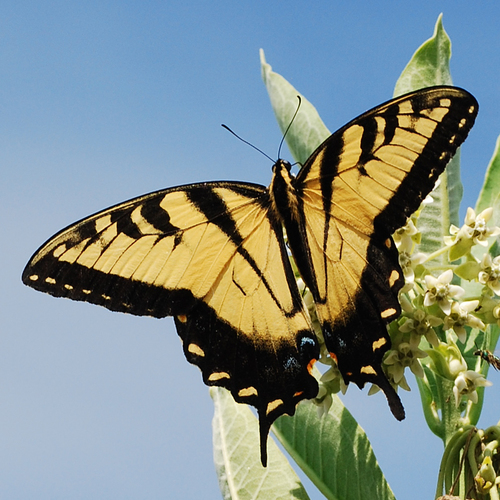
The classic adult has a deep yellow ground colour on both wings, overlaid with four broad black 'tiger stripes' on each forewing and a heavy black border along the outer wing margin. The hindwings carry small red and blue spots along the inner margin. The long black tail that gives the group its common name extends from each hindwing.
Males and yellow-form females look nearly identical at a glance, but close inspection shows sex differences:
- Males: Yellow ground colour, minimal blue scaling on the hindwings.
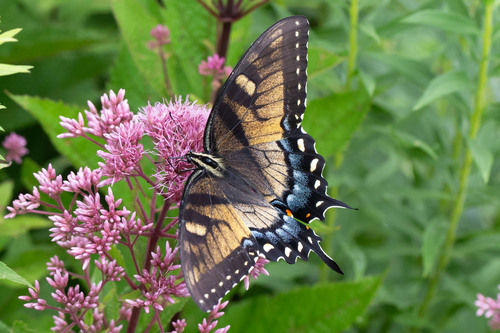
- Yellow-form females: Yellow ground colour, a conspicuous band of blue along the hindwing.
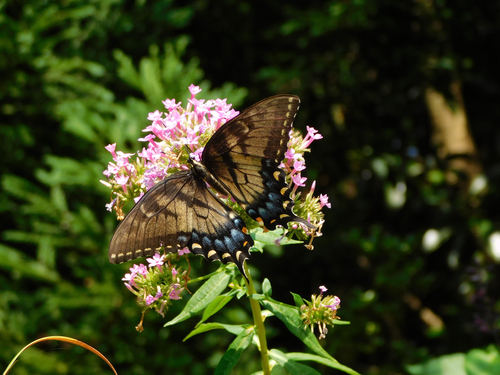
- Dark-form females: Blackish wings with a faint ghost of the tiger stripes visible from certain angles, strong blue-and-orange markings on the hindwing.
The caterpillar goes through five instars, each a radically different costume, discussed in its own section below.
The Caterpillar's Two Disguises
The eastern tiger swallowtail is famous among entomologists less for its adult wings than for what the caterpillar does as it grows. A newly hatched caterpillar is tiny, dark brown and marked with a white saddle across the middle of its back. The pattern is not decorative. It is a near-perfect mimic of a fresh bird dropping: irregular dark-and-white smear, slight shine, about the right size.
Birds, which are the main daytime predator of caterpillars, tend to ignore bird droppings on leaves and so they ignore the caterpillar too.
The bird-dropping disguise works only at small body sizes. Once the caterpillar grows larger the illusion collapses, because real bird droppings do not grow that big. So P. glaucus swaps costumes. After the third moult the caterpillar becomes bright green, matching fresh foliage and develops two fake eyespots on the thorax.
Each eyespot is black, yellow and blue. Viewed from the front or from above, the caterpillar's head-end looks convincingly like the head of a small tree snake peering out from a leaf fold.
The intimidation effect is reinforced by the caterpillar's habit of resting in a silken pad on the top surface of a rolled leaf. From the perspective of a passing bird, a green snake's head is protruding from a dark shelter.
Just before pupating, the caterpillar changes colour again to dull brown, and its chrysalis varies from off-white to dark brown. The chrysalis is the overwintering stage for the final brood of the year.
The Osmeterium: Chemical Defence at Will
Every swallowtail caterpillar, including P. glaucus , carries an extra line of defence that is not visible unless you scare one. Folded inside a transverse slit on the top of the first thoracic segment, just behind the head, is a forked, brightly coloured organ called the osmeterium. In the eastern tiger swallowtail it is bright orange.
When the caterpillar is grabbed, squeezed, or poked, it inflates the osmeterium using body fluid pressure. The organ flips inside out and extends upward like a V-shaped horn. Its surface is coated in a cocktail of volatile chemicals dominated by foul-smelling terpenes.
The smell is meant to repel predators.
The osmeterium is available on demand whenever the mimicry fails.
Osmeteria are a defining feature of the family Papilionidae. You will not find them in other butterfly families. In the field, flipping out a caterpillar's osmeterium with a gentle poke is one of the fastest ways to confirm that a suspect caterpillar is a swallowtail.
Female Dark Morph: Pretending to Be Poisonous
The eastern tiger swallowtail is one of the clearest living textbook examples of Batesian mimicry. Batesian mimicry is the phenomenon in which a harmless species copies the warning signals of a toxic one in order to scare off predators without paying the cost of actually being toxic.
In this case the model is the pipevine swallowtail ( Battus philenor ), a blackish butterfly with metallic blue hindwings and a wicked secret: its caterpillars feed on Dutchman's pipe vines in the genus Aristolochia , whose tissues contain aristolochic acids. The caterpillars store the toxin, the chrysalis keeps it and the adult butterfly keeps it.
Predators that eat a pipevine swallowtail learn to avoid anything that looks like one.
Female eastern tiger swallowtails come in two genetically controlled colour forms. The yellow form matches the male. The dark form drops most of the yellow and takes on a blackish colour with blue iridescence, a convincing imitation of the pipevine swallowtail.
The mimicry is not perfect (a shadow of the tiger stripes can be seen on the underside of some dark females), but it helps protect the palatable females from vertebrate predators.
The dark trait is controlled by a single sex-linked gene and is therefore inherited strictly from mother to daughter. Dark morph females are more prevalent in the south, where pipevine swallowtails are more common, and the frequency of the dark morph correlates with the abundance of the model species. Mimicry fades where the model disappears.
Habitat and Range
The eastern tiger swallowtail occupies a broad swath of eastern North America. Its northern limit runs through southern Vermont and southern Ontario, the southern limit reaches Florida, where it is rarer in the south and absent from the Florida Keys. To the west it extends to eastern Texas and the Great Plains.
Within that range, favoured habitats include:
- Deciduous and mixed forests with open canopies
- Forest edges and woodland clearings
- River and stream corridors with willows, cottonwoods and ashes
- Orchards, parks and suburban gardens
- Roadside verges with nectar-rich flowers
It is remarkably tolerant of human-modified landscapes, and suburban neighbourhoods with mature trees and flowering gardens often hold strong populations.
Life Cycle and Reproduction
Papilio glaucus runs through a classic complete insect metamorphosis with four stages: egg, caterpillar, chrysalis, adult. The number of generations per year varies with latitude:
- Northern populations: one or two generations per year
- Southern populations: three generations
The egg is pale green, nearly spherical, about 1.2 millimetres wide, and laid one at a time on the upper surface of a host-plant leaf. Eggs hatch in four to ten days depending on temperature.
The caterpillar grows through five instars. It starts as a bird-dropping mimic and transitions to a green snake mimic after the third moult, as described above. At the end of the fifth instar it changes colour to brown, wanders away from the host plant and finds a twig or stem on which to pupate.
The chrysalis is roughly three centimetres long and ranges from off-white to dark brown. It is attached to the substrate by a silk pad on the tail end and a silk girdle around the middle. Summer chrysalises hatch in nine to eleven days. The final brood of the year overwinters as a chrysalis and hatches the following spring.
The adult spends its life in flight, nectar feeding, mud-puddling (mostly males), patrolling for mates (males), and egg-laying (females). During courtship the male and female fly about each other before landing and mating.
Mud-Puddling and Feeding Behaviour
Adult eastern tiger swallowtails feed mainly on nectar from many flowers, especially members of the families Apocynaceae (including milkweeds), Asteraceae and Fabaceae. They have also been seen feeding on dung, carrion and urine. The proboscis is a long coiled tube that the butterfly unrolls to probe into flowers. At rest the proboscis spirals back up against the head.
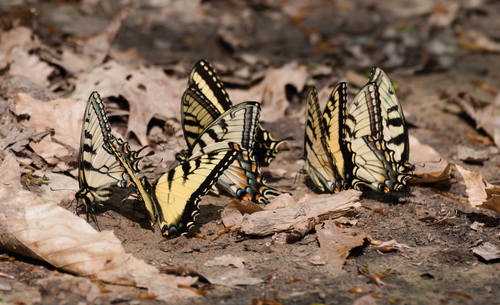
One of the most striking behaviours of the species is mud-puddling. On warm afternoons male tiger swallowtails often gather in groups on patches of damp sand, mud, animal dung, or urine-soaked earth. They are not simply drinking water. They are extracting sodium ions and amino acids, which aid reproduction.
Females will occasionally puddle, but they do not form congregations, so a puddle cluster of tiger swallowtails is almost always an all-male gathering. It is one of the most observable spectacles in eastern butterfly watching.
Hybrids and the Tiger Swallowtail Complex
The eastern tiger swallowtail sits at the centre of a group of closely related species that interbreed at their range boundaries:
| Neighbour species | Contact zone | Notes |
|---|---|---|
| Canadian tiger swallowtail | Southern Ontario, northern Great Lakes | Smaller; continuous yellow band on forewing underside |
| Appalachian tiger swallowtail | Southern Appalachian highlands | Larger than both relatives; flies later |
| Western tiger swallowtail | Western edge of the range | Occurs west of the Great Plains |
Hybrids between P. glaucus and P. canadensis are found along hybrid zones. The Appalachian tiger swallowtail is thought to have evolved as a hybrid species from P. glaucus and P. canadensis , a case of hybrid speciation in butterflies.
Shifting thermal landscapes are thought to have moved the ranges of P. glaucus and P. canadensis enough to overlap, which led to the hybrid origin of the Appalachian tiger swallowtail.
Conservation Status
NatureServe ranks Papilio glaucus as Secure, and the species is not considered threatened. It benefits from:
- A broad range of acceptable host plants, which insulates it from local host declines
- Tolerance of suburban and edge habitats
- Wide geographic range spanning many climate zones
Localised pressures exist but none are pushing the species toward decline. Pesticide drift from agriculture can reduce caterpillar survival near farmland. Climate shifts may compress or move contact zones with the Canadian and Appalachian swallowtails, which could alter the genetic structure of the species over decades.
Simple ways to support local populations include planting native host trees such as tulip tree, wild cherry and ash, providing pesticide-free nectar flowers through the full flight season, leaving a patch of damp sandy soil for males to puddle, and leaving garden corners unraked through winter so that overwintering chrysalises are not destroyed.
Cultural Footprint: The Six-State Butterfly
Six states have named it their official state butterfly or state insect:
- Georgia (state butterfly)
- South Carolina (state butterfly)
- Alabama (state butterfly)
- Virginia (state insect, adopted 1991)
- North Carolina (state butterfly)
- Delaware (state butterfly)
Its selection reflects both its abundance and its sheer visual impact, a flash of ten-centimetre yellow-and-black wings sailing over a meadow is hard to miss. Its cultural ubiquity is matched by its ecological role as an abundant, generalist herbivore in the caterpillar stage and a nectar feeder as an adult.
The eastern tiger swallowtail is, in short, both a common backyard butterfly and an insect whose natural history rewards closer attention than most people give it. Between the bird-dropping caterpillar, the snake-eyed caterpillar, the orange osmeterium, the dark-form female pretending to be poisonous, the mud-puddle boys' club and the six state legislatures that wrote it into law, Papilio glaucus is one of the richest small stories in North American entomology.
Frequently asked questions
Adult eastern tiger swallowtails (Papilio glaucus) have wingspans ranging from roughly eight to fourteen centimetres, or 3.1 to 5.5 inches. Females are the larger sex, and southern individuals are larger than northern ones.
Caterpillars reach about 5.5 centimetres before pupating.
Eastern tiger swallowtail caterpillars are generalist feeders that accept a wide variety of trees. Favoured host plants include tulip tree (Liriodendron tulipifera), wild black cherry (Prunus serotina), sweet bay magnolia, ash, cottonwood and willow. Females lay their eggs singly on host plant leaves.
The caterpillar eats the leaves and rests on a silk pad on a leaf with its edges folded over. Adult butterflies do not chew at all. They drink nectar through their coiled proboscis and have also been seen feeding on dung, carrion and urine.
Papilio glaucus occupies deciduous forests, woodlands, fields, river corridors, roadsides, parks and gardens across eastern North America. The range stretches from southern Vermont and southern Ontario south to Florida, and west to eastern Texas and the Great Plains.
In the south the butterfly produces three broods per year, in the north one or two. Two closely related tiger swallowtails replace it at the northern (Canadian tiger swallowtail) and Appalachian high-elevation (Appalachian tiger swallowtail) edges of its range.
Female Papilio glaucus come in two colour forms: the yellow form that resembles the male, and a dark morph with blackish wings. The dark morph is a Batesian mimic of the pipevine swallowtail (Battus philenor), whose caterpillars feed on toxic Aristolochia vines and keep the poisons into adulthood.
Predators that learn to avoid the toxic pipevine swallowtail also tend to avoid the harmless dark female tiger swallowtail. The trait is controlled by a single sex-linked gene and is inherited from mother to daughter. Dark females are more prevalent in the south, where pipevine swallowtails are more common.
The osmeterium is a fleshy, forked, orange organ that all swallowtail caterpillars carry folded inside a slit just behind the head, on the first thoracic segment. When a caterpillar is grabbed, poked, or otherwise threatened, it inflates the osmeterium with body fluid, everting the organ.
The organ emits foul-smelling terpenes that repel predators. Together with the eyespots, it makes the caterpillar resemble a snake.
Osmeteria are a defining feature of the swallowtail family, Papilionidae.
The egg hatches in about four to ten days, the caterpillar grows through five instars, and a summer chrysalis hatches in nine to eleven days. Because the generation count rises from one or two in the north to three in the south, a southern population can cycle through several generations between spring and autumn.
The final generation of the year overwinters as a chrysalis and emerges the following spring.
Male eastern tiger swallowtails gather in groups on wet sand, mud, dung, or damp gravel, a behaviour called mud-puddling. They are not simply drinking water. They are extracting sodium ions and amino acids, which aid reproduction.
Females will occasionally puddle but do not form congregations, so a puddle cluster is almost always an all-male gathering.
No. NatureServe ranks the eastern tiger swallowtail as Secure, and Papilio glaucus is common throughout its range and not considered threatened. Its flexibility as a caterpillar, accepting many host trees and its tolerance of suburban environments help protect it.
Some smaller pressures may apply: climate shifts may alter contact zones with the Canadian and Appalachian tiger swallowtails, and pesticide drift from agriculture can affect caterpillar survival near farmland.
Gardeners can support local populations by planting native host trees and pesticide-free nectar flowers, and by leaving garden corners unraked through winter so that overwintering chrysalises are not destroyed.
References
- Relevant peer-reviewed and reference sources consulted for this entry include the Butterflies and Moths of North America (BAMONA) species account for Papilio glaucus, the Xerces Society pollinator conservation profiles, the IUCN Red List assessment for Papilio glaucus, and published research in the Journal of the Lepidopterists' Society, Evolution, and Ecological Entomology.
- State butterfly adoption dates reflect the official statutes of Georgia, South Carolina, Alabama, Virginia, North Carolina, and Delaware.
- View source