Formosan Termite: 400 g of Wood a Day
Coptotermes formosanusA single Formosan termite colony can eat roughly 400 grams of wood a day and release over 70,000 winged alates. US damage runs to about $1 billion a year.
 Strange Animals EditorialJune 2, 2025·13 min read·Editorial standards ↗
The Formosan subterranean termite is one of the most economically destructive termite species in the world. Native to southern China, Coptotermes formosanus has hitchhiked around the world in shipping pallets and wooden crates and now thrives as an invasive pest in Taiwan, Japan, Hawaii, the southeastern United States and parts of South Africa.
Colonies are significantly bigger than those of native North American termites, and a mature colony can severely damage a structure in as little as three months.
This guide covers every aspect of Formosan termite biology, ecology and economic impact: taxonomy, caste structure, colony growth, nest architecture, chemical defence, invasive spread and the reasons why conventional termiticides so often fail against this species.
Etymology and Classification
The scientific name Coptotermes formosanus was described by Shiraki in 1909. The species is named after Formosa, the historical name for Taiwan. The epithet formosanus simply means 'of Formosa'.
Termites were long classified in their own order (Isoptera) on the assumption that their eusocial biology and soft bodies set them apart from other insects. Modern molecular phylogenetics has settled the question decisively: termites are social cockroaches. They nest inside the order Blattodea as the infraorder Isoptera , sister to the wood-feeding cockroach genus Cryptocercus .
Every termite alive today descends from a cockroach-like ancestor that combined subsocial brood care with an obligate gut microbiome for digesting wood.
Coptotermes is the most economically important genus of the family Rhinotermitidae, which contains the subterranean termites. Within the genus, C. formosanus and C. gestroi (the Asian subterranean termite) are responsible for tremendous property damage in the United States.
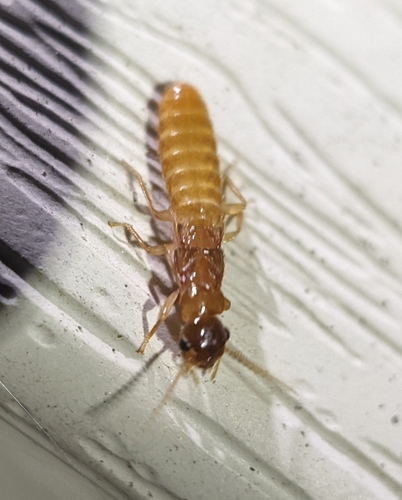
Formosan Subterranean Termite Size and Caste Structure
Termites are eusocial: individuals divide labour into specialised reproductive and non-reproductive castes that cannot survive as solitary insects. A Formosan colony typically contains four castes: workers, soldiers, primary reproductives and secondary reproductives (neotenics).
Workers:
- Colour: creamy white, soft-bodied, blind
- Role: foraging, tunnelling, brood care, nest construction, feeding all other castes
Soldiers:
- Length: 6-7 mm
- Colour: orange-brown head, yellowish-white body
- Head shape: enlarged, oval with black sickle-shaped mandibles and a forehead pore (the fontanelle)
- Role: colony defence, especially against ant raids
Alates (winged reproductives):
- Length: 12-15 mm including wings
- Colour: yellowish-brown body with a golden-brown head, clear wings covered with fine hairs
- Role: dispersal flight, founding of new colonies
Primary queen and king:
- The original pair of alates that founded the colony
- Queen swells (physogastric) with egg-laying capacity, eventually laying large numbers of eggs
Secondary reproductives (neotenics):
- Develop from workers or nymphs within the colony
- Supplement or replace the primary queen and king
- Allow colonies to expand rapidly and to persist even if the founding pair dies
Castes result from a blend of genetics, pheromonal signals from existing reproductives and the developmental diet. While the queen remains active and well-fed, she produces inhibitory pheromones that stop workers from becoming reproductives.
Colony Size and Growth
Formosan termites beginning a new colony start out small. The king and queen produce about 15 to 30 eggs in the initial batch, and it takes three to five years for the colony to grow large enough to cause serious damage and produce alates. Once workers begin foraging and nourishing the reproductives, growth speeds up.
Formosan colonies are significantly bigger than those of native North American Reticulitermes termites. A single colony can consume roughly 400 grams of wood per day, a sustained rate that compounds over years into structural failure of wooden framing, floor joists, and load-bearing beams.
The queen drives this growth. A physogastric Formosan queen has an abdomen swollen far beyond that of a worker. Secondary reproductives (neotenics) supplement her output in older colonies and allow a colony to survive the loss of the primary pair.
Nest Architecture: The Carton Nest
Most subterranean termites must maintain constant contact with soil moisture. The Formosan subterranean termite is different. It builds carton nests: cardboard-like structures constructed from chewed wood fibre, soil particles, saliva and faecal pellets, that retain moisture internally and allow the colony to live and reproduce entirely above ground.
Typical carton nest locations:
- Inside wall voids of infested buildings
- Inside attics, behind insulation
- Inside hollowed cavities of living trees (oak, cypress, pecan)
- Inside wooden boat hulls and utility poles
- Inside railway sleepers, fence posts and landscape timbers
A carton nest is functionally a self-contained city. It contains the royal cell, brood chambers, worker galleries, food stores and ventilation channels. A single colony may maintain multiple carton nests connected by underground tunnels and above-ground shelter tubes that run along joists, wiring, or plumbing.
The operational significance of carton nests is enormous. A soil-applied liquid termiticide, the standard control method for most subterranean termites, creates a barrier between soil and structure. Formosan termites with an established aerial carton nest do not need the soil.
They can live, breed and expand indefinitely inside a wall cavity as long as there is a source of cellulose and some trapped moisture (a leaking pipe, condensation from an air conditioner, a damp roof penetration). This is why Formosan infestations often persist after a full perimeter soil treatment and why monitoring and baiting have replaced barrier chemistry as best practice.
Foraging and Diet
Formosan termites eat cellulose. In practice this means essentially any plant-derived material.
Typical substrates consumed:
- Structural softwoods (pine, spruce, fir) and hardwoods
- Living tree heartwood: especially oak, cypress, maple and pecan
- Paper, cardboard, books, files
- Cotton fabric, rope and wallpaper backing
- Landscape mulch, wooden fences, railway sleepers
- Wooden pallets, crates and packaging
In addition, workers have been documented chewing through soft non-cellulose materials in pursuit of food or moisture: thin lead and copper sheeting, foam insulation, asphalt, plaster and some plastics. These substrates are not digested, they are penetrated en route to something edible.
A mature colony's foraging territory can intercept multiple adjacent buildings, trees and utility structures. Shelter tubes, hollow tunnels of soil and carton, are constructed across exposed surfaces to allow workers to cross concrete, stone, or metal without desiccating.
Workers cannot digest cellulose on their own. Inside their hindgut lives a dense community of mutualistic protozoa and bacteria that produce cellulase enzymes and break wood polymers into short-chain fatty acids the termite can absorb. The protozoa in particular are obligate mutualists, they cannot survive outside a termite gut, and the termite cannot survive without them.
When a worker moults its gut lining, it loses its protozoa along with the cuticle. To reacquire them, newly moulted workers practise proctodeal trophallaxis: anus-to-mouth feeding from nestmates. A colony that cannot exchange microbes starves inside wood it cannot digest.
Defence Chemistry and the Fontanelle
The soldiers of Coptotermes formosanus have an unusually elaborate chemical defence system. Their enlarged heads carry a large gland called the frontal gland that opens through a pore on the forehead known as the fontanelle . When a colony is breached, most commonly by raiding ants, soldiers rush to the breach, snap their mandibles and eject a milky-white defensive secretion from the fontanelle onto the attackers.
Components of the Formosan soldier defensive secretion:
- A sticky protein matrix that physically gums up ant mandibles, legs and antennae
Soldiers themselves cannot feed. Their mandibles are specialised for defence to the point that they cannot chew wood or even self-feed. They depend entirely on workers to regurgitate food to them.
Reproduction and the Swarm
Once a colony is several years old and large enough, it begins producing reproductives. Alates develop inside the colony from nymphs.
The swarm:
- Density: a single colony may produce over 70,000 alates
Swarming is synchronised across colonies in the same region so that alates from different parent nests mix and outbreed. After landing, alates shed their wings (leaving characteristic piles of discarded wings beneath lights and windowsills), pair off and search for a crevice in wood or soil. A mated pair excavates a small royal cell and begins laying eggs within days.
Only a tiny fraction of alates survive to found a colony. Birds, ants, spiders, geckos and other predators attack swarming termites in vast numbers. A colony must produce large numbers of reproductives to compensate for the high mortality of the swarm.
Swarming alates near lights inside a building at night are one of the strongest diagnostic signs of an active Formosan infestation or of a structure immediately adjacent to one.
Invasive Spread
Coptotermes formosanus is native to southern China. Its global spread is a human artefact, a textbook case of accidental biological invasion through wooden shipping materials.
Key invasive timeline:
- Around the middle of the 20th century: probable arrival at the Port of New Orleans
- 1970s: the USDA begins tracking the spread of Formosan infestations
The species has been reported in 11 US states (Alabama, California, Florida, Georgia, Hawaii, Louisiana, Mississippi, North Carolina, South Carolina, Tennessee and Texas), and also occurs in Japan, Taiwan, southern China and South Africa. It is rarely found north of 35°N, because its eggs do not hatch below about 20 °C.
Within a country, the spread is driven by short-distance alate flight plus long-distance transport of infested timber. Used railroad cross ties have been implicated in long-distance spread, and boats can also carry infestations.
Economic Impact
The Formosan subterranean termite is the most destructive and economically important termite species in the southern United States.
Estimated annual damage:
| Region | Annual economic impact (USD) |
|---|---|
| United States (total) | ~$1 billion |
These figures combine direct structural damage, repair costs and the cost of control treatments. They exclude indirect losses such as reduced property values, insurance exclusions for termite damage and damage to cultural heritage buildings.
The species also damages living trees, especially cypress, oak and pecan, by hollowing out heartwood. Urban street trees weakened by Formosan infestation can fail catastrophically in storms.
Control and Management
Control of established Formosan infestations requires a multi-step integrated approach. No single chemical or technique works reliably in isolation.
Standard approaches:
- Inspection. A qualified inspector checks for shelter tubes, damaged wood, swarmer wings, carton deposits in wall voids and active workers. Moisture meters and acoustic detectors supplement visual inspection.
- Baiting. In-ground and above-ground bait stations contain cellulose matrices laced with insect growth regulators (hexaflumuron, noviflumuron, bistrifluron). Workers feed on the bait, carry it back to the colony through trophallaxis, and distribute it to nestmates. The bait disrupts moulting and collapses the colony over weeks to months. Baiting is now the standard first-line approach to confirmed Formosan infestations.
- Soil termiticide treatment. Liquid termiticides (fipronil, imidacloprid, chlorfenapyr) are applied as a perimeter barrier. This is more effective for prevention than cure against Formosan colonies with aerial carton nests.
- Direct nest treatment. Where a carton nest is located, it can be treated directly with dusts or foams containing non-repellent insecticides.
- Construction practice. Physical barriers, stainless steel mesh, graded granite particles, termite-resistant treated timber, reduce the risk of new colonies establishing in new construction.
- Area-wide management. Cities with heavy Formosan populations, such as New Orleans, have implemented coordinated inspection, bait station networks and public education across entire neighbourhoods. Area-wide approaches are more effective than isolated property-level treatment because Formosan colonies routinely span property lines.
Detection in a previously uninfested region triggers regulatory response including quarantine of wooden materials, mandatory treatment and sometimes destruction of infested timber. Biosecurity inspection of shipping pallets, dunnage and wooden crates at ports is the main line of defence against further global spread.
Illustration.
Frequently asked questions
Formosan subterranean termite (Coptotermes formosanus) colonies are significantly bigger than those of native North American Reticulitermes termites. A mature colony can consume roughly 400 grams of wood per day, and large colonies can simultaneously damage multiple adjacent buildings, trees, and utility structures.
A colony begins with a royal pair, and secondary reproductives (neotenics) may form if the queen or king dies or the colony becomes large.
Several traits combine. First, colony size: very large colonies consume wood far faster than smaller ones, and can severely damage a structure in as little as three months. Second, aggressive foraging: workers chew through some non-cellulose materials such as thin lead and copper sheeting, plaster and asphalt.
Third, carton nests: the species can build above-ground, moisture-retaining nests inside wall voids, so it does not need constant soil contact and is harder to treat with conventional barrier termiticides. Together these traits cost the United States over $1 billion per year in damage, repair and control.
Formosan subterranean termites are native to southern China. The species is named after Formosa, the historical name for Taiwan. They have spread globally through human shipping and commerce, including wooden materials and used railroad cross ties.
Established invasive populations now exist in Taiwan, Japan, Hawaii, South Africa and the southern United States, where the termite probably arrived at the Port of New Orleans around the middle of the 20th century. It has been reported in 11 US states and is rarely found north of 35°N.
Formosan termites eat cellulose in essentially any form: softwoods and hardwoods, living tree heartwood, paper, cardboard, cotton fabric, books, wooden furniture, fence posts and railway sleepers. They cannot digest cellulose on their own. Instead, a dense community of mutualistic gut protozoa and bacteria breaks wood polymers down into compounds the termite can absorb.
Newly moulted workers must reacquire their gut microbes from nestmates by proctodeal trophallaxis (anus-to-mouth feeding).
Carton is a cardboard-like material Formosan termites manufacture from chewed wood, soil, saliva and faecal pellets. Carton nests are moisture-retaining structures that can be built above ground, inside wall voids, attics, tree cavities, or even boat hulls. This is the key difference from most subterranean termites, which must maintain constant contact with soil moisture.
An established carton nest lets the colony survive and reproduce without touching the ground, which is why soil-applied liquid termiticides are often only partially effective.
Soldiers in Coptotermes formosanus have enlarged oval heads and sharp, sickle-shaped mandibles. When disturbed, they rush to the breach and bite attackers, but their main weapon is chemical. A pore on the forehead called the fontanelle releases a milky-white, glue-like fluid that gums up and disables ants and other invaders.
Soldiers cannot feed themselves and depend on workers to feed them.
Reproductive alates (winged termites) leave mature colonies in swarms, typically on warm, humid evenings. A single colony may produce over 70,000 alates. Only a tiny fraction survive to found a colony.
After a brief flight, pairs shed their wings, find a moist crevice and form a royal chamber, where the queen begins laying eggs within days. Swarming alates near lights inside a building at night are a strong sign that a structure is infested or immediately adjacent to an infested one.
Combining inspection, baiting and targeted treatment forms effective control strategies. Chemical barriers from soil-applied liquid termiticides like fipronil and imidacloprid work well but fail against Formosan populations with established aerial carton nests, since the nest does not require soil contact.
Now, in-ground and above-ground baiting systems with insect growth regulators (hexaflumuron, noviflumuron) represent the standard method: workers transport the slow-acting bait through trophallaxis and the population collapses over weeks to months.
Area-wide management programs in heavily invaded cities such as New Orleans integrate inspection, treatment and monitored bait stations across entire neighbourhoods.
References
- Relevant peer-reviewed and governmental sources consulted for this entry include the USDA Formosan Subterranean Termite Program reports, Louisiana State University AgCenter Formosan termite research, University of Hawaii Urban Entomology publications, and peer-reviewed studies in Journal of Economic Entomology, Insectes Sociaux, Sociobiology, and Biological Invasions.