Bullet Ant: Pain That Lasts 24 Hours
Paraponera clavataBullet ants top the Schmidt Sting Pain Index at 4.0-plus, and one sting can cause throbbing pain for up to 24 hours. The culprit is poneratoxin.
 Strange Animals EditorialMarch 26, 2025·16 min read·Editorial standards ↗
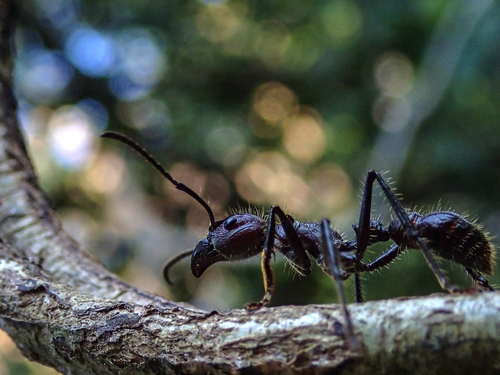
The bullet ant is a large, reddish-black rainforest ant best known for delivering what entomologists and victims agree is the most painful sting of any insect on Earth.
Paraponera clavata sits at the very top of the Schmidt Sting Pain Index with a rating of 4.0-plus, and the pain produced by a single sting is famously described as "pure, intense, brilliant pain, like walking over flaming charcoal with a 3-inch nail embedded in your heel".
In Venezuela the species is called hormiga veinticuatro, the 24-hour ant, because one sting can produce waves of burning, throbbing pain that last up to a full day.
All dimensions of bullet ant biology and ecology appear in this guide, including taxonomy, anatomical details, the chemistry behind poneratoxin venom, colony structure, foraging patterns and diet, nesting behaviours, geographic distribution, the Satere-Mawe glove initiation ritual, pharmaceutical research drawn from the venom and the unique characteristics that set this species apart from any other ant.
Etymology and Classification
The genus name Paraponera translates to "near- Ponera ", after the ant genus Ponera . The species epithet clavata means "club-shaped".
The common English name "bullet ant" comes from the comparison of the sting to being shot by a gun: many victims compare the pain to being shot. Spanish speakers know it as hormiga veinticuatro, the 24-hour ant, a reference to how long the pain persists.
In parts of Brazil the species is called tocandira or formiga-cabo-verde, and in Costa Rica it is known as bala, the bullet.
Bullet ants belong to the subfamily Paraponerinae, within the family Formicidae. Paraponera clavata is the only living species of its subfamily and genus, the only other known member of the genus is an extinct species, Paraponera dieteri , described from Dominican amber.
Size and Physical Description
Bullet ants are among the largest ants on Earth.
Workers:
- Length: 18-30 mm from head to tip of gaster
- Colour: reddish-black
- Head: large, with powerful mandibles used for carrying prey
- Thorax: robust, with strong leg musculature for climbing large tree trunks
- Gaster: distinctly segmented, ending in a prominent sting
Queens:
- Size compared to workers is only marginally larger, which is unusual for ants.
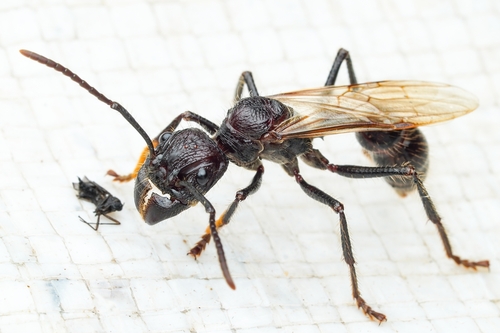
- Wings: present until the nuptial flight, then shed
- Role: continuous egg production for the life of the colony
Males:
- Wings: always fully developed
- Role: mating only, die shortly after nuptial flights
The relative similarity in size between queens and workers is diagnostic for the species. In most ants, especially species with large colonies, the queen is physically much larger than a worker because she needs an enormous abdomen to hold eggs and fat reserves. In bullet ants, the modest size difference reflects the small colony size, a bullet ant queen does not need to produce the millions of eggs per year required to run a leafcutter or fire ant colony.
At a distance, a bullet ant moving along a trunk resembles a small wasp more than a typical ant.
The Sting and Poneratoxin
The bullet ant is famous for one reason above all others: its sting. Entomologist Justin Schmidt, who built his career on deliberately allowing himself to be stung by many species of Hymenoptera so that he could rate each sting on a 0 to 4 scale, placed the bullet ant at the absolute top of the Schmidt Sting Pain Index. His published description reads: "Pure, intense, brilliant pain.
Like walking over flaming charcoal with a 3-inch nail embedded in your heel." The bullet ant is commonly listed at 4.0-plus, and Schmidt's 2016 list gives it a 4, the top of the scale, alongside the tarantula hawk wasp.
Schmidt Sting Pain Index context:
| Rating | Example species | Duration of peak pain |
|---|---|---|
| 1.0 | Sweat bee (Halictidae) | 5 minutes or less |
| 2.0 | Honey bee (Apis mellifera) | 5-10 minutes |
| 3.0 | Paper wasp (Polistes spp.) | About 1 to 30 minutes (level 3 range) |
| 4.0 | Tarantula hawk (Pepsis spp.) | About 5 minutes |
| 4.0+ | Bullet ant (Paraponera clavata) | Up to 24 hours of waves |
What separates the bullet ant from other top-rated stingers is not the peak intensity in the first seconds but the duration. A tarantula hawk delivers blinding pain that fades within minutes. A bullet ant sting produces waves of burning, throbbing pain that can continue for up to 24 hours.
Victims frequently report sweating, shaking, nausea and involuntary muscle tremors in the stung limb, along with lymph node swelling.
The active compound is poneratoxin, a 25-amino-acid neurotoxic peptide unique to the species. Poneratoxin binds to voltage-gated sodium channels in nerve and muscle membranes and prevents them from closing normally after firing. The practical effect is that affected neurons fire continuously when they would normally reset, overloading pain pathways and causing muscle twitching.
Because the target, voltage-gated sodium channels, is a key regulator of insect nervous system function, poneratoxin is exceptionally effective against prey as well as vertebrate predators. Poneratoxin is being investigated for possible medical applications and as a bio-insecticide.
Research applications of poneratoxin:
- Template for novel insecticidal peptides (bio-insecticides)
- Model compound for understanding sodium channel pharmacology in general
- Possible medical applications, still under investigation
Despite the ferocity of the pain, systemic danger from a bullet ant sting is limited. Anaphylaxis is rare, and lethal reactions have not been clearly documented in the scientific literature. This is one reason traditional cultures have been able to incorporate the species into ritual exposures without a pattern of deaths. The venom is designed to drive vertebrate attackers away by inflicting unbearable pain, not to kill them.
Stridulation and "Screaming"
A second feature that makes the bullet ant unusual among ants is its ability to produce a clearly audible stridulating sound when disturbed in or near the nest.
Stridulation may function as a warning to vertebrate predators, a kind of acoustic "do not touch" signal reinforcing the visible threat of a 25-millimetre ant with a prominent sting.
Colony Structure and Social Life
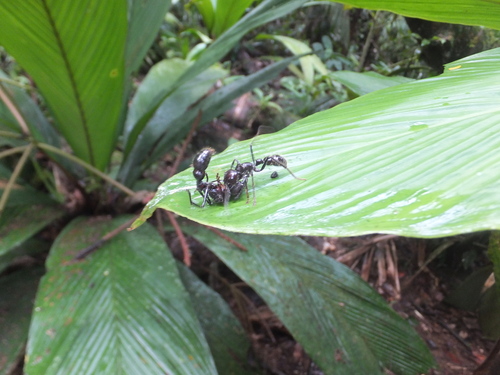
Bullet ant colonies are small, typically consisting of several hundred individuals.
Colony features:
- Population: typically several hundred workers
- Foraging mode: solitary (no pheromone trails, no mass raids)
- Recruitment: only for specific purposes such as defence or very large prey
- Defensive behaviour: stinging swarms only when the nest is disturbed directly
The absence of mass foraging trails is one of the most striking differences between bullet ants and more typical tropical ants such as leafcutters or army ants. A bullet ant worker leaving the nest walks alone, climbs the host tree trunk alone, hunts alone and returns alone. Encounters between workers from the same colony appear incidental rather than coordinated.
When a worker discovers a particularly large food item, limited recruitment can occur, but the colony does not generate the great living rivers of ants characteristic of army ants or the persistent highways of leafcutters.
Nesting and Habitat
Bullet ant nests are almost always built at the base of a large rainforest tree, often a tree with buttressed roots.
Nest characteristics:
- Typical location: base of a large tree in lowland forest, below about 750 m elevation
- Host tree: any of several large canopy species, no tight species specificity
- Use of the tree: foragers ascend the same trunk to hunt and collect nectar
Workers forage arboreally, climbing the host tree to reach the upper canopy.
Diet and Foraging
Bullet ants are opportunistic predators and important nectar feeders. Their diet combines animal prey, providing protein and lipids for the brood, with substantial quantities of plant sugars that fuel adult workers during long foraging excursions.
Animal prey:
- Other insects (beetles, caterpillars, termites, other smaller ants)
- Spiders and other arachnids
- Small arthropods in leaf litter and on bark
- Occasional scavenging of dead invertebrates
Plant and liquid food:
- Nectar from extrafloral nectaries on trees and vines
- Flower nectar when accessible
- Plant exudates and honeydew in small quantities
- Fruit juice from over-ripe fallen fruit
Foraging behaviour:
- Solitary: no trails, no mass recruitment
- Vertical: most foraging conducted up on the host tree and adjacent foliage
- Territorial: workers defend foraging routes from competing ants
Foraging success depends on individual worker ability, not colony coordination, which places an evolutionary premium on large body size and powerful mandibles.
The absence of fungal agriculture, large honeydew-farming herds and mass-raiding behaviour places bullet ants toward the more generalist end of tropical ant ecology. They are not specialists, and they are not mass-action foragers. They are large, capable individual hunters that depend on rainforest structural complexity.
Life Cycle and Reproduction
Bullet ant reproduction follows the general Hymenoptera pattern: single nuptial flights produce mated queens, which found or rejoin colonies and enter long periods of egg-laying.
Nuptial flight:
- Participants: winged virgin queens and males from mature colonies
- Post-flight: males die shortly after
Life stages:
- Egg
- Larva
- Pupa
- Adult worker
The Satere-Mawe Glove Initiation
The best-known cultural fact about bullet ants concerns the Satere-Mawe people of Brazil. Satere-Mawe men traditionally undergo a coming-of-age ritual in which live bullet ants are woven into ceremonial gloves that the initiate must wear.
Ritual sequence (as documented in ethnographic research):
- Elders locate a bullet ant nest and gather workers.
- The ants are sedated in a plant-based infusion.
- Sedated ants are woven into a pair of gloves made of leaves or vines with their stingers pointing inward.
- When the initiate inserts his hands into the gloves, the ants revive and sting continuously.
- The gloves are worn for five to ten minutes or longer.
- To complete the initiation, the ordeal must be repeated 20 times over several months or even years.
The ceremony is extraordinarily demanding. The venom causes intense waves of pain, muscle tremors, lymph node swelling and sometimes temporary partial paralysis of the arms. Afterwards the hand and part of the arm are temporarily paralysed, and the initiate may shake uncontrollably for days.
Conservation Status and Threats
The IUCN Red List has not formally assessed Paraponera clavata . Across most of its extensive Central and South American range the species remains relatively common in suitable mature forest. Because it occurs from Honduras to Brazil, total range and total population are large.
Main threats at the local and regional scale:
- Habitat loss. Conversion of lowland rainforest to agriculture removes the large trees bullet ants nest beneath.
Bullet Ants and Humans
Beyond the Satere-Mawe ritual, the ant has many local names across the neotropics, including tocandira in Brazil and hormiga veinticuatro in Venezuela.
In modern rainforest research and ecotourism, bullet ants are treated as an occupational hazard.
Poneratoxin is being investigated for possible medical applications and as a bio-insecticide.
Whether any commercial product will eventually result is still uncertain, but the research underscores how a compound evolved to cause extreme pain in vertebrates can, with the right molecular engineering, become the basis for medicines that relieve it.
See also: Bullet Ant vs Asian Giant Hornet
Frequently asked questions
Bullet ant (Paraponera clavata) workers measure 18 to 30 millimetres from head to gaster, placing them among the largest ants on Earth.
Queens are only slightly larger than workers, a striking contrast with species like leafcutter ants where the queen is far larger than her workers.
The bullet ant earns the top slot on the Schmidt Sting Pain Index, rated 4.0 or 4.0-plus depending on the source. Entomologist Justin Schmidt described the sensation as ‘pure, intense, brilliant pain, like walking over flaming charcoal with a 3-inch nail embedded in your heel’.
The pain arrives in waves of burning, throbbing pain and victims report shaking, sweating, nausea and temporary paralysis of the stung limb. Unlike most wasp or bee stings, which last minutes, bullet ant pain can persist for up to 24 hours. The sensation is driven by poneratoxin, a peptide that causes sustained firing of pain-signalling nerves.
Poneratoxin is a 25-amino-acid neurotoxic peptide found in bullet ant venom. Its target is the voltage-gated sodium channel, the molecular gate that controls how nerve and muscle cells fire electrical signals.
Poneratoxin prevents the channels from inactivating normally, so affected neurons fire repeatedly. The result is sustained firing of pain pathways and muscle twitching in both insects and vertebrates. It is being investigated for possible medical applications and as a bio-insecticide.
The Satere-Mawe people of Brazil practise an initiation ritual in which boys wear gloves filled with live bullet ants. The ants are sedated with a natural sedative, then woven into gloves made of leaves or vines with their stingers facing inward.
When the ants revive and the boy’s hands enter the gloves, they sting continuously for five to ten minutes or longer. To complete the initiation, the ordeal must be repeated 20 times over several months or even years. Afterwards the hand and part of the arm are temporarily paralysed, and the boy may shake uncontrollably for days.
Paraponera clavata inhabits humid lowland rainforests of Central and South America. Its range runs from Honduras, El Salvador, Nicaragua, Costa Rica and Panama in the north through Venezuela, Colombia, Ecuador, Peru and Bolivia to Brazil. Colonies are found in lowland areas from sea level to about 750 metres, although specimens have been collected at 1,500 metres.
Nests are usually situated at the base of trees. Foragers climb the same tree to the upper canopy, where they hunt small arthropods and collect nectar, then return to the nest along the trunk. Surveys in Costa Rica and on Barro Colorado Island found about four nests per hectare.
Bullet ant colonies are small for ants of their size, typically consisting of several hundred individuals. This is a fraction of the population found in a mature leafcutter, army, or fire ant colony, which can contain hundreds of thousands to millions of individuals.
Foragers operate alone rather than along pheromone trails, so colony-level foraging output depends on individual success rather than mass recruitment.
Bullet ants are opportunistic predators and nectar feeders. Workers hunt small arthropods, including other ants, caterpillars, spiders, small beetles and termites, on tree trunks and up into the canopy. Nectar is a critical second food source: bullet ants visit extrafloral nectaries on host trees and flowers, carrying droplets of sugary liquid back to the nest.
The nectar fuels adult workers while captured prey provides protein and lipids for developing larvae. Unlike many tropical ants, bullet ants do not cultivate fungus, do not herd honeydew-producing insects in large numbers, and do not conduct mass raids.
Bullet ants are dangerous to humans only in the narrow sense that a sting is extraordinarily painful. Anaphylaxis is rare, and lethal systemic reactions have not been clearly documented in the medical literature.
The main effects are temporary paralysis of the stung limb and intense pain lasting up to 24 hours. Conservation status has not been formally assessed by the IUCN Red List.
The species is widespread across Central and South America and is not considered threatened across most of its range, but it lives in rainforest and depends on forest habitat.
References
- Relevant peer-reviewed and governmental sources consulted for this entry include Justin Schmidt's published work on the Schmidt Sting Pain Index, research on poneratoxin pharmacology published in Toxicon, Journal of Biological Chemistry, and FEBS Letters, ethnographic reports on Satere-Mawe ritual practice, field studies of Paraponera clavata colony biology published in Insectes Sociaux and Biotropica, and regional neotropical ant surveys conducted by research stations in Costa Rica, Panama, Ecuador, and Brazil.