Bar-Tailed Godwit: 13,560 km Without Stopping
Limosa lapponicaIn 2022 a young bar-tailed godwit flew at least 13,560 km from Alaska to Tasmania in 11 days without landing, beating the 11,680 km set by E7 in 2007.
 Strange Animals EditorialMarch 9, 2025·17 min read·Editorial standards ↗
The bar-tailed godwit is the undisputed world record holder for non-stop bird flight. No other species, not the Arctic tern, not any albatross, not the wandering great frigatebird, flies as far in a single continuous effort as Limosa lapponica . A juvenile godwit tagged in Alaska in 2022 flew 13,560 kilometres in 11 days to Tasmania, without landing, without feeding, without drinking a single drop of water.
Before departure, godwits of this subspecies build the greatest fat loads of any migratory bird studied so far and shrink their digestive organs.
This guide covers the biology, ecology and strange edges of the bar-tailed godwit: its size and anatomy, the physiology of the record-breaking non-stop flight, the pre-migration fat loading and organ shrinkage, the sexual dimorphism in bill length, the discovery of the species' migration by Robert Gill and colleagues, and the conservation pressures now bearing down on the East Asian-Australasian Flyway.
Etymology and Classification
The scientific name Limosa lapponica was coined by Carl Linnaeus in 1758. The genus name Limosa comes from the Latin limus , meaning mud, a direct nod to the coastal mudflats where godwits feed in vast flocks. The species epithet lapponica means "of Lapland", reflecting the bird's breeding distribution across the far north of Europe.
In Maori the species is called kuaka . Dutch and German coastal communities call the bird rosse grutto and Pfuhlschnepfe respectively.
Taxonomically the bar-tailed godwit sits in the family Scolopacidae, the great sandpiper and snipe family and in the order Charadriiformes, the wader and seabird order that also contains plovers, terns, auks and gulls. The genus Limosa contains four species: the bar-tailed godwit, the black-tailed godwit ( L. limosa ), the Hudsonian godwit ( L. haemastica ), and the marbled godwit ( L. fedoa ).
Five subspecies of bar-tailed godwit are currently recognised, differing in breeding range, wintering range and migratory strategy. The Alaskan population, subspecies baueri: is the group that performs the record trans-Pacific flights. The Siberian population, menzbieri: uses the East Asian-Australasian Flyway via the Yellow Sea. European populations ( lapponica and taymyrensis ) winter around the Wadden Sea and West Africa.
Size and Physical Description
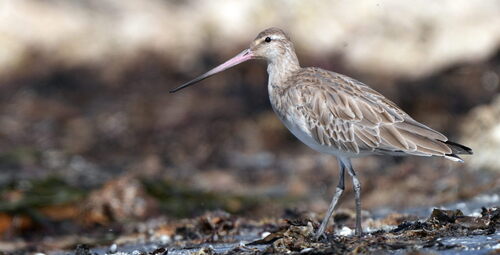
Bar-tailed godwits are medium-sized shorebirds with long legs, long upturned bills and a streamlined body built for sustained flight.
Adult measurements:
- Body length: 37-41 cm from bill tip to tail tip
- Wingspan: 70-80 cm
- Weight: males 190-400 g, females 260-630 g
- Bill: long and slightly upturned, longer in females than in males
Plumage (breeding male):
- Rich rust-red head, neck and underparts
- Streaked brown upperparts
- Barred black-and-white tail (the feature that gives the species its common name)
- The bill is long and slightly upturned, pink at the base and black towards the tip.
- Long legs
Plumage (breeding female):
- Paler buff underparts with limited rust tone
- Similar streaked upperparts
- Longer bill than the male
- Generally larger overall than the male
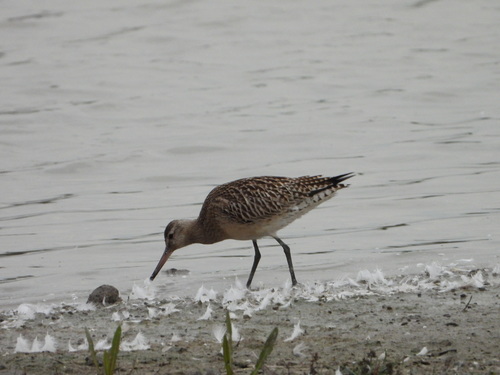
Non-breeding adults and juveniles lose most of the rust colouring, becoming overall grey-brown above and white below, with fine dark streaking on the breast. The barred tail remains diagnostic in all plumages.
Females are larger than males and have longer bills.
The most likely adaptive explanation is ecological niche partitioning on shared mudflat feeding grounds, the longer female bill probes deeper into sediment to reach larger, deeper-burrowing marine worms and bivalves, while males specialise on shallower, smaller prey. This division of foraging layers reduces competition between pair members and across mixed flocks at wintering sites.
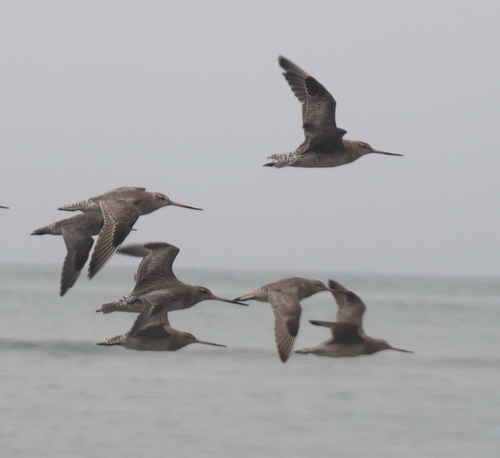
Godwits have a distinctive silhouette in flight: long pointed wings, long trailing legs and a straight neck. Flight is rapid, powerful and low over water, often with dozens to thousands of birds moving as a single coordinated flock.
Built for Non-Stop Flight
Almost every feature of the bar-tailed godwit's biology is an answer to the same engineering problem: how do you fly for 11 days over open ocean without stopping to refuel? The solution is a coordinated physiological and behavioural programme unlike anything in other birds.
Pre-migration fat loading:
- Birds feed intensively at staging sites before departure
- Body mass increases sharply as fat is deposited
- Fat deposits form beneath skin and around visceral organs
- Godwits carry the greatest fat loads of any migratory bird studied so far
Organ remodelling:
- Digestive organs shrink before departure
In-flight metabolism:
- Fat is the primary energy source
- Some lean tissue from the organs is also broken down as fuel
- Metabolic water from fat oxidation supplies hydration needs
The consequence of this design is an animal that arrives in New Zealand or Australia having used up most of its fat reserves. It then spends months on its wintering grounds before the return journey via the Yellow Sea the following spring.
The Longest Non-Stop Flight on Earth
The bar-tailed godwit's trans-Pacific crossing is the headline fact of the species and the reason it appears in almost every textbook on bird migration. The scale has only become clear in the last two decades, since satellite telemetry and lightweight GPS tags made it possible to track individuals through an entire crossing.
Headline numbers:
| Metric | Value |
|---|---|
| World record non-stop flight | 13,560 km in 11 days 1 hour (bird B6, 2022) |
| Typical Alaska-New Zealand leg | About 11,000 km |
| Flight duration | 8-11 days continuous |
The record crossing belongs to a juvenile godwit. The bird, flagged B6, departed Alaska on 13 October 2022 and landed in Tasmania 11 days and one hour later, having covered at least 13,560 kilometres without a stop.
In 2007 a female known as E7 set a then-record of 11,680 kilometres from western Alaska to the Piako River, New Zealand, in eight days. A male known as 4BBRW later flew about 13,000 kilometres from Alaska to New South Wales in 2021.
Birds nesting in Alaska migrate directly across the Pacific to Australasia, about 11,000 km away, rather than following the Asian coast as Siberian breeders do.
Pacific northbound migration follows a different pattern. Birds leave New Zealand and Australia, fly northwest to staging grounds around the Yellow Sea, refuel for several weeks and then make a final leg of roughly 7,000 kilometres to Alaska.
The Yellow Sea staging sites are critical to the northbound journey, and the loss of intertidal habitat there is a major conservation concern.
Tracking work indicates that godwits can time departures to favourable winds: birds often leave New Zealand early when winds are favourable, and they seem able to predict weather patterns that will assist them along the route.
Discovery of the Migration
The modern understanding of bar-tailed godwit migration is a story of dogged field research by a small team of biologists.
In 2005 Gill and colleagues published evidence for an 11,000-km non-stop flight from Alaska to New Zealand and eastern Australia.
The E7 revelation (2007):
Birds in New Zealand were fitted with surgically implanted satellite transmitters and tracked to the Yellow Sea. One female, flagged E7, flew on to Alaska and bred there. In August 2007 she left western Alaska on an eight-day non-stop flight of 11,680 kilometres to the Piako River near Thames, New Zealand. The work was published by Gill, Tibbitts, Battley, Piersma and colleagues in 2009.
Later records:
Later tracking of tagged birds produced further record flights, including those of the male flagged 4BBRW in 2020 and 2021.
The B6 record (2022):
In October 2022 a juvenile godwit flagged B6 left Alaska and flew non-stop to Tasmania, the first time a tagged bird had flown this route. It flew a minimum of 13,560 kilometres in 11 days 1 hour, the current record non-stop distance.
Diet and Feeding Behaviour
Bar-tailed godwits are tactile probers of soft sediment, using the long sensitive bill to detect invertebrate prey buried in mudflats and estuarine sediments. Their whole feeding strategy is built around probing cycles rather than visual hunting.
Primary prey on wintering grounds:
- Polychaete marine worms ( Nereis , Abarenicola , Nephtys and related genera)
- Bivalves (small mussels, cockles, venerids)
- Small crustaceans (amphipods, crabs)
- Marine snails on productive mudflats
Primary prey on breeding grounds:
- Adult and larval insects (craneflies, beetles, midges)
- Spiders and other tundra arthropods
- Occasional seeds and berries during poor insect years
Probing technique:
- On the mudflats, the godwit moves slowly with its head down and posture measured.
- The long bill is inserted vertically into the sediment to a depth of several centimetres.
- Sensitive nerve endings at the bill tip (Herbst corpuscles) detect prey vibrations and tissue.
- When a worm or bivalve is located, the bird grips and withdraws it, often with visible tension through the whole body.
- Prey is swallowed whole.
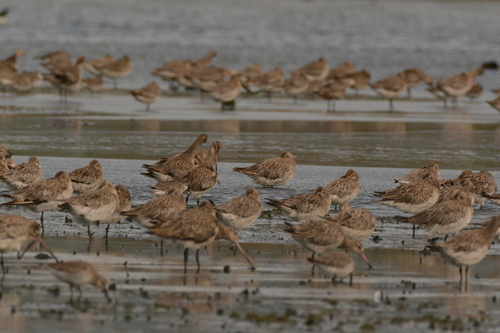
Bill length determines probing depth, which is why the sex difference matters directly. Females access deeper-burrowing worms and larger prey, males work shallower layers. At staging sites such as the Yellow Sea tidal flats during peak periods, godwits feed nearly nonstop during low tide and roost in tight flocks once the water covers the mud.
Breeding Season and Parental Care
The bar-tailed godwit's breeding life is compressed into the Arctic summer. Timing has to align with insect emergence, snow melt and long photoperiods of near-continuous daylight.
Annual breeding cycle:
- May: arrival at breeding grounds in Alaska
- Pair formation, territorial display, nest site selection
- Egg laying (clutch of two to five eggs, averaging four)
- Incubation (20 to 21 days), shared by both parents
- Chicks hatch
- Chicks fledge at around 28 days
Nests are shallow cups in moss, sometimes lined with vegetation. Both sexes share incubation, the male during the day and the female at night. Males perform ceremonial display flights with song.
Chicks are precocial and down-covered.
Populations and Distribution
Bar-tailed godwits are distributed across every inhabited continent except South America and Antarctica, with different subspecies using different flyways.
Subspecies and flyway distribution:
| Subspecies | Breeding range | Wintering range | Flyway |
|---|---|---|---|
| baueri | Alaska, Chukotka | New Zealand, eastern Australia | Central Pacific (non-stop) |
| menzbieri | Northeastern Siberia (Anabar to Kolyma rivers) | Northern Australia, SE Asia | East Asian-Australasian (Yellow Sea) |
| lapponica | Scandinavia, NW Russia | Western Europe, West Africa | East Atlantic |
| taymyrensis | Central Siberia (Taymyr) | West Africa (Banc d'Arguin) | East Atlantic |
The global population is estimated at about 1.1 million individuals. Numbers of baueri in New Zealand have declined from over 100,000 in the late 1980s to 67,500 in 2018.
Conservation Status and Threats
The IUCN Red List classifies the bar-tailed godwit as Near Threatened with a decreasing global population trend. The threats driving decline are concentrated at the flyway's most critical bottleneck: the staging mudflats of the Yellow Sea.
Primary threats:
- Yellow Sea tidal-flat reclamation. The construction of seawalls and the reclamation of mudflats has sharply reduced food supplies for migrating birds, particularly menzbieri, which rely on the Yalu Jiang estuary. Adult survival of baueri and menzbieri decreased between 2005 and 2012, probably because of the loss of intertidal staging areas in the Yellow Sea.
- Arctic breeding ground changes. Thawing permafrost, shifting insect emergence and changes to tundra hydrology alter the match between chick demand and prey availability. Mismatch leads to reduced fledging success.
- Coastal disturbance at wintering sites. The birds are easily spooked, and disturbance at high-tide roosts causes stress because they cannot rest.
Conservation measures:
- Listed under the Agreement on the Conservation of African-Eurasian Migratory Waterbirds (AEWA), protected in New Zealand under the 1953 Wildlife Act, baueri and menzbieri were listed as Endangered under Australia's EPBC Act in 2024.
- Long-term banding and GPS tracking programmes that inform flyway-scale management.
The long-term outlook depends on whether the remaining Yellow Sea tidal flats are retained, whether Arctic breeding conditions remain viable, and whether Pacific wind systems continue to support non-stop crossings. Local conservation at wintering sites helps but cannot compensate for staging habitat loss or climatic shifts over the open ocean.
Bar-Tailed Godwits and Humans
In New Zealand the species is called kuaka in Maori.
Since the E7 flight of 2007, the bar-tailed godwit has become an international symbol of long-distance migration.
For ordinary observers the bar-tailed godwit offers the same reminder as other extreme migrants: small animals can do enormous things. A bird weighing a few hundred grams flies from Alaska to Tasmania in a single continuous effort, without stopping or landing.
Illustration.
Frequently asked questions
The bar-tailed godwit (Limosa lapponica) holds the verified world record for the longest non-stop flight by any bird. A juvenile flagged B6 left Alaska on 13 October 2022 and flew a minimum of 13,560 km to Tasmania in 11 days 1 hour, without landing. The routine Alaska-New Zealand crossing of the subspecies L. l. baueri is about 11,000 km.
Before migration, bar-tailed godwits feed intensively on mudflats, converting prey such as marine worms and bivalves into the greatest fat loads of any migratory bird studied so far. They also shrink their digestive organs before departure. Waders on very long flights burn mainly fat and also break down some lean tissue from their organs.
Females are larger than males and have longer bills. The likely explanation is niche partitioning on shared mudflats: longer-billed females eat more deeply buried prey such as worms, while shorter-billed males feed more on small surface prey such as snails. This reduces competition between the sexes.
Bar-tailed godwits breed across Arctic coasts and tundra from Scandinavia through Alaska. New Zealand and eastern Australia host the winter range of the Alaska-breeding baueri subspecies, with birds flying non-stop across the Pacific. Northeastern Siberia supports the menzbieri subspecies, which winters in southeast Asia and northwest Australia with the Yellow Sea serving as a staging area. European populations of lapponica and taymyrensis winter along the coasts of western Europe and Africa.
In 2005 Robert Gill and colleagues published evidence for an 11,000-km non-stop flight from Alaska to New Zealand and eastern Australia. Seven godwits in New Zealand were then fitted with surgically implanted satellite transmitters and tracked to the Yellow Sea. One female, E7, flew on to Alaska and bred there. In August 2007 she flew 11,680 km non-stop from western Alaska to the Piako River, New Zealand, in eight days. In 2022 a juvenile flagged B6 flew at least 13,560 km to Tasmania in 11 days 1 hour.
The IUCN Red List classifies the bar-tailed godwit as Near Threatened with a decreasing population. The global population is estimated at about 1.1 million individuals. Adult survival of the baueri and menzbieri subspecies fell between 2005 and 2012, probably because of the loss of intertidal staging areas in the Yellow Sea, where seawalls and reclamation have reduced food supplies. Baueri numbers in New Zealand fell from over 100,000 in the late 1980s to 67,500 in 2018.
Tracking work indicates that godwits can time departures to favourable winds. Birds often leave New Zealand early when winds are favourable, and they seem able to predict weather patterns that will assist them along the migration route.
References
- Relevant peer-reviewed and governmental sources consulted for this entry include Gill et al. (2009) "Extreme endurance flights by landbirds crossing the Pacific Ocean" in Proceedings of the Royal Society B, Battley et al. (2012) "Contrasting extreme long-distance migration patterns in bar-tailed godwits" in Journal of Avian Biology, Conklin et al.
- (2021) reviewing bar-tailed godwit flyway ecology, US Geological Survey Alaska Science Center tracking data releases (2007-2023), reports of the 2022 record flight, IUCN Red List assessments for Limosa lapponica, BirdLife International species factsheets, and the East Asian-Australasian Flyway Partnership status reports on Yellow Sea staging habitat.
- Population figures reflect consolidated estimates from the most recent BirdLife International assessment and the 2023 flyway population review.