Arctic Tern: 96,000 km in Ten Months
Sterna paradisaeaA Farne Islands Arctic tern covered 96,000 km in ten months, a migration record. Greenland and Iceland birds averaged 70,900 km a year in a 2010 study.
 Strange Animals EditorialJuly 5, 2025·15 min read·Editorial standards ↗
Of all animal long-distance champions, the Arctic tern holds the top position. Not the humpback whale, not the monarch butterfly, not any albatross or shorebird matches the Sterna paradisaea 's annual migration pattern. Birds tracked from Greenland and Iceland flew about 70,900 kilometres each year on average, and one individual covered 96,000 kilometres in ten months, shuttling between Arctic summer and Antarctic summer and accumulating more daylight exposure over a lifetime than any other species on Earth.
This guide covers the biology, ecology and strange edges of the Arctic tern: its size and anatomy, its pole-to-pole migration and the winds that shape it, its diet and plunge-diving technique, its colony life and fearsome defensive behaviour, its long monogamous pair bonds and its conservation outlook in a warming ocean.
Etymology and Classification
The scientific name Sterna paradisaea was coined by Erik Pontoppidan in 1763. The genus name Sterna comes from Old English stearn , meaning "tern". The species epithet paradisaea comes from Late Latin paradisus , "paradise".
In English the bird is called the Arctic tern, but across its range it carries local names that reflect long familiarity. Icelanders call it kria , an onomatopoeic rendering of the piercing alarm call. Faroese fishermen call it terna .
Taxonomically the Arctic tern sits in the family Laridae, which groups it with gulls and other terns, and in the order Charadriiformes, the great seabird and shorebird order that also contains auks, skuas, plovers and sandpipers. Its closest relatives are a group of South Polar species: the South American tern ( S. hirundinacea ), the Kerguelen tern ( S. virgata ) and the Antarctic tern ( S. vittata ).
Size and Physical Description
Arctic terns are small, light and exquisitely proportioned for long-distance flight.
Adult measurements:
- Body length: 33-36 cm from bill tip to tail tip
- Wingspan: 76-85 cm
- Weight: 86-127 g
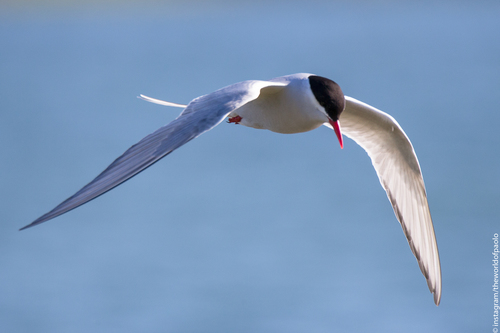
Plumage (breeding adult):
- Black cap from forehead to nape
- Pale grey upperparts and wings
- White underparts with a faint grey wash on the belly
- Long, deeply forked white tail streamers
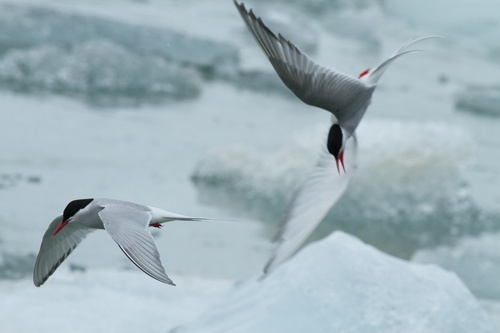
- Blood-red bill with no black tip (a key feature distinguishing it from the common tern)
- Short, coral-red legs
Juveniles and non-breeding adults lose most of the black cap, retain a dark half-mask behind the eye and show barred grey-and-white upperparts. Bills and legs turn blackish outside the breeding season.
The proportions are functionally extreme. Wings are narrow and pointed: a high aspect ratio that favours efficient, gliding flight at low cost. Tail streamers add manoeuvrability in flight and serve as display features on the breeding grounds.
Arctic terns can be distinguished from the similar common tern by the all-red bill, shorter legs, longer tail streamers and the translucent primary feathers that glow when backlit against a pale sky.
Can you tell a male Arctic tern from a female?
Not by looks. The sexes look alike, so the male and female of a breeding pair share the same black cap, pale grey body, long tail streamers and solid red summer bill. The work of breeding is shared as well: both parents incubate the eggs and both bring fish to the chicks.
Built for Endless Flight
Almost every feature of the Arctic tern's biology is an answer to the same engineering problem: how do you fly tens of thousands of kilometres a year between the poles?
Energy economy features:
- High aspect ratio wings favour efficient, gliding flight.
- Without giving up strength, hollow bones and air-sac anatomy reduce skeletal mass.
Flight behaviour:
- Their migration follows a convoluted course that takes advantage of prevailing winds.
The consequence of this design is an animal whose life is almost entirely airborne. When they do rest, it is usually on a floating piece of debris, a small iceberg, or the edge of the Antarctic pack ice.
The Longest Migration on Earth
The Arctic tern's migration is the headline fact of the species and the reason it appears in almost every textbook on bird movement. The scale only became clear once miniaturised geolocator tags made it possible to track individuals through an entire annual cycle.
Headline numbers:
| Metric | Value |
|---|---|
| Average annual round trip (Greenland and Iceland birds) | ~70,900 km |
| Longest tracked individual | ~96,000 km in about ten months |
| Shortest distance between breeding and wintering areas | 19,000 km |
| Average lifespan | About 30 years |
| Longest recorded lifespan | 31 years |
| Estimated lifetime distance | ~2.4 million km (more than 3 round trips to the Moon) |
The route is not a straight line. A 2010 geolocator study of eleven birds from Greenland and Iceland found that they covered 70,900 km on average in a year, with a maximum of 81,600 km, far more than earlier estimates, because they follow meandering courses rather than a straight route.
Dutch birds studied in 2013 averaged about 48,700 km a year, roughly following the coastlines of Europe and Africa on the way south.
The birds follow a convoluted course in order to take advantage of prevailing winds.
How does the Arctic tern compare with the bar-tailed godwit?
The two birds hold different records. The Arctic tern covers the greatest total distance in a year: geolocator tracking of birds from Greenland and Iceland showed annual round trips of more than 70,000 km (about 43,500 miles). The bar-tailed godwit holds the record for the longest single flight without stopping. In October 2022 a four-month-old godwit tagged B6 flew 8,425 miles (about 13,560 km) from Alaska to Tasmania in 11 days, the longest documented non-stop flight by any animal.
The tern does not attempt anything similar. The godwit crossed the Pacific on its fat reserves alone, without landing.
Diet and Feeding Behaviour
Arctic terns are surface-feeding piscivores with a secondary appetite for krill and other small invertebrates. Their whole hunting strategy is built around the plunge dive.
Primary prey:
- Sand eels ( Ammodytes spp.) in North Atlantic waters
- Capelin ( Mallotus villosus ) in Arctic waters
- Juvenile cod and herring where available
- Euphausiid krill in Antarctic waters
- Amphipods and other small crustaceans year-round
Secondary and opportunistic prey:
- Insects swept off tundra ponds during breeding
- Molluscs, marine worms and berries occasionally
Plunge-diving technique:
- The tern flies over the water, head angled down, scanning.
- When a fish is spotted near the surface, the bird hovers briefly, bill aligned vertically.
- It folds its wings and drops in a rapid, almost ballistic dive.
- At the moment of impact the wings extend partially to break the fall and the tern strikes with the bill.
- The bird lifts off almost immediately, without diving deep.
Dives are shallow: Arctic terns dip down to the surface of the water to catch prey close to the surface and do not dive deep like auks or gannets.
During the breeding season, adults ferry fish back to their chicks. Skuas, gulls and other terns often harass the adults and steal their food.
Breeding Season and Colony Life
The Arctic tern's breeding life is compressed into the short northern summer.
Annual breeding cycle:
- Arrival at colony, courtship, pair re-formation
- Egg laying: clutch of 1-3 eggs, usually 2
- Incubation: 22-27 days, shared by both parents
- Chicks hatch and grow on a fish-heavy diet
- Fledging at 21-24 days after hatch
- Southward migration begins
Nests take the form of simple scrapes - shallow depressions in gravel, sand, short tundra vegetation or moss and occasionally lined with grass or similar materials. Colonies establish wherever suitable substrate and fishing-ground access coincide: offshore islands are preferred as they reduce predation from foxes and weasels.
Defensive behaviour is one of the most striking features of Arctic tern life. When a potential predator, an Arctic fox, a great skua, a herring gull, a researcher, enters the colony, the response is immediate and coordinated. Alarm calls escalate. Adults launch into the air in a swirling cloud. The nearest birds dive at the intruder's head, striking with the bill.
Strikes can draw blood, although the birds are too small to cause serious injury to a human.
Chick Development and Parental Care
Arctic tern chicks hatch after 22 to 27 days of incubation, covered in down. They are precocial and begin to move around and explore within one to three days, but usually do not stray far from the nest and still depend on parental feeding.
Both parents feed the chicks, with one parent typically guarding the nest while the other hunts. Parents selectively bring larger prey items to chicks than they eat themselves.
Chick mortality is high. Predation, including by large gulls and poor food supply take a toll, and in years of sand eel collapse whole colonies can fail to fledge any chicks.
Parents keep feeding their young for about a month after fledging and then wean them gradually. The young terns then fly south to their first Antarctic winter with the help of their parents.
Populations and Distribution
Arctic terns are among the most widely distributed breeding birds on Earth. Any tundra coast, gravel island, or low-lying rocky shoreline within the Arctic and sub-Arctic is a potential colony site.
Global population estimates put the total at more than two million individuals, over half of them in Europe. The IUCN Red List classifies the Arctic tern as Least Concern based on range size and overall numbers, while noting regional declines and the ecological sensitivity of the species to ocean change.
During the southern summer the birds are found at sea, reaching the northern edge of the Antarctic ice.
Conservation Status and Threats
The Arctic tern is listed as Least Concern globally, but beneath the headline status sit several serious long-term pressures.
Primary threats:
- Climate-driven prey declines. A crash of sand eel stocks led to the Arctic tern being regionally uplisted to Vulnerable in Iceland in 2018. In the southern part of its range the species has been declining, largely because of a lack of food.
- Predators. Nesting Arctic terns are vulnerable to predation by cats and other animals, and herring gulls steal eggs and hatchlings.
- Hunting. The New England population was reduced in the late nineteenth century by hunting for the millinery trade, and exploitation continues in western Greenland, where the species has declined greatly since 1950.
Conservation measures:
- International protection under the Agreement on the Conservation of African-Eurasian Migratory Waterbirds (AEWA).
The long-term outlook depends on ocean ecosystems more than on local colony management. Healthy sand eel and krill populations, stable wind systems and intact pack ice together determine whether two million Arctic terns continue to cross the planet each year.
Arctic Terns and Humans
The Arctic tern has appeared on the postage stamps of several countries and dependent territories, including Canada, Finland, Iceland and the Faroe Islands.
For biologists the Arctic tern has become one of the most important animals in the study of animal movement. A geolocator study published in 2010 by Carsten Egevang and colleagues showed that earlier research had seriously underestimated the distances the species travels.
A 2015 to 2017 study on the Farne Islands recorded a bird that covered 96,000 km in ten months, a new migration record.
For ordinary observers Arctic terns offer a yearly reminder that small animals can do enormous things. A bird that weighs about a hundred grams can cover more than twice the Earth's circumference in a year, and the average bird lives about thirty years.
Frequently asked questions
Arctic terns (Sterna paradisaea) migrate between breeding grounds in the Arctic and wintering grounds in Antarctic waters every year. A 2010 geolocator study found that birds from Greenland and Iceland covered about 70,900 km on average in a year, while Dutch birds averaged about 48,700 km. The longest individual tracked, a bird from the Farne Islands, travelled approximately 96,000 km in ten months. This is the longest documented migration of any animal on Earth.
Birds do not fly in a straight line: they follow a convoluted course that takes advantage of prevailing winds.
Arctic terns are long-lived for such small birds: many reach fifteen to thirty years of age, with a record of 31 years. The average bird lives about 30 years. Many chicks never reach that point, since predation and poor food supply cause high chick mortality.
Lifespan combined with annual migration distance produces the species’ most striking statistic: a single bird can log roughly 2.4 million km of flight over its life, equivalent to more than three round trips to the Moon.
Arctic terns eat mainly fish and small marine invertebrates. Their diet is dominated by small schooling fish (sand eels, capelin, herring, juvenile cod) plus krill, amphipods and other small crustaceans. They dip and plunge down to the water surface to catch prey close to the surface, and do not dive deep.
During breeding, adults ferry fish to their chicks. Insects are also taken on the northern breeding grounds, and molluscs, marine worms and berries occasionally.
Arctic terns have a circumpolar breeding distribution covering the Arctic and subarctic regions of Europe (as far south as Brittany), Asia and North America (as far south as Massachusetts). Colonies form on coasts, islands and occasionally inland on tundra near water, and isolated nesting sites help reduce predation.
During the southern summer they are found at sea, reaching the northern edge of the Antarctic ice. By living through the Arctic summer and then the Antarctic summer, Arctic terns see more daylight than any other animal on Earth.
Arctic terns are among the most aggressive terns and fiercely defend their nests and young. Their nests are simple ground scrapes with no shelter from predators. When a potential threat, such as an Arctic fox, a great skua, a herring gull, or a human, enters the colony, alarm calls escalate and adults launch into the air in a swirling cloud. The nearest birds dive at the intruder’s head, striking with the bill.
The birds are too small to cause serious injury to a human, but strikes can draw blood.
The IUCN Red List classifies the Arctic tern as Least Concern. The global population is estimated at more than two million individuals, over half of them in Europe. However, some regional populations are under pressure. A crash of sand eel stocks led to the species being regionally uplisted to Vulnerable in Iceland in 2018, and numbers have been declining in the southern part of its range, largely through lack of food.
Predation by cats and other animals, and hunting in places such as western Greenland, are further threats. Arctic terns are protected under the Agreement on the Conservation of African-Eurasian Migratory Waterbirds (AEWA).
Yes. Arctic terns mate for life and, in most cases, return to the same colony each year. Courtship is elaborate, especially in birds nesting for the first time.
Breeding is a shared effort: both parents incubate the eggs, which hatch after 22 to 27 days and both bring fish to the chicks. Parents keep feeding their young for about a month after fledging.
References
- Relevant peer-reviewed and governmental sources consulted for this entry include Egevang et al. (2010) "Tracking of Arctic terns Sterna paradisaea reveals longest animal migration" in Proceedings of the National Academy of Sciences, subsequent geolocator studies published in Marine Ecology Progress Series and Journal of Avian Biology, IUCN Red List assessments for Sterna paradisaea, BirdLife International species factsheets, and long-term colony monitoring reports from the Icelandic Institute of Natural History, the Farne Islands (National Trust), and the Alaska Department of Fish and Game.
- Population figures reflect consolidated estimates from the most recent BirdLife International assessment.
- National Audubon Society. Arctic Tern, Guide to North American Birds.
- Phys.org (2010). Arctic terns confirmed to have the longest animal migration in the world (report on Egevang et al. 2010).