Sword-Billed Hummingbird: Bill Beats Body
Ensifera ensiferaIts 8 to 12 cm bill outmeasures the rest of its body, true of no other bird, and it matches the flower tube of Passiflora mixta almost exactly.
 Strange Animals EditorialJanuary 6, 2025·14 min read·Editorial standards ↗
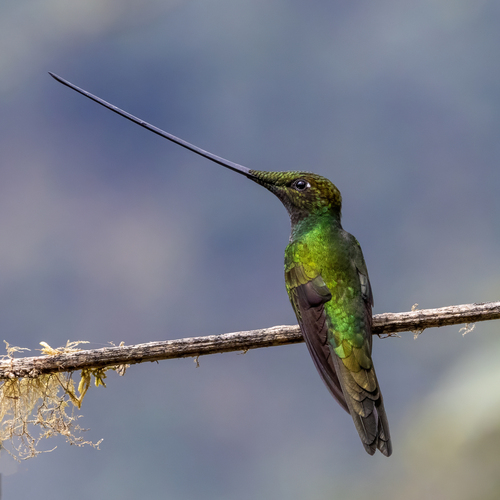
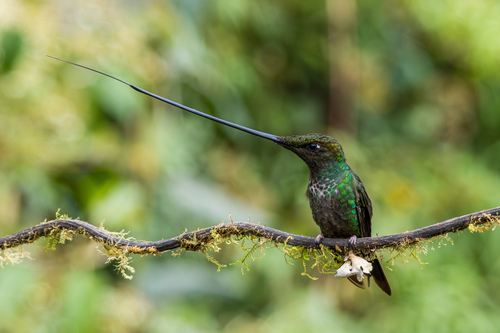
The sword-billed hummingbird is the only bird on Earth whose bill is longer than the rest of its body. A living paradox of proportions, Ensifera ensifera looks less like a functional animal and more like a rapier someone has strapped to a small green bird.
The bill is 8-12 centimetres long, and once the tail is excluded, it is longer than the rest of the body.
No other bird species comes close to this ratio, and the adaptations that surround it, upward-angled perch and foot-based scratching, form one of the most coherent packages of evolutionary strangeness in the bird world.
This guide covers every aspect of sword-billed hummingbird biology and ecology: size and proportions, Andean habitat, co-evolution with Passiflora mixta , hovering flight mechanics, the unusual preening and perching behaviours forced on it by its anatomy, nesting and life cycle and conservation.
Etymology and Classification
The scientific name Ensifera ensifera comes from the Latin ensis , meaning sword and ferre , meaning to bear, the sword-bearing sword-bearer. The tautonymous construction is a traditional signal in zoology that the species is the type and often the only member of its genus. Ensifera is exactly that: a monotypic genus containing this one species, first described as Ornismya ensifera by Auguste Boissonneau in 1839 and moved to the genus Ensifera by René Lesson in 1843.
The sword-billed hummingbird sits inside the hummingbird family Trochilidae, order Apodiformes, class Aves. Trochilidae is one of the largest bird families on Earth with about 375 species, almost all restricted to the Americas. Within the family the sword-bill belongs to the brilliants clade (tribe Heliantheini).
Common names in Spanish include colibri pico espada and picaflor espada , both translating directly as sword-beak hummingbird.
Size and Physical Description
The sword-billed hummingbird is among the largest hummingbirds, and its proportions are dominated by a single structure. Measurements vary slightly across the Andean range but the key values are remarkably consistent.
Adult measurements:
- Body length (excluding the bill): 13-14 cm
- Bill length: 8-12 cm
- Weight: 10-15 g
Proportion metrics:
- The bill is the largest of any hummingbird and the largest relative to body length of any bird
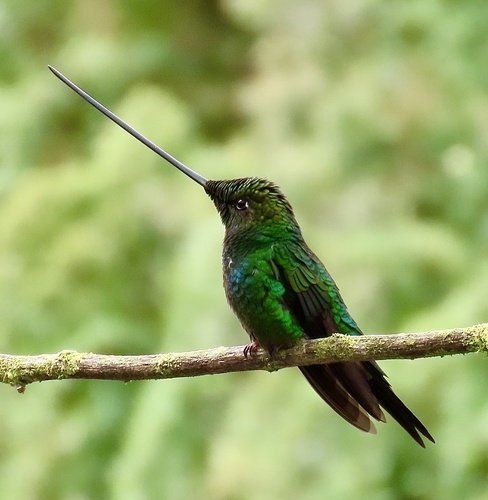
Plumage is relatively subdued for a hummingbird. Males have bronze-green upperparts with a coppery-bronze head, dusky throat, metallic green underparts and a forked blackish tail. Females have similar upperparts but white underparts with grayish throats and bellies speckled with green, and a less deeply forked tail. Juveniles look similar to females.
The bill itself is black, heavy and slightly upturned.
Males have shorter bills but longer wings and tails than females.
Hummingbird legs are short and little used for walking, but the sword-bill uses its feet for grooming.
The Bill: a Closer Look
A bill of 8-12 centimetres on a bird about 13-14 centimetres long is a structural challenge as much as an evolutionary one.
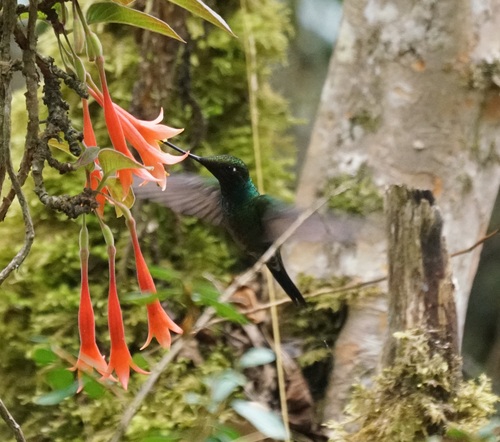
The bill is almost exactly the same length as the corolla tube of Passiflora mixta , its main food flower. The bird probes flowers from below.
Like other hummingbirds, the sword-bill's tongue is forked and lined with fringed lamellae that unfurl on contact with nectar and snap shut as the tongue is retracted, loading a liquid column into the throat with every pump.
Andean Habitat and Range
Sword-billed hummingbirds are restricted to the Andes mountains and are essentially absent from any other biome. Their distribution runs from western Venezuela and the Colombian Andes in the north, south through Ecuador and Peru, to Bolivia.
Preferred habitat:
- Humid montane cloud forest
- Shrubland and forest edges
- Edges of paramo grassland
- Mountain gardens at appropriate elevation
- Forest gaps with abundant long-tubed flowering vines
Elevation band:
- Lower limit: ~1,700 m
- Most common: 2,400-3,100 m
- Upper limit: ~3,500 m
Within this band the bird favours areas with persistent mist, dense epiphyte cover and scattered flowering vines, particularly Passiflora mixta and related species with long-tubed blooms.
The range is structurally linear, which means local populations are strung out along the Andean spine and depend on corridors of connected forest at the right altitude.
Co-evolution with Passiflora mixta
No account of the sword-billed hummingbird makes sense without the banana passionfruit, Passiflora mixta , and no textbook discussion of plant-pollinator co-evolution leaves out the sword-bill.
Passiflora mixta is a climbing vine of the Andean cloud forest that produces long-tubed flowers. The nectar sits at the bottom of that tube, which is almost exactly as long as the sword-bill's bill. The flower is an inaccessible food source to nearly every other species, but the sword-billed hummingbird can reach it.
Because the sword-bill is the only bird that can drink from the flower, it is also the only bird that regularly carries its pollen. Each time the bird hovers below the flower and slides its bill in, it contacts the flower's sexual structures, picking up pollen and depositing pollen from previously visited flowers on the stigma. The plant's reproduction depends almost entirely on this single species of pollinator.
From the plant's perspective, investing in a long corolla is expensive but filters out visitors that would steal nectar without transferring pollen. From the bird's perspective, investing in a long bill is expensive but opens a nectar source with almost no competition. Over thousands of generations each has pushed the other further in the same direction, a feedback loop known as reciprocal co-evolution .
Other long-tubed Andean flowers also receive regular visits from sword-bills, including species of Brugmansia , Fuchsia and Datura . In most of those cases the bird is one of several possible pollinators rather than the exclusive one, but its reach into long corollas makes it disproportionately important for deep-tube specialists.
Hovering Flight with a Handicap
Every hummingbird is an aerodynamic marvel, but the sword-bill has to be that marvel while carrying what is effectively a skewer longer than itself. The centre of gravity is pushed sharply forward, rotational inertia increases along the bill axis, and the normal head-down posture used by many hummingbirds to feed from above becomes impossible.
Flight features:
- Higher wing-disk loading than other hummingbirds
- Approach to flowers usually from below or beside, not above
Hovering is energetically expensive, and the bird is a trap-line feeder, visiting a regular sequence of flowers.
Perching, Preening, and Grooming
The sword-bill's most famous oddity besides the bill itself is how it handles gravity when not flying. At rest it perches with the bill angled almost straight up, sometimes fully vertical, rather than held level like most birds. This posture reduces the strain of the heavy bill and improves balance.
Feather maintenance is a second consequence of the extreme bill. Most birds preen by running the bill through feathers to align barbs, redistribute oils and remove parasites. The sword-bill's bill is too long for effective preening. The solution is foot-based scratching.
The sword-bill uses its feet to groom, even though this takes longer than using the bill.
Life Cycle and Reproduction
Breeding occurs from February to March. As in other hummingbirds, the female raises the young alone.
Nesting is entirely the female's work. She builds a cup nest made of moss, usually hung among root fibers high above the ground.
Nesting summary:
- Clutch size: 2 white eggs
Females must incubate while still maintaining their own demanding metabolism, which forces them to leave the nest frequently for short feeding trips. Chicks hatch naked and blind. They are fed a diet richer in arthropods than the adult diet, because nestlings need protein, amino acids and minerals more than pure sugar to build feathers, bones and muscle.
Fledglings stay dependent on the mother for a short period after leaving the nest, then disperse.
Lifespan, Predation, and Mortality
No reliable lifespan figures are available for the species in the wild. Likely mortality factors include the following.
Main mortality sources:
- Nest predation by small mammals, snakes and jays
- Starvation during gaps in flower bloom cycles
- Weather events: cold snaps, heavy rain, landslides
- Collisions with windows and wires near human settlements
- Small raptors such as forest falcons and accipiters
Conservation Status and Threats
The IUCN Red List currently classifies the sword-billed hummingbird as Least Concern , reflecting its large range, lack of significant population decline and lack of major threats, and its ability to use man-made habitats in some areas. There is no census of global numbers.
Primary threats:
- Cloud forest loss. Andean cloud forests are being cleared for pasture, small farms, coffee plantations and infrastructure. Fragmentation is particularly damaging because the range is already linear.
- Passiflora population disruption. When passionfruit vines are removed or heavily grazed, the bird loses its primary nectar source.
- Climate shift. Cloud forest depends on a stable elevation band where warm moist air meets cooler mountain slopes. As temperatures rise, the cloud band shifts upward and above a certain elevation there is no more mountain. This compresses habitat from both sides.
The species is known to occur in several protected areas and benefits indirectly from any policy that preserves Andean cloud forest.
Sword-billed Hummingbirds and Humans
The sword-billed hummingbird appeared in the Jungles episode of the BBC series Planet Earth II.
Because Passiflora mixta depends on the bird for pollination, a decline in sword-billed hummingbird numbers would most likely reduce the abundance of the flower.
Illustration.
Frequently asked questions
The sword-billed hummingbird (Ensifera ensifera) uses its very long bill to reach nectar in flowers with long corollas that are inaccessible to other species. Its main food plant, Passiflora mixta, has a corolla tube almost exactly as long as the bird’s bill.
The two species are an example of extreme co-evolution: the plant depends on the bird for pollination, while the bird gets a high-quality food source with little competition.
The bill is 8-12 cm long, the largest of any hummingbird and the largest relative to body length of any bird. The sword-billed hummingbird is the only known bird whose bill is longer than the rest of its body, excluding the tail.
Sword-bills inhabit the Andes from western Venezuela through Colombia, Ecuador and Peru to Bolivia. They live in humid montane forest, forest edges, shrubland, gardens and patches of paramo at elevations of 1,700-3,500 metres, and are most common between 2,400 and 3,100 metres.
The species is generally non-migratory, but birds in Colombia and northwestern Venezuela move to higher altitudes in the early wet season and return to lower elevations in the dry season.
The sword-billed hummingbird feeds mainly on nectar from flowers with long corollas, especially Passiflora mixta and other passionflowers. Other nectar sources include Brugmansia, Datura, Fuchsia and several other plant genera. It probes flowers from below and visits a regular sequence of flowers, a habit known as trap-lining.
Like other hummingbirds, it also hawks flying insects.
Because the bill is so long, the sword-billed hummingbird uses its feet rather than its bill to groom and scratch, even though this takes longer than traditional bill preening. When resting, it perches with the bill angled upward, which reduces the strain of the heavy bill and improves balance.
No. The IUCN Red List classifies the sword-billed hummingbird as Least Concern, because of its large range, lack of significant population decline and lack of major threats. It has adapted to man-made habitats in some areas and occurs in several protected areas.
The most probable threats are climate change and deforestation, which could cause habitat loss and reduce its food supply, especially Passiflora mixta.
Like other hummingbirds, the sword-billed hummingbird can hover and fly backwards. It has a higher wing-disk loading than other members of its family, and it usually probes flowers from below rather than from above.
No reliable lifespan figures are available for the species in the wild. Breeding occurs from February to March. The female builds a cup nest of moss, usually hung among root fibers high above the ground, and, as in other hummingbirds, raises the young alone.
References
- Sources consulted for this entry include the IUCN Red List assessment for Ensifera ensifera and Lindberg and Olesen (2001), The fragility of extreme specialization: Passiflora mixta and its pollinating hummingbird Ensifera ensifera, Journal of Tropical Ecology 17: 323-329.
- Distribution and elevation data follow the Birds of the World species account (Züchner and Kirwan, 2020).
- Lindberg, A. B. and Olesen, J. M. (2001). The fragility of extreme specialization: Passiflora mixta and its pollinating hummingbird Ensifera ensifera. Journal of Tropical Ecology 17(2): 323-329.
- Züchner, T. and Kirwan, G. M. (2020). Sword-billed Hummingbird (Ensifera ensifera). Birds of the World, Cornell Lab of Ornithology.