Bee Hummingbird: World's Smallest Bird
Mellisuga helenaeAdult males weigh under two grams, yet their wings beat roughly 80 to 200 times per second. One Cuban bee hummingbird may visit up to 1,500 flowers in a day.
 Strange Animals EditorialMay 7, 2025·15 min read·Editorial standards ↗
The bee hummingbird is the smallest bird alive on Earth. An adult male weighs under two grams and measures about five and a half centimetres from bill tip to tail, small enough that on first sight many observers assume they are watching a large bumblebee rather than a vertebrate.
Endemic to Cuba and the nearby Isla de la Juventud, Mellisuga helenae compresses the full architecture of a warm-blooded, feathered, egg-laying animal into a body lighter than a one-cent coin, and then drives that body through one of the most demanding metabolisms ever measured in the animal kingdom.
This guide covers every major aspect of bee hummingbird biology and ecology: size and structure, the mechanics of flight at the absolute lower edge of bird anatomy, diet and co-evolution with a narrow range of Cuban flowers, the nest, torpor, conservation status and the relationship between bee hummingbirds and the human communities who share their island.
Etymology and Classification
The scientific name Mellisuga helenae is a binomial. The genus Mellisuga is a Latin coinage that translates roughly to 'honey-sucker', an early European label for hummingbirds based on their nectar feeding. The species was formally described in 1850 by Juan Lembeye.
The bee hummingbird belongs to the order Apodiformes, a group whose Latin name means 'without feet' and whose members share the trait of tiny, weak, near-vestigial legs. Inside Apodiformes the family Trochilidae contains the hummingbirds, all confined to the Americas.
The genus Mellisuga contains just two species: the bee hummingbird and the larger vervain hummingbird ( Mellisuga minima ) of Jamaica and Hispaniola. The two are close relatives but differ enough in size, range and flower preferences to function as distinct species.
Cuba's isolation as a large Caribbean island has produced a high rate of endemic bird species, of which the bee hummingbird is the most famous.
Size and Physical Description
The bee hummingbird is the smallest bird species in the world by both length and mass. No other bird comes close.
Body dimensions:
- Total length: about 5.5 cm in males and 6.1 cm in females
- Weight: about 1.95 g on average in males, 2.6 g in females
Sex differences:
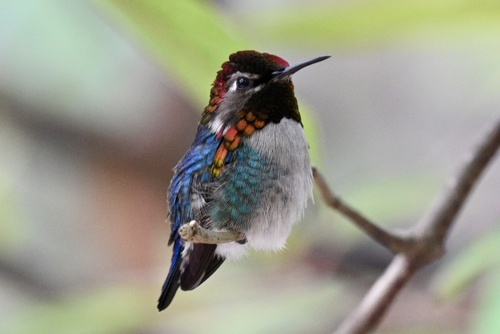
- Males: smaller, with an iridescent scarlet gorget and elongated lateral plumes
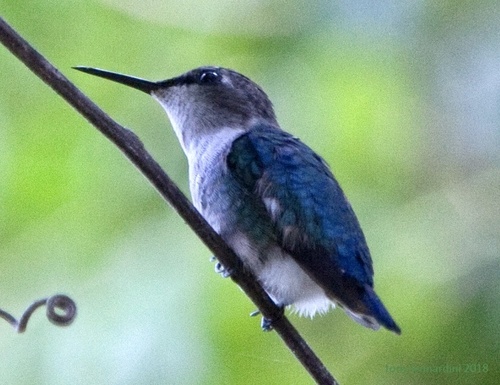
- Females: slightly larger and heavier, with pale grey underparts and white-tipped tail feathers
- Juveniles: resemble females with slightly duller plumage
Unlike most birds, female bee hummingbirds are larger than males. This reversal is common in hummingbirds and is thought to reflect the female's greater investment in nest building, incubation and chick feeding, all of which benefit from a slightly larger body with more fat reserves.
The feet are almost vestigial, as they are across Apodiformes. The legs are too short and weak for walking, hopping, or serious gripping at an angle. A bee hummingbird can latch onto a twig tightly and can shuffle sideways for a few centimetres, but on flat ground it is helpless. Flight handles all major tasks: feeding, travel and courtship.
The wing is built like a miniature rigid propeller. The shoulder joint rotates almost 180 degrees, letting the wing invert between strokes so that lift is generated on both the forward and the backward half of each beat. The wings beat roughly 80 to 200 times per second.
Built for Extreme Metabolism
The bee hummingbird pushes vertebrate physiology to the mathematical edge of what warm-blooded biology can sustain. Its tiny body has a surface-to-volume ratio so unfavourable for heat retention that maintaining a typical avian body temperature of about 40 degrees Celsius requires running the furnace at full power almost constantly.
To fuel this metabolism the bee hummingbird may eat up to half its body weight in food in a typical day, mostly nectar with some insects and spiders.
This is only sustainable because the bird feeds almost continuously during daylight, may visit up to 1,500 flowers per day, and combines high-sugar nectar with small amounts of high-protein arthropods.
Hovering, Backward Flight, and Aerial Control
Like other hummingbirds, the bee hummingbird can hover in true stationary flight, fly backward under full control, pivot on its axis and briefly fly upside down. What distinguishes it is the sheer efficiency demanded by operating at extreme small size. Drag, turbulence and Reynolds number effects that a larger hummingbird can shrug off become physical challenges at two grams of body mass.
Aerodynamic features that enable flight at two grams:
- The shoulder joint permits rotation close to 180 degrees, which enables the wing to invert between strokes.
- The rigid wing functions as a reciprocating propeller instead of a conventional flapping aerofoil.
- Lift is generated on both the upstroke and the downstroke
- Wing beat frequency of roughly 80 to 200 beats per second
Typical flight speeds:
| Flight mode | Speed |
|---|---|
| Hovering | 0 km/h |
| Forward cruise | 40-48 km/h |
Diet and Co-evolution with Cuban Flowers
Bee hummingbirds are nectarivores in daily practice and facultative insectivores out of necessity. Their narrow island range has driven a tight co-evolutionary relationship with a small suite of native Cuban flowering plants. One study reported visits to ten plant species, nine of them native to Cuba.
Preferred nectar sources:
- Hamelia patens (scarlet bush, firebush)
- Chrysobalanus icaco (coco plum)
- Pavonia species
Many of these flowers show classic features of hummingbird pollination syndrome, ornithophily, including tubular shape, red to pink to orange colour, daytime opening, copious dilute nectar and little or no scent. Flower tubes closely match bee hummingbird bill length.
Some flowers have evolved shapes and positions that exclude larger hummingbirds and favour access by this smallest species.
The tongue itself is one of the most refined feeding structures among vertebrates. It is forked at the tip, with the outer edges curling inward to form two parallel grooves lined with hair-like lamellae. High-speed video research has shown that the tongue does not simply suck nectar.
Instead, as the tongue is extruded it compresses and flattens, when the tip touches nectar, the tongue snaps open and the lamellae unfurl, trapping liquid between them, the nectar is drawn back into the bill as the tongue retracts.
Insect prey:
- Small flies and gnats
- Tiny spiders gleaned from webs and foliage
Adult bee hummingbirds capture flying insects on the wing and glean stationary prey from leaves and bark. Nestlings eat almost nothing but arthropods for their first days of life. The female hunts small insects for the chicks. A single bee hummingbird may visit up to 1,500 flowers in a day, which collectively add up to a meaningful pollination service across its island range.
Life Cycle and Reproduction
Bee hummingbird breeding is compressed into a few warm months of the Cuban year, typically March through June. Males sing from high exposed perches within their territories. Males play no role beyond mating. Females carry the full burden of nest construction, incubation and chick rearing.
Nest construction:
- Location: roughly 3-5 m above ground
- Material: plant down, cobwebs, lichen flakes, bark fragments
- Size: about 2.5 cm across, a cup lined with soft plant wool
Spider silk is the structural secret, as in other hummingbirds. The female lays one or two eggs, each about the size of a coffee bean.
Breeding timeline:
- Clutch size: 1 or 2 eggs
- Incubation: about 21 days, female only
- Chick care: about 18 days after hatching
Nest success rates depend heavily on hurricane activity, predator pressure and the availability of nectar-producing flowers within a short flight of the nest.
Nightly Torpor
Hummingbirds can cope with the night-time energy problem by entering torpor, a controlled drop in body temperature and metabolism.
Torpor is not sleep. It is a true regulated hypothermia, with the hypothalamus setting a much lower temperature target. Arousal is deliberate and expensive: at dawn, the bird shivers as muscle contractions generate heat and re-warm the core.
The Gorget: Structural Colour
The adult male bee hummingbird's defining feature is the iridescent gorget that runs from the base of the bill across the throat and flares into pointed lateral plumes. Depending on angle and light, the colour can appear fiery red, rose pink, magenta, or, in other angles, close to black.
Structural mechanism:
- Gorget feather barbules contain stacks of melanin-filled platelets
- Platelets are separated by microscopic air-filled spacers
- Light hits the stack at varying angles
- Wavelengths reinforce or cancel based on geometry
- At the correct angle, red-pink wavelengths dominate
- At other angles, the feather appears dull black or grey
This is the same physical principle that gives peacock feathers, morpho butterflies and soap bubbles their colour. Unlike pigment, structural colour is viewing-angle dependent. A male bee hummingbird looks nondescript from most angles and blinding from one specific direction.
Females lack the gorget, showing pale grey underparts.
Conservation Status and Threats
The IUCN Red List classifies the bee hummingbird as Near Threatened . The species is not yet endangered, but its global population is confined to a single island and a small offshore island, making it unusually vulnerable to habitat loss, pesticide use, hurricanes and introduced predators.
Primary threats:
- Habitat loss. Deforestation in Cuba has reduced the forest the species depends on.
- Fragmentation. Bee hummingbirds must commute between scattered flower resources as remaining forest remains patchy.
- Pesticide use. Agricultural pesticides reduce the insect prey that nestlings depend on and can also contaminate nectar.
- Invasive predators. Introduced rats and domestic cats near human settlements take nestlings, fledglings and incubating females.
- Hurricanes. One powerful hurricane can remove flowers from an area for months on end, leaving local populations facing food scarcity.
- Climate shifts. Changes in rainfall and bloom timing can decouple breeding from peak nectar availability.
Several protected areas safeguard core populations, including the Zapata Swamp national park, Alexander von Humboldt National Park in the east, and various reserves across the western mogote country of Pinar del Rio.
The species is not currently at immediate risk of extinction, but its narrow range and specialised diet mean that a few bad decades could change that quickly. Long-term survival depends on maintaining forested habitat across the Cuban archipelago, limiting pesticide loads in agricultural lowlands, and continuing to recognise the bird as a cultural and ecological treasure of the island.
Bee Hummingbirds and Humans
The bee hummingbird is locally known as zunzuncito .
Modern ornithology keeps finding surprises in Mellisuga helenae . Research continues on tongue mechanics, energetics and the structural physics of the gorget. The bird remains a frontier subject for physiologists studying the absolute lower limit of vertebrate size.
A bird cannot be much smaller than two grams and still carry a working heart, lungs, eyes, brain, gut and reproductive system, which means that the bee hummingbird probably sits near a hard physical floor imposed by vertebrate biology itself.
Frequently asked questions
The bee hummingbird (Mellisuga helenae) is the smallest bird species alive on Earth. Adult males average about 1.95 g and 5.5 cm long, lighter than a US penny. Females are slightly larger, at about 2.6 g and 6.1 cm, reversing the size pattern typical of most birds. The eggs are about the size of a coffee bean and the nest is only about 2.5 cm across.
The genus name Mellisuga means ‘honey-sucker’.
Bee hummingbirds are endemic to the Cuban archipelago, including the main island of Cuba and the Isla de la Juventud. They generally live in areas of thick growth that contain lianas and epiphytes.
The population is fragmented. The species is found in the mogote areas of Pinar del Rio, more commonly in the Zapata Swamp and in eastern Cuba, including Alexander von Humboldt National Park in Guantanamo and sites in Holguin.
Bee hummingbirds feed mainly on nectar and occasionally eat insects and spiders. One study reported visits to ten plant species, nine of them native to Cuba, including Hamelia patens, Chrysobalanus icaco and Pavonia paludicola.
A bee hummingbird may visit up to 1,500 flowers in a day and can eat up to half its body weight in food. Insects and spiders supply protein that nectar lacks, and nestlings are fed small arthropods by the female.
Bee hummingbirds beat their wings roughly 80 to 200 times per second. This lets them hover in place to feed at flowers. They can also fly at about 40 to 48 km/h.
The shoulder joint is very mobile, and the wing generates lift on both the upstroke and the downstroke.
The bee hummingbird has a very high metabolism. It may eat up to half its body weight in food in a typical day, mostly nectar with some insects and spiders, and it feeds almost continuously during daylight.
Hummingbirds in general can enter torpor overnight, a controlled drop in body temperature and metabolism that saves energy.
The female builds a cup-shaped nest about 2.5 cm across from cobwebs, bark and lichen, lined with soft plant wool, roughly 3 to 5 metres above the ground. She lays one or two eggs, each about the size of a coffee bean.
Incubation lasts about 21 days and is carried out by the female alone. The chicks are then cared for by the mother for about 18 days. Males play no role after mating.
Bee hummingbirds live up to seven years in the wild and about 10 years in captivity. They reach sexual maturity at one year of age.
The bee hummingbird appears on the IUCN Red List as Near Threatened. Its entire range sits on the Cuban archipelago, and it depends on a restricted suite of flowering plant species for food.
Habitat destruction, habitat fragmentation, pesticide application that lowers insect prey, invasive predators and hurricane damage pose the main threats. Parks like the Zapata Swamp and Alexander von Humboldt National Park protect core populations from these risks.
References
- Relevant peer-reviewed and governmental sources consulted for this entry include the Cornell Lab of Ornithology's Birds of the World account for Mellisuga helenae, BirdLife International species factsheets, IUCN Red List assessments, Cuban ornithological surveys published by the Instituto de Ecologia y Sistematica, and research in Journal of Experimental Biology, Proceedings of the Royal Society B, The Auk, and Nature.