King Cobra: A Nest-Building Snake
Ophiophagus hannahFemale king cobras pile leaf litter into nests up to 55 cm high and stay by them for up to 77 days. The longest known specimen measured 5.85 metres.
 Strange Animals EditorialAugust 26, 2025·14 min read·Editorial standards ↗
The king cobra is the longest venomous snake on Earth and one of the strangest predators in the reptile world. Despite its name, it is not a true cobra at all. Ophiophagus hannah belongs to its own genus, sister to the mambas and specialises in a diet that would be suicidal for almost any other predator: it eats other snakes, including highly venomous ones.
It grows to four metres as a matter of routine and sometimes reaches nearly six. It can rear the front of its body upright and still advance toward a threat. It growls rather than hisses. And uniquely among snakes, it builds a nest and guards its eggs like a bird.
This guide covers every major aspect of king cobra biology: taxonomy, size, habitat, diet, venom chemistry, reproduction, conservation and the cultural weight the species carries across South and Southeast Asia.
Etymology and Classification
The scientific name Ophiophagus hannah was coined by Danish naturalist Theodore Edward Cantor in 1836. The genus name Ophiophagus derives from Greek ophis (snake) and phagos (eater), literally 'snake-eater'. The origin of the species epithet hannah was not specified in the original description, it may refer to Hannah Sarah Wallich, daughter of the botanist Nathaniel Wallich, who hosted Cantor in India.
Early taxonomists placed king cobras within the genus Naja alongside the common Asian cobras. Morphological and genetic analysis eventually demonstrated that king cobras are only distantly related to true cobras.
Ophiophagus hannah was accepted as the valid name in 1945, and molecular work since 2000 has shown that their nearest relatives are the mambas ( Dendroaspis ) of sub-Saharan Africa rather than any Asian elapid.
A 2024 taxonomic revision recognised four species in the complex: the Western Ghats king cobra ( O. kaalinga ), the northern king cobra ( O. hannah ), the Sunda king cobra ( O. bungarus ), and the Luzon king cobra ( O. salvatana ). These are geographically isolated genetic lineages.
Size and Physical Description
The king cobra is the longest venomous snake alive today. No other front-fanged snake comes close.
Typical adult dimensions:
- Length: 3.18 to 4 metres
- Weight: males measured in Kerala weighed up to 10 kilograms
- Head: distinctly broader than the neck, with large occipital scales behind the hood
- Fangs: short and fixed (proteroglyphous)
Record specimens:
- Longest known: 5.85 metres
Hatchlings:
- Length at emergence: 37.5 to 58.5 cm
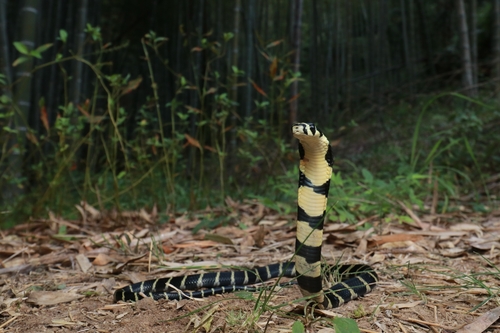
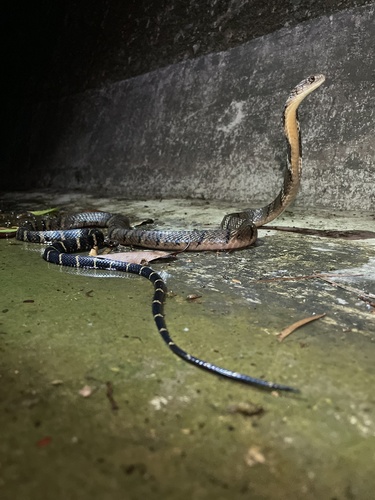
- Colour: jet black with bright yellow or white crossbands, fading with age
- Venom: as potent as that of adults
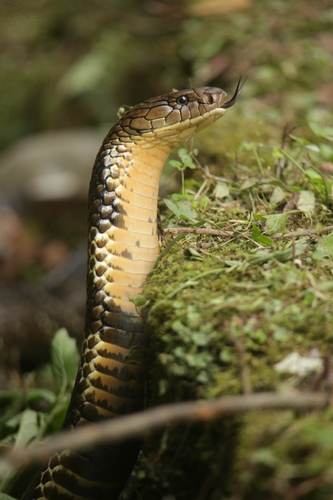
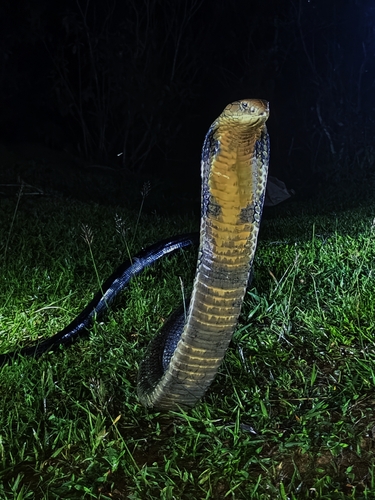
Adult king cobras are olive-green, yellowish-brown, or nearly black depending on subspecies and region. Juveniles carry bold banded patterns that gradually fade as the animal matures. The belly is cream or pale yellow. The hood is narrower and more elongated than that of a true Naja cobra and lacks the distinctive spectacle or monocle markings seen on Indian and Chinese cobras. The head carries a pair of large occipital scales on top.
The body is slender relative to total length, built for active hunting rather than ambush. King cobras are strong climbers and competent swimmers.
Range and Habitat
King cobras occupy one of the largest geographic ranges of any elapid. They are found from the foothills of the Himalayas through most of South and Southeast Asia.
Countries with confirmed populations:
- India (Western Ghats, Eastern Ghats, north-east India)
- Nepal and Bhutan (low-elevation forests)
- Bangladesh (including the Sundarbans)
- Myanmar, Thailand, Laos, Cambodia, Vietnam
- Southern China
- Malaysia (peninsular and East Malaysia)
- The Philippines
- Indonesia
Preferred habitat types:
- Dense evergreen and deciduous tropical forest
- Mangrove swamps and estuarine forest edges
- Bamboo thickets
- Tea, rubber and coffee plantations adjacent to forest
- Stream and river corridors within otherwise dry landscapes
King cobras require cover, water and a concentrated prey base of other snakes. They steer clear of open agricultural land, cities and dry scrub. The snakes are primarily diurnal, although they have been spotted at night on occasion.
Diet and Hunting
The king cobra is the most specialised ophidiophage among all snakes. The scientific name says it plainly: Ophiophagus means snake-eater, and snakes are what it eats.
Documented prey species:
- Rat snakes ( Ptyas spp.)
- Indian cobra ( Naja naja )
- Banded krait ( Bungarus fasciatus )
- Reticulated python ( Malayopython reticulatus )
- Keelbacks and water snakes ( Natricidae )
- Vine snakes ( Ahaetulla )
- Monitor lizards (occasionally)
- Birds and other small vertebrates (when food is scarce)
Snakes are its main prey, lizards and rodents are occasional prey. Its venom consists primarily of three-finger toxins and snake venom metalloproteinases.
Hunting sequence:
- Long-range prey detection by scent, using the forked tongue and Jacobson's organ
- Visual confirmation once within a few metres
- A fast forward strike that pins the prey snake mid-body
- Envenomation: the king cobra grips and chews, working its short fixed fangs deeper
- Prey is swallowed whole once immobilised
After a large meal, a king cobra may go for many months without another one because of its slow metabolic rate.
Venom
King cobra venom is primarily a neurotoxic cocktail designed to shut down the neuromuscular system of prey. It differs significantly from the cytotoxic venoms of most true cobras.
Major components:
- Alpha-neurotoxins: block acetylcholine receptors post-synaptically, causing flaccid paralysis
- Cardiotoxins: damage myocardial tissue directly
- Ophiophagus-specific three-finger toxins: effective against snake prey
Venom statistics:
| Metric | Value |
|---|---|
| Yield per bite | Up to 420 mg dry (400-600 mg overall) |
| LD50 (mouse, subcutaneous) | 1.5 to 1.7 mg/kg |
| Venom collected by milking (research) | Up to 1 g |
| Fastest time to death (human, untreated) | As little as 30 minutes |
| LD50 (mouse, intravenous) | 1.28 mg/kg |
A king cobra can deliver an immense venom yield in a single bite, and untreated envenomation can be fatal within as little as 30 minutes.
King cobras remain reluctant to bite. The species is not aggressive by nature and normally avoids humans, with encounters happening only when an individual is cornered or exposured by chance.
The Growl, the Hood, and the Threat Display
Most snakes hiss when threatened. King cobras growl. Acoustic recordings show a low-frequency vocal signature centred around 600 Hz, far below the dominant frequency near 7,500 Hz of most snake hisses, and the growl consists solely of frequencies below 2,500 Hz.
The growl is produced through enlarged diverticular pouches branching off the trachea that act as resonance chambers, amplifying and deepening the airflow. The pitch is much closer to that of a human voice than to a typical snake hiss.
The full threat display is unmistakable.
Sequence of a king cobra threat display:
- The snake lifts the front part of its body off the ground
- The long narrow hood flares, powered by elongated ribs beneath the neck
- The growl begins, often preceding any visible movement
- With its head tracking the target, the snake can continue to move the rest of its body forward.
- If the threat does not retreat, short feints and bluff strikes may follow
- Only after those fail does the snake deliver a bite
The ability to remain upright and mobile is unusual. Most cobras that rear up must anchor the rest of their body in place. A king cobra can continue to move forward during the display, and can strike at long range.
Reproduction and the Snake That Builds a Nest
Among all snakes on Earth, only the king cobra builds a nest. This singular behaviour distinguishes the species from the thousands of other serpents that simply lay eggs or give live birth.
Breeding timeline:
- Late March to late May: the female builds the nest from dry leaf litter
The female gathers dry leaf litter into a layered mound, up to about 55 cm high and 140 cm wide at the base, usually at the base of a tree. The eggs are laid in a chamber within the mound.
Clutch and incubation:
- Eggs per clutch: 7-43
- Incubation: 66-105 days
- Nest temperature: varies with elevation, from 13.5 to 37.4 degrees Celsius
She aggressively defends the nest and rapidly attacks intruders.
Females stay by their nests for between two and 77 days.
Hatchlings are between 37.5 and 58.5 cm long, boldly banded and fully venomous. Their venom is as potent as that of adults.
Conservation Status and Threats
The IUCN Red List classifies the king cobra as Vulnerable with a decreasing population trend. It has been listed as Vulnerable since 2010.
Primary threats:
- Habitat loss. The most significant pressure across the entire range. Tropical forest conversion to palm oil, rubber, coffee and tea plantations destroys both cover and the snake prey base on which king cobras depend.
- Snake-charmer trade. Illegal across most of India but persistent at village and tourist levels. Fangs are often crudely removed or mouths sewn shut.
- Skin trade. King cobra hide is used in leather goods, particularly in Southeast Asia. International trade is restricted under CITES Appendix II.
- Fear-based killing. Villagers in several range states routinely kill king cobras on sight, despite the species' low propensity to bite humans.
Conservation measures:
- Schedule II of the Wildlife Protection Act 1972 classifies the species, and killing becomes a criminal offence as a result.
- CITES Appendix II restricts international trade.
No quantitative global population estimate is currently available. The species is cryptic, secretive and occupies very large individual home ranges, making any census extremely difficult.
King Cobras and Humans
Few animals carry as much cultural weight across as many cultures as the king cobra. In Hindu mythology the cobra, specifically the nagaraja, king of serpents, is associated with Shiva, who wears one around his neck and with Vishnu, who rests upon the multi-headed serpent Shesha. The Naga deities in Hindu and Buddhist traditions are frequently depicted with the hood of a king cobra.
In Thailand and Myanmar the species is revered and associated with guardian spirits.
Snake charming with king cobras remains a highly visible, and controversial, practice across India and parts of Southeast Asia despite being officially illegal in most range states. The charmers typically remove fangs or sew the snake's mouth, which shortens the animal's life dramatically.
Medical consequences of king cobra envenomation remain serious. Without prompt treatment, death can occur in as little as 30 minutes, and polyvalent antivenom must be given as soon as possible.
Despite all of this, documented unprovoked king cobra attacks on humans are extremely rare relative to the species' range and prey abundance. The overwhelming majority of human encounters end with the snake retreating. Bites typically follow accidental contact, attempted handling, or nest defence.
Frequently asked questions
Adult king cobras (Ophiophagus hannah) typically measure 3.18 to 4 metres in length. The longest known individual measured 5.85 m. Males are larger than females: males captured in Kerala measured up to 3.75 m and weighed up to 10 kg. Hatchlings emerge at 37.5 to 58.5 cm and are already fully venomous. The king cobra is the world’s longest venomous snake.
King cobras feed chiefly on other snakes. Recorded prey includes Indian cobras (Naja naja), banded kraits, rat snakes, reticulated pythons and keelbacks. They also take monitor lizards and other lizards, and when food is scarce other small vertebrates such as birds. After a large meal a king cobra may go for many months without another one because of its slow metabolic rate. The genus name Ophiophagus means ‘snake-eater’.
King cobras occur across South and Southeast Asia, from the Terai of India and southern Nepal through Bhutan, north-east India, Bangladesh, Myanmar, southern China, Cambodia, Thailand, Laos and Vietnam to Malaysia, Singapore, Indonesia and the Philippines. They prefer dense tropical forest, bamboo thickets, mangrove swamps and plantations near forest, where water and prey snakes are available. A 2024 taxonomic revision recognised four species in the complex: the Western Ghats king cobra, the northern king cobra, the Sunda king cobra and the Luzon king cobra.
A king cobra can deliver up to 420 mg of venom (dry weight) per bite, or 400 to 600 mg overall. The venom consists primarily of three-finger toxins, with alpha-neurotoxins the predominant and most lethal components, along with cytotoxins and cardiotoxins. Without treatment, death from respiratory failure can occur in as little as 30 minutes, so prompt antivenom is critical. Despite this, king cobras are not considered aggressive and usually avoid humans. Most encounters happen when an individual is cornered or inadvertently exposed.
Yes. The king cobra is the only snake known to build a nest from dry leaf litter, starting from late March to late May. Most nests are at the base of trees, up to about 55 cm high and 140 cm wide at the base, and consist of several layers. Clutches range from 7 to 43 eggs, with incubation periods of 66 to 105 days. The female stays by the nest for between two and 77 days and defends it aggressively.
The IUCN Red List has classified the king cobra as Vulnerable since 2010. Habitat destruction from deforestation and agricultural expansion is the main threat. Other threats include poaching, the snake-charmer trade, the skin trade and killing out of fear. It is listed in CITES Appendix II, and India protects it under Schedule II of the Wildlife Protection Act 1972.
Instead of a typical hiss, the king cobra produces a low-pitched growl. Its warning tone sits at around 600 Hz and contains only frequencies below 2,500 Hz, whereas most snake hisses cover roughly 3,000 to 13,000 Hz with a peak near 7,500 Hz. Tracheal diverticula, low-frequency resonating chambers, assist in producing this growl. One of its prey species, the rat snake, also has these structures and can generate a comparable growl.
References
- Das, I.; Shankar, P. G.; Swamy, P.; Williams, R. C.; Lalremsanga, H. T.; et al. (2024). Taxonomic revision of the king cobra Ophiophagus hannah (Cantor, 1836) species complex (Reptilia: Serpentes: Elapidae), with the description of two new species. European Journal of Taxonomy 961: 1-51. View source
- Stuart, B.; Wogan, G.; Grismer, L.; et al. (2012). Ophiophagus hannah. IUCN Red List of Threatened Species. View source
- King cobra. Wikipedia. View source