Gharial: Fewer Than 650 Breeding Adults
Gavialis gangeticusGharial eggs average about 160 grams, the largest of any crocodilian, and males start growing the pot-shaped ghara on the snout at about 11.5 years old.
 Strange Animals EditorialFebruary 25, 2025·13 min read·Editorial standards ↗
The gharial is the strangest crocodilian alive. Everything about it, the needle-thin snout, the pot-shaped growth on the male's nose, the belly-slide locomotion, the fish-only diet, sets it apart from every other member of Crocodilia. Gavialis gangeticus is the only living member of its genus, Gavialis, in the family Gavialidae and the only crocodilian whose adults cannot walk with the body raised off the ground on land.
It is also one of the most endangered reptiles on the planet, with fewer than 650 breeding adults clinging on in a handful of north Indian rivers.
This guide covers every aspect of gharial biology and conservation: taxonomy, the peculiar male ghara, the jaw and teeth, hunting and diet, reproduction, locomotion, habitat, population collapse and the coordinated effort to pull the species back from the edge.
Etymology and Classification
The name gharial comes from the Hindi word ghara , meaning a round earthenware pot. It refers not to the animal's body shape but to the bulbous cartilage growth that develops on the snout tip of mature males. Early naturalists documenting the animal along the Ganges noticed this feature immediately, and the Hindi name stuck in English, French and scientific usage worldwide.
The scientific name Gavialis gangeticus was first named by Gmelin in 1789 as Lacerta gangetica . The genus Gavialis was proposed by Oppel in 1811, and gangeticus refers to the Ganges. Older literature sometimes uses 'gavial'. Modern usage in conservation and taxonomy strongly prefers 'gharial'.
Taxonomically, the gharial sits in the crocodilian family Gavialidae, together with the false gharial. Molecular work over the last twenty years has complicated the older view that Gavialidae was a peripheral branch far from true crocodiles. Current phylogenetic analyses place gharials and the false gharial ( Tomistoma schlegelii ) together as sister taxa, and then close to rather than distant from Crocodylidae.
Regardless of the exact tree, Gavialis gangeticus is the only living member of its genus and a relic of a much richer family that extends back tens of millions of years in the fossil record.
Size and Physical Description
Adult gharials are among the largest living crocodilians by length, though not by body mass. Their extremely elongated build makes them look long even when they are not particularly heavy.
Males:
- Length: 3-6 metres
- Weight: about 160 kg on average, with large males reaching 600-750 kg
- Ghara: prominent pot-shaped growth on snout tip, begins to grow at about 11.5 years of age
- Snout: extremely elongated, narrow, almost tubular
Females:
- Length: 2.6-4.5 metres
- Snout: elongated and narrow like the male but less massive at the base
- No ghara
Hatchlings:
- Length: 34-39 cm
- Weight: 82-130 grams
- Proportionally long-snouted from the moment they hatch
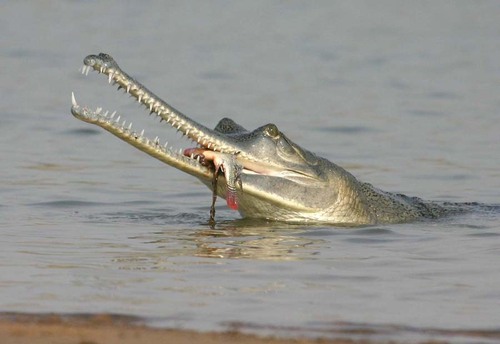
The most distinctive physical feature of the species is the snout. In an adult gharial the snout is about 3.5 times longer than the width of the skull's base, a proportion that looks almost pathological compared to a robust crocodile skull. This elongation is an adaptation for catching fish.
A narrow snout moves through water with minimal drag and can be swept sideways through a fish school at speed. A broader skull would create turbulence that would warn prey.
The teeth match the snout. Adult gharials carry about 110 teeth, arranged as a series of interlocking needles that mesh when the jaws close. Each tooth is sharp, slightly recurved and designed to puncture and grip rather than cut.
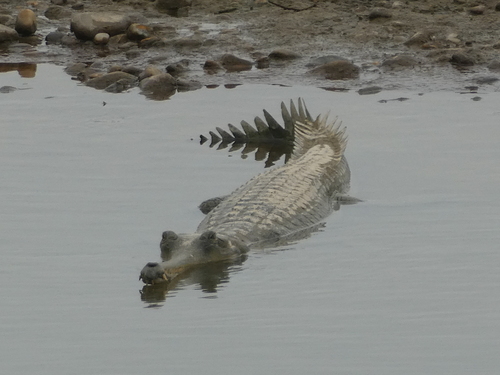
The body behind this extraordinary head is relatively conventional: armoured dorsal scutes, a powerful laterally compressed tail for swimming, and four comparatively slender legs. Coloration is dark olive on the back, pale cream on the belly, often with irregular darker cross-bands on the tail. Juveniles are considerably more patterned than adults and progressively lose their markings as they mature.
The Ghara and Sexual Display
The ghara is the single most unusual piece of anatomy in the gharial and one of the more unusual in all of Crocodilia. It is a bulbous hollow cartilage boss that forms over the nasal opening at the tip of the male's snout, growing gradually from about 11.5 years of age until it resembles an upturned pot sitting on the nose.
Functions of the ghara:
- Acoustic amplifier. The male produces underwater hisses through his nostrils, and the ghara acts as a resonator that turns those hisses into the distinctive buzzing pop characteristic of territorial and mating displays.
- Bubble display. Males construct this visual display during courtship by exhaling through the ghara to create strings of bubbles that rise in a visible column, an visual element that combines with acoustic signalling.
- Visual rank signal. A large ghara advertises that the male has survived long enough and grown well enough to reach full sexual maturity.
- Species recognition. Because no other crocodilian develops this structure, it serves additionally as an unambiguous marker of species identity.
The ghara does not appear in females, juveniles, or sub-adult males. It is one of the clearest secondary sexual characters in any reptile. The ghara starts growing at about 11.5 years, and males mature at 15-18 years of age, once it is developed.
Built for Fish
Everything behind the ghara is optimised for catching, gripping and swallowing fish. The gharial is among the most specialised predators in Crocodilia and among the narrowest dietary specialists of any large reptile.
Fish-catching adaptations:
- Narrow tubular snout: low drag for fast sideways sweeps through water
- About 110 interlocking needle teeth: high-grip surface for slippery prey
- Laterally compressed, powerful tail: rapid underwater bursts
- Webbed hind feet: fine steering during strikes
- Dome pressure receptors on jaws: detect vibration of nearby fish
Hunting behaviour:
- Ambush in deep river pools with the mouth held partly open underwater. Fish swimming past are seized by a sideways snap of the head.
- Active pursuit in shallow riffles, where the gharial sweeps its jaws laterally through the water to strike passing fish.
Prey gets swallowed whole and head-first. The snout is not built for dismembering large animals. Juveniles eat insects, tadpoles, small fish and frogs, adults feed on larger fish and small crustaceans.
This dietary narrowness is both an evolutionary success and a conservation vulnerability. A gharial thrives where a river has abundant fish and suffers immediately if overfishing, pollution, or river regulation reduces the fish community.
Locomotion: The Crocodilian That Cannot Walk
One of the strangest and most famous traits of the gharial is its inability to walk on land. Every other living crocodilian, alligators, caimans, true crocodiles, the false gharial, can perform a high walk with the belly lifted clear of the ground. Adult gharials cannot. Their legs are too narrow and laterally positioned to support their body mass out of water.
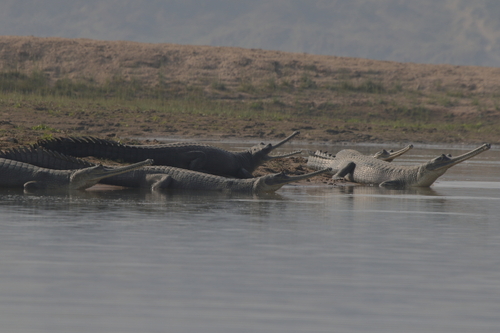
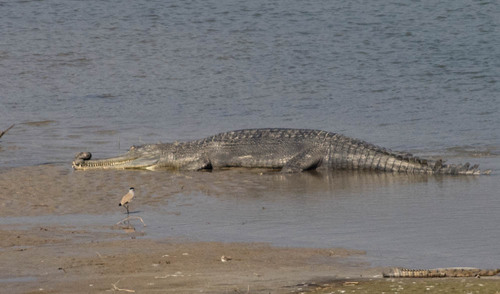
Instead, adults move on land by belly-sliding: the body remains flat on the ground, the hind legs push rearward and outward and the tail provides additional propulsion. It is slow, awkward and energy-expensive. Gharials leave the water only for basking and nesting, which is why the species depends on gently sloping sandbanks close to the water.
In the water, by contrast, the gharial is a strong and graceful swimmer. The laterally compressed tail drives the animal forward with minimal effort, the webbed hind feet steer and the narrow snout produces almost no drag. Gharials can accelerate sharply from rest, sustain strong cruising speeds and manoeuvre precisely enough to strike fish with a sideways snap.
The trade-off is clear: gavialid evolution has specialised so heavily for aquatic life that terrestrial mobility has been sacrificed. In a river with intact banks and undisturbed pools, this is a perfectly workable design. In a modern river fragmented by dams, mined for sand and crowded with fishing nets, it becomes a liability.
Life Cycle and Reproduction
Gharial reproduction synchronizes to a seasonal schedule that depends on the Indian monsoon cycle.
Annual reproductive timing:
- Mid-February: courtship and mating begin at the end of the cold season
- Late March to early April: females lay eggs in nests dug into sandbanks
- April to July: incubation of 71-93 days
- July: hatching just before the onset of the monsoon
Females lay 20-95 eggs per clutch. The eggs are the largest of any crocodilian, averaging about 160 grams and are buried in sand nests 20-55 cm deep. Females guard the nests and the young.
Sex in gharials is most likely determined by nest temperature , as in most reptiles.
Hatching is spectacular. When young gharials are ready to emerge they chirp from inside the eggs, and the female digs the nest open, but she does not help them reach the water.
Hatchlings stay near the nesting sites until the monsoon floods arrive. In captivity, a male gharial was once observed carrying hatchlings on his back with the female's tolerance.
Young gharials hide and forage in shallow water during their first year, reaching 80-116 cm in two years and 130-158 cm in three. Females mature at a body length of about 2.6 m, males mature at 15-18 years of age, once the ghara is developed.
Habitat and Range
The gharial is endemic to the northern Indian subcontinent and requires a very specific combination of habitat features.
Habitat requirements:
- Deep, clear, fast-flowing freshwater rivers
- Sandy, gently sloping banks for nesting
- Adjacent basking beaches with direct water access
- Abundant fish populations
- Minimal boat traffic and entanglement risk
Historical range:
Across the 19th and early 20th centuries the gharial occurred throughout the Indus, Ganges, Brahmaputra, Mahanadi and Irrawaddy river systems in what are now Pakistan, India, Nepal, Bhutan, Bangladesh and Myanmar. Population estimates from the 1940s placed wild numbers between 5,000 and 10,000 animals.
Current range:
| River system | Country | Status |
|---|---|---|
| Chambal River | India | Stronghold: largest wild population |
| Girwa River | India | Small breeding population |
| Gandak River | India | Reintroduced, recovering |
| Son River | India | Small population |
| Rapti / Narayani | Nepal | Small breeding population in Chitwan |
| Mahanadi | India | Near extirpation |
| Brahmaputra | India | Sporadic sightings only |
| Indus | Pakistan | Functionally extinct |
| Irrawaddy | Myanmar | Functionally extinct |
The National Chambal Sanctuary, a protected stretch of the Chambal River along the borders of Madhya Pradesh, Rajasthan and Uttar Pradesh, holds the largest wild gharial population and is the single most important piece of gharial habitat on Earth.
Population Collapse and Conservation
Few large vertebrates have declined as sharply and as quickly as the gharial.
Drivers of decline:
- Hunting. Gharials were killed by fishermen and hunted for skins, trophies and indigenous medicine and their eggs were collected for consumption. Hunting is no longer considered a significant threat.
- Sand mining. Large-scale commercial removal of sand from riverbanks destroys nesting habitat directly. Sand mining remains a continuing threat.
- Dams and river regulation. Dams fragment populations, alter seasonal flow regimes, flood nesting banks at the wrong times and block fish migrations that support prey populations.
- Fishing net entanglement. Monofilament nylon gill nets are extremely efficient at trapping and drowning gharials. Increased use of gill nets in gharial habitat is a major reason for the recent decline.
- Pollution. Heavy metals, pesticides and sewage concentrate along the Indian rivers that gharials need, reducing fish populations and directly harming animals.
From estimated mid-20th-century populations of 5,000-10,000, numbers collapsed to fewer than 200 animals across the entire range by 1976. The IUCN has classified the species as Critically Endangered since 2007, and its 2019 assessment put wild mature adults at roughly 650 individuals.
Conservation response:
- National Chambal Sanctuary. A coordinated tri-state protected area covering the most important stretch of gharial habitat remaining.
- Captive breeding and head-starting. Facilities including the Kukrail Gharial Rehabilitation Centre collect eggs, incubate them, and rear hatchlings in captivity for two to three years before releasing head-started juveniles of about one metre back to the wild. More than 5,000 gharials were released into Indian rivers between the early 1980s and 2006, though releases have not contributed significantly to re-establishing viable populations.
- Gharial Conservation Alliance. A network of scientists, sanctuary managers and NGOs coordinating research, monitoring and recovery policy across range countries.
- CITES Appendix I. International trade in gharials and their parts is banned.
- Chitwan National Park reintroductions (Nepal). Captive-bred gharials have been released into the Rapti and Narayani rivers inside Chitwan, producing Nepal's small but reproducing population.
Despite decades of work, wild recruitment, the number of hatchlings that survive to breeding age without human intervention, remains fragile. Releases continue, but long-term recovery depends on controlling sand mining, removing illegal fishing nets and maintaining ecologically functional river flows.
Gharials and Humans
Gharials and human communities share the same rivers, and unlike Nile or saltwater crocodiles, gharials do not pose a threat to people. The species has never been credibly linked to predation on humans. The narrow snout and needle teeth cannot hold or dismember a mammal, and the animal lacks the aggression that marks many large crocodilians. Swimmers and fishers in Chambal villages coexist with the species in a way that would be impossible with Crocodylus niloticus or Crocodylus porosus .
This is part of what makes the gharial's decline so poignant. One of the largest crocodilians alive is also one of the least dangerous, and still a concerted combination of hunting, sand mining, fishing pressure and dam construction has pushed it within arm's reach of extinction.
In Hindu cosmology the gharial is a minor but enduring figure, sometimes identified with the mount of the goddess Ganga. Members of the Crocodile Specialist Group have recommended greater engagement of local communities in gharial conservation programmes.
Illustration.
Frequently asked questions
Adult males measure about 3-6 metres and females about 2.6-4.5 metres. Males average around 160 kg, though large males can reach 600-750 kg. A 6.55 m gharial was claimed to have been killed in 1920, but no reliable measurements were taken. Males outgrow females and continue developing the bulbous ghara on the snout tip as they mature.
Hatchlings emerge at roughly 34-39 cm and 82-130 grams. Females mature at a body length of about 2.6 m, while males mature at 15-18 years of age, once the ghara is developed.
The ghara is a bulbous, hollow growth at the tip of the snout in mature male gharials. Its name comes from the Hindi word for ‘pot’, because the shape resembles a round earthenware vessel, and it gives the species its common name.
It acts as a resonator that amplifies the male’s hissing and buzzing sounds, which are used in the breeding season. It also indicates sexual maturity. Only males develop it, starting at about 11.5 years of age. Females, juveniles and sub-adult males lack the ghara entirely.
Gharials are among the most specialised predators in the Crocodilia. Adults feed mainly on fish, and their anatomy is built around fish catching. The extremely long, narrow snout meets little resistance in the water and can be swept sideways at speed. The roughly 110 interlocking needle teeth mesh into a trap that grips slippery, wriggling prey without crushing it.
Hunting is often ambush-based: the gharial waits in a pool with its jaws open underwater and snaps shut sideways when a fish passes. Young gharials take insects, tadpoles, frogs and small fish. The slender jaws are not built to dismember large prey.
The gharial is endemic to the rivers of the northern Indian subcontinent. It requires deep, clear, fast-flowing freshwater with sandy banks for nesting and basking. Historically the species occupied the Indus, Ganges, Brahmaputra, Mahanadi and Irrawaddy river systems across Pakistan, India, Nepal, Bangladesh, Bhutan and Myanmar.
Today wild breeding populations survive in only a handful of rivers: the Chambal (the global stronghold), the Girwa, the Son, the Gandak and the Rapti. The National Chambal Sanctuary protects the largest remaining population. Reintroduction efforts continue in Nepal and parts of India, but most former range has been lost to habitat destruction, sand mining and fishing pressure.
Unlike other crocodilians, adult gharials cannot walk with the body raised off the ground. Their limbs are short, slender and positioned laterally, suited to steering in fast river currents rather than to locomotion on land. When an adult gharial leaves the water to bask or nest, it must belly-slide across the sand.
This is why gharials choose nesting sites on gently sloping sandbanks close to the water. They leave the water only for basking and nesting.
Gharials are essentially harmless to humans. Their narrow, fish-specialised jaws cannot gain traction on a mammalian body, and their teeth are designed to grip small, slippery prey rather than shear large muscle tissue. The species coexists with riverside communities along the Chambal and Girwa. The belief that gharials eat humans may stem from jewellery found in some gharial stomachs.
The irony of gharial conservation is considerable: one of the largest crocodilians on Earth is also one of the least dangerous and has still been hunted close to extinction.
Courtship and mating begin in mid-February, at the end of the cold season. Adult males make loud underwater sounds, amplified by the ghara. Between late March and early April, females lay 20-95 eggs, the largest eggs of any crocodilian, in nests 20-55 cm deep dug into sandbanks.
Incubation lasts 71-93 days, and sex is most likely determined by nest temperature, as in most reptiles. Young gharials hatch in July, just before the monsoon. The female digs up the hatchlings in response to their chirps, but she does not help them reach the water. Hatchlings stay near the nesting sites until the monsoon floods arrive.
In captivity, a male gharial has been observed carrying hatchlings on his back with the female’s tolerance.
The IUCN Red List classifies Gavialis gangeticus as Critically Endangered, the last category before Extinct in the Wild. The species is also listed on CITES Appendix I, banning international commercial trade. The 2019 IUCN assessment put wild mature adults at around 650 individuals. The population is estimated to have declined by 96-98% between 1946 and 2006.
Core drivers of decline are habitat loss (dams, river regulation, fragmentation), sand mining, entanglement in fishing gill nets, pollution, and historical hunting for skins, trophies and indigenous medicine.
Captive breeding, head-starting, and reintroduction programmes in India and Nepal have released more than 5,000 gharials since the early 1980s, though releases have not contributed significantly to re-establishing viable populations.
References
- Relevant peer-reviewed and governmental sources consulted for this entry include the IUCN Crocodile Specialist Group Gharial Status Review (most recent assessment), publications by the Gharial Conservation Alliance, survey reports from the National Chambal Sanctuary authorities, Madras Crocodile Bank Trust technical reports, and peer-reviewed work in Herpetological Journal, Oryx, Conservation Biology, and Journal of Threatened Taxa.
- Population figures reflect the most recent consolidated counts from Indian and Nepali range-state authorities and associated non-governmental monitoring partners.
- View source
- View source