Beluga Whale: Why It's the Canary of the Sea
Delphinapterus leucasBelugas share their family only with the narwhal, and a beluga-narwhal hybrid has been confirmed from a Greenland skull. Calves nurse into a second winter.
 Strange Animals EditorialFebruary 23, 2025·14 min read·Editorial standards ↗
The beluga whale is the chatterbox of the Arctic. No other whale is so vocal, so facially expressive, so pale against the ice, or so tolerant of human contact.
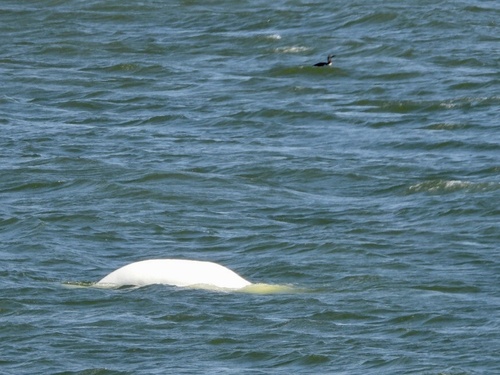
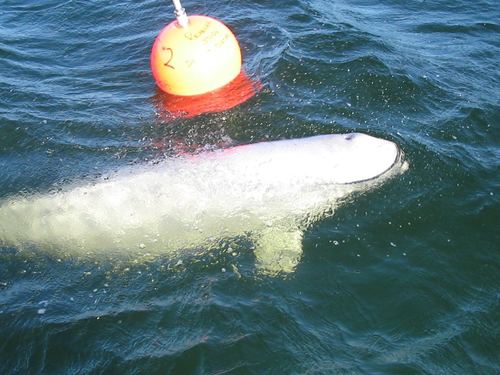
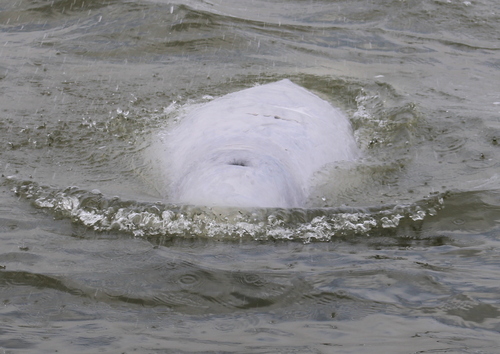
Delphinapterus leucas is a mid-sized toothed whale, roughly three to five and a half metres long, that has evolved to live on the sea-ice edge: circumpolar, gregarious and instantly recognisable by its bulbous forehead, stubby beak and pure white adult skin. It is one of only two living members of the family Monodontidae, sharing the group with the narwhal.
This guide covers every major dimension of beluga biology and ecology: anatomy, vocalisation, diet, migration, reproduction, social life, conservation status and the strange edges of the species' story, from the talking beluga NOC to the narluga hybrid skull to the crashing Cook Inlet population.
Etymology and Classification
The species was formally described by Peter Simon Pallas in 1776 and named Delphinapterus leucas , literally 'dolphin without a wing' (no dorsal fin) with a Greek species epithet meaning 'white'. The common name 'beluga' comes from the Russian belukha , itself derived from belyy: 'white'.
Confusingly, the name is shared with the beluga sturgeon, a huge Caspian fish famous for caviar, which is an entirely unrelated animal. The Russian name has long been used for the whale.
Within the infraorder Cetacea, belugas belong to the parvorder Odontoceti, the toothed whales and to the small family Monodontidae which contains only two living species: the beluga and the narwhal ( Monodon monoceros ). The two species are close enough that a confirmed first-generation hybrid has been identified from a skull collected in Greenland.
The full taxonomy runs: Animalia, Chordata, Mammalia, Artiodactyla, Cetacea, Monodontidae, Delphinapterus , D. leucas . No subspecies are currently recognised, although distinct subpopulations differ in size, migration, genetics and contaminant burden strongly enough that several are managed as separate conservation units.
Size and Physical Description
Belugas are mid-sized among toothed whales, smaller than an orca, larger than a bottlenose dolphin. Adults show moderate sexual dimorphism, with males about a quarter larger and heavier than females.
Males:
- Length: 3.5-5.5 metres
- Weight: typically 1,100-1,600 kg
- Reaches maximum size by about age 10
Females:
- Length: 3.0-4.1 metres
- Weight: 700-1,200 kg
- Reaches maximum size by about age 10
Calves at birth:
- Length: about 1.5 metres
- Weight: about 80 kg
- Colour: grey, turning dark grey or blue-grey within a month
The body is torpedo-shaped but stockier than most dolphins, with a short neck, small rounded flippers and no dorsal fin. In place of a fin the beluga carries a tough dorsal ridge that runs along the back. Adults are white or whitish-grey. Calves are born dark and slowly pale through childhood, passing through blue-grey, slate, dirty cream and finally ivory white by ages seven to nine.
The head is the species' signature feature. A large, bulbous 'melon' sits on the forehead above a short beak, giving the animal its distinctive 'cartoon whale' silhouette. The melon is filled with specialised lipid tissue and acts as an acoustic lens, focusing and steering the whale's echolocation clicks.
Unusually among cetaceans, the melon is soft enough that it visibly deforms during vocalisation: bulging, pumping, flattening and compressing in real time as the whale directs its sound beam. Trained observers can sometimes guess what kind of call is coming next from the shape changes alone.
Uniquely among almost all living whales and dolphins, the beluga has unfused cervical vertebrae. The seven neck bones are separate rather than welded into a single immobile block, which gives the animal enough neck flexibility to turn its head sideways without rotating the body, and to nod. Combined with the flexible lips and a rare ability to make facial movements, this produces the strikingly expressive face that has made belugas popular in aquariums.
Coat, Skin and Moulting
Beluga skin is unusually fragile at the surface. Every summer the outer layer yellows, cracks and has to be physically removed, a process called epidermal moulting . Belugas handle this by congregating in shallow, warmer river estuaries and rubbing themselves against the gravel bottom.
The moulting aggregations are among the most spectacular wildlife gatherings in the Arctic. Sites like Cunningham Inlet on Somerset Island, the Churchill River Estuary in Manitoba and the mouth of the Mackenzie can hold thousands of whales at a time, adults rolling in the shallows and calves learning the behaviour.
Metabolism speeds up and the skin begins to renew itself while time is spent in the warmer estuary water.
Built for the Ice Edge
Belugas live through Arctic winters without migrating south. Their adaptations are different from those of the big baleen whales (which fatten up and leave) and different again from bowheads (which stay and break ice with their skulls).
Ice adaptations:
- No catch hazard under ice instead of a dorsal fin, and this design can break thin ice from below.
- Flexible neck: essential for navigating narrow breathing leads
- Tough forehead skin: protects the skull during ice breaking
- High fat content: 40 per cent or more of total body mass
- White adult colour: camouflage against sea ice from below and above
Thermal regulation:
- Blubber layer up to 15 centimetres thick on the body
- Counter-current blood flow in flukes and flippers
- Highly compressible rib cage, allowing deep dives without injury
- Ability to reduce peripheral circulation during long surface-interval exposures
Belugas use echolocation to find breathing holes under sheet ice. Mass ice entrapments do occur, when freeze-up traps pods in shrinking polynyas.
The Canary of the Sea
Beluga vocalisation is the feature that separates them from nearly every other whale. Belugas communicate with high-pitched sounds that can resemble bird song, which earned them the nickname canary of the sea .
Beluga sounds include:
- Echolocation clicks for finding prey and navigating under ice
- Whistles
- Trills, cackles and squawks
A 2015 study found that the sounds of European belugas were stable through time but varied between geographical locations.
The single most famous beluga vocalisation is also the strangest. In 1984 a young male beluga named NOC, held at the US National Marine Mammal Foundation in San Diego, began producing rhythmic, low-pitched sounds that closely resembled human speech. Staff repeatedly assumed a person was talking in the pool.
In 2012, Current Biology published formal analysis showing NOC had lowered his vocal frequency several octaves beneath the normal beluga range to align with human speech frequencies, apparently through changes to his nasal vocal mechanics and inflation of a vestibular sac. Around the time he reached sexual maturity, this behavior ceased approximately four years later.
Hunting and Diet
Belugas are flexible generalist carnivores. They eat whatever is locally abundant, and their diet shifts dramatically with season, region and life stage.
Main prey categories:
- Schooling fish in the Arctic include Arctic cod, capelin, herring, salmon, smelt and sand lance.
- Cephalopods: squid and octopus
- Benthic invertebrates: shrimp, crabs, marine worms
- Occasional: sculpins, flatfish, lampreys
A typical adult eats 18 to 27 kilograms per day. Hunting usually happens in coordinated groups: belugas herd fish against ice edges, shallow shelves or riverbanks, then pick them off individually. In open water they echolocate for prey and dive to catch it, routine dives are around 20 metres deep, with maximum recorded dives past 900 metres, and dives can last over 20 minutes.
Despite having teeth (about 40 peg-like ones arranged in a single row per jaw) belugas rarely chew. They suction-feed, using a rapid expansion of the throat to vacuum prey in. The protrusible lips form a tight seal that makes this efficient. Young calves nurse for around 20 months on milk that is approximately 28 per cent fat.
Life Cycle and Reproduction
Beluga reproduction is slow by mammalian standards, more typical of long-lived primates than of smaller dolphins.
Reproductive timeline:
- Sexual maturity: females 8-14 years, males 9-15 years
- Mating season: late winter to early spring (February-May)
- Gestation: about 12-14.5 months
- Birth season: March to September in the Canadian Arctic, peaking in late June in Hudson Bay
- Lactation: about 20 months, sometimes over two years
- Inter-birth interval: about 3 years
Females give birth in warm, shallow estuarine water. Calves often return to the same estuary as their mother in later summers. Newborns are grey, about 1.5 metres long, and already capable of swimming alongside the mother. The calf nurses through its first long winter and often through a second.
Calves gradually pale with age. Calves are grey at birth and turn dark grey or blue-grey within a month, before gradually losing pigment. They reach adult white at about seven years in females and nine in males.
Movement, Range, and Migration
Belugas undertake some of the best-documented long-distance migrations of any cetacean. Some populations travel as far as 6,000 kilometres per year. The general pattern is: summer in shallow, warm estuarine water for moulting and calving, autumn dispersal into offshore pack ice, winter along the pack ice edge using polynyas and leads, spring return to the summer estuaries.
| Metric | Value |
|---|---|
| Cruising swim speed | 3-9 km/h |
| Burst swim speed | up to 22 km/h |
| Typical dive depth | ~20 m |
| Maximum recorded dive | 900+ m |
| Maximum recorded dive time | 20+ minutes |
| Annual migration distance | up to 6,000+ km |
Some populations are sedentary and do not migrate over great distances during the year.
The Cook Inlet belugas of Alaska do not migrate at all, instead shifting seasonally within the same shallow, silty, semi-enclosed body of water. The Saint Lawrence population similarly stays year-round in the lower river estuary and adjacent gulf waters.
Belugas can also swim backwards, a rare trick among cetaceans and use the ability to negotiate tight ice leads, river channels and shallow flats where turning around is impossible.
Populations and Subpopulations
Belugas are divided into distinct subpopulations, and the worldwide population is thought to number around 200,000.
| Region | Population estimate | Status |
|---|---|---|
| Saint Lawrence Estuary | Small | Endangered (COSEWIC) |
| Cook Inlet (Alaska) | Small | Critically Endangered (IUCN) |
The Cook Inlet crisis is the most urgent regional concern. The Cook Inlet subpopulation is considered critically endangered and is protected under the United States Endangered Species Act.
Proposed causes include shipping noise, oil and gas activity, reduced salmon runs and contaminants from the heavily urbanised Anchorage region at the head of the inlet.
Conservation Status and Threats
The species as a whole is listed as Least Concern by the IUCN. This classification hides local problems. The Cook Inlet subpopulation is considered critically endangered, and the eastern Hudson Bay, Ungava Bay and Saint Lawrence populations are listed as endangered in Canada.
Primary threats:
- Contaminants. Belugas at the top of the Arctic and northern temperate food chain accumulate persistent organic pollutants (PCBs, DDT, PBDEs), methylmercury and microplastics in their blubber. Saint Lawrence belugas carry heavy contaminant loads.
- Noise pollution. Shipping, seismic surveys for oil and gas and sonar interfere with beluga communication and echolocation. Cook Inlet sits at the end of a busy shipping channel.
- Climate change and ice loss. Reduced sea ice changes prey distribution, opens new shipping and industrial routes into previously remote habitat, and exposes belugas to increased predation from killer whales expanding into newly accessible Arctic waters.
- Bycatch and entanglement. Belugas get caught in gillnets and weirs used by commercial and subsistence fisheries, and their chance of survival from entanglement is low.
- Subsistence hunting. Indigenous peoples across the Arctic hunt belugas for food and cultural purposes under quota systems. In most populations the harvest is sustainable, but some local stocks (Ungava Bay in particular) were depleted by historical commercial hunting and have not recovered.
- Habitat loss and disturbance. Hydro development, oil terminals and port expansion threaten key estuaries, especially in Russia and Alaska.
Protection regimes include the US Marine Mammal Protection Act, Canada's Species at Risk Act, CITES Appendix II listing of the entire species, and several Indigenous co-management agreements across the range.
Beluga Whales and Humans
Belugas have been hunted by Arctic peoples for many centuries.
Belugas were also hunted by non-native people, primarily Europeans, in the 19th century and part of the 20th century. Subsistence hunts by Indigenous peoples continue in parts of the range.
Belugas have also had an outsized place in human captivity. Their docile demeanour, characteristic smile and communicative nature have made them one of the most commonly kept cetaceans in captivity.
NOC, whose talking behaviour became famous, was captured for the US Navy in 1977.
In the wild belugas are curious about humans and frequently swim alongside boats.
Frequently asked questions
Adult beluga whales (Delphinapterus leucas) measure roughly 3 to 5.5 metres in length and weigh 700 to 1,600 kilograms. Males are about 25 per cent longer than females and sturdier. Males reach 3.5 to 5.5 metres and 1,100 to 1,600 kilograms, while females reach 3 to 4.1 metres and 700 to 1,200 kilograms. Both sexes reach maximum size by about age 10. Newborn calves are about 1.5 metres long and weigh about 80 kilograms.
Among toothed whales, they are mid-sized: smaller than an orca and larger than a bottlenose dolphin.
Belugas are among the most vocal cetaceans and communicate with high-pitched sounds, including whistles, trills, cackles and squawks, that can resemble bird song. This earned them the nickname ‘canary of the sea’.
Their melon, a fatty organ in the forehead, acts as an acoustic lens that focuses echolocation clicks into a beam. Belugas use sound for communication, for navigation and to find breathing holes in the ice.
Beluga whales inhabit Arctic and sub-Arctic waters across the Northern Hemisphere, with populations along the coasts of Alaska (United States), northern Canada, Greenland and Russia. Distinct subpopulations range from the resident Cook Inlet and Saint Lawrence stocks to migratory populations such as those of Hudson Bay and the Beaufort Sea.
Unlike most whales, belugas tolerate fresh and brackish water and sometimes swim up rivers such as the Saint Lawrence, the Yukon and the Kuskokwim. In summer they gather in shallow, warm coastal estuaries to moult and calve. In winter they move to the pack ice edge or ice-covered areas and use polynyas to surface and breathe.
The global species is listed as Least Concern by the IUCN, and the worldwide population is thought to number around 200,000 animals. However, this hides regional problems. The Cook Inlet subpopulation in Alaska is considered critically endangered and is protected under the US Endangered Species Act.
In Canada, the eastern Hudson Bay, Ungava Bay and Saint Lawrence populations are listed as endangered, and Saint Lawrence belugas carry heavy contaminant loads. Other threats include oil and gas development, shipping noise, bycatch, climate-driven ice loss and subsistence hunting. Belugas are protected under the US Marine Mammal Protection Act and Canada’s Species at Risk Act.
NOC was a male beluga held by the US National Marine Mammal Foundation who, beginning around 1984, produced rhythmic vocalisations that sounded uncannily like human speech. The observations were formally published in 2012 in the journal Current Biology. One account is that a diver in NOC’s enclosure surfaced asking who had told him to get out.
NOC had dropped his vocal frequency well below the normal beluga range to match human speech, apparently by altering his normal nasal vocal mechanics and over-inflating a vestibular sac. The case is widely cited as evidence that cetaceans can modify their vocal production to imitate other species.
Yes, at least occasionally. Belugas and narwhals are the only two living members of the family Monodontidae. A skull collected in West Greenland was confirmed by genome analysis in 2019 to belong to a hybrid whose mother was a narwhal and whose father was a beluga.
The hybrid’s unusual teeth indicate it hunted on the seabed, much as walruses do, which is a feeding habit different from either parent species. Whether such hybrids can breed is unknown.
Early estimates suggested belugas rarely lived beyond 30 years. Age is estimated by counting layers in the teeth, and a 2006 study using radiocarbon dating showed that the layers are laid down once a year, not more often. The study therefore estimated that belugas can live for 70 or 80 years. Females reach sexual maturity at 8 to 14 years and males at 9 to 15 years.
A female typically gives birth to one calf about every three years. Fertility begins to decrease around age 25, and no births have been recorded for females older than 41.
Belugas have a dorsal ridge instead of a dorsal fin. The evolutionary preference for a ridge is believed to be an adaptation to under-ice conditions, or possibly a way of preserving heat. A prominent fin would be likely to catch on ice and expose more surface to the cold.
The hard dorsal ridge, along with the head, can be used to open holes in ice up to about 8 centimetres thick. The narwhal, the beluga’s close relative, also lacks a dorsal fin and lives in Arctic waters.
References
- The documented narluga hybrid was confirmed in Skovrind et al., 'Hybridization between two high Arctic cetaceans', in Scientific Reports (2019). The NOC human-speech mimicry paper is Ridgway et al., 'Spontaneous human speech mimicry by a cetacean', in Current Biology (2012).