Coconut Crab: Largest Land Arthropod
Birgus latroA coconut crab can span up to 1 metre claw to claw and weigh about 4 kg, yet a large adult drowns within roughly an hour underwater, its gills long reduced.
 Strange Animals EditorialJune 14, 2025·13 min read·Editorial standards ↗
The coconut crab is the largest terrestrial arthropod alive on Earth today. A fully grown Birgus latro can span a metre from claw tip to claw tip, weigh four kilograms, break into a coconut with its claws, climb vertical palm trees, live for more than sixty years and drown in the ocean its ancestors came from. Everything about this animal is extreme, and everything about it is a paradox.
This creature is a hermit crab that has lost its shell, a marine animal that cannot swim, an omnivore that prefers vegetation but will scavenge carrion and consume its own kind, and a terrestrial slow mover with an extraordinarily strong pinch.
This guide covers the full biology and ecology of the coconut crab: taxonomy, anatomy, sensory systems, the legendary claw, diet and feeding behaviour, tree-climbing, life cycle, island distribution, conservation status and the strange cultural stories that have gathered around this species over the centuries.
Etymology and Classification
The scientific name Birgus latro includes a Latin species epithet meaning 'robber', a reference to the crab's habit of carrying off unattended objects.
The English common name reflects its ability to husk and crack coconuts, a feat few other animals can match, while other names include robber crab , palm thief , kaveu and unga in the Cook Islands, and ayuyu in the Mariana Islands.
The coconut crab's taxonomic position is more interesting than it first appears. The species belongs to the family Coenobitidae, which otherwise contains the land hermit crabs, small animals that carry borrowed snail shells to protect their soft abdomens. Birgus latro descends from a hermit crab ancestor and its juveniles briefly use borrowed shells, but the adult has lost this behaviour entirely.
In its place the coconut crab evolved a calcified, hardened abdomen that provides structural protection without requiring an external shell. This evolutionary move allowed the animal to grow far larger than any shell-bearing hermit crab could manage, because it is no longer limited by the size of available gastropod shells.
Birgus is related to Coenobita , the land hermit crabs and contains only a single species, making the coconut crab a true evolutionary one-off.
Size and Physical Description
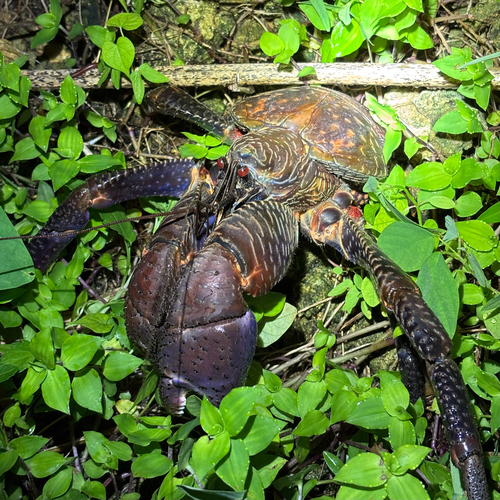
Coconut crabs are built on a grand scale relative to any other land-dwelling invertebrate. A mature individual carries ten legs arranged in the standard decapod pattern: two large front claws (chelipeds), two pairs of large walking legs, a smaller fourth pair and a very small final pair usually held in the cavity containing the breathing organs, which the crab uses to clean the lung chamber.
Adult dimensions:
- Leg span (tip to tip): up to 1 metre
- Body length (carapace plus abdomen): up to 40 cm
- Carapace width: up to 20 cm
- Weight: up to about 4 kg
Colouration:
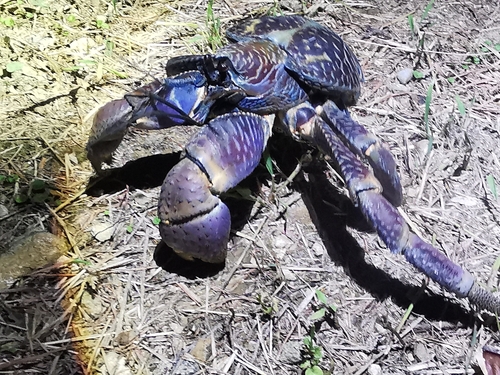
Colours range from orange-red to purplish blue. Blue is the predominant colour in most regions, but in some places, such as the Seychelles, most individuals are red.
The body is covered by a thick exoskeleton that must be shed to allow growth. Adults moult annually, digging a burrow in which to hide while the new exoskeleton hardens.
Anatomy and Physiology of a Land Animal
The coconut crab's most unusual anatomical feature is its respiratory system. The species is fully terrestrial as an adult and cannot survive long immersion in water, yet its lineage is marine. Evolution solved this problem by rebuilding the original branchial chamber into a functional lung.
Inside the carapace, the coconut crab carries a paired organ called the branchiostegal lung . The walls of this chamber are covered in spongy, highly vascularised tissue that functions much like the lung of a land vertebrate. Oxygen diffuses directly from the air into blood flowing through fine vessels in the tissue. A small pair of modified rear legs grooms this chamber to keep it clean and moist. The original gills have been reduced and can no longer support the animal in water.
Because the branchiostegal lung must remain moist for gas exchange, the crab cannot tolerate dry heat. It retreats to humid burrows or rock crevices during the hottest hours of the day, emerges at night when humidity rises and is often found near freshwater seeps or coastal vegetation that traps dew. Conversely, full submersion is lethal within roughly an hour for a large adult because the lung cavity floods and cannot be cleared.
Other key physiological features include:
- Drinking: the coconut crab may drink water from small puddles by transferring it from its claws to its mouthparts.
The Claws
The most famous biomechanical feature of the coconut crab is the sheer force of its pinch. The pincers are powerful enough to cause noticeable pain to a human.
The front claws are asymmetric, with the left claw larger than the right.
Diet and Feeding Behaviour
Despite the name, coconuts are not the only food item in the coconut crab's diet. The species is an opportunistic omnivore that will eat almost anything organic it can locate.
Regular food sources:
- Coconuts
- Pandanus fruit
- Other fleshy fruits, nuts, seeds and the pith of fallen trees
- Carrion, fish, seabirds, rodents
- Smaller land crabs and hermit crabs
- Turtle hatchlings
- Seabird eggs and chicks
- Rats
- Other coconut crabs (especially freshly moulted individuals)
- Their own discarded exoskeletons after moulting
Coconut crabs locate food primarily by smell. Their antennae carry short, blunt aesthetascs similar to those of insects, an example of convergent evolution between the crustacean and insect lineages. The crab can detect the smell of rotting meat, bananas and coconuts over large distances.
The coconut-cracking sequence:
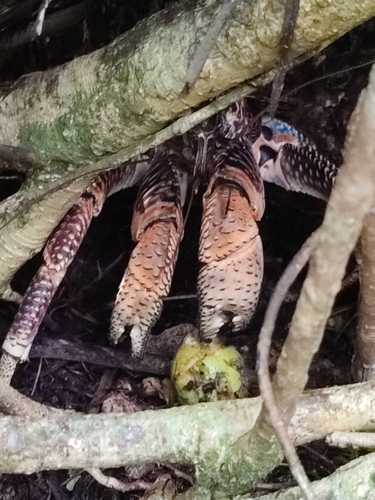
- Rip the husk off in strips with the claws, always starting from the side with the three germination pores.
- Bang the pincers on one of the pores until it breaks.
- Pull out the white flesh with the smaller pincers on the other legs.
Several days may be needed before a coconut is opened. Some accounts describe a crab carrying a husked nut up a tree about 10 m high and dropping it to get at the flesh inside.
Tree-Climbing and Terrestrial Agility
Coconut crabs are among the very few large arthropods that routinely climb vertical trunks. The crab has been filmed climbing coconut and pandanus trees, using the pointed tips of its walking legs, and can climb trees about ten metres high. It often descends by falling and can survive a fall of at least 4.5 m unhurt.
Tree-climbing serves several functions:
- Accessing ripe coconuts and other fruit in the canopy
- Escape from larger rival crabs on the ground
On the ground the coconut crab is slow but methodical.
Adults live alone in burrows or rock crevices, digging their own burrows in sand or loose soil.
Life Cycle and Reproduction
The coconut crab has one foot firmly in the sea even though the adult cannot survive there. Reproduction begins on land but the entire larval phase plays out in open ocean water.
Mating: Adults pair briefly on land, usually between May and September depending on latitude. Mating is rapid.
Egg carrying: A gravid female carries the fertilised eggs glued to the underside of her abdomen for a few months.
Release: When the eggs are ready to hatch, the female migrates to the shoreline, usually at dusk and especially at high tide, and releases the larvae into the sea. Females that misjudge and wade too deep can drown.
Larval stages: The free-swimming zoea larvae drift in the open ocean for three to four weeks, passing through three to five zoea stages. They feed on plankton and are entirely marine.
Glaucothoe stage: After the zoea stages, larvae transform into a settling stage called the glaucothoe, which returns to shore and seeks out an empty gastropod shell for protection. At this point the juvenile coconut crab is functionally a small hermit crab.
Juvenile hermit phase: Young coconut crabs live in borrowed shells, and those that cannot find a shell of the right size often use broken coconut pieces.
Adult transition. Once the crab outgrows the largest shells available, it abandons the hermit lifestyle completely. Calcification sets in across the abdomen, the posterior curl typical of hermit crabs straightens and the animal assumes its final adult form.
Sexual maturity occurs around five years of age. Growth proceeds slowly, with the animal reaching maximum size only after 40 to 60 years and the full lifespan extending over 60 years or more.
Distribution Across the Indo-Pacific
The coconut crab occupies a broad but fragmented range across tropical islands broadly between the tropics of Cancer and Capricorn. The species is almost never found on large continental landmasses, partly because of habitat preferences and partly because of hunting pressure wherever dense human populations exist.
Approximate regional distribution:
| Region | Representative island groups |
|---|---|
| Western Indian Ocean | Zanzibar, Aldabra, Seychelles, Chagos |
| Eastern Indian Ocean | Christmas Island, Andaman and Nicobar Islands |
| Southeast Asia | Parts of Indonesia and the Philippines |
| Micronesia | Mariana Islands, Marshall Islands, Caroline Islands |
| Melanesia | Solomon Islands, Vanuatu, parts of Papua New Guinea |
| Polynesia | Cook Islands, Tuamotu, Gambier, Pitcairn |
The largest surviving populations are on islands without significant human settlement or with strong hunting regulations. Christmas Island in the Indian Ocean has the largest and densest coconut crab population in the world. At the other extreme, many once-productive islands in Southeast Asia and the South Pacific now support only remnant populations or have lost the species entirely.
Conservation Status and Threats
The IUCN Red List classifies Birgus latro as Vulnerable , following an assessment made in 2018 and published in the 2020 Red List update. The primary pressures on the species include:
- Hunting for food. Coconut crab meat is considered a delicacy across much of the range and commands premium prices in local markets and tourist restaurants. Large individuals are preferentially targeted, which removes the most reproductively valuable part of the population.
- Slow life history. Late maturity, slow growth and heavy larval predation make the species intrinsically vulnerable to overharvest.
- Habitat loss occurs through coastal development, resort building and clearing for palm plantations, which eliminate burrow sites and the shoreline areas where larvae release.
Minimum legal size limits exist in Guam and Vanuatu, capture of egg-bearing females is banned in Guam and the Federated States of Micronesia, and hunting in the Northern Mariana Islands is limited to a licensed season. In the Philippines it is illegal to catch or sell coconut crabs, although open capture for the tourist trade continues. Enforcement is difficult on remote atolls and illegal harvest persists wherever monitoring is thin.
Coconut Crabs and Humans
Human relationships with the coconut crab span the gulf from reverence to exploitation. In some regions, such as the Nicobar Islands, Flores and among the Tao people of Taiwan, taboos prohibit or limit hunting and eating the crab. Elsewhere it is eaten as a delicacy. The species' remarkable size, strength and longevity make it a focus of folklore, tourism and occasional sensational stories.
One of the more famous speculations involves the 1937 disappearance of aviator Amelia Earhart. A persistent hypothesis places her final landing at Nikumaroro, an uninhabited atoll in the central Pacific.
A popular internet legend holds that her remains were rapidly consumed by coconut crabs there. As no evidence of her plane has been found on or near Nikumaroro, historians generally discredit the theory.
Handlers who mishandle a large coconut crab risk painful pinch injuries, as the crab often keeps its hold for extended periods.
Illustration.
Frequently asked questions
The coconut crab (Birgus latro) is the largest terrestrial arthropod alive today. Fully grown adults can reach a leg span of about one metre, a body length of up to 40 centimetres and a body mass of up to about four kilograms. Males are generally larger than females.
Growth is slow: a coconut crab reaches sexual maturity around five years of age and reaches its maximum size only after 40 to 60 years.
The pincers are powerful enough to cause noticeable pain to a human, and the crab often keeps its hold for extended periods. The front claws are asymmetric, with the left claw larger than the right.
The crab uses its claws to rip the husk off coconuts and bang them open, while the smaller pincers on the other legs pull out the flesh.
Adult coconut crabs are obligate air-breathers. Although the species evolved from marine hermit crabs and its larvae develop in seawater, the adult respiratory system is built around a branchiostegal lung: a cavity lined with spongy, vascularised tissue that functions much like a terrestrial lung. The original gills have been reduced and can no longer extract enough oxygen from water to keep a large, active animal alive.
If a coconut crab is held underwater for more than roughly an hour, it drowns. The lung also needs to stay moist, so the crab seeks humid burrows during the hottest hours of the day.
Coconut crabs are distributed across tropical islands of the Indian and Pacific Oceans, from the western Indian Ocean (Zanzibar, Aldabra) through Southeast Asia and Melanesia to Polynesia as far east as the Gambier Islands and Pitcairn. They have been extirpated from most areas with a significant human population, such as mainland Australia and Madagascar.
The crabs live alone in burrows dug in sand or loose soil, or in rock crevices. They live almost exclusively on land and return to the sea only to release their larvae.
Coconut crabs are opportunistic omnivores. They feed mainly on fleshy fruits, nuts, seeds and the pith of fallen trees, and they also eat coconuts: they rip off the husk in strips and bang on one of the germination pores until it breaks, a process that can take several days.
They also eat carrion, turtle hatchlings, smaller crabs, rats, seabird eggs and the moulted exoskeletons of other crustaceans. They scavenge the carcasses of other coconut crabs, and larger crabs eat smaller ones. Their sense of smell is highly developed and detects food over large distances.
Yes. Coconut crabs have been filmed climbing coconut and pandanus trees, using the pointed tips of their walking legs to grip, and can climb trees about ten metres high. Climbing is also an immediate escape route from predators when the crab is away from its burrow.
Some accounts describe crabs carrying a husked nut up a tree and dropping it to get at the flesh inside, although the crab has never been filmed selectively picking coconut fruit. Crabs often descend by falling and can survive a fall of at least 4.5 metres.
Coconut crabs are long-lived for an arthropod. They reach their maximum size only after 40 to 60 years, and the total lifespan may be over 60 years. Growth is slow because, like all arthropods, the animal must moult its exoskeleton to grow, and adults moult annually.
After moulting the crab hides in a burrow while its exoskeleton hardens, which takes one to three weeks and remains there for 3 to 16 weeks depending on size. Sexual maturity arrives at about five years.
The IUCN Red List classifies Birgus latro as Vulnerable, following a 2018 reassessment. The primary threat is hunting for food: coconut crabs are considered a delicacy across much of their range and are very rare on islands with a human population.
Habitat loss also contributes to declines. Some regions have introduced minimum size limits, bans on capturing egg-bearing females, or licensed hunting seasons and the Philippines prohibits catching or selling the species, but enforcement is difficult and open capture continues in places.
References
- Cumberlidge, N. (2020). Birgus latro. The IUCN Red List of Threatened Species 2020: e.T2811A126813586. View source
- Coconut crab. Wikipedia. View source