Beaver: Iron Makes Its Teeth Orange
Castor canadensisThe largest known beaver dam, in Alberta's Wood Buffalo National Park, is reported at roughly 775 to 850 m. Iron in the enamel turns beaver incisors orange.
 Strange Animals EditorialFebruary 12, 2025·18 min read·Editorial standards ↗
The North American beaver, builder of the continent's most conspicuous dams, is its largest rodent, the world's second-largest rodent overall, and among the most influential non-human landscape engineers in the northern hemisphere.
Castor canadensis cuts down full-grown trees with its teeth, dams streams with the trunks, plasters the resulting wall with mud, raises the water behind it, in some cases by up to three metres and in doing so converts fast-flowing creeks into layered wetlands that support waterfowl, amphibians, fish, moose and that store carbon, sediment and groundwater.
This guide covers every aspect of the North American beaver: body plan, iron-infused teeth, the tail, the lodge, the dam, diet, reproduction, family life, conservation and the long shadow of the fur trade that nearly erased the species between 1500 and 1900.
The sister species, the Eurasian beaver ( Castor fiber ), is mentioned throughout for comparison but is covered in its own entry.
Etymology and Classification
The genus name Castor comes from the Greek word kastor, meaning beaver and was coined by Carl Linnaeus. The species epithet canadensis : "of Canada", was given by Heinrich Kuhl in 1820.
Many Indigenous languages across North America have their own names for the beaver, recognising it as a foundational animal in stories, place names and subsistence traditions.
Beavers belong to their own family, Castoridae. Once diverse, the family is now reduced to just two living species: the North American beaver ( Castor canadensis ) and the Eurasian beaver ( Castor fiber ). The two species look almost identical to the casual eye but cannot interbreed.
North American beavers have 40 chromosomes and Eurasian beavers have 48, so every experimental attempt at hybridisation has produced either no conception or sterile pregnancies. Mitochondrial DNA studies place the common ancestor of the two species at around 8 million years ago, long enough for chromosomal rearrangement to make the lineages reproductively isolated.
Fossil Castoridae were once among the largest rodents ever to live. The ice-age genus Castoroides , the giant beaver of Pleistocene North America, was about 1.9 to 2.2 m long and weighed roughly 90 to 125 kg. Giant beavers did not build dams as far as palaeontologists can tell, and they went extinct roughly 10,000 years ago. The two surviving species are what remains of a once-broad lineage.
Size and Physical Description
North American beavers are large rodents with obvious adaptations for semi-aquatic life. Unlike most large mammals they show almost no sexual dimorphism. Males and females are almost identical externally.
Adults:
- Body length (nose to base of tail): 74-90 cm
- Tail length: 20-35 cm
- Total length: 1-1.3 m
- Shoulder height on all fours: 30-60 cm
- Weight: typically 11-32 kg, record individuals above 40 kg
Kits at birth:
- Born precocial and fully furred, with eyes opening within days
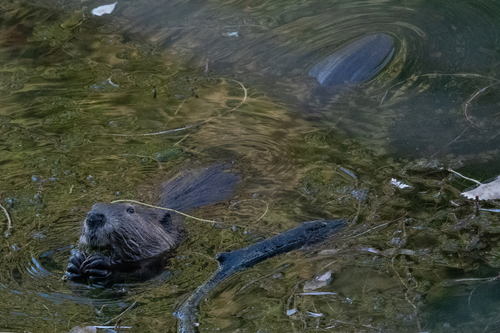
The body is stocky and barrel-shaped, built for mass and insulation rather than speed. The head is small relative to the torso, with a wide rounded muzzle and small ears set low on the skull. The front legs are short and end in strong, dexterous hand-like paws used for carrying sticks, grasping food and manipulating mud and stones.
The hind legs are much larger, with broad webbed feet that function as swim paddles. The second toe of each hind foot carries a specialised split claw used for grooming.
Beaver fur has two layers. The outer guard hairs are long, oily and water-shedding, which is exactly what made beaver felt the premium material for European hats. The underfur is dense and soft, trapping a layer of air against the skin that gives the animal insulation against cold water. Beavers groom constantly, using their split grooming claw and oily secretions from glands near the tail base to keep the coat waterproof.
The Tail
The flat, scaly tail is one of the most recognisable features of any mammal. It is not primarily a swim paddle: beavers swim mostly with their webbed hind feet, and the tail acts as a rudder. The tail is a multi-function organ.
- Fat storage. The tail stores fat for winter.
- Thermal radiator. The tail is rich in blood vessels and loses heat efficiently when the beaver is in danger of overheating.
- Balance. On land, where beavers are slow and awkward, the tail acts as a counterbalance and prop, especially when the beaver stands on its hind legs to cut down a tree.
- Alarm drum. A hard slap of the tail on water produces a percussive "splat". It alerts the rest of the family to a potential threat.
Iron-Infused Teeth
Beaver incisors are probably the most chemically unusual teeth in any mammal. Each of the four front incisors, two upper, two lower, carries a visible orange coat on the outer face. The colour comes from iron that is chemically incorporated into the enamel matrix during tooth formation.
Iron-rich enamel has two practical advantages for a rodent that cuts wood for a living.
- Hardness. The iron-infused outer layer is measurably harder than ordinary mammalian enamel, extending tooth life in an animal that must gnaw daily.
- Acid resistance. Bark and cambium ferment in the mouth and produce mild acids that slowly dissolve ordinary enamel. Iron-rich enamel resists that erosion.
Behind the orange outer enamel sits softer yellow dentin. As the beaver chews, the softer dentin wears faster than the harder enamel, and each incisor ends up with a permanent chisel edge that is always sharper than the day before. This is why beaver teeth do not need to be sharpened the way human chisels do, they self-sharpen with every use.
Beaver incisors grow continuously throughout life, fast enough to replace the material lost to daily cutting of bark, cambium and whole trees. The growth rate is not optional. A beaver that stops gnawing, because of jaw injury, captive diet, or disease, will die when its incisors grow long enough to curve back into the skull or lock the jaws shut. This failure mode is a risk for poorly managed zoo and wildlife rescue animals.
A beaver can fell a 15 cm diameter tree in well under an hour, while trees 25 cm or more across may take hours. Trees over 1 m in diameter have been recorded as felled.
The Lodge and the Dam
Beaver construction is the single behaviour that makes the species ecologically unique. The architecture has two components: the dam, which impounds water and the lodge, which houses the family. Together they convert a flowing stream into a stable, predator-resistant, temperature-regulated home.
The dam. Beavers select sites on streams narrow enough to block. Trees are felled along the banks, floated to the dam site and woven into a horizontal foundation of trunks and branches. Stones and sod are wedged into gaps, and the upstream face is plastered with mud dredged from the stream bottom. Dams run from a few metres to hundreds of metres long.
The largest known beaver dam, in Wood Buffalo National Park in northern Alberta, is reported at roughly 775 to 850 m long. It was discovered through satellite imagery in 2007 and did not exist in 1975.
Dams are triggered and maintained by the sound of running water. In one test, a recording of running water was played in a field near a beaver pond, and a beaver covered the speaker with branches and mud even though it was on dry land.
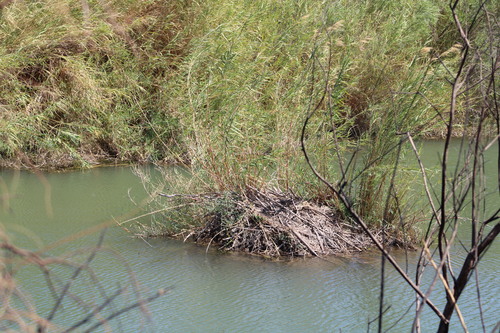
The lodge. The lodge is a dome-shaped house of sticks and mud built inside the pond the dam creates. An experienced family can build a lodge about 2 m tall and 6 m across above the water. Inside the dome is a dry living chamber above the waterline, with a feeding area close to the water entrance.
One or two entrance tunnels open underwater so predators cannot follow the family indoors. In winter the outer mud freezes to roughly the consistency of concrete.
The food cache. Before freeze-up each year the family anchors a raft of leafy branches to the pond bottom near the lodge entrance. Under cold water bark and cambium remain nutritious for months, and the cache functions as an accessible pantry all winter. Beavers swim out under the ice, cut a branch from the cache and drag it back into the lodge to gnaw in warm air.
| Structure | Typical size | Purpose |
|---|---|---|
| Dam | A few metres to about 100 m long, 0.2-3 m tall | Impound water around lodge |
| Record dam (Wood Buffalo, Alberta) | ~775-850 m | Multi-generation super-structure |
| Lodge | Up to ~6 m wide, ~2 m tall | Dry living chamber for family |
| Underwater entrance | Entrances open underwater | Predator-proof doorway |
| Food cache | Branches stored under water | Winter larder under ice |
Hunting, Diet, and Digestion
Beavers are strict herbivores. Despite living in water they do not eat fish.
Preferred plant foods:
- Cambium (inner bark) of aspen, willow, poplar, cottonwood, birch
- Leaves, twigs and buds of the same trees
- Aquatic plants, water lilies, pondweeds, sedges, cattails
- Ferns and herbaceous riverbank plants in summer
- Stored branches from winter caches in the cold months
The digestive strategy is hindgut fermentation. A large cecum houses microbes that break down cellulose, similar to a horse rather than a cow.
Beavers cut trees for two reasons: food and construction material. Small trees are eaten whole. Larger trees are stripped of accessible bark and cambium while the trunk is cut into sections for dam or lodge use. Selective cutting over decades converts nearby forest into an aspen-dominated or willow-dominated regrowth stand that regenerates faster than other species, which in turn produces more food for the colony.
Family Life and Reproduction
Beavers are among the most socially stable mammals in North America. A colony is not a herd but a nuclear family: a monogamous breeding pair, their kits from the current year and yearlings from the previous year. Families can have as many as ten members.
Reproductive schedule:
- Mating. Peaks in January, usually in water.
- Gestation. About 128 days on average.
- Birth. Late April to June, inside the lodge.
- Litter size. Typically 3-6 kits.
- Nursing. Kits can eat solid food in their second week and may suckle for up to three months.
- First swim. After up to a month in the lodge, though kits may ride on parental backs.
- Dispersal. At 2 years old, when yearlings leave to find their own territories.
Beavers live in monogamous pairs, and a beaver that loses its partner will wait for another to come by.
Yearlings are an unusual feature of the beaver social system. Rather than dispersing at first maturity, they spend a full second year in the natal lodge as non-breeding helpers. They babysit kits, groom them, contribute to dam and lodge maintenance and share food. This "yearling daycare" arrangement is functionally similar to the helper systems of meerkats, wolves and several cooperative birds.
It reduces parental burden, improves kit survival and gives the helpers a full extra year to grow and to learn construction and foraging before they face life alone.
At about 2 years old, the yearlings disperse. Dispersing beavers often travel less than 5 km to find unoccupied stream reaches, though long-distance dispersals are not uncommon.
Swimming, Diving, and Cold Tolerance
Beavers spend the great majority of their active hours in water. The adaptations are comprehensive.
Aquatic toolkit:
- Webbed hind feet: primary propulsion
- Flat tail: steering and counterbalance, occasional forceful stroke
- Transparent nictitating membrane over the eyes: built-in swim goggles
- Valve-like nostrils and ear canals: close automatically underwater
- Lips that close behind the incisors: gnaw underwater without flooding the mouth
- Oxygen-rich blood and slow heart rate: breath holds of up to 15 minutes
| Metric | Value |
|---|---|
| Maximum breath hold | ~15 minutes |
| Typical dive length | 5-6 minutes |
| Surface swim speed | ~8 km/h |
| Underwater swim speed | Hind feet move together underwater |
| Walking speed on land | Awkward, though quick when threatened |
| Cold-water tolerance | routinely active under ice at 0 degrees Celsius |
On land a beaver is vulnerable. Awkward gait and short legs make the species easy prey for wolves, coyotes and cougars once it is more than a few body lengths from the water. That is why a beaver at the base of a tree always works with one ear on the stream, at the first alarm from a family member or the first snapped twig, the adult dives back into the pond and disappears under the lodge.
The Fur Trade and Near-Extinction
Between roughly 1500 and 1900, beavers were hunted almost to extinction in North America, and entirely out of most of Europe, to supply felt for the men's hat industry.
Beaver underfur has tiny barbs that allow the fibres to mat into dense, water-shedding felt when subjected to heat and pressure. For almost four centuries this made "castor felt" the premium material for the hats that defined middle-class and upper-class European dress. Tricorn hats, stovepipe hats, bowlers and top hats were all built around beaver felt.
Demand drove the expansion of the Hudson's Bay Company, the Northwest Company and comparable French and Russian fur operations. Beaver pelts became a literal currency, the "made beaver", against which other trade goods were valued at HBC posts. As eastern populations were depleted, trappers pushed west and the era of the mountain man (1806-1838) brought the beaver to the brink of extinction in the West.
Pre-contact North American beaver populations are estimated at 60-400 million animals. The species was extirpated across much of its former range.
Legal protection, trapping regulation and reintroduction efforts started recovery in the early twentieth century. Beavers were translocated into watersheds devoid of them for decades thereafter.
North American Castor canadensis populations were estimated at 6-12 million animals in a 1988 review.
Ecosystem Engineering and Climate Restoration
Beavers are the defining real-world example of what ecologists call an ecosystem engineer, a species whose physical work on the environment is large enough that removing it collapses a suite of other species, and restoring it rebuilds them.
A single active beaver dam produces:
- Wetlands. Impounded water spreads laterally into a mosaic of open pond, flooded forest, emergent marsh and wet meadow.
- Groundwater recharge. Water ponded on the surface infiltrates the aquifer and pushes up water tables.
- Flood attenuation. Slowing a stream over a series of dams reduces peak flood heights downstream during spring melt and storms.
- Sediment and nutrient capture. Fine sediment, phosphorus and nitrogen are trapped behind the dam, improving water quality downstream.
- Fish habitat. Deep pools upstream of dams are used by trout and salmon for overwintering and spawning.
- Biodiversity. Waterfowl, amphibian, fish and invertebrate communities can expand after beavers recolonise a stream reach.
- Carbon sequestration. Behind long-lived dams, peat and sediment accumulation increases carbon storage.
In the past decade these effects have been scaled up deliberately. The western United States, facing deeper droughts and longer wildfire seasons, now supports beaver-based restoration projects. Many involve real beavers, released or tolerated on public land.
Some managers employ human-built beaver dam analogues, rough timber-and-post structures designed to resemble beaver work until beavers recolonize and assume maintenance. Studies in Oregon and California have documented increases in steelhead and coho salmon populations, and beaver ponds can help riparian plants resist wildfires.
Eurasian beavers have been reintroduced to parts of Great Britain since 2009. The Eurasian beaver population in Europe was estimated at over one million in 2020, after the species had been reduced to roughly 1,200 animals by the early twentieth century.
Beavers and Humans
Beavers and humans have a complicated and still-unfolding relationship. As a fur species the beaver funded continental exploration and drove several ecological catastrophes. As an ecosystem engineer it now funds climate and drought resilience projects and drives measurable environmental gains. As a neighbour it floods culverts, undermines road embankments and drowns orchards.
Castoreum. Beavers secrete a strongly scented yellow-brown substance called castoreum from a pair of castor sacs near the cloaca. In the wild it is used to mark territory.
In trade it has been extracted for perfumery, for traditional medicine (its effects have been credited to salicylic acid accumulated from the willow and aspen that beavers eat), and as a food and drink flavouring.
Beaver fever. Beavers can carry the protozoan parasite Giardia and spread it to surface water. The resulting gastrointestinal illness, giardiasis, is colloquially called "beaver fever" in North America. Backcountry drinking water downstream of occupied beaver habitat must be filtered or treated. Beavers are far from the only wildlife that can transmit Giardia , but the colloquial name stuck.
Beaver moon. The full moon of November is called the Beaver Moon in most North American English-language almanacs. The name comes from both Indigenous traditions and colonial trappers, November is the month beavers race to finish their food caches before freeze-up, and the month traders set their last line of traps on unfrozen waterways before winter closed the rivers. The name is still standard on modern calendars and almanacs.
Conflict management. Where beaver dams flood roads, culverts, farmland, or homes, managers increasingly use non-lethal solutions. Pond levellers (also called "beaver deceivers") are perforated pipes run through a dam that limit how high the beaver can raise the water without triggering the instinct to patch the leak. Flow devices around culverts prevent beavers from hearing running water and attempting to block it.
These tools now allow human infrastructure and beaver families to coexist in many catchments.
Illustration.
Frequently asked questions
Adult North American beavers (Castor canadensis) measure 74-90 cm in body length, with an additional flat tail of 20-35 cm, giving a total length of about 1-1.3 m. Healthy adults weigh 11-32 kg, and unusually large old individuals have been recorded above 40 kg. That makes the beaver the second-largest living rodent on Earth, behind only the South American capybara.
Males and females are almost identical externally. Kits are born precocial and fully furred, with eyes that open within days.
North American beavers (Castor canadensis) and Eurasian beavers (Castor fiber) look almost identical, but they are genuinely separate species. Eurasian beavers have 48 chromosomes while North American beavers have only 40, which prevents them from interbreeding. Eurasian beavers tend to have a longer skull, a narrower tail and lighter fur, and are slightly larger on average.
North American beavers were introduced to Finland in 1937 and created an invasive population there. Mitochondrial DNA studies place the common ancestor of the two species at around 8 million years ago.
A beaver family builds a dam to raise water levels around its lodge. The dam is a mat of logs, branches, stones and grass, plastered with mud that freezes to roughly the consistency of concrete in winter. Most dams run from a few metres to about 100 m long, but the largest known dam, in Wood Buffalo National Park, Alberta, is reported at roughly 775 to 850 m and was discovered through satellite imagery in 2007.
The lodge sits inside the pond created by the dam: a dome of sticks and mud that can reach about 2 m tall and 6 m across, with underwater entrances that open into a dry living chamber above the waterline. A food cache of leafy branches is stored under water near the lodge before freeze-up, and beavers swim out under the ice to reach it.
Beavers start building dams when they hear running water and will cover a speaker playing stream recordings with branches and mud.
Beaver incisors are orange or reddish-brown because their enamel is coloured by iron compounds. Iron-rich enamel is harder and more resistant to the acids produced when bark and cambium ferment in the mouth. Behind the enamel sits softer yellow dentin.
As the beaver gnaws, the dentin wears faster than the orange enamel, and the tooth self-sharpens to a chisel edge. Beaver incisors grow throughout life, fast enough to keep pace with the wear of cutting trees. A beaver that cannot gnaw can die when its unworn incisors grow long enough to curve back into its skull.
The IUCN lists the North American beaver (Castor canadensis) as Least Concern, with a population now estimated at 10-15 million animals. Before the fur trade, beaver populations likely numbered between 60 and 400 million across North America. Demand for beaver-felt hats nearly exterminated the species and eliminated it from much of its range.
Legal protection, trapping regulation and reintroduction programmes from the early twentieth century rebuilt the population across Canada and the United States. The Eurasian beaver (Castor fiber) followed a similar recovery arc and is also now Least Concern after being reduced to about 1,200 animals in Europe by the early twentieth century.
Local populations can still be affected by habitat loss, road mortality and conflict-driven killing where dams flood agricultural land or roads.
Beavers usually live up to about 10 years in the wild. Felids, canids and bears may prey on them, and they are safest in their lodges and near water.
Beavers reach sexual maturity at around 1.5 to 3 years of age and have one litter per year, typically of 3-6 kits born between April and June. Young beavers help their families with construction after their first year and become independent at about 2 years old, when they disperse to find their own territories.
Beavers are a classic example of an ecosystem engineer: a species that physically restructures its environment enough to create habitat for many other species. A single active dam converts a flowing stream into a mosaic of ponds, flooded forest, marsh and meadow. These wetlands raise the water table, slow floods, trap sediment and nutrients and increase carbon storage in peatlands.
Beaver ponds benefit waterfowl, amphibians, fish such as salmon and trout and invertebrates. Humans now build beaver dam analogues to gain similar benefits for drought resilience, salmon recovery and wildfire protection.
Eurasian beavers have also been reintroduced to parts of Great Britain since 2009.
Beavers are rarely dangerous to humans. A healthy beaver will dive into water and slap its tail rather than confront a person.
Beavers can carry rabies, and they occasionally attack humans and pets, particularly when infected, defending their territory, or feeling threatened. Some attacks have been fatal, including at least one human death.
The more common health issue associated with beavers is giardiasis, colloquially called ‘beaver fever’, caused by the protozoan Giardia. Beavers can spread it by infecting surface waters, so untreated drinking water from backcountry streams downstream of beaver habitat should be filtered or treated.