African Wild Dog: Hunts Voted by Sneezes
Lycaon pictusWild dogs sneeze to vote on hunts, a 2017 Okavango study found: about three sneezes suffice when a dominant dog starts the rally. Litters run 6 to 16 pups.
 Strange Animals EditorialApril 8, 2025·15 min read·Editorial standards ↗
The African wild dog is the largest wild canine in Africa. It is not a wolf. It is not a jackal. It is not a feral domestic dog. Lycaon pictus , the painted wolf, belongs to a genus of its own, whose lineage diverged from those of Canis and Cuon about 1.7 million years ago and which is largely isolated from gene transfer with other canids.
Its four-toed front feet, enormous rounded ears, mottled coat and extraordinary cooperative hunting behaviour make it unmistakable and, among biologists, one of the most interesting carnivores on the continent.
This guide covers every aspect of African wild dog biology: size and physiology, hunting and diet, pack structure, sneeze-voting, reproduction, movement and range, conservation status and the relationship between wild dogs and the humans whose activities now determine the species' survival.
Etymology and Classification
The scientific name Lycaon pictus combines the Greek lykaios (wolflike) with the Latin pictus (painted), reflecting the species' striking multicoloured coat. Common names vary by region: painted wolf and painted hunting dog are preferred by many conservationists, Cape hunting dog appears in older literature, African wild dog remains the standard English name.
Swahili speakers call the species mbwa mwitu . Afrikaans uses wildehond .
Genetically the species is a striking outlier. Lycaon is a monotypic genus: it is the only living member of its genus. A 2019 genomic study indicated that the lineage diverged from Cuon and Canis about 1.7 million years ago. Whole genome sequencing has also found evidence of ancient genetic admixture between African wild dogs and the dhole ( Cuon alpinus ) of Asia.
The species is largely isolated from gene transfer with other canid species. Disease transmission from domestic dogs, however, remains a threat.
Five subspecies are listed by Mammal Species of the World, but these designations are not universally accepted, and studies with larger samples found extensive past intermixing between East African and Southern African populations.
Size and Physical Description
African wild dogs are medium-sized canids, taller and leaner than they look in photographs.
Adults:
- Weight: 18-36 kg (southern populations larger than east African)
- Shoulder height: 60-75 cm
- Head-to-body length: 71-112 cm
- Tail length: 29-41 cm
- Sexual dimorphism: slight, females are usually 3-7% smaller than males
Pups at birth:
- Typical litter: 6-16 pups (largest of any canid)
Wild dogs are built for sustained pursuit in open habitat. Their legs are disproportionately long, their chests deep and their waists narrow, a body plan built for endurance rather than short-burst sprinting. Shoulders are lightly muscled compared to lions or leopards because wild dogs do not ambush or grapple prey. They simply run them to exhaustion.
The most diagnostic feature is the front paw. Most other canids have a dewclaw on the front foot in addition to four functional digits. Lycaon pictus has only four toes. The lack of dewclaws is one of the features that distinguishes the genus from Canis .
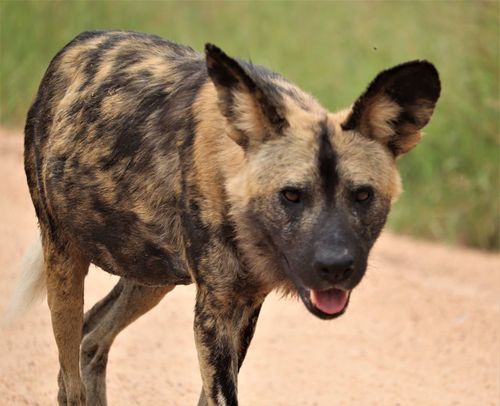
The coat is the second unmistakable feature. Black, white, rust, yellow and brown blotches combine into a pattern that is never repeated between individuals. Researchers track populations by photograph alone, because every dog carries a lifelong fingerprint across its flanks.
Regional populations tend toward broadly different palettes, east African dogs are typically darker and more mottled, southern African dogs are more yellow-toned, but within any pack, every dog is clearly distinguishable.
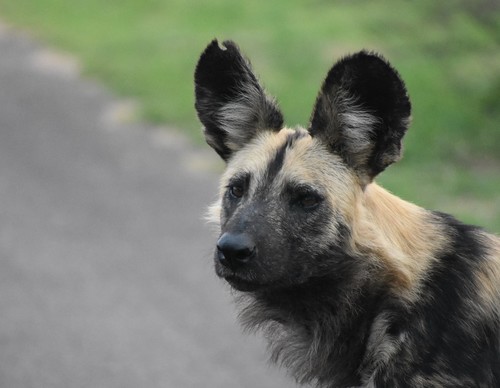
The ears are the third diagnostic trait. They are enormous and rounded, outsized compared with the ears of members of the genus Canis .
Ears and Communication
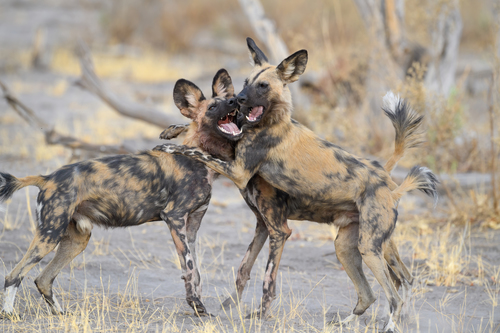
Vocalisations are unusually diverse for a canid. Wild dogs twitter, whine, yelp, squeal, bark, growl, hoo, and, notably, sneeze.
Pack Structure and Cooperative Breeding
A wild dog pack is one of the tightest social units in the mammal world. The core consists of an alpha male and alpha female, supported by a cooperative group of adult helpers that are usually close relatives of one or both alphas. Pack size ranges from 2 to 27 adults, with typical sizes varying by region (four or five adults in Kruger and the Maasai Mara, eight or nine in Moremi and Selous).
Dispersal pattern (reversed compared to wolves):
- Young females leave the natal pack to seek unrelated males
- Young males tend to remain in the natal pack
Breeding monopoly:
- Only the alpha female normally produces pups each year
- The dominant female may kill the pups of subordinate females
- Cooperative breeding means every adult helps raise the pups
Every adult in a healthy pack, regardless of relation to the alphas, contributes to raising the pups. Regurgitation is the core mechanism. Hunters return to the den with stomachs full of meat and are mobbed by pups, by the alpha female who remains with the den, and by any injured or sick adults who could not join the hunt. Universal regurgitation is rare among carnivores, it is a signature wild dog behaviour.
Injured, old, or sick pack members are fed in the same way.
Hunting and Diet
African wild dogs are hypercarnivores specialised for cooperative endurance pursuit. Their hunting behaviour is the feature that distinguishes them most clearly from every other large African carnivore.
Primary prey:
- Impala ( Aepyceros melampus ), most important across southern Africa
- Thomson's gazelle, the most common prey in East Africa
- Greater kudu, larger packs take sub-adults and calves
- Blue wildebeest, calves and juveniles
- Bushbuck, steenbok, duiker, reedbuck, lechwe
Secondary and opportunistic prey:
- Warthog (high risk, low yield)
- Hare and small mammals (supplementary)
- Livestock (locally important near unfenced reserves)
The hunt:
- Dawn or dusk rally. Hunting is mostly at dawn and dusk, with some daytime activity. The pack gathers, engages in excited social interaction and sneeze-votes to confirm commitment.
- Approach and target selection. The pack trots toward the nearest herd of antelope, typically spreading slightly to fan the prey. A specific individual is selected, often a young or slightly weaker animal and the pack locks onto it.
- Sustained pursuit. Chases attain speeds of up to 66 km/h and sustain that pace for 10 to 60 minutes.
- Prey collapse. The average chase covers about 2 km, during which large prey is repeatedly bitten on the legs, belly and rump until it stops running, while smaller prey is simply pulled down.
- Kill and rapid consumption. Wild dogs do not suffocate prey the way big cats do. Several dogs tear into the animal while it is still moving, Medium-sized prey is often killed in 2 to 5 minutes, while larger prey such as wildebeest may take half an hour. A pack can consume a Thomson's gazelle in about fifteen minutes, and speed matters because lions and spotted hyenas will steal kills.
Hunt success is often quoted as above 80%, but that figure is disputed.
Success varies with prey type, vegetation cover and pack size. Often more than 60% of chases end in a kill, sometimes up to 90%. However, an analysis of 1,119 chases by a pack of six Okavango wild dogs found an individual kill rate of only 15.5%, and a compilation across prey species and ages found an average success rate of 31.2%. Because kills are shared, each dog still gets an efficient benefit-cost ratio.
Sneeze Voting and Rally Behaviour
In 2017, researchers working in Botswana's Okavango Delta published a study in Proceedings of the Royal Society B showing that African wild dogs use sneezes to vote on whether to start a hunt.
The finding was elegant. During a rally, any pack member may sneeze. The number of sneezes recorded during a rally strongly predicts whether the pack actually moves off to hunt. A rally initiated by a dominant animal reached "quorum" at about three sneezes. Rallies initiated by lower-ranking dogs required ten or more sneezes before the pack would commit. Sneezes functioned as a democratic override: a low-status dog could still call a hunt, but only if enough packmates agreed.
The researchers described this as a variable quorum response: the number of sneezes needed depends on which dog starts the rally.
Reproduction and Pup Rearing
Breeding is largely restricted to the dominant pair.
Breeding cycle:
- Mating: no fixed season in East Africa, usually April to July in southern Africa
- Gestation: 69-73 days
- Litter size: 6-16 pups (the largest of any canid)
The den period is a dangerous stretch for the pack. Lions kill wild dog pups and adults. After giving birth, the mother stays close to the pups in the den while the rest of the pack hunts.
Pups leave the den at around three weeks and are fed regurgitated meat from about five weeks. Once they reach eight to ten weeks the pack abandons the den and the young follow the adults on hunts. The youngest pack members are allowed to eat first at kills.
Litters are large enough that a single female can produce enough young to form a new pack every year.
Movement and Range
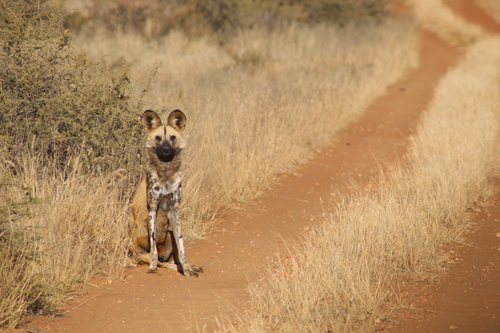
Packs travel through scrubland, woodland and montane areas in pursuit of prey.
Because wild dogs live at low density and range widely, the species needs very large protected areas.
Populations and Conservation Status
The IUCN Red List classifies African wild dogs as Endangered , with a declining population trend. An estimated 6,600 adults, of which only about 1,400 are mature individuals, live in 39 subpopulations, and the largest subpopulation probably numbers fewer than 250 mature individuals. The species has been exterminated in large parts of North and West Africa and greatly reduced in Central Africa, Uganda and much of Kenya. A stable population of more than 370 individuals lives in Kruger National Park.
Primary threats:
- Habitat fragmentation. Wild dog packs need very large territories. Roads, fences, settlements and farmland fragment ranges below viable size. Isolated sub-populations then face inbreeding and stochastic extinction.
- Direct persecution. Farmers and ranchers shoot, snare, poison and trap wild dogs where livestock occur near protected area boundaries.
- Infectious disease. Rabies and canine distemper, both spread from domestic dogs at reserve boundaries, have wiped out entire packs. Vaccination of domestic dogs around reserves is now a standard tool.
- Interspecific competition. Lions kill wild dog pups and adults. Spotted hyenas are frequent kleptoparasites, although in the Selous Game Reserve wild dogs reportedly lose only about 2% of kills to them. A healthy lion population suppresses wild dog density.
- Genetic bottlenecks. Isolated small populations lose genetic diversity quickly. South African meta-population management moves dogs between reserves to keep gene flow alive.
Conservation measures:
- Meta-population management in fenced South African reserves, with translocation between sites
- Vaccination programmes for domestic dogs around key reserves
- Community conservation schemes that compensate livestock losses
- Transfrontier conservation areas (Greater Limpopo, Kavango-Zambezi) to maintain connectivity
The long-term outlook is tightly linked to protected area size and connectivity. Where large intact landscapes persist, Okavango, Selous-Ruaha, Greater Limpopo, wild dogs can sustain themselves. Where protected areas are small or disconnected, populations fade.
Wild Dogs and Humans
Long plagued by negative perception, wild dogs have prompted some conservation groups to adopt names like painted wolf or painted dog in hopes of altering that image.
Despite their reputation, there are essentially no verified records of a wild dog pack attacking or killing a human being in the wild. The species is shy, avoids human settlements and flees on encounter. The real direction of conflict is the reverse: humans kill wild dogs at scale through persecution, accidents and disease transmission.
Illustration.
Frequently asked questions
African wild dogs (Lycaon pictus) are medium-sized canids that weigh between 18 and 36 kilograms. Shoulder height falls between 60 and 75 centimetres, head-to-body length is about 71-112 centimetres, and the tail adds 29-41 centimetres.
Compared with members of the genus Canis, they are lean and tall, with outsized ears and no dewclaws. Females are usually 3-7% smaller than males.
Success rates vary with prey type, vegetation cover and pack size. Often more than 60% of chases end in a kill, sometimes up to 90%, but a compilation across prey species and ages found an average success rate of only 31.2%, which challenges the popular claim of over 80%.
Chases can reach up to 66 km/h and the average chase covers about 2 km. Typical prey includes impala, greater kudu, Thomson’s gazelle and blue wildebeest calves.
Yes. In 2017 a research team working in Botswana’s Okavango Delta published a study in Proceedings of the Royal Society B showing that sneezes during the pre-hunt rally influence whether the pack sets off to hunt. The more sneezes recorded during a rally, the more likely the pack was to depart.
A rally initiated by a dominant animal needed only about three sneezes to reach quorum, rallies started by lower-ranking dogs required about ten. The researchers described this as a variable quorum response.
African wild dogs are native to sub-Saharan Africa and occur mainly in southern and East Africa. They have been exterminated in large parts of North and West Africa and greatly reduced in Central Africa, Uganda and much of Kenya. A stable population of more than 370 individuals lives in Kruger National Park.
The species prefers savannas and arid zones and generally avoids forest, although a forest-dwelling population exists in Ethiopia’s Harenna Forest. Because packs range widely at low density, the species needs very large protected areas.
The IUCN classifies Lycaon pictus as Endangered. An estimated 6,600 adults, of which only about 1,400 are mature individuals, live in 39 subpopulations, and the largest subpopulation probably numbers fewer than 250 mature individuals. Primary drivers are habitat fragmentation, direct persecution by people and infectious disease.
Rabies and canine distemper, spread from domestic dogs at reserve boundaries, have wiped out entire packs. Because wild dogs live at naturally low density and need enormous ranges, small populations are extremely vulnerable to random events.
A wild dog pack is built around a dominant breeding pair, supported by a cooperative group of adult helpers, usually close relatives of the alphas. Pack size ranges from 2 to 27 adults, with typical sizes varying by region. Unlike wolves, sex roles in dispersal are reversed: young females leave their natal pack to find unrelated males, while males tend to remain.
Breeding is largely restricted to the dominant female, which may kill the pups of subordinates. Adults regurgitate meat for pups and for other adults, which is unusual among carnivores.
African wild dogs have an average lifespan of about 10 to 11 years in the wild. Lions are a major source of mortality for both adults and pups, and disease and persecution add to the toll.
Despite their reputation as ruthless pack hunters, there are essentially no verified records of a wild dog pack attacking or killing a person in the wild. The species is shy, avoids human settlements and flees on encounter.
Conflict with humans is almost entirely one-directional: farmers and ranchers shoot, poison, snare and trap wild dogs, and domestic dog diseases kill whole packs.
References
- Relevant peer-reviewed and organisational sources consulted for this entry include the IUCN/SSC Canid Specialist Group African Wild Dog status reviews (2012, 2020), the Range Wide Conservation Program for Cheetah and African Wild Dogs regional action plans, Walker et al.
- (2017) "Sneeze to leave" in Proceedings of the Royal Society B, research published in Animal Conservation, Journal of Zoology, Biological Conservation, and African Journal of Ecology, and long-term field monitoring from the Botswana Predator Conservation Trust, Painted Dog Conservation (Zimbabwe), and the Endangered Wildlife Trust's Wild Dog Advisory Group (South Africa).
- Population figures reflect the most recent consolidated estimates available from IUCN and range-state wild dog monitoring programmes.