Sun Bear: A Tongue About 30 cm Long
Helarctos malayanusA sun bear's tongue reaches about 30 centimetres fully extended, and a 2019 study found it mimics facial expressions as precisely as gorillas and humans.
 Strange Animals EditorialApril 6, 2025·13 min read·Editorial standards ↗
The sun bear is the smallest bear species on Earth and the only one that lives its entire life in the tropics. Unlike polar bears or grizzlies, Helarctos malayanus never hibernates, climbs almost constantly and wears a blaze of yellow or orange fur across its chest that gives the species its common name. It is the only bear placed in its own genus, and the only one that combines strict tropical ecology with a fully arboreal lifestyle.
This guide covers every major aspect of sun bear biology and ecology: body plan, climbing adaptations, tongue specialisation, diet, social behaviour, reproduction, subspecies, conservation status and the relationship between sun bears and the people who share Southeast Asian rainforests.
Etymology and Classification
The scientific name began as Ursus malayanus , proposed by Stamford Raffles in 1821 for a sun bear from Sumatra. Thomas Horsfield placed the species in its own genus, Helarctos , in 1825. The genus name combines the Greek roots helios ("sun") and arktos ("bear"), a direct reference to the golden chest patch.
In Bahasa Malaysia and Indonesian the sun bear is called beruang madu , literally "honey bear", after its most famous feeding habit.
Sun bears are the only members of the genus Helarctos . Molecular evidence places them on an early-branching lineage within the family Ursidae, distinct from the closely related Ursus clade that contains brown, polar and black bears. Current genetic work suggests the sun bear line split from the common bear ancestor roughly five to six million years ago.
Two subspecies are currently recognised. H. m. malayanus occupies the Asian mainland and Sumatra. H. m. euryspilus is the Bornean sun bear, restricted to the island of Borneo, with a smaller skull. Genetic differences between the two are obscure, and some authors treat the species as monotypic.
Size and Physical Description
Sun bears are the smallest bears alive today. The size gap between them and the next-smallest species (the Andean bear) is modest, but the gap between sun bears and the largest bears, polar and Kodiak, is enormous.
Adults:
- Head-body length: 100-140 cm
- Shoulder height: nearly 70 cm
- Tail: 3-7 cm (very short)
- Weight: 25-65 kg (males tend to be roughly 10-20% larger than females)
Cubs at birth:
- Weight: around 325 grams
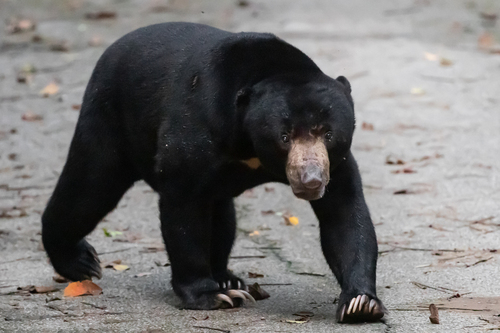
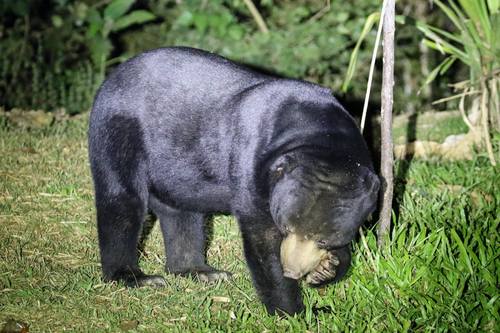
Sun bears are compact, stocky and powerful for their size. They have exceptionally short fur for a bear, a dense black coat only a few centimetres long, which reflects their hot, humid habitat where a thick pelt would be a serious liability. The muzzle is light greyish or tan, the chest patch is yellow, orange, or cream, typically U-shaped but sometimes circular. Some individuals lack it.
The head is broad and short-jawed. The bite force is remarkable for an animal this size, sun bears routinely crack open hardwood logs to reach beetle larvae. Their forepaws are large and inward-turning, with hairless soles for grip and strongly curved claws. The hind feet are plantigrade, like all bears, but flexible enough for sure-footed tree climbing.
The skin, particularly around the neck and shoulders, is unusually loose. This is not an accident of anatomy. A sun bear seized from behind by a tiger or clouded leopard can twist its body inside its own skin, rotate its head back and bite the attacker's face. Few large carnivores share this capacity.
Built for the Canopy
Sun bears are the most arboreal of the eight living bear species. They do not merely climb occasionally, they live in the trees. Adults feed, sleep, raise cubs and escape threats in the canopy, descending to the forest floor primarily to travel between fruiting trees or to dig into termite mounds.
Climbing adaptations:
- Long, strongly curved claws
- Hairless paw pads for traction on wet bark
- Powerful forelimbs disproportionate to body size
- Inward-rotated forefeet that hook around trunks
- Loose skin around the neck for rapid body rotation
- Relatively small body mass that supports arboreal locomotion
- Short fur that does not snag on branches
Sun bears sunbathe and sleep in trees 2 to 7 metres above the ground, and also rest in hollow logs and tree cavities.
Cubs are kept on buttress roots at the base of trees until they learn to walk and climb properly, and mothers protect them aggressively. The tiger is the major predator of sun bears, with dholes and leopards recorded less often.
Unlike hibernating bears, sun bears never enter prolonged dormancy. Food is available year-round in their tropical habitat, so the metabolic shutdown of winter sleep would be pointless. They maintain a consistent activity budget throughout the year, adjusting only for local fruiting cycles and weather.
The Tongue
Among the sun bear's most distinctive features is its tongue. It can reach about 30 centimetres when fully extended.
The tongue is narrow, muscular and tapered. Its length evolved for a specific set of feeding tasks:
- Probing the inner chambers of bee and wasp nests
- Extracting honey from hollow branches and rock crevices
- Cleaning out termite galleries after the bear breaks open the mound
- Harvesting ants and ant brood from tree trunks
- Reaching beetle larvae through narrow cracks in hardwood
The tongue's reach, combined with the bear's strong claws and powerful bite, allows sun bears to exploit food sources that other mammals cannot reach.
The common name "honey bear" refers directly to this equipment. A sun bear will climb a tree, tear open a wild bee colony with its claws, and scoop out comb and larvae with its tongue.
Diet and Foraging
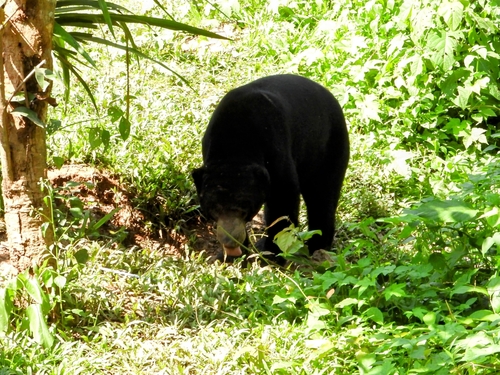
Sun bears are opportunistic omnivores with a strong bias toward soft, high-energy foods. Their diet is one of the most varied of any bear species, but several items dominate.
Primary foods:
- Termites (including entire mounds broken open with forelimbs)
- Ants and ant brood
- Beetle larvae extracted from dead wood
- Bees, wasps and honey
- Wild figs ( Ficus spp.), a keystone food in many ranges
- Durian, rambutan and dozens of other tropical fruits
Secondary foods:
- Small mammals and lizards
- Bird eggs and nestlings
- Carrion (when encountered)
- Palm hearts and tender shoots
- Crops (especially bananas, corn, coconuts, palm fruit)
Sun bears are important ecological actors. By consuming fruit across wide areas and defecating seeds far from parent trees, they contribute significantly to tropical seed dispersal. By breaking open hardwood logs to reach grubs, they accelerate the decomposition of fallen timber and redistribute nutrients to the soil. By digging into termite mounds, they expose soil and control insect populations.
Home ranges reported for sun bears run from about 7 to 27 square kilometres in Borneo and Peninsular Malaysia.
Life Cycle and Reproduction
Sun bear reproduction is less rigidly seasonal than in temperate species. Mating can occur in any month, though some populations show loose peaks tied to regional fruiting cycles.
Reported gestation lengths vary from 95 to 240 days, possibly because of delayed implantation or fertilisation. Pregnancies tend to be longer in zoos in temperate climates.
Typical reproductive cycle:
- Mating: any month, occasionally prolonged
- Gestation: reported as 95-240 days
- Litter size: 1-2 cubs
- Birth weight: around 325 grams
- Eye opening: roughly 25 days
- Independence: nearly 3 years
- Sexual maturity: 2-4 years
Cubs are born inside hollow tree cavities, deaf and with their eyes closed.
Social Behaviour and Communication
Sun bears are generally solitary, though they are sometimes seen in pairs such as a mother and her cub.
Documented social phenomena:
- Facial mimicry during play and solicitation (confirmed 2019)
- Vocalisations including grunts, snuffles, short barks and roars during the breeding season
In 2019, a study documented sun bears demonstrating skilful mimicry of facial expressions with precision equal to that found in gorillas and humans.
Range, Population, and Subspecies
Sun bears inhabit the tropical and subtropical forests of Southeast Asia, one of the most biodiverse and also most deforested regions on Earth.
Range by country:
| Country | Status |
|---|---|
| Indonesia | Widespread on Borneo and Sumatra; major stronghold |
| Malaysia | Both peninsular and East Malaysian populations |
| Thailand | Declining; locally extinct across much of its former range |
| Myanmar | Present but poorly surveyed |
| Laos | Bear farming and poaching reported |
| Cambodia | Present; declining |
| Vietnam | Feared to decline severely over the next 30 years |
| China | Presence confirmed in 2017 in Yingjiang County, Yunnan |
| India | Northeastern states; status uncertain |
| Bangladesh | Numbers especially low |
No reliable global population estimate exists. Reported densities range from about 4 to 6 bears per square kilometre in Khao Yai National Park, Thailand, to 26 per square kilometre in the Harapan Rainforest in southern Sumatra. The two subspecies differ noticeably.
Subspecies comparison:
| Feature | H. m. malayanus (mainland/Sumatra) | H. m. euryspilus (Borneo) |
|---|---|---|
| Distribution | Mainland Southeast Asia, Bangladesh and Sumatra | Borneo only |
| Skull | Larger | Smaller |
Conservation Status and Threats
The IUCN Red List classifies sun bears as Vulnerable with a decreasing population trend. The species is listed on CITES Appendix I, which prohibits international commercial trade, and is legally protected from hunting across most of its range, with exceptions in Sarawak (Malaysia) and Cambodia.
Primary threats:
- Habitat loss. Oil palm, rubber, pulp plantations, logging and road construction have fragmented most of the sun bear's range.
- Poaching for bile and gall bladders. Sun bear bile is used in traditional medicine in parts of Southeast Asia and East Asia. Adult bears are killed, cubs are sometimes taken for the pet trade.
- Bile farming. Multiple range states, including Laos, Vietnam and Myanmar, have seen sun bears held captive at bear farms. Bans in various countries have not stopped illegal operations from continuing. The welfare costs are severe.
- Pet trade. Cubs are captured when mothers are killed. Orphaned cubs end up in homes, roadside attractions, or private collections.
- Human-bear conflict. Farmers killing sun bears that raid crops or honey hives is common practice. Expansion of plantations from former forest areas boosts the frequency of bear-farmer encounters.
- Road mortality. New forest roads fragment habitat.
Protected areas across the sun bear's range, anti-poaching patrols, community education and rescue operations at centres like the Bornean Sun Bear Conservation Centre in Sabah form the core conservation strategy. What happens to Southeast Asia's remaining primary forest will determine the species' long-term future.
Sun Bears and Humans
Sun bears occupy a particular place in the folklore of Southeast Asia. In Malay culture the name beruang madu is entirely descriptive, focused on the bear's honey-raiding habit rather than on any supernatural attribute.
Modern relationships are more difficult. Sun bears are hunted illegally across much of their range for meat, bile and gall bladders. Cubs continue to be taken for the pet trade despite national laws. In agricultural areas, bears are killed when they damage crops. Conservation organisations work to reduce these pressures through enforcement, education, and, where appropriate, financial compensation to affected farmers.
Ecotourism remains small but growing in parts of Borneo and peninsular Malaysia, where rehabilitated bears in forest enclosures allow visitors to observe the species without impact on wild populations. Done well, this tourism supports conservation and livelihoods. Done badly, it risks habituating rescued bears to human presence in ways that preclude eventual release.
Illustration.
Frequently asked questions
Sun bears (Helarctos malayanus) are the smallest bears alive today. Adults measure 100-140 cm from nose to tail and stand nearly 70 cm at the shoulder. Adults weigh about 25-65 kg, and males tend to be roughly 10-20% larger than females.
Cubs weigh around 325 grams at birth and stay with their mother for nearly three years. The Bornean subspecies (H. m. euryspilus) has a smaller skull than the mainland Malayan form (H. m. malayanus).
Sun bears are opportunistic omnivores with a strong preference for insects and fruit. Their core diet includes termites, ants, beetle larvae, bees, honey, wild figs, durian and other tropical fruits. They will also take small vertebrates, birds’ eggs and carrion when available. Their very long tongue, which can reach about 30 cm, is adapted for probing honey combs and insect galleries inside trees.
Sun bears act as seed dispersers for rainforest fruit trees. By tearing open logs to reach grubs they also help break down fallen timber.
Sun bears inhabit the tropical forests of Southeast Asia. Their range spans Borneo, Sumatra, the Malay Peninsula, Myanmar, Thailand, Laos, Cambodia, Vietnam, Brunei, northeastern India and Bangladesh. Their presence in China was confirmed in 2017 in Yunnan Province. They are extinct in Singapore.
They are typically found at low altitudes in evergreen and seasonal forest. Sun bears tend to avoid heavily logged forest and areas close to human settlement, although they are sometimes seen in farmland, plantations and orchards. They are locally extinct across much of their former range, especially in Thailand.
The IUCN lists sun bears as Vulnerable with a decreasing population trend. No reliable global population estimate exists, but the population is estimated to have declined by about 35% since the 1990s. Heavy deforestation from agriculture, logging and forest fires, together with hunting for the wildlife trade, are the most severe threats.
Secondary threats include poaching for traditional medicine (especially bile and gall bladders), the pet trade in cubs and conflict with farmers protecting crops. Sun bears are kept in bear farms for bile in Laos, Vietnam and Myanmar, which remains a major welfare and conservation issue.
No. Sun bears do not hibernate, possibly because food resources are available throughout the year across their tropical range. There is no seasonal shortage severe enough to force the metabolic shutdown seen in brown bears or black bears during winter.
Because they never hibernate, sun bears are active year-round and they breed throughout the year.
Sun bears are the most arboreal members of the bear family. They climb to feed on fruit, raid bee nests, escape threats and sleep or sunbathe in trees 2 to 7 metres above the ground. Their anatomy is built for climbing: strongly curved claws, powerful forelimbs, a flattened chest, hairless soles and inward-turning forefeet.
Cubs are kept on buttress roots at the base of trees until they learn to walk and climb properly. Mothers protect them aggressively, and the tiger is the main predator of sun bears.
Yes. A study published in 2019 described skilful mimicry of facial expressions by sun bears, with precision comparable to that seen in gorillas and humans.
The finding suggests a degree of social cognition in a species that is otherwise generally solitary.
Sun bears rarely attack people, whether provoked, injured or protecting cubs. Historically tamed and kept as pets due to their shy nature, they become fierce when surprised in the wild.
Extra loose neck skin allows a restrained bear to swing and bite an attacker, a defensive mechanism found in few other carnivores.
References
- Range and subspecies information reflects consolidated findings from the TRAFFIC sun bear trade reports and the Bornean Sun Bear Conservation Centre's published field data.
- Scotson, L., Fredriksson, G., Augeri, D., Cheah, C., Ngoprasert, D. & Wai-Ming, W. 2017. Helarctos malayanus (errata version published in 2018). The IUCN Red List of Threatened Species 2017: e.T9760A123798233. View source