Indian Red Scorpion: Why Its Sting Kills
Hottentotta tamulusClinical studies report that 8% to 40% of Indian red scorpion sting victims died, mostly children, yet early oral prazosin cut mortality to below 4%.
 Strange Animals EditorialFebruary 1, 2025·12 min read·Editorial standards ↗
The Indian red scorpion is one of the most medically dangerous scorpions on Earth. It is not the biggest and it is not the most famous, that honour belongs to the deathstalker of North African deserts.
Yet Hottentotta tamulus , a reddish-orange arachnid small enough to fit inside a child's palm, is of great medical significance in densely populated parts of India and Nepal.
It does so from inside the walls and under the bedding of rural Indian village houses, where encounter rates are high and children are exposed, and its cardiotoxic venom causes deaths every year.
This guide covers every aspect of the Indian red scorpion's biology, venom pharmacology, clinical medicine and the uneven relationship between a small arachnid and the people who live within reach of its sting.
Etymology and Classification
The scientific name Hottentotta tamulus was assigned by the naturalist J.C. Fabricius, who named it Scorpio tamulus in 1798. The species was placed in the genus Hottentotta by A. A. Birula in 1914. The species epithet tamulus refers to the Tamil-speaking region of southeastern India, where the species occurs.
Taxonomically the Indian red scorpion sits in the family Buthidae, the same family that contains the deathstalker, the Brazilian yellow scorpion and most other medically significant scorpion species. Buthidae includes most of the medically significant scorpion species.
Hottentotta itself contains dozens of species spread across Africa, the Middle East and South Asia.
Although filed in the site hierarchy under insects/scorpions for navigation, the Indian red scorpion is not an insect. It is an arachnid, sharing its class with spiders, ticks and mites. Arachnids have eight legs, two body segments and no antennae, a body plan that diverged from the insect lineage more than four hundred million years ago. Scorpions are among the oldest terrestrial animals on Earth, with a fossil record stretching back at least 430 million years.
Indian Red Scorpion Size and Physical Description
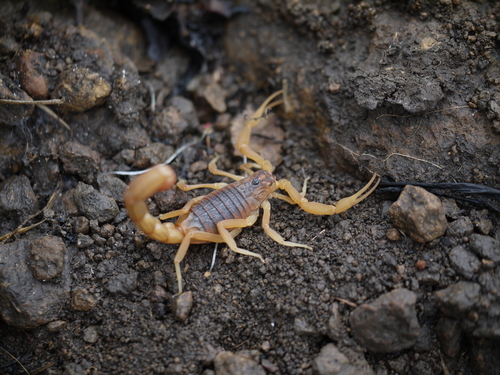
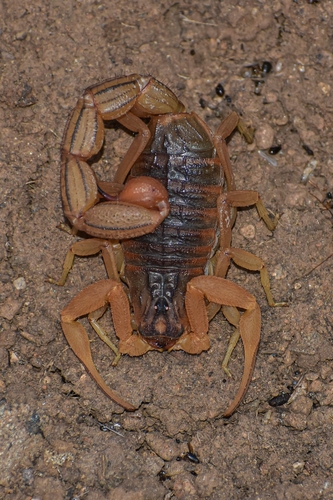
The Indian red scorpion is a small to medium scorpion. Adult body length, measured from the chelicerae to the tip of the telson, is about 50 to 90 millimetres in total. The base of the pedipalp pincers is slightly more inflated in males than in females.
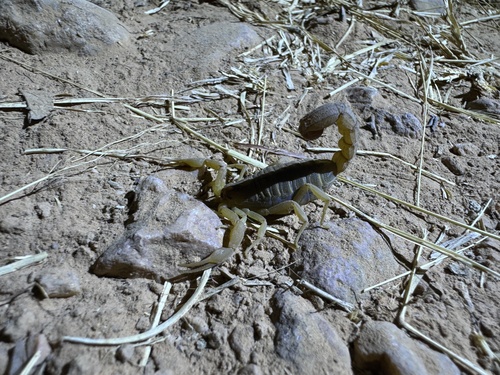
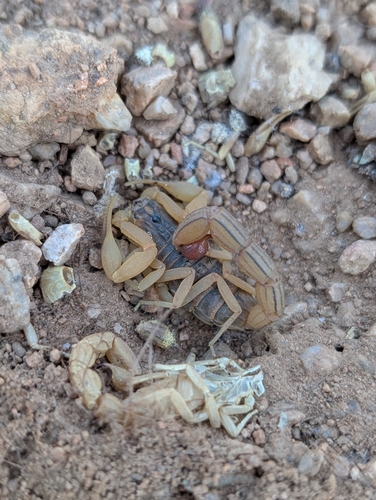
The colour is diagnostic. Adults are reddish-orange to deep rust-red across the carapace, mesosoma and metasoma (tail). Some populations trend browner, others are almost scarlet. The walking legs and the tips of the pincers are often paler, orange-yellow to light reddish-brown.
The dorsal surface of the tail bears fine longitudinal ridges, and the telson, the bulb that houses the venom glands, is large relative to the body and distinctly bulbous, tipped with a sharply curved aculeus. The red colouration is aposematic in evolutionary terms: a warning signal to potential vertebrate predators that the animal is dangerous. In practice this warning is ignored by most rural Indian children, who handle the scorpions regardless.
Body plan summary:
- Total length: about 50-90 mm
- Colour: reddish-orange to rust-brown
- Pincers (pedipalps): slender, not massive, indicative of reliance on venom rather than grip
- The tail (metasoma) comprises five segments that are ridged dorsally and ends with a large venom bulb.
- Eyes: one median pair plus two to five lateral pairs, vision poor
Habitat and Range
Hottentotta tamulus is native to the Indian subcontinent. Its range covers most of India, eastern Pakistan and the eastern lowlands of Nepal, and it has been recorded more recently from northern Sri Lanka.
The species tolerates a remarkably wide range of habitats. It lives in scrubland, rocky ground, cropland, orchards and plantations. Above all it lives in and around human dwellings. Village houses built with mud bricks, stone, fired brick, or thatched roofing provide ideal scorpion habitat: cool, dark daytime refuges with stable humidity, plus an abundant supply of insect prey drawn to human food stores and light.
Typical daytime hiding places inside rural homes include wall crevices, gaps behind plaster, under stacked firewood, inside piles of grain sacks, under discarded footwear, beneath doormats, under cooking vessels, inside bedding and in rolled-up clothing. The species is strongly nocturnal. At night it emerges to hunt small invertebrates, and occasionally small vertebrates such as lizards.
Venom Chemistry and Pharmacology
Indian red scorpion venom is a complex cocktail of short-chain and long-chain peptide toxins, many of which act on ion channels in vertebrate nerve and heart cells. The dominant clinical actors are sodium channel toxins that block the inactivation of voltage-gated sodium channels on peripheral sympathetic and parasympathetic nerves.
The result is a flood of neurotransmitter release, principally adrenaline and noradrenaline, but also acetylcholine, from autonomic nerve terminals throughout the body.
This is fundamentally different from the venom of many classical killers, such as cobras, whose toxins act directly on neuromuscular junctions. H. tamulus kills primarily by hijacking the victim's own autonomic nervous system. The first few minutes after a severe sting bring an intense cholinergic phase: sweating, salivation, vomiting, bradycardia and priapism are classic early features.
This is followed by an adrenergic storm: severe hypertension, tachycardia, peripheral vasoconstriction and pulmonary oedema.
The final cause of death in fatal cases is almost always acute pulmonary oedema and cardiogenic shock driven by catecholamine cardiotoxicity. Children are more vulnerable because the pediatric heart is smaller, the venom dose per kilogram is higher and the pediatric myocardium responds more severely to catecholamine overload.
Mortality and Public Health Impact
Fatality rates of 8% to 40% have been reported in clinical studies of Indian red scorpion stings, and most victims are children.
Deaths from stings have also been recorded in Nepal and Sri Lanka.
Children account for the majority of victims. Several factors are thought to drive the age skew. Biologically, a child's lower body mass concentrates venom at a higher dose per kilogram. The pediatric heart is more susceptible to catecholamine-induced myocardial injury.
Behaviourally, children in rural India play on the ground, pick up firewood and sleep on low bedding where scorpions hide. Socially, parents may try village remedies before travelling to a hospital, losing the critical first few hours when prazosin is most effective.
The Prazosin Story
The single most important clinical advance in Indian red scorpion medicine came not from a new antivenom but from the pharmacological repurposing of an existing antihypertensive drug. Prazosin, a selective alpha-1 adrenergic receptor blocker originally developed in the 1970s for the treatment of high blood pressure, turned out to be almost perfectly suited to reversing the catecholamine-driven cardiovascular crisis of severe H. tamulus envenomation.
Rural Maharashtra clinicians made the breakthrough. Dr. H. S. Bawaskar and colleagues noticed that children killed by H. tamulus stings perished from pulmonary oedema resulting from extreme peripheral vasoconstriction and sky-high afterload on the heart.
An alpha-1 blocker, they reasoned, would relax the peripheral vasculature, reduce afterload, unload the left ventricle and clear the pulmonary oedema. Clinical studies reported that oral prazosin, given as early as possible after a suspected severe sting, reduced mortality to less than 4%.
Prazosin is now the first-line therapy for severe Indian red scorpion envenomation throughout South Asia. It is inexpensive, widely available and stable under tropical storage conditions. Scorpion antivenom is also used, but it has little effect compared with prazosin.
Treatment protocol summary:
- Administer oral prazosin as soon as severe envenomation is suspected, with repeat doses as needed
- Provide supplemental oxygen and monitor cardiac rhythm and blood pressure continuously
- Give scorpion antivenom in severe cases where available, though its effect is limited
- Manage pulmonary oedema with conservative fluid balance, inotropic support if cardiogenic shock develops
Behaviour, Reproduction, and Life Cycle
Indian red scorpions are nocturnal ambush and pursuit predators. They emerge from diurnal refuges at dusk, forage through the night using sensitive mechanoreceptors on the pectines and legs to detect vibrations and chemical cues, and return to cover before dawn. Prey is captured with the pincers, immobilised with a venom sting and consumed over a period of hours.
Reproduction is live-bearing, a feature shared with all scorpions. Mating follows a characteristic scorpion courtship dance called the promenade a deux , during which the male grasps the female's pincers and moves her in a coordinated walk over suitable ground while depositing a spermatophore that she takes up into her genital opening.
Females give birth to live young, called scorplings, which climb onto the mother's back and remain there through their first moult before dispersing.
Cohabitation With Humans
The Indian red scorpion often lives close to human settlements, especially in rural areas. Human settlement has expanded its habitat rather than reduced it. Village houses provide a stable microclimate, abundant insect prey and countless refuges. Agricultural landscapes offer further habitat via stone walls, crop stubble and irrigation channels. The result is frequent contact between the scorpion and rural people.
Preventive measures focus on reducing indoor hiding places and protecting vulnerable family members. Raised beds with mosquito nets tucked under the mattress substantially reduce nocturnal stings during sleep. Sealing wall cracks, removing piles of firewood from inside homes, clearing clutter around sleeping areas and checking footwear before putting it on are all simple and effective.
Pet Trade and Legal Status
Scorpions are widely kept as pets, but the Indian red scorpion is a medically dangerous species and is not a suitable pet.
Most responsible keepers discourage the species on welfare and safety grounds, and the rules on keeping dangerous scorpions vary between jurisdictions.
Because the venom can be fatal, a sting in a home collection far from specialist care would be a genuine medical emergency.
Conservation and Threats
Hottentotta tamulus has not been formally assessed by the IUCN Red List. Local abundance across its range is high, the species is commensal with rural human settlement and thrives in agricultural landscapes, so global extinction risk appears very low. Localised threats include habitat conversion, intensive pesticide use in some agricultural regions, and targeted killing after human stings.
The species is not listed under CITES. For most of its range, the Indian red scorpion is a public health concern rather than a conservation concern, and that balance is likely to continue.
Illustration.
Frequently asked questions
Adult Hottentotta tamulus measure about 50-90 mm in total length. The pincers are rather small, the tail segments moderately thickened and the telson bulbous with a large stinger.
Its modest size lets it hide in wall cracks, clothing folds and bedding, which is part of why human encounters inside village homes are common.
Hottentotta tamulus is of great medical significance in densely populated areas of India and Nepal. Fatality rates of 8-40% have been reported in clinical studies, and most victims are children.
The combination of a cardiotoxic venom, close contact with rural households and limited hospital access in the regions it inhabits makes it a serious public health problem.
The venom is a complex mixture of peptide toxins that act on ion channels. The dominant clinical effect is an autonomic storm: sodium channel toxins force a massive release of neurotransmitters, including adrenaline and noradrenaline. The surge drives severe hypertension, tachycardia, peripheral vasoconstriction and pulmonary oedema.
Acute myocarditis and shock can follow. Treatment rests on the alpha-blocker prazosin and supportive care, with scorpion antivenom used where available, though its effect is limited.
Hottentotta tamulus is native to the Indian subcontinent. Its range covers most of India, eastern Pakistan and the eastern lowlands of Nepal, with more recent records from northern Sri Lanka. The species tolerates a range of habitats: scrubland, rocky ground, cropland, orchards, plantations and above all human dwellings.
It thrives in rural villages where wall cracks, thatched roofs, stacked firewood and discarded footwear provide dark daytime refuges.
Emergency care centres on prazosin, an alpha-1 adrenergic blocker given orally as soon as severe envenomation is suspected. It reverses the catecholamine-driven cardiovascular crisis and has been reported to reduce mortality to less than 4%.
Scorpion antivenom is also used in severe cases where available, though it has little effect compared with prazosin. Supportive intensive care (oxygen, fluid balance, inotropes where needed and close cardiac monitoring) manages complications.
Most victims of fatal stings are children. Biologically, a child’s smaller body mass concentrates venom at a higher dose per kilogram than in an adult stung by the same scorpion. The pediatric heart is also more susceptible to catecholamine-induced myocardial injury. Behaviourally, children in rural India play on the ground, handle footwear without checking and sleep on low bedding where scorpions hide.
Socially, parents may try village remedies before travelling to a hospital, losing the critical window when prazosin works best.
Scorpions are widely kept as pets, but the Indian red scorpion is a medically dangerous species and most responsible keepers discourage it on welfare and safety grounds. Rules on keeping dangerous scorpions vary between jurisdictions.
Because the venom can be fatal, a sting in a home setting far from specialist care would be a genuine medical emergency.
Hottentotta tamulus has not been formally assessed by the IUCN Red List. Local abundance across its range is high, and the species is commensal with rural human settlement and thrives in agricultural landscapes, so global extinction risk appears very low. Localised threats include habitat conversion, pesticide exposure in intensive farming and targeted killing after human stings.
For most of its range the species is a public health concern rather than a conservation concern.
References
- Relevant peer-reviewed and governmental sources consulted for this entry include the Haffkine Institute clinical protocols for scorpion envenomation, Bawaskar H.S. and Bawaskar P.H. published work on prazosin therapy in the Journal of Association of Physicians of India and The Lancet, Indian Council of Medical Research public health bulletins, and published research in Toxicon, Clinical Toxicology, and BMJ.
- Specific mortality figures reflect pediatric case series from Maharashtra, Tamil Nadu, and Karnataka tertiary care centres.