European Stag Beetle: Years as a Grub
Lucanus cervusEuropean stag beetle larvae spend three to seven years chewing rotten hardwood underground, while the winged adult lives only a few weeks of summer.
 Strange Animals EditorialMay 26, 2025·14 min read·Editorial standards ↗
The European stag beetle is the largest terrestrial beetle in northern Europe, the flagship insect of every dead-wood conservation campaign on the continent, and one of the most unmistakable creatures a gardener in southern Britain or the Rhine valley is ever likely to encounter.
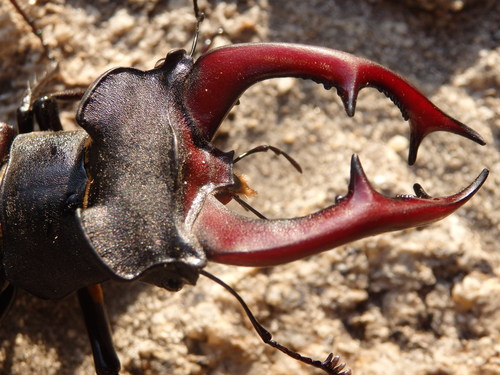
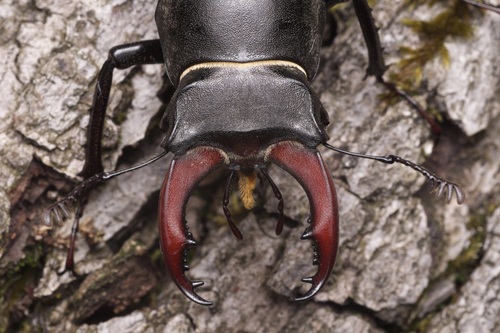
Males carry a pair of enormous antler-shaped mandibles, a display weapon so exaggerated that the species was named after the red deer ( cervus ) it seems to imitate. Yet the swaggering, armoured adult is only the public face of a much stranger creature.
For every few weeks a stag beetle spends flying, fighting and drinking tree sap, it has already spent three to seven years underground as a pale, legless grub chewing slowly through rotten heartwood.
This guide is a full wiki-style reference for Lucanus cervus : taxonomy, size and physical description, life cycle, the ecology of the larva, the short adult summer, the mechanics of male combat, habitat, range, cultural and folkloric reputation and the conservation crisis that now protects the species under law in much of Europe.
Etymology and Classification
The genus name Lucanus is ancient. Pliny the Elder, writing in the first century CE, records that the name was given after the region of Lucania in southern Italy, where the beetles were used as amulets. The species epithet cervus is simply the Latin word for red deer, a direct reference to the male's antler-like jaws. Linnaeus described the species in 1758 as Scarabaeus cervus , and it was later placed in the genus Lucanus .
In common speech almost every European language gives the beetle a name rooted in deer or cattle imagery. English 'stag beetle' mirrors German Hirschkafer (stag beetle), French cerf-volant (flying stag), Dutch vliegend hert (flying deer), Italian cervo volante , and Spanish ciervo volante .
Taxonomically Lucanus cervus sits inside the family Lucanidae , the stag beetles proper, within the enormous order Coleoptera. Roughly 1,200 stag beetle species are currently described worldwide, but L. cervus is the undisputed European flagship and the species most people mean when they say 'stag beetle' without a qualifier.
In Britain, the smaller, all-black lesser stag beetle ( Dorcus parallelipipedus ), which has a squarer head, is often confused with female L. cervus . Identification depends on mandible shape, colour saturation of the elytra and subtle details of the male's head-shield.
Size and Physical Description
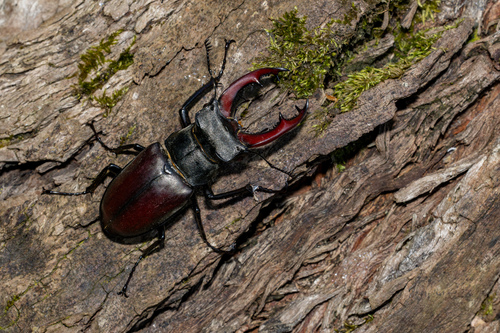
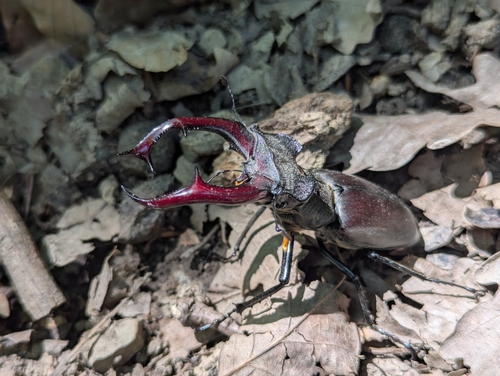
Stag beetles show pronounced sexual dimorphism. Males are larger on average, more heavily armoured and carry the oversized mandibles that give the species its name. Females are smaller, rounder and matte brown to almost black rather than the chestnut-red of a well-nourished male.
Males:
- Total length including mandibles: up to 75 mm
- Elytra (wing cases): deep chestnut red to mahogany brown
- Head and thorax: glossy black with a bronze sheen in fresh specimens
Females:
- Total length: 30-50 mm
- Mandibles: short, straight, sharply pointed, black
- Colour: more uniformly dark brown or black
- Build: stockier, with a broader abdomen to accommodate eggs
The difference in mandible size is extreme and is driven almost entirely by larval nutrition. A grub raised in a large, fungus-saturated oak stump finishes its larval period with surplus body reserves, which it channels into producing a 'major' male with huge antlers. A grub raised in a smaller or drier piece of wood emerges as a 'minor' male with noticeably shorter jaws.
These morphs belong to the same species, can breed freely with each other and use fighting tactics that reflect the armaments they possess.
The elytra are smooth, slightly rounded and beautifully polished. Under the elytra lie fully functional membranous flight wings. In flight the beetle hangs almost vertically with head and thorax raised and legs trailing, a distinctive silhouette and the flight is slow and lumbering with a low-pitched buzz.
The Hidden Life of the Larva
More than ninety per cent of a stag beetle's biological life is spent underground, hidden inside rotten wood, as a pale C-shaped grub. This is the phase most people never see and the phase that drives almost every aspect of the species' conservation status.
Larval profile:
- Body: soft, whitish, plump, curled in a C-shape
- Head capsule: hard, orange-brown, with powerful cutting mandibles
- Legs: three pairs, very short relative to body size
- Duration: 3-7 years depending on climate and food quality
The larva eats only decaying hardwood. It cannot process living, sap-filled tissue and depends on white-rot fungi that have already partially broken down the lignin and cellulose of the wood. Recorded host trees include oak, lime, beech, willow, black poplar, ash, horse chestnut, wild cherry and common walnut.
Grubs are almost always found at or below ground level, deep inside stumps, in buried roots, in wooden fence posts rotting below the soil line, or in compost heaps containing substantial chunks of hardwood.
Larvae produce audible stridulations using combs on their legs. These vibrations travel through the surrounding rotten wood and allow larvae to communicate with one another.
Growth is slow, thermally limited and strongly seasonal. A larva passes through three instars before pupation, and the whole larval stage lasts three to seven years.
Pupation happens in an earthen cell in the soil, constructed by the final-instar larva. Inside this cell the larva undergoes metamorphosis, emerges as a teneral (soft-bodied, pale) adult, and then waits underground for months while the cuticle hardens and darkens. The new adult usually emerges above ground only in the summer following pupation.
The Short Summer of the Adult
After up to seven years underground, the winged adult emerges for a frantic, short-lived surface phase measured in weeks rather than years. Across most of Europe adults are on the wing between late May and early August, with peak activity in June and July.
Adult activity schedule:
- Emergence: from late May
- Peak flight: warm, still, humid evenings an hour before and after dusk
- Daily pattern: hidden in leaf litter or under bark by day, active at twilight
- Mating and oviposition: late June to late July
- Death: within a few weeks, by about August
Adults do not feed on solids. Their mandibles, despite looking like weapons, are non-functional for chewing: in males the inner surfaces are specialised for gripping rival males, while in females the mandibles are shorter and stouter. Actual feeding is done by the labium , a soft pad covered in dense hairs that functions as a sponge for lapping up tree sap, rotting fruit juice and honeydew.
The sap-feeding adults are surprisingly social at good sap runs. A single weeping oak wound can attract several beetles, including both sexes and provide a rendezvous where mating occurs. Males patrol sap sites aggressively, driving away rivals, while females visit briefly to drink and to assess potential mates.
Females lay eggs singly or in small groups in soft rotten wood close to or below ground level. A female lays about 30 eggs over her brief adult life. Each egg hatches into a first-instar grub, which immediately begins to feed on the surrounding wood. The cycle then restarts, another three to seven years underground before the next adult summer.
Male Combat and Sexual Selection
The oversized male mandibles are, from an evolutionary standpoint, the single most important feature of the species. They are a textbook example of sexual selection: a weapon shaped not by predators or prey but by competition for mates.
Mechanics of combat:
- Two males meet on a sap run, a branch, or the bark of an egg-laying tree.
- Both raise their forebodies and spread their mandibles wide in a threat display. In most encounters one male backs down at this point.
- If neither retreats, the larger male advances and locks mandibles with the rival.
- The aim is not to bite but to slide the mandibles underneath the opponent's body, grip the underside of the thorax, lift the opponent clear of the surface and flip him off the branch.
- Dislodged losers walk away generally uninjured. Winners maintain the territory and, usually, access to any nearby females.
This combat style explains why the mandibles are so long yet so mechanically weak. A wrestler's advantage comes from reach, not bite force. The longer a male's mandibles relative to his body, the more easily he can slide them under a rival and lever him off the branch.
Contrary to a persistent myth, male stag beetles cannot meaningfully bite a human finger. The mandibles are too long for strong closure. Females are another matter: their shorter, straighter, sharper mandibles are perfectly capable of pinching hard enough to draw a droplet of blood from handling, though they are not venomous and do not pursue people.
Habitat, Range, and Population Hotspots
Lucanus cervus has a broad but increasingly patchy distribution across Europe and into western Asia.
Core range by country:
| Country | Status | Notes |
|---|---|---|
| United Kingdom | Declining, legally protected | Largely south-east England, especially South and West London |
| Germany | Widespread | Mainly in the south |
| Spain and Portugal | Present | Northern half of each country |
| Italy | Present | Mainly northern and central regions |
| Hungary and Romania | Present | Hilly and mountainous areas |
| Croatia and Slovakia | Range increasing | Only countries where the range is expanding |
| Denmark | Disappeared around 1970 | Reintroduced in 2013 |
| Latvia | Extinct | No surviving population |
| Turkey, Caucasus, Asia Minor, Syria, west Kazakhstan | Eastern part of range | Beyond the European core |
The species is widespread across Europe but absent from Ireland. Within its range, stag beetles are not uniform: they are absent from intensively managed farmland, young plantations, conifer forests and most tidy urban parks. They persist where mature native hardwoods and substantial dead wood buried in the soil overlap.
Crucially, in Britain many populations now live in suburban gardens and allotments rather than in forests. This is because gardens often retain buried stumps, old fence posts and compost-heap woodpiles in exactly the configuration a larva needs, while modern forestry removes such material almost everywhere else.
Conservation Status and Legal Protection
The IUCN European Red List assessment (2010) classifies Lucanus cervus as Near Threatened , while the 2017 Mediterranean assessment lists it as Least Concern.
Legal protection:
- EU Habitats Directive Annex II (since 1992): species of community interest whose conservation requires the designation of Special Areas of Conservation
- Bern Convention Appendix III
- United Kingdom Wildlife and Countryside Act 1981 (Schedule 5): protection against sale
- UK Priority Species under the Post-2010 Biodiversity Framework
Principal threats:
- Loss of dead wood. Modern forestry, parkland management, suburban tidying and the replacement of traditional hedgerows all strip away rotting stumps, buried roots and fallen logs. Because larvae cannot relocate, the loss of a stump is the permanent end of that family line.
- Habitat fragmentation. Adults are weak flyers. Once a population is isolated from neighbouring populations by unsuitable land, genetic exchange effectively stops and local extinction risk rises.
- Road traffic. Flying adults are struck in large numbers on warm summer evenings, especially on roads that pass through oak woodland.
- Predation. Magpies, crows, badgers and foxes learn to intercept emerging adults at known breeding sites. Domestic cats take a meaningful toll on adult beetles in suburban gardens.
- Pesticides. Systemic insecticides used on garden trees and in orchards can poison both larvae in buried roots and adults feeding on sap.
- Climate change. Emergence timing shifts, summer drought intensity and winter warmth may desynchronize adult activity with nectar and sap availability and speed up the drying of larval habitat in wood.
Active conservation measures:
Large-scale public monitoring programmes run by the People's Trust for Endangered Species in the United Kingdom and equivalent bodies across Europe depend on citizen reports of adult sightings. Gardeners are actively encouraged to leave stumps in place, bury hardwood logs vertically as 'log pyramids' or 'loggeries', and avoid pesticide use.
None of these measures addresses the forestry-scale loss of dead wood across most of the European continent.
Cultural History
Few insects carry as heavy a cultural load as the European stag beetle. The species appears in Roman natural history, medieval bestiaries, Renaissance oil painting, Victorian natural history cabinets and contemporary European popular culture.
Pliny the Elder recorded that stag beetles were used as amulets in Lucania. Albrecht Durer's 1505 watercolour Hirschkafer is one of the most celebrated insect portraits in the history of European art.
In England's New Forest the beetle was known as the 'devil's imp', believed to be sent to harm corn crops and people stoned the insects on sight.
Stag beetles as a group are popular pets in parts of Asia.
Stag beetles also feature in folklore, children's literature and modern conservation branding. The species is effectively the panda of European invertebrate conservation: large, charismatic, easy to recognise, easy to photograph, easy to explain to the public and a genuine indicator of wider ecological health.
Stag Beetles and Humans Today
For most Europeans today, a stag beetle encounter is a summer evening novelty: a large, slow-flying, helicopter-shaped insect landing on a fence, a shed wall, or a warm pavement. The beetles are harmless, fascinating and increasingly scarce, and nearly every national wildlife agency encourages the public to record sightings rather than remove the animals.
Practical advice issued by conservation charities is consistent across the continent: do not lift stag beetles by their mandibles, do not move them away from where they were found, do not relocate them to 'better' habitat because adults die within weeks regardless, and in particular do not dig up or move suspected larvae, which almost never survive transfer.
Gardeners wishing to help are advised to leave any existing buried wood undisturbed, bury additional hardwood logs vertically in shaded corners of the garden, avoid all use of systemic insecticides on trees, and report adult sightings to national monitoring schemes.
The long-term future of Lucanus cervus is uncertain but not hopeless. Unlike many threatened species the remedy is known, cheap and popular with the public: leave dead wood in the landscape. Whether European forestry and parkland management will do so at scale is a political question as much as a biological one.
Frequently asked questions
Adult males of Lucanus cervus grow up to about 75 mm in total length including the mandibles, making the species the largest terrestrial beetle in Europe and the UK’s largest beetle. Females are smaller, usually 30-50 mm and lack the oversized jaws.
Mandible size in males varies with larval nutrition: a grub that grew up in a well-rotted, fungus-rich oak stump becomes a ‘major’ male with huge antlers, while one raised in drier or poorer wood emerges as a ‘minor’ male with noticeably smaller jaws. Both morphs are the same species and interbreed freely.
Diet differs completely between life stages. The larva feeds on decaying wood of trees such as oak, beech, ash, willow, lime and wild cherry, and relies on white-rot fungi to partially break down the wood before it consumes the fibres. Adults do not chew solid food.
Adults drink liquids such as tree sap, the juice of fallen fruit and nectar, topping up fluid reserves while searching for mates and egg-laying sites.
Lucanus cervus is widespread across Europe, though absent from Ireland and extends east to Asia Minor, the Caucasus, Syria and west Kazakhstan. It is associated with mature oak woodlands, parklands, hedgerows and gardens that retain fallen logs, tree stumps and dead wood in the soil.
In the United Kingdom, stag beetles are largely found in south-east England, especially South and West London. The species is extinct in Latvia, and it disappeared from Denmark around 1970 before being reintroduced in 2013.
No. Male stag beetles’ oversized antler-like mandibles are too weak to harm a person, they are used for wrestling other males. Females, which have shorter and more powerful mandibles, can give a painful pinch if handled carelessly, but they are not venomous and do not attack unprovoked.
Stag beetles do not sting or transmit any disease to humans or pets. They are harmless and, in much of Europe, legally protected.
Most of a stag beetle’s life is spent underground. The larva lives in rotting wood for three to seven years, slowly chewing through decomposing wood, then pupates in an earthen cell in the soil.
The winged adult appears from late May and lives only a few weeks, dying by about August. The flying stag beetle seen in European gardens is a short-lived reproductive stage at the end of a much longer hidden existence.
The IUCN European Red List assessment (2010) lists Lucanus cervus as Near Threatened. The species is listed in Annex II of the EU Habitats Directive and Schedule 5 of the UK Wildlife and Countryside Act 1981. The dominant threat is loss of dead and decaying wood.
Modern forestry, tidy parkland management, the removal of old orchards and urban land clearance strip away the rotting stumps, buried roots and fallen logs the larvae must eat. Other threats include pesticides, road traffic that kills flying adults, predation and climate change.
Because larvae are tied to specific wood patches, local extinctions are often permanent.
Male combat is a wrestling contest for access to females. When two males meet on a sap run or a log, they raise their forebodies, spread their mandibles wide and advance. Each male tries to grip the opponent with his mandibles and throw him off the log or branch.
Injuries are rare because the long mandibles are mechanically weak: they work more like a wrestler’s arms than weapons, and the loser generally walks away unharmed.
Stag beetles are flagship members of the saproxylic invertebrate community, the organisms that depend on dead and decaying wood. Their larvae help break down rotten wood and return its nutrients to the soil.
Adults are prey for crows, magpies, foxes, badgers, woodpeckers, kestrels and domestic cats. Because the species is so visible and so dependent on dead wood, conservation bodies use it as a flagship for protecting decaying-wood habitats.
References
- Relevant peer-reviewed and governmental sources consulted for this entry include the IUCN Red List assessment of Lucanus cervus (2010), the EU Habitats Directive Annex II species account, the People's Trust for Endangered Species Great Stag Hunt surveys, national Red Data Books of Germany, the Netherlands, and the United Kingdom, Joint Nature Conservation Committee Species Action Plans, and peer-reviewed research published in Journal of Insect Conservation, Biological Conservation, European Journal of Entomology, and Insect Conservation and Diversity.
- Wikipedia contributors. Lucanus cervus. Wikipedia. View source