Mute Swan: Wings Heard 1 to 2 km Away
Cygnus olorEach mute swan wingbeat can be heard 1 to 2 km away, and since the 12th century the Crown has claimed unmarked mute swans on open British waters.
 Strange Animals EditorialJuly 11, 2025·15 min read·Editorial standards ↗
The mute swan is the large white swan that most people in Europe picture when they hear the word "swan". It is the heraldic bird of English rivers, the property of the British Crown, the star of a thousand park postcards, and, behind the postcard image, one of the most physically imposing flying birds alive today.
Cygnus olor belongs to the duck family Anatidae, forms lifelong pairs, defends territory with surprising violence, and possesses wings that sing loud enough in flight to be heard a kilometre away even though the bird has a famously quiet voice.
All major aspects of mute swan biology and ecology appear in this guide, including size and physical characteristics, habitat preferences, feeding habits, reproductive cycles, communication methods both vocal and non-vocal, conservation status, the unusual legal ties linking the species to British monarchy through history, and the curious facts that distinguish Cygnus olor even among a family of striking waterfowl.
Etymology and Classification
The scientific name Cygnus olor combines the Greek kyknos (swan) with the Latin olor (also swan). The species was formally described by Johann Friedrich Gmelin in 1789, although the bird had been familiar to European naturalists for centuries before that under a variety of regional names. The English word "swan" derives from Proto-Germanic swanaz , thought to share a root with words meaning "to sound", an irony given that this particular species is the quietest of the group.
The mute swan sits inside the order Anseriformes, which contains all ducks, geese and swans, and specifically within the family Anatidae.
The genus Cygnus includes six species: the mute swan, whooper swan ( Cygnus cygnus ), trumpeter swan ( Cygnus buccinator ), tundra swan ( Cygnus columbianus ), black swan ( Cygnus atratus ), and black-necked swan ( Cygnus melancoryphus ).
Mute swans are genetically closer to the black swan of Australia than to the whooper or trumpeter, despite sharing the northern hemisphere with the latter two.
Common names across its range reflect both the species' prominence and its legal status. Traditional English sources distinguish cob (adult male), pen (adult female), and cygnet (juvenile). German speakers call it Hockerschwan (knob-swan) after the bill protrusion, French cygne tubercule , Russian lebed-shipun (hissing swan).
Size and Physical Description
Mute swans are among the largest flying birds in the world and the heaviest native waterbird in most of their European range. They sit near the physical ceiling of powered flight: any heavier and they would struggle to take off at all.
Males (cobs):
- Length: typically 140-160 cm from bill tip to tail, up to 170 cm
- Wingspan: up to 2.4 m
- Weight: typically 9-14 kg, the top normal weight for a big cob is about 15 kg, and one unusually big Polish cob weighed almost 23 kg
- Visibly larger basal knob on bill
Females (pens):
- Length: from about 125 cm (species range 125-170 cm)
- Wingspan: from about 2.0 m (species range 2.0-2.4 m)
- Weight: typically 7.6-10.6 kg
- Smaller, flatter basal knob
Cygnets at hatching:
- Weight: 180-248 g
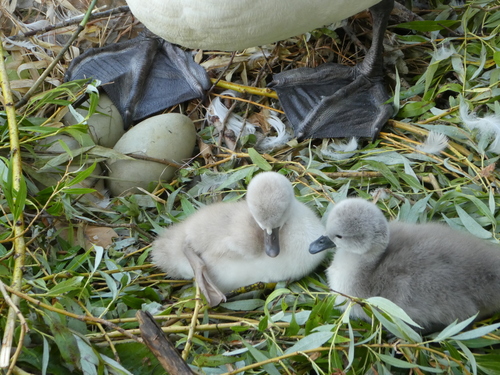
- Down white, grey or buff (grey or buff most common), dull greyish-black bill
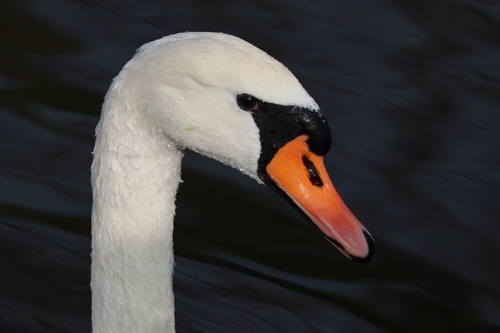
The plumage of adult mute swans is uniformly white, with a faint cream or rust tint sometimes caused by iron-rich water staining the head and neck. The bill is bright orange with black edges and a distinctive black fleshy knob, the basal knob, sitting over the nostrils.
The breeding-season swelling of this knob makes it one of the best field indicators for gendering adults. Male individuals carry a larger, higher knob that distinguishes them reliably from females. Leg color is dark grey throughout. Juveniles keep grey plumage until at least one year old, and their bill remains dull greyish-black and non-orange during the first year.
The long neck allows a swan to upend and reach submerged plants without diving. The neck is usually held in a distinctive S-curve, unlike the straight-necked whooper and trumpeter swans, another reliable field identification cue.
How does a mute swan compare with a Canada goose or a snow goose?
The mute swan is far larger than either goose. Audubon gives the mute swan a length of 1.4 to 1.6 m (4 ft 7 in to 5 ft 3 in), a wingspan of 2 to 2.4 m (6 ft 7 in to 7 ft 10 in) and a weight of 9 to 14.3 kg (20 to 31 lb).
A Canada goose measures 76 cm to 1.2 m (2 ft 6 in to 3 ft 10 in) and weighs 2.9 to 8.9 kg (about 6.5 to 20 lb), while a snow goose is smaller still at 64 to 79 cm (2 ft 1 in to 2 ft 6 in) and 1.6 to 3 kg (about 3.5 to 6.5 lb).
Colour separates the three at a glance. The mute swan is white all over, with an orange bill topped by a black knob, and usually swims with its neck in an S-curve. The Canada goose has a black head and neck with a white chinstrap. The adult snow goose is white like the swan but has black wingtips and a pink-orange bill and legs. Both geese have wingspans of about 1.3 to 1.7 m (4 ft 2 in to 5 ft 7 in), well short of the swan's.
Habitat and Range
Mute swans occupy shallow, calm, nutrient-rich fresh water and sheltered coastal environments. Ideal habitat includes lakes, slow rivers, reservoirs, ornamental park lakes, gravel pits, coastal lagoons and estuaries with beds of submerged vegetation. They avoid deep, fast, or heavily wooded waters and are rarely found far from reeds, rushes, or similar cover for nesting.
Native range:
- Core: the United Kingdom, Ireland, Scandinavia, the Low Countries, France, Germany, Poland, the Baltic states, Ukraine and Russia west of the Urals
- Secondary: patches of central Asia into Mongolia, with isolated breeding as far east as Primorye
Introduced range:
- North America (Atlantic seaboard from Massachusetts to Virginia, the Great Lakes, parts of the Pacific Northwest), now classified as invasive
- Southern Africa (small populations)
- Australia (Perth region)
- New Zealand (small populations)
- Japan (feral urban populations)
Northern European populations are partially migratory. Birds breeding in Scandinavia, the Baltic and Russia typically move south or west in autumn to ice-free waters along the North Sea, the Baltic coast and the Black Sea. British, Irish and continental temperate populations are largely sedentary, though individual birds move in response to local freezing.
Urban mute swans are a special case. Populations in central London, Stockholm, Copenhagen, Prague and Amsterdam have become so habituated to humans that they feed from hand at canal edges. These urban populations have higher survival rates than most rural ones (no hunting, regular supplementary feeding, few predators) but also elevated rates of obesity, lead poisoning from ingested fishing weights, and collisions with boats.
Diet and Feeding Behaviour
Mute swans are primarily herbivores, though they are not rigid dietary specialists. Several studies have concluded that mute swans severely reduce the density of submerged vegetation where they occur, which is part of what makes the species ecologically contentious in its introduced range.
Primary foods:
- Submerged aquatic plants: pondweeds ( Potamogeton ), stoneworts ( Chara ), water milfoil, hornwort
- Floating plants: duckweed, water lily leaves
- Brackish-water plants: eelgrass ( Zostera ), widgeon grass
- Riverbank grasses and sedges
- Agricultural crops: winter wheat, oilseed rape, potatoes (when accessible)
Incidental foods:
- Aquatic insects and larvae
- Tadpoles and small fish
- Molluscs, especially small snails
- Frog spawn
Feeding techniques:
- Upending. Divers extend their head and neck underwater while the tail points straight up. Their long neck enables the bill to pluck submerged plants.
- Surface skimming. The swan sweeps its bill along the water surface to collect floating vegetation.
- Grazing. On land, swans walk along riverbanks, park lawns and agricultural fields pulling up grass and shoots. This behaviour is responsible for most swan-farmer conflicts.
- Tipping young plants. Mothers often pull up underwater plants and let floating fragments be grabbed by cygnets who cannot yet reach the bottom.
Breeding and Life Cycle
Of all European waterbirds, mute swans exhibit one of the most finely tuned breeding cycles, driven by the extended cygnet growth period and the species' dedication to a single territory held by a pair working as a unit.
Annual cycle:
- Late February to April: pair returns to breeding territory, aggressive boundary displays
- April to May: nest construction and egg laying
- May to June: incubation
- Mid-June to August: cygnet rearing on water
- September to October: cygnets fledge, family structure loosens
- November to February: flocking on ice-free waters, courtship of new pairs
Nests are large mounds built from waterside vegetation, usually in shallow water on islands or at the edge of a lake, and are often re-used each year, restored or rebuilt as needed.
Clutch size is typically 5 to 8 eggs. Eggs are roughly 9 to 12 cm long. The female broods for around 36 days, with cygnets normally hatching between May and July. Cygnets may shelter under a parent's wings during heavy rain and may climb onto a parent's back when tired.
Cygnets grow rapidly, reaching close to adult size in about three months. Young swans can fly 60 to 65 days after hatching, although they fledge after 120 to 150 days. Foxes, pike and invasive American minks occasionally prey on cygnets.
Non-mated juveniles up to 3 to 4 years old commonly form larger flocks, which can total several hundred birds, often at regular traditional sites.
Pair bonds:
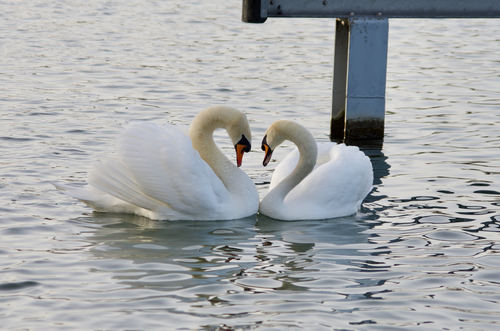
Mute swans are monogamous, and like other swans they are known to grieve for a lost mate.
Flight and the Singing Wings
For a bird this heavy, takeoff is a serious engineering problem. Mute swans run along the water surface, flapping vigorously, at around 48 km/h before becoming airborne.
Once airborne, the mute swan flies strongly and straight, and can reach speeds of up to 88.5 km/h. They fly with their necks fully extended and rarely soar, instead beating continuously. The wingbeat frequency is slower than most ducks but each stroke moves far more air.
The species is best known in flight for a non-vocal sound: the singing wings . Each wingbeat produces a distinctive rhythmic whoosh, whoosh, whoosh audible from a range of 1 to 2 km. The throbbing sound is unique to the species.
Mute swans appear to use the singing wings as a contact sound between birds in flight.
Communication, "Muteness", and Busking
The name "mute swan" is a historical comparison, not an accurate description. The species produces a rich repertoire of calls:
- Hiss. The classic threat call, directed at intruders near nests or cygnets.
- Snort / grunt. Contact call between pair members and between parents and cygnets.
- Trumpet. Softer than whooper or trumpeter swans but still audible, used in greeting, courtship and nest relief.
- Cygnet cheeps. High-pitched whistling contact calls from young, used throughout the first summer.
The most famous visual display is busking , in which a threatened cob half raises its wings with the neck curved back and paddles both feet in unison, giving a jerky movement. It is a common threat display.
Fights between rival swans can be violent. Swans strike with the bony spurs in their wings, accompanied by biting with the bill and intruding birds may be killed by drowning.
Conservation Status and Population
The IUCN Red List classifies the mute swan as Least Concern . The total native population is about 500,000 birds at the end of the breeding season (adults plus young), of which up to 350,000 are in Russia.
The population in the United Kingdom was about 22,000 birds in the 2006-2007 winter, a slight decline from a peak of about 26,000 to 27,000 in 1990.
Recovery from historical lows is a 20th-century success story in parts of western Europe. Numbers declined significantly in many parts of England from around 1960 to the early 1980s, primarily because of lead poisoning from ingested lead shot and discarded fishing weights. After lead weights and shot were mostly replaced by less toxic alternatives, numbers increased again rapidly.
Remaining threats:
- Lead poisoning. Still significant where lead shot and older fishing weights persist in sediments.
- Collisions. Power lines are a known cause of fatal collisions.
- Habitat loss. Canalisation of rivers, drainage of shallow lakes and disturbance of nesting sites.
- Illegal persecution. Anglers and some farmers occasionally kill swans over perceived fishery or crop damage.
- Human interference at nests. Disturbance by walkers, dogs and boats during incubation causes abandonment.
In the introduced range, the mute swan is controversial. In parts of the northeastern United States, state wildlife agencies actively manage populations through egg addling and culling, on the grounds that dense mute swan populations damage submerged aquatic vegetation used by native waterfowl. Conservationists disagree sharply about whether mute swans should be removed, tolerated, or even protected in their introduced range.
The Swans and the Crown
The legal status of mute swans in Britain is unique among birds. The Crown has held the right to claim ownership of all unmarked mute swans in open waters from as far back as the 12th century, by royal prerogative.
In the 15th century, the Crown granted limited ownership rights to two London livery companies, the Worshipful Company of Vintners and the Worshipful Company of Dyers, who marked their birds with distinctive bill nicks. A swan with no bill nick still belongs to the sovereign today.
The practical expression of this royal prerogative is the annual Swan Upping ceremony. Each July, a flotilla of traditional rowing skiffs travels up the Thames from Sunbury-on-Thames to Abingdon in a five-day census.
The Swan Uppers, led by the King's Swan Marker and accompanied by uniformed representatives of the Vintners and Dyers, catch each cygnet they encounter, weigh it, ring it, check it for injuries and release it. Swan Upping provides population data for the Thames swans.
Swans were formerly a prized food, served at banquets and feasts. Today the Crown exercises its ownership purely for welfare and census purposes, the swans are no longer eaten, hunted, or harvested.
In Denmark, the mute swan has been the national bird since 1984.
Mute Swans and Humans
Mute swans are the waterbird most people in their range have seen closest up. Urban populations feed from the hand in central European capitals, park flocks in London, Copenhagen and Stockholm are national tourist fixtures, weddings, heraldry, literature and ballet ( Swan Lake , 1877) have enshrined the bird as a symbol of grace, loyalty and beauty.
The other side of the relationship is less picturesque. Mute swans can be very aggressive in defence of their nests and young. Reported problems include:
- Bruises and welts from wing strikes
- Lacerations from bill jabs
- Repeated attacks on swimmers, rowers and paddleboarders
Mute swans readily attack dogs that approach a nest or cygnets. It is sensible to keep a distance from any visible nest, keep dogs leashed near water and retreat if a swan begins busking or hissing.
Despite these risks, the species remains one of the most beloved birds in its range. The mute swan is also the symbol of the Sydney Swans football club.
Frequently asked questions
Adult mute swans (Cygnus olor) measure 125 to 170 cm from bill tip to tail, with a wingspan of 2.0 to 2.4 metres. Males, called cobs, typically weigh 9 to 14 kg, with a top normal weight of about 15 kg and one unusually big Polish cob weighing almost 23 kg, females, called pens, are slightly smaller at 7.6 to 10.6 kg. This makes the mute swan one of the largest flying birds in the world, sitting near the physical ceiling of powered avian flight.
Cygnets hatch weighing around 180 to 248 grams.
Mute swans are primarily herbivores. Their main foods are submerged aquatic plants such as pondweed, stonewort, water milfoil and eelgrass, which they reach by upending their bodies and extending their long necks.
They also graze on riverbank grasses and agricultural crops including winter wheat and oilseed rape, and incidentally take aquatic insects, tadpoles, small fish and molluscs. Studies have found that mute swans can severely reduce the density of submerged vegetation where they occur.
The name is misleading. Mute swans are not silent: they hiss aggressively at intruders near nests or cygnets, use soft snorts and grunts as contact calls in family groups, and give a trumpeting call in greeting, courtship and nest relief. They are called ‘mute’ as a historical comparison, because they are less vocal than other swans such as the whooper swan (Cygnus cygnus).
Strikingly, the species compensates through its wings: the rhythmic throbbing of mute swan wings in flight is audible from 1 to 2 km away.
Legally, yes, to a point. Under a royal prerogative dating back to at least the 12th century, the Crown has the right to claim ownership of all unmarked mute swans in open waters. Since the 15th century, two London livery companies, the Vintners and the Dyers, have held similar rights.
Every July, the King’s Swan Marker leads the Swan Upping ceremony on the Thames from Sunbury-on-Thames to Abingdon, where cygnets are caught, weighed, ringed and checked for injuries as a population census. The swans are no longer eaten, hunted, or harvested, the Crown exercises its ownership purely for welfare and census purposes.
They can be, particularly during the nesting season. A breeding swan defending its nest and cygnets will attack intruders, striking with its bill and with the bony spurs in its wings. Swans readily attack dogs that approach a nest or cygnets, and have been known to attack small boats such as canoes.
The safest policy is to keep a distance from any visible nest or cygnet group, keep dogs leashed near water and retreat if a swan begins busking or hissing.
Mute swans are native to temperate Europe and parts of central Asia, breeding into Mongolia and as far east as Primorye in the Russian Far East. Their preferred habitats are shallow, calm lakes, slow rivers, reservoirs, estuaries, coastal lagoons and ornamental park lakes. They have been introduced to North America (where they are now classified as invasive), southern Africa, Australia, New Zealand and Japan.
Northern European populations are partially migratory, moving to ice-free waters in winter, while British, Irish and temperate continental populations are largely sedentary.
Mute swans are monogamous and often reuse the same nest each year. Like other swans, they are known to grieve for a lost mate and if one parent dies while cygnets are present, the remaining parent takes over the partner’s duties.
Non-mated juveniles up to 3 to 4 years old commonly form larger flocks before pairing up.
References
- Relevant peer-reviewed and governmental sources consulted for this entry include the IUCN Red List assessment for Cygnus olor, the Wildfowl & Wetlands Trust annual population surveys, the British Trust for Ornithology BirdFacts database, the Royal Swan Upping records held by the Royal Household, and published research in Wildfowl, Ibis, Bird Study, and Journal of Avian Biology.
- National Audubon Society, Guide to North American Birds: Mute Swan, Canada Goose and Snow Goose species accounts (audubon.org).
- View source
- View source