Superb Lyrebird: Australia's Master Mimic
Menura novaehollandiaeOne of the best vocal mimics in the animal kingdom, the superb lyrebird also turns over up to 200 tonnes of soil and litter per hectare each year as it feeds.
 Strange Animals EditorialJanuary 12, 2025·9 min read·Editorial standards ↗
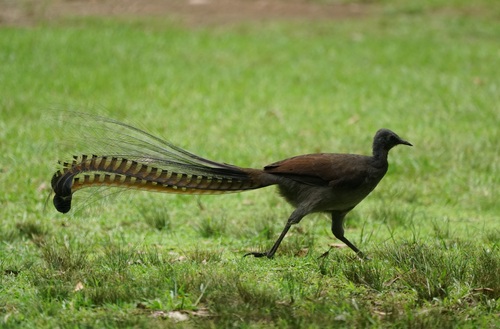
The superb lyrebird is one of the largest songbirds in the world and one of the most accomplished vocal mimics in the animal kingdom.
Native to the temperate rainforests of south-eastern Australia, Menura novaehollandiae occupies an ecological and acoustic niche all its own: a ground-dwelling, scratch-feeding passerine the size of a small pheasant, whose males reproduce the songs of many other bird species and, in some cases, the sounds of chainsaws, camera shutters and car alarms with unsettling fidelity.
All major dimensions of superb lyrebird biology, ecology and cultural impact appear in this guide, including taxonomy, habitat details, lyrebird size, tail anatomy, song-mechanism explanation, the 2021 mobbing-flock mimicry study during courtship and copulation, the BBC documentary that transformed a retiring Australian rainforest bird into a worldwide icon, and the species' representation on the Australian 10-cent coin.
Etymology and Classification
The genus name Menura derives from Greek men (moon) and oura (tail), a reference to the transparent crescent-shaped markings John Latham described on the inner webs of the outer tail feathers. The species epithet novaehollandiae : "of New Holland", uses the early European name for Australia and was coined by the British naturalist John Latham in 1801, shortly after the first specimens reached London.
The classification of lyrebirds was debated for years after the first specimens reached European scientists.
Modern taxonomy places the superb lyrebird in its own family, Menuridae , which contains only two living species: Menura novaehollandiae and Albert's lyrebird ( Menura alberti ), a smaller, shyer relative restricted to a tiny patch of rainforest on the New South Wales-Queensland border.
Both are members of the order Passeriformes (the "perching birds" or "songbirds") and are considered among the most ancient songbird lineages alive today. Lyrebird fossils date back about 15 million years.
Common names reflect the bird's most famous feature: the spreadable tail of a courting male recalls the shape of a lyre, the small stringed instrument of ancient Greece.
Superb Lyrebird Size and Physical Description
The superb lyrebird is one of the largest members of the order Passeriformes. Males are noticeably larger than females, and only males develop the ornamental tail.
Males:
- Length including tail: about 1 m
- Tail length: up to 70 cm in fully mature birds
- Weight: about 1.1 kg
Females:
- Length: about 86 cm
- Weight: about 0.9 kg
- No ornamental tail, plumage is simpler, with long graduated brown tail feathers
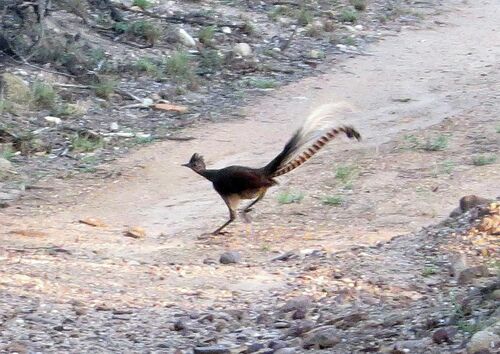
The body plumage is mainly dark brown on the upperparts, with greyish-brown underparts and red-tinged flight feathers. Legs and feet are grey and exceptionally powerful for a bird of this size, lyrebirds spend most of their lives walking and scratching rather than flying, and the claws on the middle toe are elongated for raking through leaf litter.
Their flight muscles are proportionally reduced compared with most passerines, and though they can fly short distances, they often glide downhill from trees rather than flap.
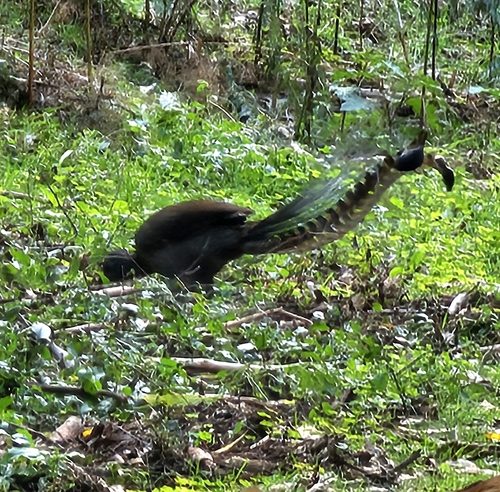
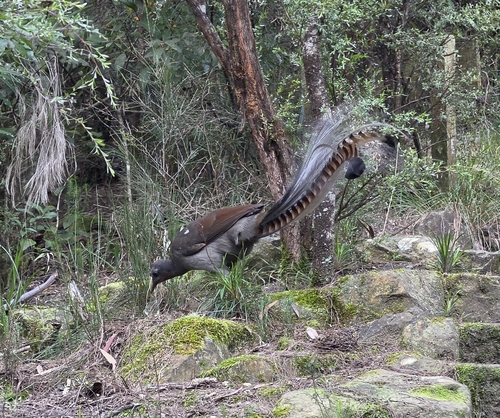
The male's tail is the defining anatomical feature of the species. It consists of sixteen specialised feathers: two outer lyrates (broad, S-shaped, brown and buff), twelve slender filamentaries (flexible and silvery), and two silvery median feathers.
At rest the tail trails behind the bird and appears unremarkable, in full display it is flipped forward over the head and spread into a trembling silver fan that almost entirely obscures the bird beneath.
Habitat and Range
Superb lyrebirds are endemic to south-eastern Australia. Core natural range stretches from south-east Queensland in the north, through the coastal and dividing-range forests of New South Wales, and across most of Victoria. An introduced population exists in Tasmania, established through deliberate releases between 1934 and 1954, made amid ill-founded fears that the species was threatened on the mainland.
Preferred habitat is dense temperate rainforest, wet sclerophyll forest and fern-lined gullies with year-round moisture, deep leaf litter and a dense understorey of tree ferns ( Dicksonia and Cyathea species).
Lyrebirds are closely associated with the mountain ash ( Eucalyptus regnans ) forests of the Central Highlands of Victoria, among the tallest flowering trees in the world, and are particularly abundant along the Great Dividing Range wherever humidity, elevation and shade combine to keep the forest floor damp.
Each adult male holds a territory containing several display mounds, and a male's territory can overlap with up to six female territories.
Diet and Foraging
Superb lyrebirds are almost exclusively insectivorous. Their diet is dominated by soft-bodied invertebrates found in the upper few centimetres of leaf litter and moist soil.
Typical prey items:
- Earthworms and terrestrial flatworms
- Beetle adults and larvae (scarabs, weevils, carabids)
- Amphipods ("land hoppers")
- Centipedes, millipedes and slaters
- Spiders, including large wolf spiders
- Ant and termite larvae
- Occasional small frogs, skinks, or snails
Lyrebirds do not dig with their bills. They scratch backward with powerful feet, flicking leaves and soil aside in characteristic arcs that leave the forest floor pockmarked with shallow excavations. A single bird can turn over a surprising volume of substrate.
Research in Victorian mountain ash forests found that a lyrebird can move and bury up to 200 tonnes of soil and leaf litter per hectare per year, disturbing the soil more than virtually any other animal.
This scratching behaviour has consequences far beyond the birds themselves. It hastens the decomposition of leaf litter, increases nutrient cycling and reduces the fuel available for forest fires.
Vocal Anatomy and Mimicry
The species' reputation rests on its voice. The superb lyrebird mimics other species with remarkable accuracy, using its syrinx , the songbird equivalent of a voice box.
Its imitations are so accurate that, in one study, shrike-thrushes responded no differently to lyrebird imitations than to their own songs.
Natural elements in the repertoire:
- Songs of many local bird species, including the grey shrike-thrush, laughing kookaburra, eastern whipbird and pilotbird
- Alarm calls of other forest birds
- Lyrebird-specific "territorial" song, not known to be mimicked
Mechanical and human sounds recorded in wild or near-human populations:
- Chainsaws
- Camera shutters
- Car alarms
The mechanical mimicry, though widely publicised by the 1998 BBC documentary The Life of Birds narrated by David Attenborough, is less common in wild populations than popular videos suggest. Two of the three lyrebirds featured in that programme were captive birds.
Captive birds can pick up human-made sounds from their surroundings. The wild repertoire is dominated by imitations of other species, mostly birds.
Juveniles initially learn mimetic items from older lyrebirds rather than from the model species themselves. Song differs between populations across the range, partly reflecting the local bird species available to copy.
Courtship, the Display Mound, and the Tail
Males build several circular mounds of bare dirt within their territory and defend them vigorously from other males. Breeding takes place in winter.
When a female approaches a mound, the male launches into a coordinated song-and-display performance. The tail is fanned out to cover the whole body and head, and the feathers are vibrated. The bird dances in time with the song.
Dance movements are coordinated with different types of song repertoire, and the display ends, if the female is receptive, with copulation on the mound.
2021 discovery: acoustic deception during mating. Dr Anastasia Dalziell and colleagues published a landmark study in the journal Current Biology documenting a previously unrecognised behaviour: courting males produce mimicked multi-species mobbing flock calls during courtship and copulation.
Mobbing calls are the sounds normally produced by flocks of small birds harassing a predator, so the male creates the acoustic illusion of a mobbing flock.
After each breeding season the male sheds every ornamental tail feather and regrows the full lyre-shaped set the following year. Males reach maturity in 7 to 9 years. Juveniles of both sexes have no ornamental tail feathers, and the tail develops through a series of annual moults.
Breeding and Life Cycle
Lyrebird breeding is slow and low-output compared with most birds of similar size. A female builds her own nest, which is a large dome of sticks, often on a raised earth platform. She usually lays a single egg per breeding season, on a bed of feathers and incubates it alone for up to seven weeks.
Breeding timeline:
| Stage | Timing |
|---|---|
| Breeding season | Winter |
| Clutch size | Usually a single egg |
| Parental care | Female only |
| Incubation | Up to 7 weeks |
| Post-fledging care | Lasts several months |
| Female maturity | 6-7 years |
| Juveniles | No ornamental tail feathers |
| Male maturity | 7-9 years |
The chick is fed entirely by the female on invertebrates. Males play no role in incubation or chick-rearing, their entire reproductive investment is the song and display performance that attracts mates. The species is polygynous, with a single male mating with several females.
Lifespan and Populations
Superb lyrebirds breed slowly, with females usually laying a single egg per year.
The IUCN Red List classifies the superb lyrebird as Least Concern , and it is common across much of its range. Pressures include:
- Bushfire. Large fires can destroy the moist forest the species depends on.
- Logging. Logging can degrade the moist forest habitat lyrebirds require.
- Feral predators. Introduced red foxes ( Vulpes vulpes ) are a predation threat, particularly near urban areas.
- Climate change. Increasing drought frequency and fire intensity threaten the moisture-dependent forests lyrebirds need.
- Habitat fragmentation. Urban sprawl at the edges of Sydney, Melbourne and coastal New South Wales divides populations and alters soundscapes.
Cultural Significance
Few birds occupy a comparable cultural position in their home country. The superb lyrebird is an instantly recognisable Australian bird.
Australian 10-cent coin. Since decimal currency was introduced on 14 February 1966, the Australian 10-cent piece has carried an image of a displaying male superb lyrebird designed by Stuart Devlin. The coin remains in circulation today.
Attenborough and the BBC. In 1998 the BBC series The Life of Birds , presented by Sir David Attenborough, included a sequence of lyrebirds, two of the three of them captive birds, imitating a chainsaw, camera shutters and a car alarm.
The clip was later widely shared on video-sharing sites. For an entire generation of viewers outside Australia, the lyrebird is first and last "the bird that imitates chainsaws."
Australian arts and design. The superb lyrebird is the emblem of the NSW National Parks and Wildlife Service, and the Victorian county of Buln Buln is named for the bird's Woiwurrung name.
Frequently asked questions
Adult male superb lyrebirds (Menura novaehollandiae) measure about 1 metre in length including the tail, with the tail alone reaching up to 70 centimetres in mature birds. Males weigh about 1.1 kilograms, making the species one of the largest songbirds in the world. Females are smaller at about 86 centimetres and 0.9 kilograms, and have a less ornate tail without the lyre shape.
Despite their size, lyrebirds are primarily ground-dwellers and only fly short distances, often gliding downhill from trees rather than flapping.
Superb lyrebirds imitate other species with remarkable accuracy: in one study, shrike-thrushes responded no differently to lyrebird imitations than to their own songs. An estimated 70 to 80% of a male’s vocalisations are imitations of other species, mostly other birds.
Juveniles initially learn mimetic items from older lyrebirds rather than from the model species themselves, and song differs between populations across the range.
Some do. Lyrebirds have been recorded imitating chainsaws, camera shutters and car alarms. However, two of the three lyrebirds in the well-known Attenborough footage were captive birds, and this kind of mimicry is less common in wild populations than popular videos suggest.
The wild repertoire is dominated by imitations of other species, mostly other birds.
The superb lyrebird is endemic to the forests of south-eastern Australia, from southern Victoria through New South Wales to south-eastern Queensland. The species was deliberately introduced to southern Tasmania between 1934 and 1954 amid fears that it was threatened on the mainland.
They prefer wet forest and rainforest with an open ground layer of moist leaf litter, and are closely associated with the mountain ash (Eucalyptus regnans) forests of Victoria.
Superb lyrebirds feed mainly on invertebrates. They scratch through leaf litter and soft soil with their powerful feet, uncovering prey such as earthworms, beetles and beetle larvae, spiders, amphipods, centipedes and slaters, and occasionally small frogs or lizards.
Research in Victorian mountain ash forests found that a lyrebird can move and bury up to 200 tonnes of soil and leaf litter per hectare per year, making the species a major ecosystem engineer.
A male builds several circular mounds of bare dirt in his territory. When a female approaches, he performs on the nearest mound, fanning his tail out to cover his body and head and vibrating the feathers while he sings and dances.
The tail has sixteen feathers: two broad, S-shaped outer lyrates that give the species its name, twelve silvery filamentaries and two silvery median feathers. The male moults the ornamental tail feathers annually.
Research led by Dr Anastasia Dalziell and published in Current Biology in 2021 found that courting male superb lyrebirds create the acoustic illusion of a mobbing flock during courtship and copulation by mimicking the calls of multiple species. Mobbing calls are normally produced by flocks of small birds harassing a predator.
A firm maximum lifespan is not given here, but the species matures slowly: males reach maturity in 7 to 9 years and females in 6 to 7 years. Each female usually lays a single egg per year and incubates it alone for up to seven weeks.
The species is listed as Least Concern by the IUCN and is common across much of its range.
References
- Peer-reviewed and governmental sources consulted for this entry include the IUCN Red List assessment for Menura novaehollandiae (BirdLife International, 2024), the Australian Department of Climate Change, Energy, the Environment and Water species profile, and research published in Current Biology, The Auk, Animal Behaviour, and Emu, Austral Ornithology.
- Specific details on acoustic deception during mating draw on Dalziell, A. H., Maisey, A. C., Magrath, R. D. and Welbergen, J. A. (2021) "Male lyrebirds create a complex acoustic illusion of a mobbing flock during courtship and copulation" (Current Biology 31, 1970-1976). Ecosystem-engineering estimates draw on research in Eucalyptus regnans forests at Beenak, Victoria (Ashton and Bassett, 1997).